Showing posts with label Commander Cody. Show all posts

Friday, October 28, 2022

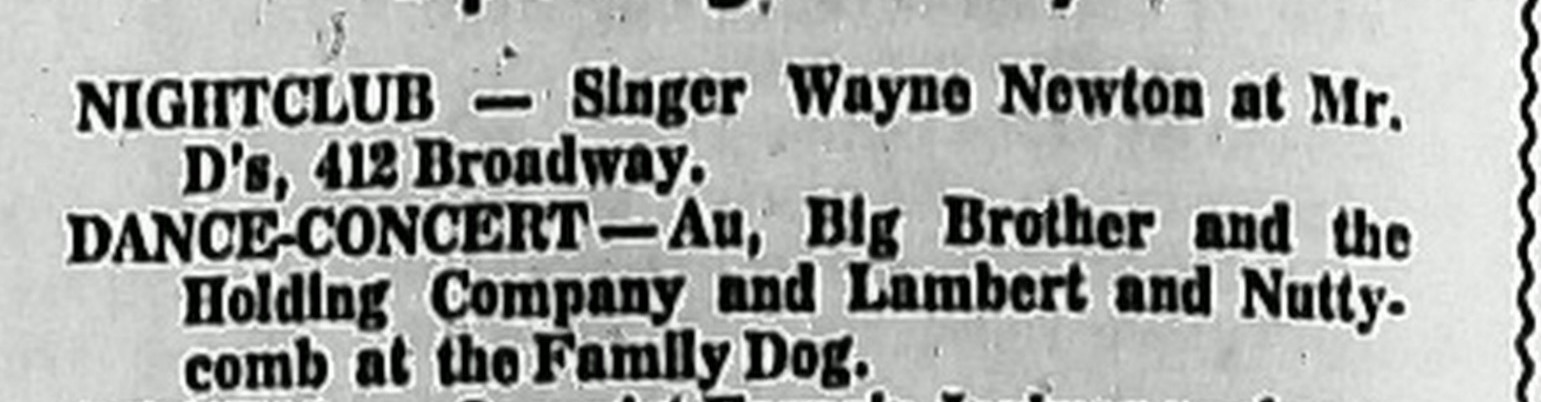
May 1-24, 1970 Family Dog on The Great Highway, 660 Great Highway, San Francisco, CA: various shows [FDGH '70 XVI]


The Family Dog on The Great Highway, at 660 Great Highway, ca. 1969

The Family Dog on The Great Highway, 660 Great Highway, San Francisco, CA
The Family Dog was a foundation stone in the rise of San Francisco rock, and it was in operation in various forms from Fall 1965 through the Summer of 1970. For sound historical reasons, most of the focus on the Family Dog has been on the original 4-person collective who organized the first San Francisco Dance Concerts in late 1965, and on their successor Chet Helms. Helms took over the Family Dog in early 1966, and after a brief partnership with Bill Graham at the Fillmore, promoted memorable concerts at the Avalon Ballroom from Spring 1966 through December 1968. The posters, music and foggy memories of the Avalon are what made the Family Dog a legendary 60s rock icon.

In the Summer of 1969, however, with San Francisco as one of the fulcrums of the rock music explosion, Chet Helms opened another venue. The Family Dog on The Great Highway, at 660 Great Highway, on the Western edge of San Francisco, was only open for 14 months and was not a success. Yet numerous interesting bands played there, and remarkable events took place, and they are only documented in a scattered form. This series of posts will undertake a systematic review of every musical event at the Family Dog on The Great Highway. In general, each post will represent a week of musical events at the venue, although that may vary slightly depending on the bookings.

If anyone has memories, reflections, insights, corrections or flashbacks about shows at the Family Dog on the Great Highway, please post them in the Comments.

660 Great Highway in San Francisco in 1967, when it was the ModelCar Raceway, a slot car track

The Edgewater Ballroom, 660 Great Highway, San Francisco, CA

As early as 1913, there were rides and concessions at Ocean Beach in San Francisco, near the Richmond District. By 1926, they had been consolidated as Playland-At-The-Beach. The Ocean Beach area included attractions such as the Sutro Baths and the Cliff House. The San Francisco Zoo was just south of Playland, having opened in the 1930s. One of the attractions at Playland was a restaurant called Topsy's Roost. The restaurant had closed in 1930, and the room became the Edgewater Ballroom. The Ballroom eventually closed, and Playland went into decline when its owner died in 1958. By the 1960s, the former Edgewater was a slot car raceway. In early 1969, Chet Helms took over the lease of the old Edgewater.
One of the only photos of the interior of the Family Dog on The Great Highway (from a Stephen Gaskin "Monday Night Class" ca. October 1969)


The Family Dog On The Great Highway

The Great Highway was a four-lane road that ran along the Western edge of San Francisco, right next to Ocean Beach. Downtown San Francisco faced the Bay, but beyond Golden Gate Park was the Pacific Ocean. The aptly named Ocean Beach is dramatic and beautiful, but it is mostly windy and foggy. Much of the West Coast of San Francisco is not even a beach, but rocky cliffs. There are no roads in San Francisco West of the Great Highway, so "660 Great Highway" was ample for directions (for reference, it is near the intersection of Balboa Street and 48th Avenue). The tag-line "Edge Of The Western World" was not an exaggeration, at least in American terms.

The Family Dog on The Great Highway was smaller than the Bill Graham's old Fillmore Auditorium. It could hold up to 1500, but the official capacity was probably closer to 1000. Unlike the comparatively centrally located Fillmore West, the FDGH was far from downtown, far from the Peninsula suburbs, and not particularly easy to get to from the freeway. For East Bay or Marin residents, the Great Highway was a formidable trip. The little ballroom was very appealing, but if you didn't live way out in the Avenues, you had to drive. As a result, FDGH didn't get a huge number of casual drop-ins, and that didn't help its fortunes. Most of the locals referred to the venue as "Playland."

The Family Dog In 1969
Chet Helms had opened the Family Dog at 660 Great Highway to much fanfare on June 13, 1969, with a packed house seeing the Jefferson Airplane and The Charlatans. One of the goals was that the Dog would feature mostly San Francisco bands and a variety of smaller community events and groups. Since so many San Francisco bands were successful, and had record contracts, this didn't confine the venue to obscurity. A lot of great bands played the Family Dog in 1969, but the distant location and the gravitational pull of major rock events hosted elsewhere in the Bay Area kept the Family Dog isolated. We know only the most fragmentary bits about music played, events and audiences throughout the year.  Despite the half-year of struggle, Helms had kept the Family Dog on The Great Highway afloat. He had entered the new year of 1970 with a new plan.

May 1-3, 1970 Family Dog on the Great Highway, San Francisco, CA: Big Brother and the Holding Company/Aum/Back Yard Mamas/Lambert & Nuttycombe (Friday-Sunday)
Chet Helms had re-opened the Family Dog on the Great Highway on a new footing at the end of January, 1970. Instead of a mixture of community events, the Dog had focused on weekend rock concerts featuring major San Francisco bands. The Dog headliners were Fillmore West headliners, too, so the venue was would be more of a destination than just a hang-out. But the momentum hadn't lasted. The big headliners faded away after April, an implicit note that Helms could no longer afford to guarantee bands a payday. Starting in May, while the Family Dog remained focused on weekend bookings, the bands weren't Fillmore West material.

Big Brother and The Holding Company had returned to headline the Family Dog for the third weekend since February. They were a huge name, of course, but without Janis Joplin fronting the band, they weren't a huge draw. The original four members (Sam Andrews, James Gurley, Peter Albin and Dave Getz) were all still in the band, along with an additional guitarist (David Schallock). Big Brother was actually a pretty good band, and they were working on an album with producer Nick Gravenites. The underrated Be A Brother would come out around July, to little fanfare. 


Aum
was a trio featuring guitarist Wayne Ceballos. Ironically, they were booked by Bill Graham's Millard Agency. Graham and Helms were competitors, but this did not extend so far as to cutting Helms out of Millard acts. Aum had released its second album in late 1969. Resurrection had been released on Fillmore Records, Graham's own label (distributed by Columbia). Aum had been booked fairly prominently around the Bay Area in 1969, often opening for the Grateful Dead (booked by Millard at the time as well). The band had faded away a little bit by 1970, and would soon break up (Ceballos continues to perform, now based out of Austin, TX).

The Backyard Mamas are familiar to me from various listings, but I don't really know anything about them.

Folk duo Craig Nuttycombe and Dennis Lambert had been in the Eastside Kids in Southern California. Their album on A&M Records had been recorded at Nuttycombe's home.


May 8-10, 1970 Family Dog on the Great Highway, San Francisco, CA: Commander Cody and His Lost Planet Airmen/Osceola/Southern Comfort (Friday-Sunday)
Commander Cody and His Lost Planet Airmen had only relocated to Berkeley from Ann Arbor, MI in the Summer of 1969. Their unique blend of dope-flavored Western Swing and old-time rock and roll instantly found an audience. One of the Airmen's first gigs had been at the Family Dog in August 1969, and they had opened shows regularly at the venue, for the Grateful Dead and for the Youngbloods. While they were the headliners at this show, the Airmen were still a local club act. They would not be signed to Paramount ABC to record their debut album until 1971. 

Osceola had been playing the Family Dog since September of 1969. They would play the Dog many times, and played around the Bay Area regularly until at least 1972. Osceola lead guitarist Bill Ande was a transplant from Florida. He had played and recorded with some modestly successful bands, like the R-Dells, the American Beetles (really), who had then changed their name to The Razor's Edge and had even played American Bandstand. Come '69, Ande had relocated to San Francisco to play some psychedelic blues. The musicians he linked up with were all Florida transplants as well, so even though they were a San Francisco band, they chose the name Osceola as an homage to their roots. To some extent, Osceola replaced Devil's Kitchen as the informal "house band" at the Family Dog, insofar as they played there so regularly.

Osceola was a five piece band with two drummers, and played all the local ballrooms and rock nightclubs. Ande was joined by guitarist Alan Yott, bassist Chuck Nicholis and drummers Donny Fields and Richard Bevis. Osceola was a successful live act, but never recorded. Almost all of the band members would return to the Southeast (mainly Tallahassee and Atlanta) in the mid-70 to have successful music careers.


Around May, 1969, drummer Bob Jones and some other local musicians formed a band modeled on Booker T and The MGs. The idea was that they would be a complete studio ensemble, and also record and perform their own music. All of the musicians were regulars in the busy San Francisco studios, often playing for producer Nick Gravenites. The members of Southern Comfort were:

Fred Burton-lead guitar [aka Fred Olson, his given name]
Ron Stallings-tenor sax, vocals
John Wilmeth-trumpet
Steve Funk-keyboards
Art Stavro-bass
Bob Jones-drums, vocals

Ron Stallings had been in the T&A Blues Band with Kahn and Jones. He would turn up later with Kahn in Reconstruction in 1979. In late 1969, Southern Comfort had been signed by Columbia Records, and Gravenites was signed up as the producer. At this period of time, Gravenites was also working with Mike Bloomfield, Brewer And Shipley and later Danny Cox (who shared management with Brewer And Shipley), and the individual members worked on many of those records. Meanwhile, Southern Comfort gigged steadily around the Bay Area.

According to Jones, Nick Gravenites found himself overcommitted in the studio, and turned the production of the Southern Comfort album over to John Kahn. Kahn and Jones were close friends, so this was fine with the band. Gravenites had been using the musically trained Kahn as an arranger and orchestrator anyway, so this was more like a promotion rather than a new assignment. Kahn was listed as co-producer on the Southern Comfort album, and he filled in a few gaps--co-writing songs, helping with arrangements, playing piano--but not playing bass.  Columbia released the Southern Comfort album in mid-1970. At the time of this Family Dog show, the album had probably just been released.


A Randy Tuten flyer for Big Mama Thornton, Sandy Bull, Mendelbaum and Doug McKechnie and His Moog Synthesizer at the Family Dog on The Great Highway, May 15-16, 1970


May 15-16, 1970 Family Dog on the Great Highway, San Francisco, CA: Big Mama Thornton/Sandy Bull/Mendlebaum/Doug McKechenie and His Moog Synthesizer
(Friday-Saturday)
Big Mama Thornton (1926-1984) had been a popular and important blues singer since the early 1950s. She had originally recorded “Hound Dog” in 1952, years before Elvis Presley, and her 1968 version of “Ball And Chain” was a huge influence on Janis Joplin’s more famous cover version (as Janis was the first to admit). However, Thornton’s successful records did not lead to her own financial success, and despite being a fine performer she was notoriously difficult to work with. Big Mama had played a number of weekends at the Fillmore in 1966, including opening for both the Jefferson Airplane (October 1966) and the Grateful Dead (December 1966). Unlike many blues artists who played the Fillmore the first year, she had not reappeared. There's no explanation as to why she hadn't been seen at rock venues since. Big Mama had played at the Family Dog back in July '69, but she had almost no rock profile.

From today's perspective, Big Mama Thornton seems like a very interesting performer, and no doubt she was, but in 1970, to the mostly teenage audience, she would have just seemed old (of course, in 1970 she would have been just 43). Her current album would have been The Way It Is, on Mercury.

Sandy Bull was a solo guitarist, a unique and remarkable performer whose elaborate fingerpicking was enhanced by various electronic looping effects. Although appealing to a rock audience, more or less, Bull was the type of performer whose audience remained seated. He had played the Bay Area many times over the years, usually at The Matrix. At this time, his most recent album would have been E Puribus Unum, released on Vanguard the  previous year. Bull had played all the instruments himself, and the music was hardly rock. 


Mendelbaum
had arrived from Wisconsin at the end of Summer 1969. They featured lead guitarist Chris Michie, who went on to play with Van Morrison and others, and drummer Keith Knudsen (who would play with Lee Michaels and then the Doobie Brothers). By May of 1970, Mendelbaum were regulars around the Bay Area rock club scene. In 2002, the German label Shadoks would release a double-cd of Mendelbaum material from 1969 and '70 (both live recordings and studio demos).

Doug McKechnie and his Moog synthesizer, ca 1968

Doug McKechnie
performed on his Moog Synthesizer. He had previously played the Family Dog under the name SF Radical Lab,  back on August 31, and then again on the weekend of September 19-21. At this time, there was a little bit of awareness about synthesizers, through Walter Carlos' 1968 album Switched On Bach record and George Harrison's 1969 Electronic Sounds lp, but they were still pretty mysterious. No one would have seen a Moog Synthesizer live, so in that respect McKechnie's performance would have been quite interesting.

Doug McKechnie's history was unique in so many ways. Around about 1968, McKechnie had lived in a warehouse type building on 759 Harrison (between 3rd and 4th Streets-for reference, 759 Harrison is now across from Whole Foods). Avalon Ballroom soundman and partner Bob Cohen lived in the building, and Blue Cheer (and Dan Hicks and The Hot Licks) practiced upstairs. One day, McKechnie's roommate Bruce Hatch acquired a Moog Synthesizer, and the instrument arrived in boxes, awaiting assembly. At the time, a synthesizer was like a musical unicorn, only slightly more real than a myth. Hatch had the technical ability to assemble the machinery, but he was basically tone-deaf. So McKechnie focused on actually making music on the Moog. 

McKechnie and Hatch referred to their enterprise as Radical Sound Labs. Word got around--McKechnie helped the Grateful Dead record the strange outtake "What's Become Of The Baby" on the 1969 Aoxomoxoa sessions in San Mateo (his memories are, uh, fuzzy). Thanks to the Dead, McKechnie and his Moog--the size of a VW Bus--can be seen in the Gimme Shelter movie, providing peculiar music on a gigantic sound system for the anxious masses.

[update 20230515: fellow scholar Jesse Jarnow points out that the founder of Rainbow Jam Lights, Richard Winn Taylor, became an important Hollywood animation pioneer]

May 22-24, 1970 Family Dog on the Great Highway, San Francisco, CA: Shorty Featuring Georgie Fame,/Jerry Hahn Brotherhood/Fourth Way (Friday-Sunday)
This May weekend featured an all jazz-rock bill, and the performances would certainly be of a very high quality. None of the groups were particularly popular, unfortunately, so attendance was probably thin.


Georgie Fame
(b. Clive Powell in 1943) had been a huge star in England in the 60s. In the early 60s, Fame played legendary gigs at the Flamingo Club for American servicemen. Fame sang and played organ, and was heavily influenced by Mose Allison, James Brown and others. He merged soul, blues and jazz in a unique English way. Without Georgie Fame, there would be no Van Morrison (Fame was an anchor of Van's live bands in the 80s and 90s, and they would make an album together). Fame had three #1 hits in England, "Yeh Yeh" (1964), "Get Away" ('66) and "The Ballad Of Bonnie and Clyde" (1967). Only the latter was a hit in the States, however. Georgie Fame never toured America with other British Invasion acts, reputedly because he had Nigerians and Jamaicans in his band. 

In 1969, Fame reformulated himself with a sophisticated band called Shorty. They released an album on Epic in early 1970. It was supposedly recorded live, but it sounds to me like it was actually recorded live in the studio with crowd noise dubbed in. In any case, there was a mixture of originals and jazzed up covers of blues songs like "Parchman Farm" and "Seventh Son." The band seemed to be a quintet with Fame on Hammond organ, an electric guitarist and a tenor saxophone. Shorty seems to have done a short American tour, as they had just played at the Fillmore West (opening for Lee Michaels and the Faces from May 7-10).


The Jerry Hahn Brotherhood
was a newly-formed, only-in-San-Francisco band, and they had gotten a fairly big advance from Columbia. Columbia was heavy in the "jazz-rock" vein, and had hit it big with Blood, Sweat & Tears and Chicago. They would release an album in the middle of the year.

Jerry Hahn was a pretty serious jazz guitarist, based in San Francisco, and he had played with John Handy and Gary Burton, among others. As "jazz-rock" became a thing, Hahn seems to have wanted to play in a more rock vein. Organist Mike Finnegan was newly arrived from Wichita, Kansas. He was not only a great Hammond player, he was a terrific blues singer too (also, he was 6'6'' tall, and had gone to U. of Kansas on a basketball scholarship, making him the Bruce Hornsby of his era). Filling out the band were local jazz musicians Mel Graves on bass and George Marsh on drums. Marsh had just left the Loading Zone, an interesting (if perpetually struggling) Oakland band


The Fourth Way
was an interesting electric jazz-rock band. There were a lot of bands in the Bay Area fusing rock, jazz and electricity, but Fourth Way did it in a less frantic style than Miles Davis or the Tony Williams Lifetime. Fourth Way did release three albums on Capitol, now long out-of-print. Bandleader Mike Nock, formerly pianist with Yusef Lateer, Steve Marcus and many others played electric keyboards. The lead soloist was electric violinist Mike White, best known for playing with the John Handy Quintet. Bassist Ron McClure had played with Handy, and then with a Charles Lloyd Quartet lineup when it was based in San Francisco (along with Keith Jarrett and Jack DeJohnette). Drummer Eddie Marshall rounded out the quartet.

This Susanna Millman photo from the old Grateful Dead Tapers Compendium shows Owsley tapes for Shorty, Fourth Way and Jerry Hahn Brotherhood from May 23, 1970


An intriguing detail about this set of concerts is that Owsley preserved tapes of all three bands from the Saturday night show (May 23, 1970). A long-ago Susanna Millman photo of the Grateful Dead Tape Vault, from the old Grateful Dead Tapers Compendium, which at the time included Owsley's material , shows tape boxes for all three bands. After Owsley had been busted with the Grateful Dead in New Orleans, back at the end of January, he was no longer able to travel with them due to a parole violation from a previous arrest. At least on some occasions, Owsley was the soundman at the Family Dog, and as a result some interesting tapes from 1970 were preserved. The current status of these three tapes is unknown, but I remain ever hopeful.

For the next post in the series (various bookings, May 29-June 27, 1970), see here


Friday, September 30, 2022

March 27-29, 1970 Family Dog on The Great Highway, 660 Great Highway, San Francisco, CA: Youngbloods/Jeffrey Cain/Commander Cody and His Lost Planet Airmen [FDGH '70 XII]


The Family Dog on The Great Highway, at 660 Great Highway, ca. 1969

The Family Dog on The Great Highway, 660 Great Highway, San Francisco, CA
The Family Dog was a foundation stone in the rise of San Francisco rock, and it was in operation in various forms from Fall 1965 through the Summer of 1970. For sound historical reasons, most of the focus on the Family Dog has been on the original 4-person collective who organized the first San Francisco Dance Concerts in late 1965, and on their successor Chet Helms. Helms took over the Family Dog in early 1966, and after a brief partnership with Bill Graham at the Fillmore, promoted memorable concerts at the Avalon Ballroom from Spring 1966 through December 1968. The posters, music and foggy memories of the Avalon are what made the Family Dog a legendary 60s rock icon.

In the Summer of 1969, however, with San Francisco as one of the fulcrums of the rock music explosion, Chet Helms opened another venue. The Family Dog on The Great Highway, at 660 Great Highway, on the Western edge of San Francisco, was only open for 14 months and was not a success. Yet numerous interesting bands played there, and remarkable events took place, and they are only documented in a scattered form. This series of posts will undertake a systematic review of every musical event at the Family Dog on The Great Highway. In general, each post will represent a week of musical events at the venue, although that may vary slightly depending on the bookings.

If anyone has memories, reflections, insights, corrections or flashbacks about shows at the Family Dog on the Great Highway, please post them in the Comments.

660 Great Highway in San Francisco in 1967, when it was the ModelCar Raceway, a slot car track

The Edgewater Ballroom, 660 Great Highway, San Francisco, CA

As early as 1913, there were rides and concessions at Ocean Beach in San Francisco, near the Richmond District. By 1926, they had been consolidated as Playland-At-The-Beach. The Ocean Beach area included attractions such as the Sutro Baths and the Cliff House. The San Francisco Zoo was just south of Playland, having opened in the 1930s. One of the attractions at Playland was a restaurant called Topsy's Roost. The restaurant had closed in 1930, and the room became the Edgewater Ballroom. The Ballroom eventually closed, and Playland went into decline when its owner died in 1958. By the 1960s, the former Edgewater was a slot car raceway. In early 1969, Chet Helms took over the lease of the old Edgewater.
One of the only photos of the interior of the Family Dog on The Great Highway (from a Stephen Gaskin "Monday Night Class" ca. October 1969)


The Family Dog On The Great Highway

The Great Highway was a four-lane road that ran along the Western edge of San Francisco, right next to Ocean Beach. Downtown San Francisco faced the Bay, but beyond Golden Gate Park was the Pacific Ocean. The aptly named Ocean Beach is dramatic and beautiful, but it is mostly windy and foggy. Much of the West Coast of San Francisco is not even a beach, but rocky cliffs. There are no roads in San Francisco West of the Great Highway, so "660 Great Highway" was ample for directions (for reference, it is near the intersection of Balboa Street and 48th Avenue). The tag-line "Edge Of The Western World" was not an exaggeration, at least in American terms.

The Family Dog on The Great Highway was smaller than the Bill Graham's old Fillmore Auditorium. It could hold up to 1500, but the official capacity was probably closer to 1000. Unlike the comparatively centrally located Fillmore West, the FDGH was far from downtown, far from the Peninsula suburbs, and not particularly easy to get to from the freeway. For East Bay or Marin residents, the Great Highway was a formidable trip. The little ballroom was very appealing, but if you didn't live way out in the Avenues, you had to drive. As a result, FDGH didn't get a huge number of casual drop-ins, and that didn't help its fortunes. Most of the locals referred to the venue as "Playland."

The Family Dog In 1969
Chet Helms had opened the Family Dog at 660 Great Highway to much fanfare on June 13, 1969, with a packed house seeing the Jefferson Airplane and The Charlatans. One of the goals was that the Dog would feature mostly San Francisco bands and a variety of smaller community events and groups. Since so many San Francisco bands were successful, and had record contracts, this didn't confine the venue to obscurity. A lot of great bands played the Family Dog in 1969, but the distant location and the gravitational pull of major rock events hosted elsewhere in the Bay Area kept the Family Dog isolated. We know only the most fragmentary bits about music played, events and audiences throughout the year.  Despite the half-year of struggle, Helms had kept the Family Dog on The Great Highway afloat. He had entered the new year of 1970 with a new plan.


March 27-29, 1970 Family Dog on The Great Highway, 660 Great Highway, San Francisco, CA: Youngbloods/Jeffrey Cain/Commander Cody and His Lost Planet Airmen (Friday-Sunday)
The Youngbloods had played the Family Dog soon after it opened (July 11-13 '69). The Youngbloods had formed on the East Coast in 1967, and RCA had released their debut album mid-year. In September 1967, the band had moved out to San Francisco, recognizing a better place for their music. By 1969, the Youngbloods had released their third album for RCA, Elephant Mountain, and had become well-entrenched in Marin and the Bay Area Fillmore scene.


Unexpectedly, a song from the Youngbloods' 1967 debut was used in 1969 as background music for a Public Service Announcement for the National Conference of Christians and Jews. "Get Together" had been a modest hit in 1967, but when it was re-released in Summer '69, it went all the way to #5 on Billboard. The Youngbloods, hitherto a fine band with only modest success, were suddenly a high-profile rock group. They had the sense to get a new contract while they were hot. By 1970, the Youngbloods had signed to Warner Brothers, who gave them their own Imprint, Raccoon Records.


The Youngbloods were a trio. Lead singer Jesse Colin Young played bass or guitar, Banana (Lowell Levenger) played piano, banjo, steel guitar and anything else, anchored by Joe Bauer on drums. Sometimes they were joined by a harmonica player (Richard "Earthquake" Anderson, who may have also been their road manager). At this time, the Youngbloods were recording shows that would make up much of their next album. Rock Festival, released on Raccoon in July 1970, was a mixture of live and studio recordings (including at least one track from the Family Dog, recorded on March 29, although I don't know which one), it would be produced by Bob Matthews and Betty Cantor, who had also produced Live/Dead and Workingman's Dead. Owsley was apparently mixing the sound, so his old partners Bob and Betty were recording sound produced by Owsley, a Hall Of Fame taping lineup.


Singer/Songwriter Jeffrey Cain had been signed to the Youngbloods' Raccoon label. The Raccoon imprint allowed the band to sign anyone they wanted, while Warner Brothers would manufacture and distribute the record. The profits and losses were assigned to the Youngbloods (the Airplane had a similar deal with RCA, where their Imprint was called Grunt Records), but the band had artistic control. Cain's album For You would be released in mid-1970, and members of the Youngbloods backed him on the album. 


Commander Cody and His Lost Planet Airmen had relocated to Berkeley from Ann Arbor, MI in the Summer of 1969. They had played some early gigs at the Family Dog, and were soon booked with some regularity. Only a few weekends after they had arrived in town, Cody and the Airmen were booked to open for the Grateful Dead on the weekend of August 28-30, 1969. They must have hit it off, since they would open for the Dead and the New Riders many times over the next several years. George (Commander) Frayne ended up playing piano on the NRPS album, and eventually became Jerry Garcia's neighbor in Stinson Beach. In 1973, when the Riders split off from Grateful Dead management, they shared management with Cody (manager Joe Kerr had been a college classmate of Frayne), accounting for the close working relationship between the bands. 

Some of the earliest Lost Planet Airmen performances were recorded by Grateful Dead soundman Owsley Stanley, and released in 2020 on the Owsley Stanley's Found In The Ozone double-cd. The first cd consisted of the Airmen's set on Saturday, March 28. Also included were additional tracks from Friday (March 27) and Sunday (March 29), as well as some tracks from when the Airmen had opened for the Dead at the Family Dog in February.

Legend has it that the unassuming Emeryville house on the left was Lost Planet Airmen HQ back in the early 1970s

Owsley Stanley had been the Dead's soundman since July 1968, but he was no longer able to travel with the Grateful Dead after they had been busted in New Orleans in February 1970. Owsley had a prior arrest and a pending case, and the bust affected his bail conditions. No longer able to travel with the Dead, Owsley became the soundman at the Family Dog on The Great Highway, at least some of the time. Youngbloods producer Bob Matthews had been Owsley's friend and apprentice when both had worked for the Grateful Dead, around 1968--Matthews had even lived in Owsley's house on Ascot Drive in Oakland. Now Matthews was recording the Youngbloods for Warner Brothers. Presumably, Owsley recorded the Cody shows where he was mixing the sound, and moved aside for the Youngbloods. My understanding is that Owsley mixed the sound for the Youngbloods while Bob and Betty were recording at the Family Dog. It makes the (unknown) track on Rock Festival a rare contemporary instance of music mixed live by Owsley but not recorded by him.

In March 1970, Commander Cody and His Lost Planet Airmen were

Billy C Farlow-vocals, harmonica
Bill Kirchen-lead guitar, vocals
West Virginia Creeper (Steve Davis)-pedal steel guitar
Andy Stein-fiddle, tenor sax
Commander Cody (George Frayne)-piano, vocals
Buffalo Bruce Barlow-bass
Lance Dickerson-drums

Guitarist John Tichy had been in the band in the Summer, but he had returned to Ann Arbor to finish his PhD in Physics at the University of Michigan.

Appendix: Commander Cody and His Lost Planet Airmen, Saturday March 28, 1970, Family Dog on The Great Highway, San Francisco, CA Setlist
Cajun Fiddle      Written-By – B. Owens*, D. Rich*
Good Rockin’ Tonight      Written-By – R. Brown*
Jambalaya (On The Bayou)    Written-By – H. Williams*
My Girl Josephine    Written-By – A. Domino*, D. Bartholomew*
What’s The Matter Now?    Written-By – B. Farlow*
Bon Ton Roulet    Written-By – C. Garlow*
Matchbox    Written-By – C. Perkins*
Long Black Limousine    Written-By – B. George*, V. Stovall*
Only Daddy That’ll Walk The Line    Written-By – I.J. Bryant*
Truck Drivin’ Man    Written-By – T. Fell*
Back To Tennessee    Written-By – B. Farlow*, G. Frayne*
Sleepwalk    Written-By – J. Farina*, S. Farina*
Midnight Shift    Written-By – E. Lee*, J. Ainsworth*
Blue Suede Shoes    Written-By – C. Perkins*
Lost in the Ozone    Written-By – B. Farlow*

Additional Songs
Sunday, March 29, 1970    
Sugar Bee    Written-By – C. Crochet*
Mama Tried    Written-By – M. Haggard*
Boppin’ The Blues    Written-By – C. Perkins*, H. Griffin*
Hot Rod Lincoln    Written-By – C. Ryan*, W.S. Stevenson
Riot In Cell Block #9    Written-By – Leiber & Stoller
Rip It Up    Written-By – J. Marascalco*, R. Blackwell*

Friday, March 27, 1970
Flip, Flop, And Fly    Written-By – J. Vernon Turner, Jr.*, C. Calhoun*
Seeds & Stems (Again)    Written-By – B. Farlow*, G. Frayne*
I Took Three Bennies (And My Semi-Truck Won’t Start) Written-By – W. Kirchen*, B. Farlow* 

For the next post in the series (April 3-5, 1970 Eric Burdon), see here

Saturday, August 27, 2022

February 27-March 1, 1970 Family Dog on The Great Highway, 660 Great Highway, San Francisco, CA: Grateful Dead/Commander Cody and His Lost Planet Airmen [FDGH '70 VII]


The Family Dog on The Great Highway, at 660 Great Highway, ca. 1969

The Family Dog on The Great Highway, 660 Great Highway, San Francisco, CA
The Family Dog was a foundation stone in the rise of San Francisco rock, and it was in operation in various forms from Fall 1965 through the Summer of 1970. For sound historical reasons, most of the focus on the Family Dog has been on the original 4-person collective who organized the first San Francisco Dance Concerts in late 1965, and on their successor Chet Helms. Helms took over the Family Dog in early 1966, and after a brief partnership with Bill Graham at the Fillmore, promoted memorable concerts at the Avalon Ballroom from Spring 1966 through December 1968. The posters, music and foggy memories of the Avalon are what made the Family Dog a legendary 60s rock icon.

In the Summer of 1969, however, with San Francisco as one of the fulcrums of the rock music explosion, Chet Helms opened another venue. The Family Dog on The Great Highway, at 660 Great Highway, on the Western edge of San Francisco, was only open for 14 months and was not a success. Yet numerous interesting bands played there, and remarkable events took place, and they are only documented in a scattered form. This series of posts will undertake a systematic review of every musical event at the Family Dog on The Great Highway. In general, each post will represent a week of musical events at the venue, although that may vary slightly depending on the bookings.

If anyone has memories, reflections, insights, corrections or flashbacks about shows at the Family Dog on the Great Highway, please post them in the Comments.

660 Great Highway in San Francisco in 1967, when it was the ModelCar Raceway, a slot car track

The Edgewater Ballroom, 660 Great Highway, San Francisco, CA

As early as 1913, there were rides and concessions at Ocean Beach in San Francisco, near the Richmond District. By 1926, they had been consolidated as Playland-At-The-Beach. The Ocean Beach area included attractions such as the Sutro Baths and the Cliff House. The San Francisco Zoo was just south of Playland, having opened in the 1930s. One of the attractions at Playland was a restaurant called Topsy's Roost. The restaurant had closed in 1930, and the room became the Edgewater Ballroom. The Ballroom eventually closed, and Playland went into decline when its owner died in 1958. By the 1960s, the former Edgewater was a slot car raceway. In early 1969, Chet Helms took over the lease of the old Edgewater.
One of the only photos of the interior of the Family Dog on The Great Highway (from a Stephen Gaskin "Monday Night Class" ca. October 1969)


The Family Dog On The Great Highway

The Great Highway was a four-lane road that ran along the Western edge of San Francisco, right next to Ocean Beach. Downtown San Francisco faced the Bay, but beyond Golden Gate Park was the Pacific Ocean. The aptly named Ocean Beach is dramatic and beautiful, but it is mostly windy and foggy. Much of the West Coast of San Francisco is not even a beach, but rocky cliffs. There are no roads in San Francisco West of the Great Highway, so "660 Great Highway" was ample for directions (for reference, it is near the intersection of Balboa Street and 48th Avenue). The tag-line "Edge Of The Western World" was not an exaggeration, at least in American terms.

The Family Dog on The Great Highway was smaller than the Bill Graham's old Fillmore Auditorium. It could hold up to 1500, but the official capacity was probably closer to 1000. Unlike the comparatively centrally located Fillmore West, the FDGH was far from downtown, far from the Peninsula suburbs, and not particularly easy to get to from the freeway. For East Bay or Marin residents, the Great Highway was a formidable trip. The little ballroom was very appealing, but if you didn't live way out in the Avenues, you had to drive. As a result, FDGH didn't get a huge number of casual drop-ins, and that didn't help its fortunes. Most of the locals referred to the venue as "Playland."

The Family Dog In 1969
Chet Helms had opened the Family Dog at 660 Great Highway to much fanfare on June 13, 1969, with a packed house seeing the Jefferson Airplane and The Charlatans. One of the goals was that the Dog would feature mostly San Francisco bands and a variety of smaller community events and groups. Since so many San Francisco bands were successful, and had record contracts, this didn't confine the venue to obscurity. A lot of great bands played the Family Dog in 1969, but the distant location and the gravitational pull of major rock events hosted elsewhere in the Bay Area kept the Family Dog isolated. We know only the most fragmentary bits about music played, events and audiences throughout the year.  Despite the half-year of struggle, Helms had kept the Family Dog on The Great Highway afloat. He had entered the new year of 1970 with a new plan.


February 27-March 1, 1970 Family Dog on The Great Highway, 660 Great Highway, San Francisco, CA: Grateful Dead/Commander Cody and His Lost Planet Airmen (Friday-Sunday)
The Family Dog had a relatively brief but intriguing history from June 13, 1969 through August 22, 1970. Without a doubt, the band that had the most importance to the venue was the Grateful Dead. They played six weekends at the Dog, and Jerry Garcia and the New Riders of The Purple Sage played five other shows when the Dead were not on the bill. No other San Francisco band of any importance played anywhere near that number of shows at the venue. We have tapes of almost all the music the Dead played, and while we have few real eyewitness accounts, the evidence suggests the Dead sold a lot of tickets and did really well at the door. That was probably not as true of other bands, although we can't be sure. We have Owsley's tapes, though, so we know the Grateful Dead played really, really well at the former Edgewater Ballroom.

Hopes must have been high when this weekend was booked. The Dead and Garcia had helped keep the Family Dog afloat in the dark Fall of 1969, and come the Winter of 1970 Chet Helms seemed to have a bright new plan. Gone was the sincere but unprofitable effort to be a "Community Center," and there was a renewed focus on being a weekend rock venue that emphasized San Francisco bands. It was true that Bill Graham Presents had first dibs on all the bands at Fillmore West, but the SF scene was vibrant enough that it didn't really matter. Bands could play a weekend at Fillmore West and follow up a few weeks later at the Family Dog, and everyone could thrive. 

I have written earlier about how things appeared: after being closed for most of January, the Family Dog had re-established itself with a series of weekend bookings featuring top San Francisco bands. Jefferson Airplane had kicked it off (January 30-31), then Quicksilver Messenger Service (February 6-7), then Steve Miller Band (February 13-14), then the re-activated Big Brother (February 20-21) and finally the Grateful Dead to close out the month. Granted, most of these bands had played Fillmore West a few weeks earlier. The Dead, for example, were booked by BGP at Fillmore West the weekend of February 5-8. They were the Dead, though--even back in 1970, four San Francisco Dead shows at Fillmore West just made their fans want to see them even more. 

Chet Helms, by all evidence, had new financial backing for the Family Dog, the kind that gave the bands (and their managements) confidence that their guarantees would be met and that they would get paid. Most importantly, however, Chet Helms had new partners, namely the Grateful Dead. According to Dead historian Dennis McNally (the Edward Gibbon of Deadheads), the Grateful Dead were going to move their operation from Novato to the Family Dog and join forces. The mind reels--imagine the 1970 Dead with their own venue at the edge of the Western World, a permanent home for Alembic, the New Riders and Bobby Ace and The Cards Off The Bottom Of The Deck.

It didn't happen. The Grateful Dead offices moved to the Family Dog in the last weekend of January, with the band otherwise occupied down on Bourbon Street, but they did not stay. Chet Helms has been criticized over the years--unfairly in my opinion--for having weaknesses as a businessman, but he was no crook. When Grateful Dead manager Lenny Hart refused to show Helms the Grateful Dead books, Helms canceled the merger. And rightly so--the Dead themselves fired Lenny Hart a few weeks later, and it would turn out that he had absconded with over $150,000 of the band's money, a staggering number in 1970. Lenny Hart quietly returned the Dead office to Novato before January was over.

On Monday, February 23, 1970, with the Dead still on the road, San Francisco bands played a benefit for them to raise cash for legal expenses

So the February 27 show must have been bittersweet behind the scenes. Instead of a triumphal homecoming by the Dead as partners in a glorious new venture, they staggered back from a Texas road trip ready to fire their manager, the looming specter of being broke and a soundman who could no longer travel with them. On Monday, February 23, Bill Graham had helped organize a benefit at Winterland for the cash-poor Dead, as the Airplane, Quicksilver and others played a gig while the band was still in Texas. As to any merger, since both the Dead and Helms had no capital, any agreement would only have been another sinkhole. This weekend's booking was just a gig for cash, which everyone needed.

The electric Grateful Dead would not play another show at the Family Dog on The Great Highway after this weekend. In April, the band would play three nights (April 17-19) billed as Bobby Ace and The Cards Off The Bottom Of The Deck and the New Riders of The Purple Sage. From what we know, this appeared to be a test run for the "Acoustic Dead" and of the new configuration of the Riders, with new bassist Dave Torbert. Miraculously, a tape survived of one of the Acoustic sets, but we actually have no eyewitness accounts of that event either. But as far as plugging in and soaring through the cosmos--the electric Grateful Dead punched their last ticket at the Dog on these nights.


There is a poster for the Grateful Dead Family Dog shows. In 1970, very few Family Dog shows had posters or flyers, that I am aware of. The Dead poster seems to be professionally done. Now, the Dead show was pretty much a guaranteed moneymaker, so spending a little extra on a poster makes sense. Still, I wonder how widely it was circulated. Bill Graham had a deal with various shopkeepers, in that he would give them a poster and they would display it in their window until after showtime, when they could keep the poster. If his team tried to tack up Fillmore posters on telephone poles or public bulletin boards, they would immediately be snatched as collector's items. Since the Family Dog had so few posters, I wonder if they even had any kind of network.


Commander Cody and His Lost Planet Airmen had relocated to Berkeley from Ann Arbor, MI in the Summer of 1969. They played some early gigs at the Family Dog, and were soon booked with some regularity. Only a few weekends after they arrived in town, Cody and the Airmen were booked to open for the Grateful Dead on the weekend of August 28-30, 1969. They must have hit it off, since they would open for the Dead and the New Riders many times over the next several years. George (Commander) Frayne ended up playing piano on the NRPS album, and eventually would become Jerry Garcia's neighbor in Stinson Beach. In 1973, when the Riders split off from Grateful Dead management, they shared management with Cody (manager Joe Kerr had been a college classmate of Frayne), accounting for the close working relationship between the bands.

Legend has it that the unassuming Emeryville house on the left was Lost Planet Airmen HQ back in the early 1970s

In February, 1970, however, the Lost Planet Airmen were still just getting their footing in the Bay Area. Their cosmic hippie cowboy rock and roll fit in with the evolution of the Dead that would begin with Workingman's Dead.  The Grateful Dead were in the midst of recording that album during this period. The New Riders were not really available, since they did not seem to have a bass player, so Cody and the Airmen were an appropriate alternative. Owsley taped Cody and the Airmen this weekend, and parts of the show turned up on the 2020 Owsley Stanley Foundation double-cd set Found In The Ozone. Most of the set was recorded in March when the Airmen would open for the Youngbloods, but there were a few tracks from the February shows.

At this time, Commander Cody and His Lost Planet Airmen were

Billy C Farlow-vocals, harmonica
Bill Kirchen-lead guitar, vocals
West Virginia Creeper (Steve Davis)-pedal steel guitar
Andy Stein-fiddle, tenor sax
Commander Cody-piano, vocals
Buffalo Bruce Barlow-bass
Lance Dickerson-drums

Guitarist John Tichy had been in the band in the Summer, but he had returned to Ann Arbor to finish his PhD in Physics at the University of Michigan.

Appendix: Grateful Dead Setlists
Friday, February 27, 1970
Cold Rain & Snow, Mama Tried, Dancin' In The Streets, Easy Wind, Black Peter, Good Lovin', China Cat Sunflower> I Know You Rider> High Time, Hard To Handle, Casey Jones, Cumberland Blues, Not Fade Away> Turn On Your Lovelight

Saturday, February 28, 1970
I: Turn On Your Lovelight> Me & My Uncle, Cumberland Blues
II: Monkey & The Engineer, Little Sadie
III: China Cat Sunflower> I Know You Rider, High Time> Dire Wolf, Good Lovin', Big Boss Man, Casey Jones, Alligator> Drums> The Other One> Mason's Children> Turn On Your Lovelight, Uncle John's Band

Sunday, March 1, 1970

I: New Speedway Boogie Jam, Casey Jones, Big Boy Pete, Morning Dew, Hard To Handle, Me & My Uncle, Cryptical Envelopment> Drums> The Other One> Cryptical Envelopment> Black Peter, Beat It On Down The Line, Dire Wolf, Good Lovin', Cumberland Blues, King Bee, China Cat Sunflower> I Know You Rider
II: Uncle John's Band, Dancin' In The Streets, It's All Over Now Baby Blue

For the next post in this series (March 6-8, 1970 Lee Michaels), see here


Thursday, December 23, 2021

November 12, 1970 Claremont Hotel, Berkeley, CA: Joy Of Cooking/Commander Cody and His Lost Planet Airmen/Ghetto Bros (Lost Horizon IX)

The Joy of Cooking and Commander Cody headlined the only known rock concert at Berkeley's luxurious Claremont Hotel on Thursday, November 12, 1970

Recently I have been focusing my research on rock shows in the Bay Area in the early 1970s, focusing particularly on the lower tiers. With patience, I have done good research on the Matrix, the Keystone Berkeley, the Long Branch and a few other clubs. Yet I consistently come across tantalizing details of other venues, different untold stories and an insight into the unexplained. Without further information, I am often stuck with just the hint, not anything like the actual story.

George "Commander Cody" Frayne, where he belonged, on stage--in this case at the reunion of Commander Cody and His Lost Planet Airmen at Provo Park in Berkeley, on April 2, 1978

The Claremont Hotel was Berkeley's premier luxury hotel, on a hill about a mile from the UC Campus. It had an elegant ballroom that was never used for rock and roll. Except, apparently, once. It was a Benefit for a UC Berkeley Law School (Boalt Hall) Defense Fund, probably for campus protesters. Appropriately, there were some local bands, but ones who became much more famous in later years. Particularly infamous was no less than Commander Cody and His Lost Planet Airmen, newly-relocated to the East Bay from Ann Arbor, MI, still a year shy of their debut album Lost In The Ozone. "Commander Cody," more or less, was pianist George Frayne, MFA '68 at U. Mich, former Assistant Professor at Wisconsin-Oshkosh, a role he gave up to play swinging honky tonk for hippies. Frayne  (1944-Sep 26 2021) and the Airmen created a genre that far outlasted the band, so its appropriate that they played the only rock show at the Claremont. Also its appropriate that there wasn't another rock show there, since the Airmen must have had too much fun.

Lost Horizons, 1970
My research method focuses on finding dates and venues where bands have performed, and constructing a narrative based on available sources. It sounds simple, but it reaps many benefits. Rather than assume what the motives and goals of different bands or promoters might be, I can let the evidence of actual performances tell me what is desired and what has resulted. The limits of this method, ultimately, are constrained by the limits of my available sources. From the 1960s and '70s, we don't always have that much evidence, so it can be hard to figure out the story. Not all old sources have been digitized, and in many cases a lot of shows were not advertised in any paper. If no local flyers were preserved, or there aren't other sources we can be left with very little.

The Lost Horizons posts are a series of posts that I can't complete. In some cases I wish someone else would write the post, in other cases I'm hoping someone else has already written it, and in some others I am hoping for more information so I can try and take them on. There's no real connection between any of these topics, save for the device that there was a live performance in 1970 that intrigued my interest. My blogs have an explicitly rock and roll orientation, but my methodological approach veers off in different directions. Fernand Braudel, Reynar Banham, Marcy (emptywheel) Wheeler--it's still rock and roll to me. I'm hoping that the magic of the Internet and eternal Comment Threads will yield up information hitherto unknown to me. If you have any insights, corrections or entertaining speculation, please Comment.


The Berkeley Barb
The Berkeley Barb had been founded by Max Scherr in 1965. The weekly paper made a point of documenting the local counterculture. The readership was distinct from anyone subscribing to the local daily papers (the San Fransisco Chronicle or Examiner, the Oakland Tribune or the Berkeley Gazette). The Barb reported on protests, pot busts, sexual freedom and local rock shows. The ads were for organic foods, head shops or local crafts. The Barb was an alternative paper for an alternative audience. It was sold by hippies to other hippies for a dime or a quarter.  I don't know if the Berkeley Barb was the first such "underground" paper, but it was one of them, and it was a model for such papers all over the country.

By 1970, the Barb was being read all over the Bay Area. I don't know the exact details, but I believe that even outside of Berkeley the paper was available in Head Shops, espresso joints and other hip places throughout the Bay Area. At the back of every issue of the Barb was "Scenedrome," a summary of upcoming and ongoing events in the next week that might be of interest to its readers. While that would always include shows at Fillmore West, for example, it also included performers at Telegraph Avenue coffee shops, foreign movies, political meetings, self-help groups and all sorts of other gatherings. Getting listed in Scenedrome any week was free--someone just had to call the Barb by Tuesday at noon. So for hippie events that were on a shoestring, or just free, calling the Scenedrome was the cheapest way to get publicity. 

While Berkeley events had always been posted in Scenedrome every week since 1965, by 1970 it was plain that the rest of the Bay Area was paying attention as well. The Friday and Saturday listings in Scenedrome went well beyond Berkeley, a clear indicator that the Barb had a broader readership beyond central Berkeley. So we get tantalizing hints of what was going on around the Bay Area, without really knowing exactly what it was. Most of my notices below come from little more than the barest of listings in the appropriate issue of the Berkeley Barb, with occasional supplements from other sources.

The Claremont Hotel in Berkeley, at Ashby and Domingo, built in 1915

November 12, 1970 Claremont Hotel, Berkeley, CA: Joy Of Cooking/Commander Cody and His Lost Planet Airmen/Ghetto Bros (Thursday) Benefit for Boalt Hall Legal Defense Fund 
For our last Lost Horizon entry, we get the unexpected listing of two of Berkeley's biggest hippie bands of 1970 playing at Berkeley's premier luxury hotel. The Claremont Hotel had been completed in 1915, and had been the nicest and most important hotel in Berkeley since then. After this night, I am not aware of another rock show at the Claremont. It must have been a great night.

The Claremont Hotel, at Ashby and Domingo (the formal address is 41 Tunnel Road), is on a hill above Berkeley. The hotel had been financed by Francis "Borax" Smith and others. Smith was one of the financiers of the Berkeley street car system, the Key Route. The Key System Transbay E Route Train terminated at the Claremont. That meant that patrons could ride from the Southern Pacific Oakland terminus right to the hotel, or from San Francisco via Ferry. Once the Bay Bridge was built, travelers could ride straight across from the city itself (old Oaklanders may recall the AC Transit "E" bus route, the successor to the old Key Route). The Claremont was Berkeley's premier resort destination.

I have been to the Claremont Hotel bar a few times over the years, and it's a wonderful place. If you go there, at least one member of your party has to take it easy, since the train no longer runs to the hotel, and the drive over the hill (in either direction) requires some concentration. I haven't ever been to the ballroom, per se, but I think I walked by it. The Claremont would have been a great place for a rock show. 

The Claremont had a nice ballroom and they had always had music. But the Claremont was about big bands and "real music" rather than grimy rock and roll. This one event seems to be the only exception. I don't know wny Boalt Hall (UC Berkeley's prestigous law school) needed a Legal Defense Fund, but I assume it was somehow related to endless Berkeley riots and cases associated with it. Younger law students would have had enough pull with elder relatives to obtain the Claremont ballroom for a fundraiser.

Commander Cody and the Lost Planet Airmen, ca 1969. Not your usual Claremont band.

By 1970, Commander Cody and His Lost Planet Airmen were an established Berkeley Band, even though they did not yet have an album. The Cody crew were all from Ann Arbor, MI, home of the Univerity of Michigan, Berkeley's sister university back in the day. I can say for a fact that there were so many Ann Arbor expats in Berkeley that anyone moving from Ann Arbor did not even have to make new friends, since they already would have so many living in the East Bay. So Cody and the Airmen had a following as soom as they arrived in Berkeley in 1969, and the band only got more popular after that. Both the Joy Of Cooking and the Airmen would release their debut albums in 1971.

Joy Of Cooking were an established Berkeley Band as well. Joy Of Cooking had formed as a duo in Berkeley called Gourmet’s Delight, featuring guitarist Terry Garthwaite and pianist Toni Brown.  Garthwaite was a veteran of the Berkeley folk and bluegrass scene, and Brown was an artist as well as a musician.  The group had expanded to include conga player Ron Wilson, bassist David Garthwaite (Terry’s brother) and drummer Fritz Kasten. They changed their name to Joy of Cooking and shared management with Country Joe and The Fish. Joy Of Cooking had been a regular performer weeknights at a tiny Berkeley club called Mandrake's, where they built up a solid following.

Joy of Cooking was a significant group on the Berkeley scene, because both Garthwaite and Brown were accomplished musicians. Although both were excellent singers as well, Joy of Cooking featured the same kind of lengthy jamming popular at the time, rather than short and sensitive neo-folk songs.  The group were ultimately signed to Capitol Records and would release their first of three Capitol albums in January 1971.

The Ghetto Brothers were a local band, described in a contemporary Barb listing as having an "Afro-ghetto sound," whatever exactly that meant (I see no chance that this group was any sort of predecessor to the mid-70s New York band of the same name). 

Commander Cody and guitarist Bill Kirchen (in Houston on Aug 3 '75), convincingly demonstrating that "there ain't no such thing as 'too much fun'"

So: a great location, a nice ballroom, some cool jamming from the Joy Of Cooking, some rockabilly swinging from the Lost Planet Airmen, and some funky soul music. All good for dancing, all good for fun. Yet never another rock show at the Claremont. Cody lead vocalist Billy C Farlow use to sing "ain't no such thing as having too much fun," but I suspect Too Much Fun was had at the Claremont. I was lucky enough to have seen the original Airmen open for the Grateful Dead (Oakland June 8 '74), and a quorum of the band having a reunion in Provo Park at Berkeley on April 2, 1978 (Joy Of Cooking had a great reunion set that day, too), so I don't have to take anyone's word for how good they were on stage. At the Claremont, I'm sure a lot of drinks got sold, and the Airmen probably burned a hole in the hotel ballroom. Nonetheless, it seems they were not invited back, nor was any other rock band, ever.

Musta been a really good time...too good to be repeated. Rest In Power, Commander Cody.