Showing posts with label East Bay. Show all posts

Monday, July 13, 2020

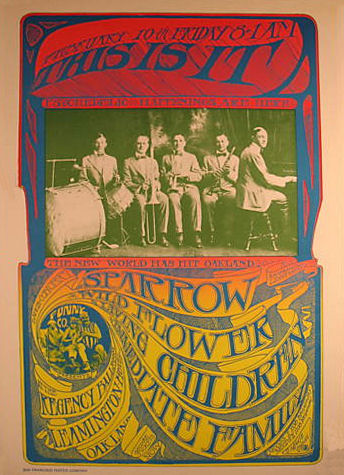
1814 Franklin Street, Oakland, CA--Regency Ballroom, Oakland, CA

The Leamington Hotel in Oakland was a downtown hotel that had fallen into disuse by the 1960s as fewer and fewer visitors actually stayed in hotels downtown. It was used briefly as a rock venue, initially for "teen" dances around 1966, and also for one psychedelic show with a widely circulated poster. On February 10, 1967, The Funny Company presented The Sparrow, The Widlflower, The Living Children and The Immediate Family at The Regency Ballroom. The Sparrow, then based in Sausalito, later evolved into Steppenwolf; The Wildflower were an Oakland-based band who were Fillmore and Avalon regulars; The Living Children were the finest psychedelic band in Fort Bragg, CA; and The Immediate Family, with guitarist Tim Barnes, were a popular Contra Costa County band. This intriguing foray into psychedelia was rare for Oakland, and never repeated at my knowledge at The Regency Ballroom. The venue was small, parking was probably difficult, public transport non-existent and the police almost certainly intolerant. Although the bands seem excellent today, and were probably a lot of fun in concert, they all would have been fairly unknown at the time. Although the site has obviously changed, the ballroom was plainly quite small by late 1960s standards, and even if the venue was full it would not have generated the kind of revenue needed to sustain a rock ballroom like The Fillmore or Avalon. I visited the site of The Leamington Hotel, at 1814 Franklin Street on August 7, 2009, and took photos of the interior (above) and exterior of the building. I assume the pretty colored glass in the center of the building is a remnant of the Regency Ballroom--it must have looked nice when it was part of a light show. The Leamington Hotel, now called "The Leamington", is basically an office building with a few shops and restaurants. In the 1980s, there was a good pizza place in the building (Da Vinci's), which is how I am aware of it.

Thursday, November 12, 2009

Springhill Road, Lafayette, CA July 22, 1967: Casa Loma Swim Club "Fantastic Flight Of The Mystic Balloon"


(update: some photos turned up that appear to be from this show)

The Summer of 1967 in the Bay Area offered a peculiar paradox for aspiring rock promoters. On one hand, it was plain to anyone who wasn't completely deaf and blind that the San Francisco rock scene was the coolest thing happening in the country. On top of that, not only were there numerous Bay Area bands, musicians were flocking from all over to start or join bands, and there weren't enough gigs at the Fillmore and the Avalon to go around. As for the audiences, kids outside of San Francisco, Berkeley and San Jose were dying to see happening rock shows, as many as they could. The only problem in the way was the absence of suitable rock venues, and the resentment and suspicion with which hippies and their music were greeted by the so-called "older generation."

This article from the July 26, 1967 edition of the Oakland Tribune describes a long-forgotten, ambitious and somewhat unsuccessful event, the "Fantastic Flight of The Mystic Balloon," a planned 12-hour Happening with a dozen bands, outdoors at the private Casa Loma Swim Club in suburban Lafayette, just over the hill from Berkeley. While Lafayette today is a somewhat upscale suburb, in the 1960s it was considerably emptier and less wealthy (though hardly poor). On the other hand, the community had more of a small town sensibility than that of a town full of urban commuters. According to the article, producer Eric Town expected to draw 6000 people (at $3 a head) to his extravaganza, to see the following bands:

Country Joe and The Fish/Steve Miller Blues Band/New Salvation Army Band/Roger Collins/Majestic Sound/Don Holland/Clark Miller Trio/Maggie’s Farm/The Virtues/Blue Union/Frumious Bandersnatch/Opus Three

The Casa Loma Swim Club had six open acres land at the deadend of Springhill Road. However, according to article, a residential group, the Springhill Improvement Association, voted to encourage District Attorney John Nejedly in declaring the promoter and the bands a "Public Nuisance," alleging a violation of zoning ordinances. A judge filed a temporary injunction,  but the show went on as planned. Nonetheless, according to the promoter, the show was "ruined," and only six of the twelve scheduled bands performed. The District Attorney and the homeowners prevailed in preventing a follow up event the next Saturday (July 29).

While complaints were alleged about excessive noise--probably with some justification--the principal issue seemed to be the threat of the "hippie element." The paper interviews one homeowner--

Alan Stanley, 33, a county engineer who lives near the club at 1200 Martino Road, said the residents were not concerned about hippies attracted to the music, but were concerned about safety.
He conceded some residents were "jumping up and down" about the hippie element. He said there were "an awful lot of psuedo-hippies, you know, kids who were trying to act like hippies." He said only about ten percent of the crowd could be considered hippies.

Its hard to parse these comments without feeling that the homeowner was trying awfully hard to find a way to explain that he feared hippies near his property, like they were some sort of species of marauding wildlife, but everyone is free to draw their own conclusions. In any case, the next weekend's shows were canceled, and Lafayette returned to its quiet sylvan state. I could find no trace of the Casa Loma Swim Club on the satellite map.

Notes On The Bands
Country Joe and The Fish were Berkeley's leading rock band. At this time, they had released their successful first album Electric Music For The Mind And Body (Vanguard) and were regular Fillmore and Avalon headliners.
Steve Miller Blues Band were a popular local group, but a year away from their first album. Steve Miller had come from Madison (via Chicago) and imported friends from there in order to start his band. At this time, Boz Scaggs was about to join the group, or may have already, as original guitarist Curly Cook had fallen ill.
New Salvation Army were a San Francisco band. They released two albums under the name Salvation, as the actual Salvation Army objected to their name.
Roger Collins was an East Bay soul singer who had some minor local hits.
Majestic Sound are unknown to me
Don Holland was a popular lounge act, probably in an R&B style. They may have backed Collins.
Clark Miller Trio are unknown to me.
Maggie's Farm appear to have been a Pleasant Hill garage band. At some point they had a keyboard player from Berkeley (Mark Batterman, formerly of Haymarket Riot), but they seem to have been a Contra Costa band.
The Virtues featured guitarist Greg Douglas (who co-wrote "Jungle Love" for Steve Miller many years later). This group evolved into Country Weather.
Blue Union are unknown to me.
Frumious Bandersnatch arose from a band called All Night Flight, founded at Diablo Valley College in Pleasant Hill. This was the first lineup, featuring drummer/vocalist Jack King, guitarists George Tickner and Brett Wilmot, bassist Brian Hough and singer Kaja Doria. This lineup broke up after their equipment was stolen in late 1967 from an Oakland warehouse. King reformed the group in 1968 and went on to play with Steve Miller in the 1970s. Tickner was a founding member of Journey, and is now apparently a doctor.
Opus Three are unknown to me.


Thursday, November 5, 2009

1275 Pine Street, Walnut Creek, CA The Hawks's Nest: The Socialites November 6-December 4, 1969

I know nothing about this group or this venue beyond what I have presented here, but it doesput the strange universe of 1969 into stark contrast. Since the late 1970s, rock and its offshoots have dominated the music industry, as the rock generation began having kids of their own, and rock and its musical values became mainstream. Even by 1969, however, rock was far from dominant except among people under a certain age, and who lived in big cities or college towns. It is easy now to mock the stoned seriousness of hippie groups who insisted on playing their own songs--not always good ones--while dressed in baggy jeans. However, a glance at the Oakland Tribune entertainment section for November 1969 shows what passed for entertainment. The ad on the top is from the Friday, November 7 1969 Trib, promoting nightly performances by "The Beautiful And Exciting Socialites," who were apparently "The Number One All Girl Band." A promotional description in the Entertainment column a few days earlier (Tuesday November 4) tells the story:
The Socialites, an all female quartet, will open a one month run at The Hawks Nest in Walnut Creek Thursday night. Shades of Phil Spittany, but I haven't seen an all-girl group since Pee Wee's opened over in North Beach in San Francisco.
That particular group, if I remember correctly, was hailed as the first topless band. The Socialites recently returned from a Vietnam tour and the Hawks Nest management has been after them for some time. They are beauties, and besides that they play their own music. I understand they're quite entertaining. The club is geared for a busy run and from all indications it will be.
So, to review:
  • the writer has only seen one other all-female band, and they were topless
  • the band members are good-looking
  • they "play their own music,"asserted with a tone of wonderment akin to meeting a dog who brushed his own teeth
What drove The Socialites? Obviously, they were musicians who wanted to make music for a living instead of work in an office, and in any case there were a lot fewer professional options for women at the time. I have ruminated before on the strange, rarely recalled history of touring Vietnam and Asia in the 60s, and it must have been doubly weird for women. Still, they were almost certainly playing cover songs in matching outfits in places where their job was to provide background music for dancing and drinking, and any artistry had to just be on private display for the occasional musicians in the crowd. Better than being a secretary or working in a Cannery, but does anyone recall them? They don't seem to have made a record, nor can I find another whiff of them (although their name is singularly difficult to google).

Compare The Socialites to the Bay Area's own all-female psychedelic band, The Ace Of Cups. For various reasons the band never made an album, and was never a headline act, but they played music they wrote, and they remained underground legends to this day. Ultimately their old tapes were made into an excellent album, and their website message board attests to the impact they had. That's not to say that The Socialites had any desire to be The Ace Of Cups, but its important to remember that the rock music scene in the 1960s was only a small slice of the musical dollar.

The site of The Hawks Nest (1275 Pine Street in Walnut Creek) is now an Enterprise Rent-A-Car. The fate of The Socialites remains unknown.

Update: I still know nothing about The Hawk's Nest, but quite the opposite is the case with respect to The Socialites. I was fortunate enough to be contacted by Socialites keyboard player Sandy Towers, who gave me the whole story (she is on the far left in the above picture). It's quite a fascinating story, so I'm posting her history in its entirety (note the link to Michigan's contribution to "all-girl" bands, The Debutantes). Sandy Towers:
The Socialites was a top-40 band, with quite a show.  Char Velasquez, a phenomenal bass player, was quite wild and uninhibited in expressing her instrument, and many times her sister, Toni Velasquez, the lead guitar player would dance in unison with Char.  Both girls would kick their legs up and throw up their instruments in unison, quite a show to see.  Their father had his own band, back in Kalamazoo, Michigan, and he encouraged the girls to start their own group.  I think they started their group at quite a young age, with a local gal, Nancy Rogers, playing drums and another girl, Nancy Anglum,  playing keyboards.  At some point the girls lost the drummer and hired a drummer from Detroit named Jino Chominski who had been playing with "The Debutantes," a very successful Detroit group.  The keyboard player also left the group.  The group had been on the road and had been doing tours in Southeast Asia.  Their manager came to Indianapolis to offer me a job with them playing in Hawaii.  I was playing with a group called the Pastels and the group was going to be breaking up. I accepted the gig in Hawaii without even meeting the players.  Soon I was on a plane, 18 years old, flying to Hawaii to meet three girls who were complete strangers.  The money was much better playing in an all-girl band as it was quite a novelty.

The material we played was danceable, party music as well as ballads with lots of three part harmony. There were some showstoppers:  both Char and I played horns while playing our instruments.  Char played trombone and bass at the same time and I played trumpet and my Hammond B3 and electric piano.  I had studied classical piano from the age of 4 and had the ability early on to hear a song and be able to play it.  I was an educated musician and was "instrumental" in helping to give the girls their vocal parts as well as the chord changes.  Our harmonies were very strong and we rehearsed constantly--we did take our music seriously.  For me, music was the only thing I ever thought about at a very young age.  We consistently toured across the US, played many gigs on the West Coast, in the Midwest and in Michigan.  
 
Jino left the group shortly after we left Hawaii and we ended up picking up a phenomenal drummer from Chicago named Donna Smolak who not only sang but play double bass drums.  SHE DID NOT PLAY LIKE A GIRL!!!  We became a very tight group.  We did get into the studio in Memphis and recorded a demo which was never released.  All good things come to an end, and unfortunately for me, I was losing my eyesight and had to quit the band.  I ultimatly went blind for six years and continued playing with local groups playing Top 40 / R&B music.  I also did some piano bar work. After two corneal transplants, I was able to prepare for a new career as an administrative assistant, actually winning a national typing contest

Tony Velasquez died of cancer a few years ago, which was devastating to her sister Char.  They were very close and Char was Tony's caretaker.  Char currently lives in Reno, Nevada, still plays the bass and has a house gig there.  As of 2009 Jino Chominski, now known asJJanice Evans, lives in Algonac, Michigan. is a Massage therapist, a Tai-Chi instructor, and a drummer.  Donna Smolak, the later drummer with the group, is a very successful realtor in downtown Chicago, right on 
Michigan Avenue. She also plays drums on the side.

All of us girls ONLY wanted to play music - it seemed our destiny and what an exciting time to be playing music.  Your reference in your article about girl musicians in the late 60's-early 70's not wanting to be a secretaries cracked me up, as that is what I ultimately ended up doing.  I am a Sr. Executive Assistant at Kellogg Company's World Headquarters - been there the past 18 years. 
Is this an amazing story or what? Most people are looking for a bite of the apple, and it seems like The Socialites got a big, juicy one. Thanks so much to Sandy Towers for bringing to light this great tale.

Sunday, November 1, 2009

May 19, 1967 Peter Wheat/Sons Of Champlin Rollarena>Carpenter's Hall


This picture caption in the May 19, 1967 points up how different the Fillmore/Avalon ballroom circuit was from the Teen rock scene that had developed just before it and was still active out in the suburbs. The picture is of Mill Valley's Sons Of Champlin, who are scheduled to play not one but two gigs on Friday May 19. They are paired with local heroes Peter Wheat, and promoter Bill Quarry has Peter Wheat and The Sons playing The Rollarena in San Leandro (at 15721 E. 14th Street). Later that evening, both bands are playing at the smaller Carpenter's Hall in Hayward. Their are different third acts on the bill for each--The Sounds of Silver Darkness play the Rollarena, and The Garden of Chaste Refreshment play Carpenter's Hall. Presumably start times were staggered so both bands could play both places.

At this time, even relatively successful local rock bands like The Sons of Champlin had very little equipment by modern standards. The Sons would have had to cart around Bill Champlin's Hammond organ--assuming he used a Hammond onstage--and Bill Bowen's drums, but bassist Al Strong and guitarist Terry Haggerty would have just had their amps. Their might have been an extra guitar and amp, as a spare and so that Champlin and saxophonist Tim Cain could double on guitar when needed. However, it all would have fit easily into a van, and could probably be moved out quickly. Thus a popular local rock band could play multiple gigs in a night. At this very same time, bands like the Dead and the Airplane were accumulating massive amounts of equipment that made multi-gig nights well nigh impossible. The Grateful Dead model of a self-contained PA and masses of equipment would soon become the rock band standard.

Up until June, 1967, The Sons of Champlin had been managed by Frank Werber's Trident Productions. Werber had struck it big with the Kingston Trio, and while he and producer Randy Stierling had very open ears and signed some good local acts, they still had a conventional show-biz approach to the business. Throughout the Spring of 1967, the Sons played many gigs sponsored by radio station KFRC, often headlining a Pepsi-sponsored Battle Of The Bands at various High Schools (student musicians at Washington High in Fremont and Woodside High in Redwood City still fondly recall The Sons' appearances, particularly guitarist Terry Haggerty). By the end of June, however, The Sons were heading in a more psychedelic direction and Trident was getting out of management, so Werber released the Sons from their contracts, freeing them to focus on the more artistic side of their music. This two-gig night was near the end of their tenure as a working dance band, and while the Sons do not reject any part of their past, they never evinced a desire to return to this kind of gig either.

Peter Wheat and The Breadmen were a popular Hayward group, one of the first "long-haired" local bands. By 1967, they had changed from British Invasion style music to more of an R&B style, with horns and a female vocalist, and mostly billed themselves as Peter Wheat (nobody was named Peter in the band, much less Peter Wheat), but their moment had passed. This show would have been near the end of their career, and the band probably broke up soon after this.

During their period with Frank Werber, the Sons of Champlin played a sort of sophisticated Beatles style rock that emphasized vocal harmonies (amply documented on the Big Beat cd Fat City). As the band became increasingly interested in the psychedelic music blossoming in the Bay Area, a split with Werber became more logical. To Werber's credit, he simply released the Sons from their contract, freeing them to continue however they pleased. By the end of June, The Sons Of Champlin had appeared at the Palo Alto Be-In with a horn section, and the same students who saw them at Woodside High wer completely surprised by their new direction. Thus the Sons set out on the path of trailblazing psychedelic fusion music that would lead them to fame and exactly no fortune whatsoever.

Friday, October 16, 2009

3101 E. 14th Street, Oakland, CA: Ann's New Mo-Skull's May 10-11, 1968


I have written earlier about trying to fathom the iconography of an ad for an Oakland club called Ann's New Mo. Here is another ad, from the Oakland Tribune of Friday, May 10, 1968. Without recapping every point of my previous post, let's consider what little we know

  • Ads in the Friday entertainment section of the Tribune were for "destination" establishments, trying to encourage patrons to come out for an evening. The Trib (Oakland's main daily) would have been too expensive for a "neighborhood" bar.
  • 3101 E. 14th Street (now International Blvd) was some miles from downtown, not part of an entertainment district. No doubt the ads were to encourage people to make the trip.
  • Ads in the Tribune were not for secret "subculture" ads, as squares might misread the ads and show up anyway, so whatever the score was here it wasn't likely to be too salacious.
  • Ann's New Mo advertised for at least three years, from 1966-69 (maybe longer), so the club stayed open awhile.

Now let's review what we don't know

  • What is Ann's New Mo? What's a Mo? Mod? Momentum? Mojo?
  • What kind of music was being played, and who did it appeal to? Jazz, blues, rock, R&B, soul?
  • Who were the bands? I have reviewed the ads in the Trib for the late 60s pretty carefully, and none of the bands who played at Ann's New Mo played anywhere else in Oakland.
  • Skull's? Is this a typo for Skulls?--It's still a strange name for a band. If the band is "Skulls," does that seem like a band who would play a nightspot that would advertise on the same page as clubs offering steak dinners and a lounge act? If its "Skull's", I'm even more confused.
  • What about the dancing girl icon? Who is that supposed to appeal to? Single businessmen? Hipsters? Emma Peel fans?

I can't get past any of this.

Thursday, October 8, 2009

April 10, 1974 Freight and Salvage, Berkeley: David Grisman and David Nichtern

The seemingly innocuous listing in the Hayward Daily Review of April 5, 1974 for Thursday, April 10 at Berkeley's Freight and Salvage, featuring David Grisman and David Nichtern, in fact appears to be the public debut of a very important band. At this time, guitarist David Nichtern was only known for writing a song for Maria Muldaur, "Midnight At The Oasis," which was currently climbing the charts. Mandolinist David Grisman was only known outside of bluegrass circles for being a pal of Jerry Garcia, having played with him in the recently defunct bluegrass group Old And In The Way. Old And In The Way's album, celebrating Jerry's 1973 return to banjo, was not released until 1975, by which time Garcia had already given up the banjo again.

Although Old And In The Way only played a modest number of gigs in 1973, and did not release an album until two years later, they ended up having an enormous effect on bluegrass. Fiddler Vassar Clements was already a great American musician, if not widely known, and David Grisman would soon become one. Peter Rowan was an interesting contemporary songwriter, and Garcia could hold his own on the banjo. Old And In The Way's 45 or so appearances and posthumous album opened up bluegrass to a wide variety of new listeners, thanks to Garcia's participation. Supposedly, for many years their album was the best selling bluegrass album ever (a less impressive achievement than it sounds, and Ricky Skaggs, Allison Kraus and others have certainly passed it). Thanks to Garcia, a wave of young hippies and college students saw bluegrass as cool, serious music--which it always was, of course, but it took Jerry and some contemporary lyrics to make it so.

Old and In The Way had run its course, however, as the band simply became too popular in the wake of the Dead's increasing popularity. David Grisman had another idea, however, which was that he would start a band that would revolutionize all American acoustic music--old timey, swing, blues, bluegrass and everything else. Garcia, being Garcia, was right on board. Other members included David Nichtern on guitar, Richard Greene on fiddle (Greene had played with Old And In The Way as well) and various guest bassists. However, Garcia only played six times with the Great American String Band, from April 20 to June 13, 1974, before it too became buried by Grateful Dead obligations and he dropped out of the band.

The Great American String Band went on under various names throughout 1974, such as Great American Music Band, or Great American Fiddle Band. By 1975, the group changed its name to The David Grisman Quintet, and subsequently the Quintet did indeed revolutionize all American acoustic music.

But the revolutionary David Grisman Quintet had to start somewhere, and it appears it started at The Freight and Salvage on April 10, 1974. Now, I don't know if the performance was just Grisman and Nichtern, or those two plus some friends, or what. Of course its possible or even likely that there were some low-key gigs in Marin to get their feet wet. However, this seems to be the first Bay Area show that was actually advertised. Furthermore, The Great American Music Band had its formal debut in Los Angeles at The Pilgrimage Theater on April 20, 1974, sponsored by a well-known music store (McCabe's), with Jerry Garcia in the band and guest Maria Muldaur singing her hit single. I can't believe that the core of the band wouldn't have a warm up gig, and this seems to be it. The Freight and Salvage had been a place for both innovative and traditional music since it opened in 1968, and it looks like here's another piece of evidence. Grisman plays the Freight (now in its third incarnation) to this day.

Who was in the band that night? I'd love to know. Was a certain Spud Boy playing banjo? Much as I wish it were so, and it is within the realm of possibility (Garcia was in town), I kind of doubt it, since by 1974 everyone who went to the Freight would recognize Jerry, and there would have at least been a legendary tale that got repeated. But Grisman is enough of a legend on his own, and its nice to see where his next chapter started.

Update: Intriguing as my speculations are, JGMF has rather definitively shown that the Great American String Band started at the Great American Music Hall on March 10, 1974. This Freight and Salvage show a month later is still an as yet undetermined piece of an intriguing puzzle, but it wasn't the debut.

Thursday, September 24, 2009

2504 San Pablo Avenue, Berkeley, CA: The Longbranch June 1975


As we have discussed earlier, in California as in most places, a Use Permit that allows a nightclub or concert venue tends to remain in force, so that new operators will always find it easier to take over or refurbish an existing venue than start a new one. If a building is in an area that is not subject to robust development, it may remain a nightclub for a very long time. Since many rock venues tend to be in either "nightclub" districts or sleepy warehouse districts that don't mind noise, many buildings have long musical histories. As a result, musicians may find themselves in long-forgotten venues many years after the fact.

The listing above is from the Music section of the Hayward Daily Review for June 6, 1975, advertising the shows at a Berkeley venue called The Longbranch, at 2504 San Pablo Avenue. The venue opened in January 1963 as The Cabale, later changed to The Cabale Creamery, and it presented folk music.In 1965 it briefly became The Good Buddy, then Caverns West and finally The Questing Beast (from November 1965 to May 1966), all of them folk joints, more or less, but with rock bands starting to play some shows at The Questing Beast. The first electric performance of Country Joe and The Fish took place at the Questing Beast, in March of 1966, when Joe McDonald, Barry Melton and Bruce Barthol brought electric instruments to the club and tried out some of their material.

From 1967 to 1969, 2504 San Pablo was a sort of R&B dance joint called Tito's, featuring local bands, but starting in 1970 it became The Longbranch. The listing above is from the June 6, 1975 Hayward Daily Review, and it is interesting to see the number of performers who appear to have some prior history with the building.

Friday, June 6, 1975 Earthquake, Eddie Money
Earthquake had originally been a Berkeley High School band called Purple Earthquake, and it would have been surprising if guitarist Robbie Dunbar had not been to the Cabale as a teenager. Eddie Money, then an unknown local singer, was originally from New York City.

Saturday, June 7, 1975 Keith and Donna
During the Grateful Dead's hiatus from 1974-76, Keith and Donna Godchaux formed their own band to play Bay Area clubs and support their album Keith and Donna. Besides Keith (electric piano and vocals) and Donna (vocals), the band was Ray Scott (guitar), Stephen "Jack Bonus" Schuster (tenor sax, flute, congas), Mike Larscheid (bass) and Grateful Dead drummer Bill Kreutzmann. When the club was called The Questing Beast in 1965-66, it was a nascent psychedelic club, managed by unknown parties with reputed ties to the reclusive acid king Owsley Stanley. Supposedly, the Grateful Dead were going to rent the building as a rehearsal hall in February of 1966, but went to Los Angleles with Owsley instead. The Dead tape that circulates as "Questing Beast Rehearsal" from February 11, 1966 is clearly spurious--the Dead were already in Los Angeles--but that doesn't rule out the fact that Kreutzmann and the others had rehearsed there, or at least checked out the building.

Friday, June 13, 1975 Alice Stuart
Alice Stuart had probably played The Cabale in 1964, but she definitely played Caverns West in mid-1965, and opened the Questing Beast in November of 1965. At the time, she would have probably been a solo folk/blues artist. By 1975, she was generally fronting an electric trio, in her appearance at a fourth incarnation of 2504 San Pablo.

Saturday, June 14, 1975 Stoneground
The original Stoneground had broken up in early 1973, but guitarist Tim Barnes had reformed the group with a somewhat stripped down lineup. I don't know who was in the band.

Mondays (June 9 and 16, 1975) The Shakers
The Shakers were a white reggae group.

Wednesdays (June 11 and 18, 1975) Delicia and The Depressions
This group is unknown to me.

Thursdays (June 12, 1975) Country Joe McDonald and Friends, Energy Crisis
Berkeley resident Joe McDonald found himself back at 2504 San Pablo, where he had first played the Cabale in 1964. His "friends" were the band Energy Crisis, a group featuring lead guitarist John Blakely, guitarist/vocalist Phil Marsh (ex-Cleanliness and Godliness Skiffle Band), drummer Tom Ralston (Sky Blue, CGSB) and bassist Bruce Barthol, also an original member of the electric Country Joe and The Fish.

Energy Crisis had not met with much success locally, so they teamed up with Joe, who was recording for Fantasy and had a new album that would be his biggest hit in years. Joe and Energy Crisis played Bay Area clubs for much of the summer, and the group would form the core of his backing group for some time. Thus Joe McDonald and Bruce Barthol found themselves back at 2504 San Pablo, trying out their new band, just like when they had begun 10 years earlier. They played the following dates at The Longbranch: May 8, 22 and 29, and June 5, 12, 21 and 26, and July 5 (for some reason they played Saturday June 21 instead of Thursday June 19). Thats about as many dates as Joe, at least, had played at The Cabale and The Questing Beast the first time around. When Joe left, the Thursday night residency was taken over by another Fillmore veteran, Jerry Miller of Moby Grape.

After a few more years, some of them as a reggae joint, The Longbranch became a store called Good Vibrations (don't Google it at work). But its still standing--so Joe may be back there one of these days in its next incarnation.

Wednesday, September 23, 2009

3101 E. 14th Street, Oakland, CA: Ann's New Mo-The Naturally Stoned, November 7, 1969


Some mysteries are probably destined to remain mysteries. This ad comes from the Oakland Tribune entertainment section of November 7, 1969. The Trib was Oakland's main paper, and the establishments that advertised in the Friday section were relatively well established destinations. Steakhouses, downtown nightclubs and Nevada Lounges (in Reno and Tahoe) all had regular ads. Certainly some out of town clubs would advertise, but they were larger clubs like Frenchy's, who featured larger acts and appealed to patrons as an evening's destination. For a bar or club, an ad in the Friday Trib was a genuine expense, and some of the smaller clubs only advertised when they had a major attraction.

Ann's New Mo advertised most weeks in 1969, featuring a variety of groups I never heard of. My favorite is this band, The Naturally Stoned. Who were they? What is the semiology of the dancing girl? Is that hip, funky, black, white, what? Who is it supposed to appeal to? Bored businessmen? 20-somethings looking for fun? And what does "Mo" mean? Momentum? Mode? There's a Wednesday jam session, but what do they play? Jazz? Blues?

3101 East 14th Street (now 3101 International Boulevard) is over in the Fruitvale District (near what is now the Fruitvale BART Station at International and Fruitvale Avenue). Presumably the ads were to encourage Trib readers to make the trip down East 14th, but its 4 miles East of downtown, not really on the way to anything. Of course, that's why a club advertises, but the ad seems to be speaking in a language I don't understand.

Its easy to imagine that the coded language is something delicious and exciting, speaking to some kind of musical, ethnic or sexual subculture, but those kind of clubs didn't advertise in the Friday Tribune, since they didn't want squares dropping by unprepared for what they were getting. This ad has to appeal to someone who would read the Friday Trib, looking for things to do and willing to drive a few miles for the experience. "Naturally Stoned" is a clue, sort of, but by 1969 the iconography of drugs was fairly common, and in any case "stoned" still meant "drunk" to a lot of people in the 60s.

I remain perplexed.

Sunday, September 20, 2009

29097 Mission Blvd, Hayward, CA: Charlie Musselwhite at Frenchy's November 7, 1969


What to make of this ad? Frenchy's was a fairly large club in Hayward that had existed since at least the early 1960s. In 1965-66, it had actually turned into a kind of happening place, if only by an accident of geography--it was the only rock club between San Jose and Berkeley. It must not have been profitable enough, however, as it went "topless" in late 1966. That too wasn't successful (the ads said "Topless Was A Big Bust") and Frenchy's reconfigured itself into a contemporary rock club in 1967. Since it stayed open, it must have done alright. It didn't hurt that there were a lot of good bands in the Bay Area, and that the rock crowd had finally gotten old enough to buy drinks.

By 1969, pretty good bands play Frenchy's. This ad from the November 7, 1969 features a gig (probably  a week-long engagement) by Charlie Musselwhite. Musselwhite had moved from Chicago to San Francisco in 1967, figuring it was better to be one of the best blues bands in San Francisco rather than one of dozens in Chicago. Although his personnel changed, Musselwhite always had a good band backing him, and he was a terrific harmonica player and a solid singer. He played gigs at the Fillmore and all over the Bay Area. The ad is the odd thing here. It says

If you are over 30, please do not come to FRENCHY'S--you probably won't enjoy it. We have the best rock and roll bands in the world. They are loud, it gets very crowded, sometimes the dance floor is very crowded. We have light shows that are very psychedelic, and sometimes its hard to see. We have a special Ladies Night on Wednesday. Lots of Ladies come, few are over 30. We have a one thousand dollar dance contest for girls on Thursday. They dance alone on a platform. You probably wouldn't like it. We have Happy Hour on Sunday from 7:30 to 9:30. We drink a lot of beer. We dress very casual and mod. Some of us have long hair. We dig it, you probably wouldn't. Our bartenders won't listen to your problems. They don't have time. Our waitresses won't listen, either, they don't like problems. We always have a lot of fun. If you are over thirty this is not for you.

Obviously this is one of those ads that is "warning" people not to come and have a good time. Given its location on the Oakland Tribune entertainment page, next to ads for Steak Restaurants, Las Vegas and other expensive entertainment, however, my theory is that the purpose of this ad is to get people over thirty to come to the club. I believe the hidden message is that there are a lot of under-30 women at the club, and middle-aged businessmen who find the Hotels in Jack London Square to be slim pickings would do well at Frenchy's. Whether that's true or not was of course another matter, but I think this litany of cliches only made sense if you were a 30-something square looking for free and easy hippie chicks.

Wednesday, September 16, 2009

1099 E Street, Hayward, CA Bret Harte School Amphitheater: Hayward Folk Song Festival, September 26, 1964


The friendly young woman with the guitar, sensible skirt and straight hair is Alice Stuart, one of the performers in the Hayward Folk Song Jamboree, held at the Bret Harte School Amphiteathre (1099 E Street in Hayward) on Saturday, September 26, 1964. The older woman on the left, pretending to play the autoharp, is the organizer, Mrs. Donald Hovenor. This Folk Festival was organized as a fundraiser by the Family Services Guild, a Southern Alameda County "Society" charity. As a result, this event got excellent promotion in the Hayward, Fremont and Oakland papers in the prior week. The photo and clipping above are from an article in the "Women's" Section of the Hayward Daily Review on September 24, 1964.

In the process of planning her fundraiser (we were breathlessly informed) Mrs. Hovenor was directed to Barry Olivier, organizer of the Berkeley Folk Festival, and he simplified the process of organizing a folk festival in Hayward. The performers were regulars at the Berkeley Folk Festival and on the Bay Area Folk Circuit: Sam Hinton, Jesse Fuller, Slim Critchlow and "for the younger set," The Pine Valley Boys, Alice Stuart, Barry Olivier and Merritt Herring. The Pine Valley Boys were a fine East Bay bluegrass band featuring Butch Waller (later in High Country), Herb Pedersen (Dillards, Desert Rose Band, many others) and David Nelson (New Riders, David Nelson Band, etc).

While this performance was probably a fun, and possibly lucrative, gig for the performers, it does show Folk Music at an interesting crossroads. Most serious young Folk musicians, like Herb Pedersen, Alice Stuart and David Nelson, got interested in bluegrass or blues not only because it was good, but because it was unsanitized and possibly a bit dangerous, unlike simper popular stuff like The Kingston Trio. Yet by late 1964, suburban Society matrons are happy to use an exported version of the Berkeley Folk Festival for a fundraiser, and equally happy for their own kids to be attending the show on a Saturday night. This was no criticism of folk music itself, but it had come a long way from the secret society it had once been.

In late 1964, things were certainly on the verge of change. Folk music did, to its credit, turn out to be threatening, if only because it often lead to rock music. Alice Stuart, for example, less than 18 months after this photo was taken, ended up getting hired by Frank Zappa to play in his band The Mothers for a few months in Los Angeles, and if that isn't threatening to parents, what is? In any case, Alice Stuart is still friendly and still has a guitar, even if its mostly an electric one these days, as she is a veteran of many recordings and performances.

Thursday, September 10, 2009

August 7, 1969 Oakland Coliseum Arena, Oakland, CA: Pop, Bach & Rock

This advertisement from the July 7, 1969 Oakland Tribune shows an interesting attempt to find a middle ground between rock and classical music. Arthur Fiedler, conductor of The Boston Pops Orchestra, was the big name here.  Boston Pops attempted to make classical music a middle-class phenomenon, using Boston Symphony players to perform both classical pieces and pop hits of the day. The Boston Pops Orchestra was a best selling ensemble, and Symphonies in major cities formed similar ensembles. By the late 1960s, Arthur Fiedler was a major star in his own right, of the stature to headline at the 15,000 seat Oakland Coliseum Arena.        

The New York Rock and Roll Ensemble was headed by future film soundtrack composer Michael Kamen. Supposedly, three members of the Ensemble were Julliard students who figured out that there was more money in rock than in classical music. Their debut album (Atco Aug 68) featured string quartets and oboe duets mixed in with rock and roll. On stage, they would play Procol Harum’s “Whiter Shade of Pale,” based on a Bach Cantata, with a cello and an oboe. By 1969, they had released a second album, Faithful Friends.

In the late 1960s, some more forward thinking people believed that it was only a matter of time that popular music merged with more "sensible" music. This turned out to be true, in a way, but it was more a matter of the economic dominance of rock subsuming other forms. The New York Rock And Roll Ensemble was a fine idea, in principle, but it turned out that they didn't really have any outstanding songs. In a way, they were the forerunner of The Electric Light Orchestra, a less pretentious band with better songwriters from Birmingham, England. In the late 1960s, however, it seemed like Rock was just about to become a normal part of the pop music spectrum.

Michael Kamen (1948-2003) had an extremely successful career in the music industry, particularly as an arranger for other artists like Pink Floyd and scoring films. Mark Snow (born Martin Fulterman), the co-founder of the New York Rock and Roll Ensemble, also had an extensive career recording soundtracks, most famously with the theme for the TV show "X-Files."

Sunday, September 6, 2009

37266 Niles Boulevard, Fremont, CA The Yellow Brick Road 1967


Update: thanks to commenters, I have discovered that the name of the venue was actually Yellow Brick Road, and the performing band was Garden Of Chaste Refreshment. See my subsequent post.

This partially-reproduced flyer for a club at 37266 Niles Boulevard in suburban Fremont, California advertises a few shows for a mysterious venue called The Garden Of Chaste Refreshment The Yellow Brick Road. The advertised shows are

June 23-24, 1967 The Plastic People/Yellow Brick Road Garden Of Chaste Refreshment
June 30-July 1, 1967 Purple Earthquake
July 7-8, 1967 The Loading Zone/Wakefield Loop

Fremont is a town halfway between Oakland and San Jose. Fremont was actually only incorporated in 1956, a merger of five smaller communities (Centerville, Niles, Mission San Jose, Irvington and Warm Springs). Although Fremont was and is a prosperous suburb, as a result of being a business-like merger of smaller communities it lacked a larger identity. Niles, where The Garden Of Chaste Refreshment was located, was originally a critical railroad Junction, and was even the location of one of California's first film studios (many early Charlie Chaplin films were made there). Whatever the story of this venue, it appears to be an attempt to capitalize on what was happening in bigger cities to the South and North, but I know of no other shows at this venue, and otherwise I know nothing about it. Did it close soon after? Become a Top 40 joint? Anyone with further information is encouraged to share it in the comments or email me.

The site was most recently "Boss Hogz Bar-B-Que", although it appears to be closed.

Notes On The Bands

The Plastic People (June 23-24) are completely unknown to me. Anyone with any insights, please comment or contact me.

Garden Of Chaste Refreshment (June 23-24) were a Southern Alameda County Band, probably based in Fremont or Hayward.
Yellow Brick Road (June 23-24) were a group featuring singer Jean Piersoll, along with Fuzzy John Oxendine (drums), Bing Nathan (bass), Terry Clements (saxophone, I think) and Henry Salas (not certain of his instrument). They apparently played some sort of rock/soul hybrid. When guitarist Darby Slick (ex-Great Society, co-author of "Somebody To Love") returned from India, he joined as lead guitarist and they changed their name (to the rather poorly chosen) Hair. Slick and Piersoll later recorded two singles for Cadet Concept in Chicago. Yellow Brick Road was the venue name, not the performing band.

Purple Earthquake (June 30-July 1) were a Berkeley band, founded at Berkeley High School in 1966. They were later known as Earthquake, and released albums on A&M and Berserkeley.

Loading Zone (July 7-8) were an Oakland band, one of the first to mix rock and soul music, adding psychedelic guitar to danceable soul. Although successors like Sly and The Family Stone, Cold Blood and Tower of Power were bigger and better, Loading Zone was the first to kick the door open. At this time, they did not yet feature Linda Tillery on vocals.

Wakefield Loop (July 7-8) Nothing much is known about Wakefield Loop (they opened for Loading Zone on July 7-8, but the band name is not visible on this scan). However, Wakefield Loop regularly appears in lists of Bay Area bands, because Ralph Gleason's daughter included them in a famous list of Bay Area band names that has been reprinted several times. It is informative that the band played Fremont, because a Google map search turns up a tiny cul-de-sac in Fremont called Wakefield Loop, distinctly suggesting that Wakefield Loop was founded or based on that street. Update: unknown no more.

update: see here for another post about The Wakefield Loop 

Wednesday, September 2, 2009

25100 Mission Blvd, Hayward, CA: Call Girl A-Go-Go, 1965


Most fads don't age well, and the "Go-Go" phenomenon seems sexist and dated now, but this particular establishment kind of takes the cake. This ad for the Call Girl A-Go-Go at Chef Fone is from the Hayward Daily Review of June 18, 1965. 25100 Mission Boulevard is on Hayward's main thoroughfare (about a mile South of Jackson Street, on the Eastern edge of the "Jackson Triangle").

Here's what I wonder--the women who danced here would be in their sixties now. What do they think of it today? I suspect a lot of Go-Go dancers look back on their employment fondly, because it was fun and life was full of possibilities. It's one thing, however, to work at "Tiger A Go Go" or "Frenchy's A Go Go," and quite another to work at Call Girl A Go Go.

"Call Girl" meant the same thing then that it does now, although perhaps the term wasn't so publicly known. What was the marketing angle? The general idea of Go Go clubs was "good clean fun." Of course it was sexy, and men were supposed to desire the dancers, but it was basically an inducement to dance, get hot and bothered and buy drinks. Would you go there on a date? "Hey honey, we could go to Frenchy's or Call Girl A Go Go?"

I'm pretty much speechless over this one.

Sunday, August 30, 2009

PayLess Drug Store, Fremont Plaza, Fremont, CA: Mount Rushmore/Linn County, October 25, 1968


These advertisements from the October 25, 1968 edition of The Fremont Argus promote "in-store" appearances of rock groups at a retailer to publicize their new albums. This is a pretty common retailing practice, made fun of in the movie Spinal Tap, but this example of it must have been a pretty strange experience.

First of all, while most records in the 1960s were sold at large general retailers like department stores, a suburban PayLess in 1968 had about the same hipness quotient that it does now. I don't doubt that many suburban fans bought many of their albums at PayLess, but I doubt it was a "destination" like a Tower Records would be.

Mount Rushmore and Linn County were both pretty good bands, if now somewhat obscure. Mount Rushmore was a San Francisco band who had formed in 1967, but only released their first album High On Mount Rushmore in late 1968. Ross Hannan and I have an ongoing project to document the complete history of Mount Rushmore and related groups like Phoenix. Mount Rushmore had played many Bay Area gigs, although I don't think there were many in Fremont, and I don't know how much the album would have been played on KSAN or KMPX, then the only two FM rock stations in the Bay Area. I would find it surprising if Mount Rushmore were well known in Fremont.

Linn County was a band that had relocated to San Francisco from Cedar Rapids, Iowa. The band had formed around 1964, and played extensively around Chicago and the Midwest. They were led by a fine organist and singer named Stephen Miller--no, not the guitarist in the Steve Miller Band. Miller (1942-2003) was a fine, if underrated performer. Linn County relocated to San Francisco in 1968, and were rapidly signed to Mercury, and their first album Proud Flesh Soothseer had just been released. They would go on to release another album, Fever Shot, before they broke up. Stephen Miller had a long performing career, and an extensive discography, playing with The Elvin Bishop Group, Clifton Chenier, Grinderswitch and many others.

Linn County, although they had only been in the Bay Area for a few months, were already regular performers at rock clubs like The New Orleans House in Berkeley, but I do not how much they would have played Fremont in 1968, if at all. Similar to Mount Rushmore, while I'm sure their album got a little play on KSAN and KMPX, as they were a local band, it would not have been an overwhelming amount.

The PayLess Drug Store in Fremont Plaza in October 1968 is pretty far from the Straight Theatre in San Francisco or the New Orleans House in Berkeley, where the bands would normally play. Fremont was in the suburbs, and in 1968 the suburbs were pretty straight. Sure, the teenagers in High School knew something was happening, and had some cool records, but they didn't want to go down to the Fremont Pay Less with their Mom. The younger kids who would go with their Mom had probably just figured out who the Jefferson Airplane were, and hadn't yet figured out about lesser known bands that KSAN played late at night.

San Francisco long hairs like the members of Mount Rushmore and Linn County would have looked pretty out of place in the Fremont Plaza Mall. All in all, this sounds even stranger than the scene in Spinal Tap where the band does an in-store and no fans show up. Perhaps I'm being unfair--perhaps pretty girls from the High School showed up and swooned over the bands, and perhaps all the boys asked about the chord changes to all the tunes, but I think that's kind of unlikely. Still, I have Proud Flesh Soothseer, and I've heard some of High On Mount Rushmore, and they are both pretty good for late 60s albums, so maybe there are people who remember the day fondly, treasuring their autographed copies.

Sunday, August 23, 2009

6300 Moraga Way, Oakland, CA: Montclair Recreation Center 1970-71

According to a long-ago eyewitness, the concerts were held in the biggest room in this building
According to an eyewitness, this building was still a working fire station and was not part of the concerts
While doing research for our Loading Zone Family Tree and Performance History, I came across numerous references to a series of shows at the Montclair Recreation Center in Oakland from 1970 to 1972. This was very surprising, because not only were there very few rock venues in Oakland, the Montclair neighborhood is in the Oakland Hills, not Downtown or near Berkeley, and I cannot think of any Oakland Hills rock venues even to this day. The Montclair Recreation Center, at 6300 Moraga Way (just after Moraga meets Thornhill) is a city park, with various picnic and play areas, plus nice grass fields, but it is relatively small.

When I was in the East Bay, I took photos of the only two buildings that could have housed rock concerts. Of course it has been many years, and a building that was used may have long since been torn down. Nonetheless, when I was there only two structures seemed like possible locations for rock concerts: a street level building that looks like a converted house (top), now boarded up, and an administration building that seems to have some community meeting rooms (below). Light show performers were identified for most events, so clearly the shows were indoors. The photos were taken August 11, 2009.

My sole source of information about these concerts was listings in the Wednesday "Teen Age" section of the Oakland Tribune, usually in the "What's Doing" section. These were free listings that included Fillmore concerts, charity events, High School dances and so on. Some listings refer to the "weekly" Saturday night concert, suggesting that I am missing many shows in my list, but at this juncture I have no way of determining that. Mostly the Tribune lists a single act plus a Light show, so it leads me to think that these shows were for teenagers and ended fairly early. I can see the Montclair neighborhood preferring that their teenagers stay home, at the price of a little noise, instead of looking for trouble and fun in Berkeley or San Francisco.

The shows first started being listed in Fall 1970, and a notice suggests that they are newly instituted. The Oakland Tribune of October 7, 1970 said the bi-weekly shows were co-sponsored by the Center and the Montclair Junior Women’s Club, which makes it clear that the operation had some civic "purpose" like keeping kids in the neighborhood on Saturday nights. Of course, the shows were sometimes more than bi-weekly, but a civic sponsor would explain why there seems to be little evidence of shows during holidays and high Summer. The bands were not obscure, but rather the sort of bands that headlined local clubs or played third on the bill at the Fillmore West. I did see a few notices for shows in 1972, but they featured considerably more local acts. Since the organization and financing of these shows is obscure, its hard to draw too many conclusions.

Here is my list of shows at the Montclair Recreation Center in Oakland for 1970 and 1971


September 19, 1970: The Tyde
October 10, 1970: The Fog
October 24, 1970: AB Skhy
October 31, 1970: Loading Zone
November 7, 1970: Loading Zone
November 14, 1970: Loveship
November 21, 1970: Beggar’s Opera
November 28, 1970: Joy Of Cooking
January 9, 1971: Loading Zone
January 30, 1971: Joy Of Cooking
February 6, 1971: Tyde
February 27, 1971: Cat Mother
March 13, 1971: Full Moon (formerly The Womb)
March 20, 1971: Loading Zone
March 27, 1971: Pipe
April 24, 1971: Western Addition
Wendy Haas, later of Azteca, was the lead singer for Western Addition.
May 1, 1971: Ice
May 8, 1971: Barry Melton and The Fish
May 22, 1971: Loading Zone
May 29, 1971: Gold
June 12, 1971: Malo
July 3, 1971: Sopwith Camel
July 10, 1971: Clover
September 19, 1971: Loading Zone
October 2, 1971: Barry Melton and The Fish
October 23, 1971: Jabo Stokes
November 6, 1971: Cat Mother
November 20, 1971: Loading Zone

Sunday, August 16, 2009

1827 San Pablo Avenue, Berkeley, CA--The Freight and Salvage (original site)


The Freight and Salvage is Berkeley's premier traditional music club, open continuously since 1968. Originally opened to provide a forum for folk music traditions after similar venues in Berkeley had closed or migrated to rock, the Freight is now a folk tradition of its own.

This is the original site, at 1827 San Pablo Avenue, now Berkeley Auto Body at 1829 San Pablo. The building was called The Freight and Salvage, and founder Nancy Owens chose to keep the name so the club could keep the Yellow Pages listing. I have written extensively about performers at the original site in the first two years of the Freight's existence.

The Freight moved to 1111 Addison Street, a few blocks away, in about 1988, and have since moved to 2020 Addison Street in downtown Berkeley. This photo was taken on August 11, 2009.

2362 San Pablo Avenue, Berkeley, CA-The Blind Lemon


The Blind Lemon was the first folk club in Berkeley, and one of the first on the West Coast. It was founded by Rolf Cahn, a German by way of Cambridge, Massachuessets, who was an accomplished guitarist. The club was opened in 1958, and served coffee and folk music, literally setting the stage for what was to come. Cahn would later found The Cabale Creamery, an important early 1960s Berkeley folk club, a few blocks away at 2504 San Pablo.

This photo was taken on August 11, 2009. The typewriter repair business at the site seems to have closed some time ago. The building is even smaller than it appears in the photo, a narrow building that is not particularly long.

2504 San Pablo Avenue, Berkeley, CA--Cabale Creamery, Good Buddy, Caverns West, The Questing Beast, Tito's, The Longbranch


2504 San Pablo Avenue in Berkeley (at Dwight Way) was a music venue in Berkeley more or less continuously from 1963 to about 1976. Use Permits in California make it a lot easier to open a venue in a building that has already received permission to be a live music venue.

This photo was taken August 11, 2009. 2504 San Pablo is the building with the brown facade, behind the bus stop. For many years it has been a retail store called Good Vibrations. You can google it, but don't do it at work.

2504 San Pablo Site History

January 1963-Early 1965: Cabale Creamery
A folk club founded by Rolf Cahn, Debbie Green, Howard Zeem and Chandler Laughlin, one of the principal folk stops on the West Coast in the early 60s.

Mid 1965; The Good Buddy

Fall 1965: Caverns West

November 1965-May 1966 The Questing Beast
A folk club with a psychedelic twist to it. A few local rock bands played there, including an embryonic Country Joe and The Fish, and there may have been an Owsley Stanley connection. A Grateful Dead tape listed as "Questing Beast Rehearsal 2-11-66" is spurious, but the Dead may have been considering using the Beast for a rehearsal hall prior to their departure to Los Angeles with Owsley in February 1966. The city Public Health department closed the club.

1967-69 Tito's
Tito's was more of a "joint", a place that featured dancing to local bands. Most of them were unknown, although a few (like The Loading Zone) became well-known later. The bookings--at least of bands that were known--seemed to lean more towards R&B or funky jazz.

1970-76 (approximately) The Longbranch
The Longbranch was a hard rock club. East Bay bands like Earthquake, Greg Kihn and Eddie Money were regulars at the venue. At one point in the early 70s, a lot of reggae bands played at the club, including groups like Toots And The Maytals, then quite unknown. A few touring acts filled in their itinerary with gigs at the club, usually when they were opening a show at Winterland or a similar venue, and had room for an extra gig.

1106 Solano Avenue (901 San Pablo Avenue), Albany, CA--The Lucky 13


The Lucky 13 in Albany is a mysterious venue for many reasons, and it has been written about elsewhere. I took some pictures of the venue site. The building is L-shaped, and original ads list the venue at 901 San Pablo Avenue (at the corner of San Pablo and Solano Avenues). The building is now listed at 1106 Solano, and it is a restaurant/dance palace called Montero's.

Briefly, in 1966-67, The Lucky 13 was a teen club that sold cokes and burgers while teenage rock bands played. By 1968, The Lucky 13 was associated with the R&B station KDIA, at 1310-AM, known as "The Lucky 13." The radio station advertised the venue as an after hours soul club, open from 2-6am. Tower of Power played a gig there and got signed to a record contract by Bill Graham's Fillmore agency.

Was the teen club open in the early evening while the soul club happened after hours? Did the venue have music at all during regular hours when it was an after hours club? These and many other questions remain currently unanswered.

These photos were taken August 11, 2009, one facing the intersection (of San Pablo and Solano) and one from the Solano Avenue side. This part of Albany is very near the Northern border of Berkeley.

1048 University Avenue, Berkeley-Mandrake's


1048 University Avenue in Berkeley (between 10th Street and San Pablo Avenue) was the site of Mandrake's. From 1965 onwards, Mandrake's was a pool hall that booked occasional music shows, often for free. By mid-1968, the venue was taken over and booked by Mary Moore, the wife of a jazz musician (Willie Moore).

From 1968 to 1974, Mandrake's was an important club on the Berkeley music scene. The Joy of Cooking had a regular weeknight gig there for much of 1969, and it helped to establish both the band and the venue. Weekly bookings at Mandrake's ran the usual spectrum of American music, but there was a little more emphasis on blues and jazz than competing clubs like The Longbranch (on 2504 San Pablo) and the New Orleans House (on 1505 San Pablo).

After Mandrake's closed around 1974, the venue reopened as Jerry's Stop Sign. The one time I went there in 1977, there were pool tables, so it appeared that the venue had returned to its earlier incarnation. I was seeing a friend's band play, but no one was there. The bartender politely suggested that the previous night's shooting may have cut down on attendance.

I took the photo above on August 11, 2009. The site is currently a pet emergency hospital. The angle is poor because of roadwork at the time, but 1048 University is the right half of the structure, with the orange awning. I no longer recall if the other half (1054) was part of the original venue, but I doubt it.

Barbara Flaska
When I originally published this post, I was trying to memorialize the location of a long-gone Berkeley venue. Befitting a blog with the name "Rock Archaeology," my best case scenario was a few Comments that would provide the equivalent of a potsherd or spearpoint, a tiny hint at the rock and roll life of Berkeley in the 60s. Who could hope for more?

All this changed a few Comments down on the thread, when Barbara Flaska joined in. Barbara had been an employee of Mandrake's starting in 1969. She stayed there for the next two years, and stayed in touch with the club and its staff for the next several years. Barbara was not just an employee, but a huge fan of the music and the ambiance, blessed with a warm spirit, an excellent memory and a determination to get history right. Her huge contributions to this post, embedded in the gigantic 500-Comment thread, show the world of Mandrake's from 1969 to 1971 in a rich light. Barbara got numerous participants from back in the day to contribute directly and indirectly, and as a result this post is far and away the richest vein of Rock Archaeology on the entire blog.

Rock Archaeology always hopes for a glimpse of a rock and roll past, discernible perhaps from a few remaining artifacts. Thanks to Barbara Flaska, we have not just a glimpse but a detailed portrait of an entire lost world, with its dark and light portions equally available. Long gone characters come to life, lesser known musicians like Freddie Roulette are a regular part of the landscape, and major stars like the Rolling Stones wander through as well, all part of the intricate fabric of Mandrake's in Berkeley, back in the day.

Here's to Barbara--thanks for making Mandrake's come to life, a gift for everyone who reads this.