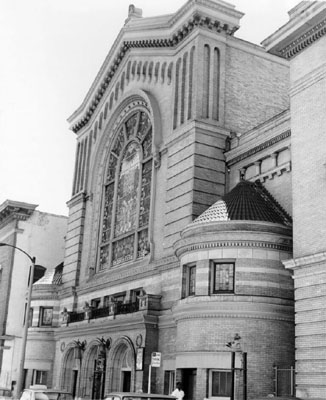
|
| The Family Dog on The Great Highway, at 660 Great Highway, ca. 1969 |
The Family Dog on The Great Highway, 660 Great Highway, San Francisco, CA
The
Family Dog was a foundation stone in the rise of San Francisco rock,
and it was in operation in various forms from Fall 1965 through the
Summer of 1970. For sound historical reasons, most of the focus on the
Family Dog has been on the original 4-person collective who organized
the first San Francisco Dance Concerts in late 1965, and on their
successor Chet Helms. Helms took over the Family Dog in early 1966, and
after a brief partnership with Bill Graham at the Fillmore, promoted
memorable concerts at the Avalon Ballroom from Spring 1966 through
December 1968. The posters, music and foggy memories of the Avalon are
what made the Family Dog a legendary 60s rock icon.
In the Summer of 1969, however, with San Francisco as one of the fulcrums of the rock music explosion, Chet Helms opened another venue. The Family Dog on The Great Highway, at 660 Great Highway, on the Western edge of San Francisco, was only open for 14 months and was not a success. Yet numerous interesting bands played there, and remarkable events took place, and they are only documented in a scattered form. This series of posts will undertake a systematic review of every musical event at the Family Dog on The Great Highway. In general, each post will represent a week of musical events at the venue, although that may vary slightly depending on the bookings.
If anyone has memories, reflections, insights, corrections or flashbacks about shows at the Family Dog on the Great Highway, please post them in the Comments.
 |
| 660 Great Highway in San Francisco in 1967, when it was the ModelCar Raceway, a slot car track |
The Edgewater Ballroom, 660 Great Highway, San Francisco, CA
As early as 1913, there were rides and concessions at Ocean Beach in San Francisco, near the Richmond District. By 1926, they had been consolidated as Playland-At-The-Beach. The Ocean Beach area included attractions such as the Sutro Baths and the Cliff House. The San Francisco Zoo was just south of Playland, having opened in the 1930s. One of the attractions at Playland was a restaurant called Topsy's Roost. The restaurant had closed in 1930, and the room became the Edgewater Ballroom. The Ballroom eventually closed, and Playland went into decline when its owner died in 1958. By the 1960s, the former Edgewater was a slot car raceway. In early 1969, Chet Helms took over the lease of the old Edgewater.
 |
| One
of the only photos of the interior of the Family Dog on The Great
Highway (from a Stephen Gaskin "Monday Night Class" ca. October 1969) |
The Family Dog On The Great Highway
The
Great Highway was a four-lane road that ran along the Western edge of
San Francisco, right next to Ocean Beach. Downtown San Francisco faced
the Bay, but beyond Golden Gate Park was the Pacific Ocean. The aptly
named Ocean Beach is dramatic and beautiful, but it is mostly windy and
foggy. Much of the West Coast of San Francisco is not even a beach, but
rocky cliffs. There are no roads in San Francisco West of the Great
Highway, so "660 Great Highway" was ample for directions (for reference,
it is near the intersection of Balboa Street and 48th Avenue). The
tag-line "Edge Of The Western World" was not an exaggeration, at least
in American terms.
The Family Dog on The Great Highway was
smaller than the Bill Graham's old Fillmore Auditorium. It could hold up
to 1500, but the official capacity was probably closer to 1000. Unlike
the comparatively centrally located Fillmore West, the FDGH was far from
downtown, far from the Peninsula suburbs, and not particularly easy to
get to from the freeway. For East Bay or Marin residents, the Great
Highway was a formidable trip. The little ballroom was very appealing,
but if you didn't live way out in the Avenues, you had to drive. As a
result, FDGH didn't get a huge number of casual drop-ins, and that
didn't help its fortunes. Most of the locals referred to the venue as
"Playland."
Chet Helms had opened the Family Dog at 660 Great Highway to much fanfare on June 13, 1969, with a packed house seeing the Jefferson Airplane and The Charlatans. One of the goals was that the Dog would feature mostly San Francisco bands and a variety of smaller community events and groups. Since so many San Francisco bands were successful, and had record contracts, this didn't confine the venue to obscurity. A lot of great bands played the Family Dog in 1969, but the distant location and the gravitational pull of major rock events hosted elsewhere in the Bay Area kept the Family Dog isolated. We know only the most fragmentary bits about music played, events and audiences throughout the year. Despite the half-year of struggle, Helms had kept the Family Dog on The Great Highway afloat. He had entered the new year of 1970 with a new plan.
- For a complete list of Family Dog shows (including FDGH), see here
- For the previous entry (March 13-15, 1970 Country Joe and The Fish) see here
- For a summary and the link to the most recent entries in this series, see here

March 18, 1970 Family Dog on The Great Highway, San Francisco, CA: Rolling Thunder/Hot Tuna/New Riders of The Purple Sage Benefit for The Sons of Thunder (Wednesday)
Almost nothing is known about this Wednesday night benefit at the Family Dog on The Great Highway, save that it happened. Initially, it was only known because there were a few listings in the Barb (above) and also in the Examiner. Since February, the Family Dog had stopped holding weeknight "community" events. There had to be some heft here for this night to be an exception.
"Rolling Thunder" was a man named John Pope. Apparently he was a "Medicine Man" of some kind, associated with Native Americans, although I know nothing about that sort of thing. Pope turns up in various chronicles of hip San Francisco, and --among other things--may have been the inspiration for the title of Grateful Dead drummer Mickey Hart's initial 1972 solo album on Warner Brothers. I know even less about The Suns Of Thunder Commune in Elko, NV. Suffice to say, Elko, NV probably isn't that Native American/Hippie Friendly today, and was probably less so in 1970. Whatever went down was surely Not Good. The fact that the spinoffs of the two most iconic San Francisco bands were on the bill suggests that Pope had good connections to leverage, good enough to ensure that the Family Dog on The Great Highway held a benefit on a Wednesday.
At this distant remove, we take for granted that Jerry Garcia played a variety of random dates with the New Riders of The Purple Sage, for convenience or fun, with little concern for the so-called "expectations" that normally accrued to legendary sixties rock guitarists. The same generally applies to Jorma Kaukonen and Jack Casady and Hot Tuna. Jorma and Jack, while playing around steadily since January 1969, had only recently publicly adopted the name of "Hot Tuna." So the dual booking of the Riders and Tuna may seem like a convergence of relaxed musician pals who enjoyed filling in their weeknights with gigs whenever they could. And it was, but there must have been more to it.
 |
| A ticket for the Grateful Dead at the Pirate's World Amusement Park in Dania, FL. The shows were booked for March 22 (Sunday) and 23 (Monday), but changed to March 23 and 24 (Tuesday) |
There are a number of very curious things about this New Riders booking, however, so curious that I had assumed some years ago that the New Riders had not played. In order of importance, the curiosities of this performance are:
- The Grateful Dead were on tour. They had played Tuesday, March 17 in Buffalo, with the Buffalo Philharmonic Orchestra. They were booked for the weekend of March 20-21 at the Capitol Theater in Port Chester, in suburban New York Metro. To play the show, Garcia, Mickey Hart and possibly others would have had to fly home to San Francisco on Wednesday, play the show, and return to New York by Friday.
- The New Riders of The Purple Sage did not have a bass player, and were effectively inactive. Nominally, Phil Lesh was the Riders' bass player, but confirmations of any Lesh performances with the New Riders are all but impossible to come by. The New Riders had booked a few gigs earlier in March, and canceled them. Bob Matthews was a full-time engineer, as far as I can tell, and Dave Torbert was still in Hawaii.
- Given the barriers to performing, and given the dead-broke band would seemingly make no money, who was John Pope, and who were the Sons Of Thunder commune that they had earned this effort? I have no information in that area, and won't speculate, but it adds to the air of peculiarity about this event.
Why Would The Grateful Dead Return To San Francisco For Just Three Days?
The Grateful Dead had no money in Spring 1970, and they had just fired manager Lenny Hart. By March, they must have figured out that Hart had been ripping them off in a big way, and that they had even less money than they thought. Since the band was playing Buffalo Tuesday night and Port Chester on Friday, wouldn't it have been simpler just to go straight over to the Capitol (just 378 miles away)?
Since the Dead would have flown out to Buffalo, however, they wouldn't have had a van. Thus they probably would have had to fly to New York Metro to get to Port Chester, then get hotels for Wednesday and Thursday night. It may not have been much more expensive to fly back to San Francisco, not pay hotel bills, and fly back to New York. Possibly a crew member or two rented a truck in Buffalo and drove the equipment to Port Chester.
More importantly, the Dead, and particularly Jerry Garcia, would have had business back in San Francisco. The bulk of the recording for Workingman's Dead had been done from March 10-16, 1970. Garcia in particular would still have been needed for overdubs, harmonies, and general oversight. Lesh and Hart also seem likely candidates for such duties, which was convenient if they were flying back from the gig anyway. So Garcia may have known that he was going to be in town on March 18, the day after Buffalo, and it wasn't a disruption at all. Perhaps some crew, and perhaps Kreutzmann, Weir and/or Pigpen stayed in New York state, although they would have had to find a way to get to Port Chester.
I never tire of the topic of who played bass for the New Riders (lengthy posts, with detailed comment threads are here [check the Comments] and here, for example). Let me briefly summarize the isssues:
The initial bass player for the New Riders was Bob Matthews. Over the decades, John Dawson, David Nelson and Jerry Garcia repeated the story over and over that the Riders were invented because the Dead could just bring Nelson and Dawson, with Garcia, Lesh and Hart filling out the band, and go on tour cheaply as the Dead's opening act. This never happened. The only time the New Riders opened for the Dead out of town during this period (Seattle and Oregon, August 1969), Bob Matthews played bass. The story has been repeated so often that even the principals thought it was true.
According to Matthews, his last show with the New Riders was in September, 1969, but that is simply not true, either. The excellent Dawn Of The New Riders Of The Purple Sage box has a set from October, 1969 with Matthews on bass. The only confirmed instance of Phil Lesh playing bass for the Riders was on a 4-track demo done at Pacific High Recorders in November 1969 (released by Relix Records on the 1986 album Before Time Began), with Bob Matthews as the engineer. There are no other known tapes, eyewitness accounts or photos of Phil Lesh playing live with the New Riders in 1969 (or any other time). If you have one, please put it in the Comments.
By January of 1970, it was clear that Matthews duties as an engineer were taking precedence over bass playing. It's also known that at least on occasion Robert Hunter rehearsed with the Riders on bass. But Hunter complained that they never asked him to play a gig, and the early 1970 period when Phil Lesh "should" have been the bass player featured no Riders' shows. There was a January 19, 1970 benefit in Berkeley, although we haven't confirmed that the band played, some canceled shows in March, and the March 18 benefit.
The history of Dave Torbert's arrival is another complex story, but the short version is that the April 17-19 Family Dog shows were the debut of Torbert. The math does not fit his arrival in March, nor could he have rehearsed, since the Dead were recording Workingman's Dead in February and March and touring constantly. So all the evidence pointed out to either the New Riders canceling out of the Family Dog show, or Phil Lesh making his last appearance as a New Rider. It had always seemed unlikely that the New Riders played this event.
 |
| Susanna Millman's photo of the Grateful Dead Vault, ca 2004 (from the Tapers Compendium) |
Guess what? Owsley taped it. Owsley was no longer able to travel around with the Grateful Dead,
thanks to the New Orleans bust, but he was the soundman for the Family
Dog on The Great Highway on occasion. We know he taped it, because a Susanna Millman photo of the Grateful Dead Vault (from the old Tapers Compendium), when Owsley's material was still there, is plain enough to read the box labels, and the distinctive writing is Owsley's. The last five boxes on the right in the photo (above) represent the Benefit. All five tapes are marked as "3/18/70 Hot Tuna/NR". Tape #1 says "Banjo Player"--yes, it does--, tape, #2 says "and NRPS", tape #3 just says "NR", and tape #4 says "Hot Tuna" and #5 says "Hot Tuna/NR." So some banjo player opened, and then the New Riders played, and then Hot Tuna ( in both rows of boxes, we can see some other non-Dead shows that Owsley taped and preserved from this period).
The Owsley Stanley Foundation is looking into the whereabouts of these tapes, and we may find out more. For now, we at least know that the benefit actually happened and that the Riders actually played.
 |
| Thanks to JGMF, we have a poster that tells us Dave Torbert was a member of the New Riders for this show at the Family Dog on March 18 |
[update 20240831] Fellow scholar JGMF has uncovered another poster for the March 18, 1970 show at the Family Dog. Remarkably, it names all the members of the New Riders--most significantly Dave Torbert. So anyone tracking the history of the New Riders bass player, which is pretty much just me, has to revise the timeline. Torbert was already in California rehearsing prior to March 18, and the Family Dog was his debut. Interestingly, given the busy schedule of the Grateful Dead during this period, recording Workingman's Dead and kicking off a tour, Torbert had probably hardly rehearsed with Garcia prior to this show.
 |
| Ralph Gleason's Chronicle column from Monday, March 6, 1970 |
Hot Tuna
Jorma Kaukonen and Jack Casady had been playing around the Bay Area since early 1969. Initially, they had played as an acoustic duo, billed under their own names. After a while, they also played as an electric trio, billed as Jorma Kaukonen, Jack Casady and (drummer) Joey Covington. When Hot Tuna recorded their famous debut album, at Berkeley's New Orleans House in September 1969, they were billed at the club as "Jorma Kaukonen and Jack Casady." The name Hot Tuna was not used until early 1970, because RCA needed a name for their new group. Chronicle columnist Ralph Gleason had reviewed an electric performance by Hot Tuna a few weeks before this Family Dog show, at the New Orleans House (in the Monday, March 6, paper, referring to the prior weekend).
Gleason mentioned Jorma, Jack and Covington, along with a rhythm guitarist whose name he did not catch. I'm pretty sure that the extra guitarist was Paul Ziegler, and old pal of Jorma's from Santa Clara days, and a member of the group Weird Herald. Gleason also mentions Marty Balin singing with Hot Tuna, which was a regular occurrence at the time. Balin did not sing "songs" as such (to my knowledge), just sort of grooved along in an Eric Burdon "Spill The Wine" kind of way. So I assume that was the lineup for the benefit--an electric quartet, possibly with a Balin guest appearance. If the Owsley tape surfaces, the recording would be a different configuration of Hot Tuna than we currently have available.
For the next post in this series (March 20-22, 1970-Big Brother), see here


 Posts
Posts