Showing posts with label 1971. Show all posts

Friday, November 15, 2024

660 Great Highway, San Francisco, CA: Friends And Relations Hall 1971-72 (after The Family Dog, FDGH Part 50)

The Family Dog on The Great Highway, ca 1969, formerly Topsy's Roost and the Edgewater Ballroom, and later Friends And Relations Hall, at 660 Great Highway in San Francisco
 

The Edgewater Ballroom, part of the San Francisco amusement park Playland-At-The Beach, and located at 660 Great Highway, had been open since at least 1930. In 1969, Chet Helms had relocated his Family Dog concert operation from the Avalon Ballroom to the Edgewater. Helms had renamed the venue The Family Dog on The Great Highway. The venue had opened with much fanfare on June 13, 1969, with Jefferson Airplane headlining to a packed house. Although a beautiful venue in a great location, Helms was undercapitalized and the Ballroom was too small for the era. There was some great music, but the Family Dog on The Great Highway never lived up to its promise. 

The Family Dog on The Great Highway had struggled along for 14 months, but it folded on August 22, 1970, after a concert by Quicksilver Messenger Service. I wrote about the music and shows at the Family Dog on The Great Highway in great detail. If the Family Dog had established a jam band palace on San Francisco's Ocean Beach in the 21st century, financed by Cannabis merchants, it would have been a massive success. But Playland had closed on Labor Day, 1972, and the adjoining Edgewater Ballroom was razed shortly afterwards. 

While the Family Dog on The Great Highway had closed in August 1970, the building itself was still in use for another two years. Esteemed scholar David Kramer-Smyth was kind enough to identify all the events at 660 Great Highway after the Family Dog closed. Given the extensive efforts I made to document the Dog's Ocean Beach adventures, it seemed appropriate to complete the loop by reviewing all the rock shows afterwards, along with at least mentioning the other theatrical events.

Playland was in San Francisco's Ocean Beach neighborhood. Ocean Beach, at the edge of the city, was essentially in an isolated suburb, with plenty of teenagers and potential rock music fans nearby, but a long way from the broader population of the Bay Area. Google maps is a little misleading if you don't know the area. The Ocean Beach neighborhood is sealed off from the rest of the Bay Area's Peninsula by some difficult hills. East Bay residents, in turn, while not a huge number of miles away, would need to cross the Bay Bridge and pass through all of San Francisco to get to Playland. The same traffic realities had boxed in the Family Dog. Thus Ocean Beach was a specialized destination, mostly just for locals. 

In the two years between the closing of the Family Dog and the razing of the old Edgewater Ballroom, various rock shows and theatrical performances were put on at Playland. Some of them were probably pretty good, actually, but 660 Great Highway was always the last choice, the venue that got used when nothing else was available. The chronicle of the venue that I have constructed for this period is a bit sad, but it's still a helpful look at the outlying tendrils of the San Francisco rock music scene from 1970 through '72.

Thanks to David Kramer-Smyth for making this post possible. Anyone with additional information, corrections, insights or recovered memories, please included them in the Comments.

September 18, 1970 Playland At The Beach Ballroom, San Francisco, CA: Miss American Vampire Contest  (Friday)
Playland-At-The-Beach had opened in 1913, on San Francisco's Great Highway between Balboa and Fulton Streets. Playland's fortunes had declined considerably by 1970, but the amusement park was still open. The former Edgewater Ballroom was at the edge of the park, so clients did not have to enter the park to see events there.

Since most of the clients of Playland itself were teenagers or even younger, the "Family Dog" ballroom name had little meaning, so this event was advertised as being at "Playland At The Beach Ballroom." The Miss American Vampire Contest was promoting the new movie House Of Dark Shadows, based on the ABC-tv Soap Opera Dark Shadows. Dark Shadows was a popular 5-day-a-week soap opera. It aired at 3:30 p.m., late enough for kids to watch it after school. Dark Shadows surrounded the doings of one Barnabas Collins, a two-hundred year old vampire, along with assorted witches, werewolves and--I kid you not--the I Ching. 

House Of Dark Shadows was a feature film made to capitalize on the TV show. The official release date of the movie (per Wikipedia) was October 28, 1970, so the opening at Loew's SF on September 23 must have been some kind of pre-release event (I have actually seen the movie, but it's too much of a rabbit hole to go into here). 

October 10, 1970 Family Dog On The Great Highway, San Francisco, CA: AB Skhy/Schon/King Klyde (Saturday)
October 11, 1970 Family Dog On The Great Highway, San Francisco, CA: BADC/Westwind/Cerith Ungle
(Sunday)
Update 20241116: Fellow scholar JGMF sent in a number of additional dates

These two shows, advertised as "Family Dog On The Great Highway," were misnomers, since Chet Helms had closed his operation. But he didn't have the resources to sue, and in any case the old "Family Dog" sign was probably on the marquee. I don't know who promoted the shows.

AB Skhy had originally been from Wisconsin, but had moved to San Francisco in 1968. They had released two albums on MGM. Howard Wales had been in the group for their 1969 debut album, but he had left by their 1970 album Ramblin' On. Probably by this time Dennis Geyer and Curley Cooke were playing guitars, with Geyer the main singer, and presumably Rick Jaeger on drums and Jim Marcotte on bass. They wouldn't stay together much longer.

Schon may have featured San Mateo teenage guitar sensation Neal Schon, then about 16 years old. He would join Santana the next year. King Klyde, BADC, Westwind, and Cerith Ungle are unknown to me.  

October 30, 1970 Old Family Dog On The Great Highway, San Francisco, CA: Aum/Tower Of Power/Naked Lunch/Joe Riccio (Thursday)
Aum was a power trio fronted by guitarist Wayne Ceballos who had released two albums. Tower Of Power were the legendary soul band from Oakland. They had just released their debut East Bay Grease. Both AUM and Tower were managed by the Bill Graham organization, and both had albums on Graham's Fillmore Records label, distributed by Warner Brothers.

Naked Lunch was a local band that featured guitarist Abel Zarate, who later ended up in the band Malo, along with keyboard player Lu Stephens, who had been in a 60s band called All Men Joy. Joe Riccio is unknown to me. [updated via JGMF 20241116].

October 25, 1970 Sunday SF Examiner

October 31, 1970 660 Great Highway, San Francisco, CA: Womb/Joe Riccio/Ice/Osceola (Friday) Transformation Witches Night  
San Francisco loves Halloween. This 1970 event was more directed at young adults rather than kids, so the address was used as the name of the venue. It seems to have mainly been a dance and costume party, and none of the bands were notable. Osceola, a band of Florida transplants led by guitarist Bill Ande, had played the Family Dog on the Great Highway many times. Womb (formerly Birth, who had released a 1969 album on Dot Records), were from San Jose. Ice was a young Marin band associated with the West-Pole, the management for Quicksilver Messenger Service. 

November 6-7, 1970 Poor Richard's, San Francisco, CA: Naked Lunch/Scamp/Dead Run/Grim Tales (Friday-Saturday)
For unknown reasons, the new name of the venue was now Poor Richard's. Scamp, Dead Run and Grim Tales are unknown to me (when I haven't heard of San Francisco bands from this era, they are definitely obscure). I have to assume that this event was mainly a sort of weekend dance for Playland patrons and local teenagers, rather than an attempt to draw anyone from farther away. 

November 20-21, 1970 Old Family Dog Ballroom, San Francisco, CA: Foxglove (Friday-Saturday)
The name reverted briefly to "Old Family Dog." Foxglove is unknown to me. [updated via JGMF 2024116]

November 27, 1970 Old Family Dog Ballroom, San Francisco, CA: Foxglove/Loose Gravel/Aliens/Cosmic Popcorn (Friday)
Loose Gravel featured guitarist Mike Wilhem, who had been The Charlatans. The Aliens were a sort of Latin-rock band from the Mission District, with some connection to Carlos Santana. Cosmic Popcorn is unknown to me. [updated via JGMF 2024116]

November 29, 1970 Poor Richard's, San Francisco, CA: Ship Of The Sun/Garfat/others (Sunday)
I assume different promoters were using different names for the venues. I recognize Ship Of The Sun from various listings, but I don't know anything else about them. Garfat is unknown to me. [updated via JGMF 2024116]

December 7-8, 1970 Poor Richard's, San Francisco, CA: Dan Hicks And The Hot Licks/Commander Cody and His Lost Planet Airmen/Jeffrey Cain/Joe Riccio and Full Sack Jack/Snow (Monday-Tuesday)
Dan Hicks and His Hot Licks, who played their unique style of acoustic, snarky swing, had deep roots in the San Francisco scene. Hicks had been the drummer in The Charlatans. Back in 1965, the Charlatans were San Francisco's first psychedelic rock band. Their new Blue Thumb Records album Where's The Money would be released in 1971. Commander Cody and His Lost Planet Airmen were also Western Swing, but in an electric honky tonk manner. They had moved to Berkeley from Ann Arbor Michigan in mid-69, but were still a year shy of making their classic debut album. Jeffrey Cain was a songwriter who worked with the Youngbloods. Snow is unknown to me. [updated via JGMF 2024116]


December 11, 1970 Old Family Dog Ballroom, San Francisco, CA: Flamin' Groovies/Loose Gravel/Cosmic Popcorn (Friday)
December 12, 1970 Old Family Dog Ballroom, San Francisco, CA: Flamin' Groovies/Loose Gravel/Foxglove
(Saturday)
The Flamin' Groovies had been around the San Francisco scene since 1965, but their adherence to a "British Invasion" style left them on the outs in the jam-oriented Fillmore scene. By this time, the Flamin' Groovies had released three albums. Their most recent had been Flamingo, on Kama Sutra. The Groovies regularly promoted their own events, and I assume they were self-promoting here. 

December 26-27, 1970 Poor Richard's, San Francisco, CA: Rumi & Sylvester (Friday-Saturday)
Rumi & Sylvester are unknown to me. I suppose Sylvester could be the popular soul singer, a former Cockette, but I think this is too early for it to be him.  [updated via JGMF 19701116]
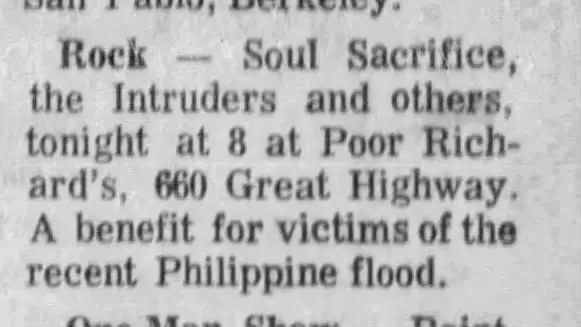
 

December 30, 1970 Poor Richard's, San Francisco, CA: Soul Sacrifice/Intruders/others (Wednesday) Benefit For Philippine Flood
One theme of this era was that since there were few concerts booked at 660 Great Highway, it was regularly available for benefit concerts. There had been substantial floods in the Phillipines in early September. There was a huge Filipino and Filipino-American community in San Francisco, with their own popular dance circuit for young Filipino adults and older teens. I don't know anything about Soul Sacrifice or The Intruders, but they were likely part of that scene.

January 9, 1971 Poor Richard's, San Francisco, CA: Country Weather/Fellin'/Liquid Heart/Wells/Wizard (Saturday) Natural Arts Festival
On Saturday, January 9, Poor Richard's hosted the "Natural Arts Festival," whatever that was. The listing in the SF Examiner says "Yoga demonstrations and visuals," so probably the Festival focused on homeopathic remedies and various kinds of holistic approaches to health.

The headline band was Country Weather, from Contra Costa County. Country Weather featured guitarist Greg Douglass, later in the Steve Miller Band (he would co-write the hit "Jungle Love"). Country Weather had been together since 1968, and had opened at the Fillmore West many times. They were widely regarded by locals at the time as an excellent band, but never released an album in the 20th century. 

Fellin', Liquid Heart, Wells and Wizard are unknown to me. 

On Tuesday, January 19, a traveling Native American ensemble called the White Roots Of Peace was scheduled to appear at Poor Richard's. It's not clear if they actually performed (whoever they may have been).  During the week of January 20, Poor Richard's was used as a sort of "Bird Hospital." Standard Oil had caused a giant oil spill just off of San Francisco, and numerous sea birds were covered with oil. Thanks to volunteers, the birds were rescued and cared for. Poor Richard's was the base of operations. 

January 29-30, 1971 Poor Richard's, San Francisco, CA: Helix/Barley At The Hops/others (Friday-Saturday)
Helix and Barley At The Hops are unknown to me. I suspect these shows were superseded by the bird rescue. [updated via JGMF 20241116]


SF Examiner March 4, 1971

On March 4, 1971 the Examiner article headlined "New Life For The Family Dog" described the plans of the new promoters at 660 Great Highway. For one thing, they would re-name the venue Friends And Relations Hall, a name that would generally stick for the remaining 18 months of the venue.

The latter day Family Dog headquarters and ballroom at 660 Great Highway will reopen on March 12 with a new paint job, new owners and a new name.
"Friends and Relations Hall" is the new name for the big oceanfront building that was once the "Edgewater" featuring big dance bands, and in recent months has tried to operate as "Poor Richard's."

 The new proprietors, who have a year's lease, include Jim Gravanes, Vince Nunno, Steve Bowen and attorney-musician Jerry Weiner.

"We have cleaned up the place a good deal" commented Gravanes yesterday, "and we have already let out various concessions, some of which will operate during the weekdays as well as in our weekend evening musical events."

First show for Friends And Relations Hall will feature Big Brother and The Holding Company, Clover and Foxglove. One of the Bay Area's veteran light show artists, Bob Holt, will be in charge of visuals.

Plans for F&R Hall include a greatly expanded restaurant facility, a new bandstand and dressing room arrangement, giant cushions for more comfortable floor seating, and a number of special activities which will run during the week.
Headlining the second weekend, March 19-20, will be Berkeley's Joy Of Cooking group.
All weekend shows will begin at 9 o'clock on Friday and Saturday nights, with a $2.50 door charge. 

The team's plan seems to have been pretty sensible. The ongoing restaurant could provide daily revenue, and the low ticket price meant that the venue was not competing directly with high profile shows at Winterland or elsewhere, but trying to be a sort of neighborhood rock venue. This wasn't a bad idea, actually, but the problem was that the 1971 Ocean Beach rock audience wasn't even of drinking age yet, and without a bar, the venue wouldn't get enough traction. In March, however, that was still yet to come.


March 7, 1971 SF  Examiner

March 12-13, 1971 Friends And Relations Hall, San Francisco, CA: Big Brother and The Holding/Clover/Foxglove (Friday-Saturday)
Big Brother and The Holding Company was a legendary San Francisco rock band, of course, but without Janis Joplin they were kind of just another band. After breaking up at the end of 1968, Big Brother had reformed in late 1969. The original quartet (Peter Albin, James Gurley, Sam Andrews and David Getz) were joined by guitarist David Schallock. Also onboard, at least in the Bay Area, was producer Nick Gravenites, who sang some songs with them. Gravenites had produced their 1970 album Be A Brother, a highly underrated record that had hardly been noticed. With Big Brother and a light show, Friends And Relations Hall was definitely marking itself as a hippie joint in the tradition of the Fillmore.

Clover's Forty-Niner album, their second album on Fantasy, released in 1970

Clover
was a Marin band. The quartet had released two albums on Fantasy. They were led by guitarist John McFee and singer Alex Call. Shortly afterwards, Clover would be joined by singer Hugh Cregg and keyboard player Sean Hopper. Clover made it to about 1977, when they finally broke up. McFee went to the Doobie Brothers, Call wrote some hits and Cregg and Hopper founded Huey Lewis and The News.

Although the Examiner article mentioned a planned booking for Berkeley's Joy Of Cooking on March 19 and 20, there was no listing for such a concert, and I don't think it happened. Country Weather, Foxglove and "Harland (magician and fire-eater)" were booked to open. 

April 2-3, 1971 Friends And Relations Hall, San Francisco, CA: Aum/Loading Zone/Flamin' Groovies (Friday-Saturday)
Loading Zone had been the first band to start playing psychedelic soul in San Francisco ballrooms, danceable music with feedback-drenched guitar solos. Their popularity kicked open the door that was walked through by Sly and Tower Of Power. Loading Zone soldiered on until 1972. [updated via JGMF 2024116]

April 9-10, 1971 Friends And Relations Hall, San Francisco, CA: Big Brother and The Holding Company/Commander Cody and His Lost Planet Airmen/Mike Finnegan (Friday-Saturday)
Big Brother returned to Friends And Relations Hall a month later. Commander Cody and His Lost Planet Airmen had relocated to Berkeley from Ann Arbor, MI in the Summer of 1969. In the mean time, they had become a popular local band, as their swinging hippie honky tonk was right on time for the upcoming rise of country rock. Cody and his Airmen were still several months away from their epic debut album Lost In The Ozone on ABC-Paramount Records.

Mike Finnegan was an organist from Topeka, KS, and a great singer. He had moved to Marin to join the the Jerry Hahn Brotherhood. Guitarist Hahn (also from Kansas) had played jazz with John Handy and Gary Burton in the 60s, but the Brotherhood was a jazz-rock outfit. After an interesting 1970 album on Columbia that didn't go anywhere, they had broken up. At this time, Finnegan led a Sunday night jam session at the Lion's Share in San Anselmo, and played around local clubs. At times, he also played with Big Brother, and he likely sat in with them this weekend.


April 11, 1971 Friends And Relations Hall, San Francisco, CA: "Turn On With Tullah" (Sunday)
Tullah Hanley was a 48-year old former belly dancer. Now a widow, she had married rich and had apparently given a $3 million gift of art to San Francisco's De Young Museum. This Sunday night event appears to have been some sort of celebration organized by Tullah herself. Your guess is as good as mine.

April 18, 1971 Friends And Relations Hall, San Francisco, CA Fox/Cosmic Popcorn/Liquid Heart/Malo/ Jim Eave’s Acoustic Quintet/Pennsylvania Pokers (Sunday) noon-8pm
For all the fanfare of the new owners, I don't know why the only events were not on weekends. If there had been notable bands playing on the weekends, they would most likely have been listed in the local papers. Of the several bands playing, most had already played 660 Great Highway. In the case of Malo, they were a new group, but they were formed from a group called the Malibus with the addition of guitarists Abel Zarate (who had been in Naked Lunch) and Jorge Santana (Carlos' younger brother, who had been in the Sounds Unlimited Blues Band).

Fox (not Foxglove), Jim Eave's Acoustic Quintet and the Pennsylvania Pokers are unknown to me. 

April 19, 1971 Friends And Relations Hall, San Francisco, CA: Big Brother and the Holding Company/Dan Hicks and His Hot Licks/Gold (Monday) Benefit for Reality House West
Big Brother returned yet again, this time at a Benefit for the Reality House West drug rehab program (Reality House West had been open since 1968, and was located at 1360 Fillmore Street).

Gold was a Berkeley group associated with Country Joe McDonald, since manager Ron Cabral was an old Navy pal of Joe's. 


April 24, 1971 Friends And Relations Hall, San Francisco, CA: Barry Melton And the Fish/Shades of Joy/Cat Mother And The All Night Newsboys
(Saturday) Celebration of the People’s Peace Treaty
I do not know if this "celebration" was a Benefit, or just an occasion.

Country Joe and The Fish had disintegrated in mid-1970. When Barry Melton was billed as "Barry Melton and The Fish" it was an indication that he would be playing with an electric band. His current album was Bright Sun Is Shining, a mostly bluesy album that had been released in 1970 on Vanguard. 

Shades Of Joy had been around since 1969. Today they would be called a "Jam Band," but no such term existed for bands that improvised a lot without playing straight jazz. The key members were guitarist Jackie King, saxophonist Martin Fierro and organist Jymm Young. They had released an album on Fontana Records in 1969.


Cat Mother and The All-Night Newsboys
had formed in 1967. By 1969, they had been signed by Michael Jeffery, the manager of Jimi Hendrix. Hendrix had even produced the band's debut album on Polydor, The Street Giveth and The Street Taketh Away. Thanks to the Jeffery connection, Cat Mother got to open for Hendrix and a number of other high profile events. Cat Mother even had a minor hit in late '69, with medley of oldies called "Old Time Rock And Roll." In fact, the band's sound was more country-folk oriented, but they were versatile musicians. By 1970, however, Cat Mother was anxious to separate themselves from Jeffery's questionable management practices. Their second album, Albion Doo-Wah, would be recorded at Pacific High Recorders in San Francisco.

After they finished their second album, Cat Mother relocated to San Francisco. San Francisco had a unique status for rock bands in the late 1960s and '70s. While the record industry was centered, as it always had been, in Manhattan and Hollywood, San Francisco was an enticing opportunity for rock groups. For one thing, the concert industry was thriving, so a good band could make a living whether they had an album or not. Plus, there were studios and plenty of A&R guys, so SF wasn't the wilderness. And, it was California--no snow, pretty girls, open minds--so it wasn't hard to persuade fellow band members to make the move. A large number of bands from elsewhere moved to San Francisco.
 
The three founding members of the band, Roy Michaels (bass, vocals), Bob Smith (keyboards, vocals) and Michael Equine (drums), would all relocate permanently to California. Michaels, Smith and Equine would move to Mendocino County and continue on as Cat Mother until 1977.
 
April 25, 1971 Friends And Relations Hall, San Francisco, CA: Shades Of Joy/South Bay Experimental Flash/Foxglove/Cosmic Popcorn/Tovarish (Sunday)
South Bay Experimental Flash were a jazz-rock band originally from San Jose, featuring David Ladd Andersen on flute and saxophone. Tovarish is unknown to me.  [update via JGMF 20241116]
 
May 1, 1971 Friends And Relations Hall, San Francisco, CA: Foxglove/Fox/Railway (Saturday)
May 2, 1971 Friends and Relations Hall, San Francisco, CA: six rock bands
(Sunday)
May 3, 1971 Friends and Relations Hall, San Francisco, CA: Blue Monday
(Monday)
Railway is unknown to me. Whatever the plans of the new proprietors of Friends And Relations Hall, whether these bands were good or not, they weren't going to draw crowds. [update via JGMF 20214116]


May 4, 1971 Friends And Relations Hall, San Francisco, CA: Cat Mother And The All Night Newsboys/Cookin' Mama/Fox/Elixir (Tuesday)
Cat Mother returned to headline, but on a Tuesday night. Elixir is unknown to me.


Cookin' Mama
was a high powered Marin band featuring guitarist Pat Thrall and singer Sherry Fox. Thrall would later become better known in groups like Automatic Man and the Pat Travers Band. Fox, oddly, is best known for earlier vocal harmony group RJ Fox. Cookin' Mama's 1972 album was recorded in Marin (at The Church in San Anselmo) and more-or-less self-released on Rock Bottom Records.

May 10, 1971 Friends And Relations Hall, San Francisco, CA: Mark-Almond/Stoneground/Chico David Blues Band/Terry Dolan/Earthrise (Monday)
Mark-Almond was a terrific jazz-rock band led by two members of John Mayall's 1969 Turning Point ensemble. Jon Mark played acoustic guitar and sang, and Johnny Almond played tenor sax and flute. They recorded for Blue Thumb and had a unique sound.

Terry Dolan was a local singer/songwriter. He would go on to work with John Cipollina and others in the group Terry And The Pirates. Chico David Blues Band and Earthrise are unknown to me [updated via DKS 2024117]

May 17, 1971 Friends And Relations Hall, San Francisco, CA: Flamin' Groovies/Sopwith Camel/Foxglove (Monday)
It's not clear to me why there was a Monday night show, and yet no weekend events. Maybe the Groovies had a better gig on the weekend. Sopwith Camel had been an original Fillmore band from 1966, and the first to score a hit, with "Hello Hello" on Kama Sutra in 1967. They soon broke up. By 1971, they had reformed, with most of the original members, and would even release an album.

May 22, 1971 Friends And Relations Hall, San Francisco, CA: Flamin' Groovies/Sopwith Camel/Flying Circus (Saturday)
For a Saturday night show, Mill Valley's Flying Circus joined the Flamin' Groovies and Sopwith Camel. Flying Circus was led by guitarist Bob McFee, brother of Clover's John McFee. Clover and Flying Circus shared a rehearsal hall. 

May 28-29, 1971 Friends And Relations Hall, San Francisco, CA: Youngbloods/Jeffrey Cain/Grootna Commander Cody and His Lost Planet Airmen (Friday-Saturday) A Benefit for The Committe for the Traditional Indian and the Soledad Prisoners Defense Fund
The Youngbloods were the most prominent band to ever play Friends And Relations Hall. The Youngbloods had unexpectedly hit it big in 1969 with re-release of their 1967 version of "Get Together." The Youngbloods shrewdly parlayed the hit into a new contract that included their own Imprint (custom label) on Warners. Raccoon Records not only released Youngbloods albums, but solo albums and records by their musical friends. The Youngbloods current album was probably Good And Dusty (I'm not certain when in 1971 it was released). The band was now a quartet, with Jesse Colin Young on guitar and vocals, Joe Bauer on drums, Michael Kane on bass and Lowell "Banana" Levenger on piano, steel guitar and various other instruments.

Jeffrey Cain was a solo artist on Raccoon. Grootna was a Berkeley band with an album on Columbia, fronted by guitarist Vic Smith and singer Anna Rizzo, both previously in the band Sky Blue. The Columbia album was produced by Airplane singer Marty Balin, who would later team with Smith to form Bodacious.

May 30, 1971 Friends And Relations Hall, San Francisco, CA: Music Of Devotion with Yogi Bhajwan and The Sufi Choir (Sunday)
The Sufi Choir was a dance and music troupe inspired by Islamic mysticism, and based in Marin. 

May 31, 1971 Friends And Relations Hall, San Francisco, CA: Victoria (Monday)
Victoria (Domagalski) was a singer-songwriter who had put out two solo albums on Bill Graham's San Francisco Records label (distributed by Atlantic). [update via JGMF 20241116]


June 3, 1971 Friends And Relations Hall, San Francisco, CA: Country Joe McDonald/New Riders of The Purple Sage/Grootna/Stoneground (Thursday) Benefit for The Bear Tribe Commune
It was not a good sign that most of the bookings at Friends And Relations Hall were billed as "Benefit" concerts, and held on weeknights. Now, from the Hall's point of view, they were likely paid the same amount for hall rental for a benefit than for a regular show, but benefits weren't premier events. 

Country Joe McDonald had split with Barry Melton in Summer 1970, and had since toured as a solo act. He was still a fairly big name in the Bay Area, however. His most recent album was Hold On, It's Coming, released by Vanguard in April, 1971.

The New Riders Of The Purple Sage had played the Family Dog on The Great Highway, as had the Grateful Dead, so Jerry Garcia surely liked the room. At this time, the Riders were producing their Columbia debut (NRPS), with Garcia still a member of the band on pedal steel guitar. The New Riders, of course, had to fit their touring schedule around the Grateful Dead, and plans were afoot to replace Garcia with Buddy Cage (which had been Jerry's recommendation). 

Stoneground had been put together by KSAN impresario Tom Donahue for a movie called Medicine Ball Caravan. The band had been signed to Warners and had released their debut earlier in 1971. The group had five lead singers, including Sal Valentino (ex-Beau Brummels) and guitarist Tim Barnes. 

June 5, 1971 Friends And Relations Hall, San Francisco, CA: Victoria/Chris Williamson/Kendall Kardt/Roland Brothers (Saturday)
Popular rock music was changing, and the new breed of singer-songwriters, often just accompanying themselves on a guitar or piano, did not benefit from being third on the bill to some noisy rock band at a giant arena. The newly opened Boarding House focused on these kinds of performers, and some astute managers organized bookings that featured a number of these artists playing together.

Victoria (Victoria Domagalski) was a singer-songwriter, part of Bill Graham's managment stable. Her debut album, Secret Of The Bloom, had been released on Graham's San Francisco Records label (distributed by Atlantic) in late 1970

Chris Williamson (b. 1947, today known as Cris Williamson) was from Deadwood, SD, of all places.  She had released three obscure solo albums on Avanti Records in 1964-65. By 1971, she had resurfaced in the Bay Area. Williamson had released an album on Ampex in 1971. It had been recorded in New York (with Eddie Kramer, at Electric Lady Studios) and in San Francisco (at Wally Heider's, with Jim Gaines). An army of session men, some well-known, were on the record. It went nowhere. Still, Williamson had just headlined a week of shows (in May) at San Francisco's Boarding House, a newly-opened "acoustic music salon," so it seems she was starting to develop a following.

In future years, Williamson would assert that there should be a record label run by women, for women, and that would lead to Olivia Records. Olivia released Williamson's 1975 album The Changer And The Changed. Besides being a fine album, Olivia was in the forerfront of DIY releases, fitting in nicely with Beserkely Records and numerous punk labels. The message was, if you want albums of a certain type, release 'em yourself.

Kendall Kardt (b. 1943) was an example of a different type of arc, an electric performer gone solo. Kardt had been in the group Rig, who had been booked by the Bill Graham organization. Rig had played the Fillmore East, and opened for a variety of National acts.  Rig released an album on Capitol in 1970. The band broke up, however, and Kardt moved to the Bay Area to be nearer to the Graham team. Kardt recorded a solo album for Capitol, with help from the likes of Jerry Garcia, Ronnie Montrose, Pamela Polland and Spencer Dryden, but the album was shelved. He would record an album for Columbia in 1972, but it too was shelved. Kardt, too, had headlined a week in May at the Boarding House.

Ultimately, Kardt would move to Chicago. He continued his career as a songwriter, and his songs were recorded by Montrose, Jim Post and others

June 12, 1971 Friends And Relations Hall, San Francisco, CA: Stoneground/Sopwith Camel/Congress Of Wonders/Beefy Red/others (Saturday)
Congress Of Wonders were a hip comedy duo from Berkeley that had released an album on Fantasy Records. Beefy Red was a 10-piece jazz-rock band from Marin County. It had some good players, like guitarist Barry Finnerty, trumpeter Mark Isham and drummer Jim Preston.  [update via JGMF 202411116]

June 21, 1971 Friends And Relations Hall, San Francisco, CA: "The City That Waits To Die" (Monday)
I have no idea what this event might have been. [update via JGMF 202411116]

June 24, 1971 Friends And Relations Hall, San Francisco, CA: Feelin'/Driver/Soquel/Peter Cosmos (Thursday)
All of these bands are obscure to me.  [update via JGMF 20241116]

June 25-26, 1971 Friends And Relations Hall, San Francisco, CA: Commander Cody and His Lost Planet Airmen/Charlie Musselwhite/Sonoma Mountain Band (Friday-Saturday)
Cody and the Airmen returned to Friends And Relations as headliners.

Charlie Musselwhite was a blues harmonica player from Memphis, by way of Chicago. He had moved out to the Bay Area in 1967 and had been a regular performer at nightclubs and ballrooms since then. Musselwhite had recorded a number of albums, but blues wasn't as appealing to record companies as it had been in the 60s. Locally based Arhoolie Records would release Takin' My Time some time in 1971, and Musselwhite's band featured the young Ukiah guitarist Robben Ford. Ford was the anchor of Musselwhite's band for some time, and may have still been in the group at this point. 

The Sonoma Mountain Band is unknown to me.

June 27, 1971 Friends And Relations Hall, San Francisco, CA: "Yogi For Joy" Sufi Bajwan/Allen Ginsberg/Rabbi Shlomo Carlebach (Sunday)
Allen Ginsberg was the legendary beat poet, and Rabbi Shlomo Carlebach was a folk-singing rabbi. In general, this would have been seen as a sort of "personal enlightenment" evening.  

June 28, 1971 Friends And Relations Hall, San Francisco, CA: Hot Tuna/Stoneground/Ace Of Cups (Monday) Benefit For Native American Church
Once again, popular local acts were using Friends And Relations Hall for a weeknight benefit. This was a sign that musicians liked the room, but it wasn't attractive for a weekend headline gig. I have no idea who or what the Native American Church might have been.

Jorma Kaukonen and Jack Casady had been playing separately from Jefferson Airplane since 1968, but had only started using the name "Hot Tuna" in early 1970. Their second RCA album, First Pull Up Then Pull Down, had just been released in June '71. Tuna had their first East Coast tour coming up--the first of many--and playing this benefit was probably a good tune-up. In their electric configuration, Jack and Jorma were joined by Papa John Creach on electric violin and Sammy Piazza on drums. At a Bay Area show, they might have been joined by a guest or two as well [note: some Hot Tuna lists show a May 1 '71 Friends And Relations date, but I think it is spurious].

Ace Of Cups were already somewhat notable, if not exactly infamous, for being the only "all-girl" band on the Fillmore scene. They wrote their own material, and there was some record company interest. They were managed by Quicksilver manager Ron Polte, but he was never able to find a deal that worked (ultimately, an album of live material and demos was released in 2003). By 1971, Ace Of Cups was only performing intermittently, and they sometimes even had men in the band, usually a husband.

Whatever the grand plans of the quartet who took over the Friends And Relations lease in March of 1971, the venue hadn't really worked out as a concert venue. Most of the shows in the preceding months had been on off-nights, or featured bands that were third-on-the-bill at Fillmore West. I do not know if the same investors continued to support Friends And Relations, but from this point onward the venue mostly put on theatrical productions, with the occasional concert. I don't actually think Friends And Relations was any more successful as a Theater. The distant location of Playland wasn't solved by putting on musicals. 


July 7-25, 1971 Friends And Relations Hall, San Francisco, CA: "Emergence" (Tuesday-Sundays)
"The Emergence" was a "psychedelic tapestry" performed by the Los Angeles Repertory Troupe Company Theatre, presented by Mel Goldblatt. I am refraining from doing any research on the musicals, as it is outside of the scope of even my rather sprawling blogs. 


There does seem to have been a poster, I don't know how widely it circulated.  

July 26, 1971 Friends And Relations Hall, San Francisco, CA: Cat Mother/Mike Finnegan/Running Easy/Fire And Ice (Monday)
Running Easy and Fire And Ice are unknown to me. [update via JGMF 20241116]


SF Examiner August 3, 1971

August 1-September 1, 1971 Friends And Relations Hall, San Francisco, CA: "Tommy" The Musical (Tuesdays-Saturdays)
After "Emergence," Friends And Relations booked a version of The Who's "Tommy" rock opera. I believe this had been San Francisco college production (at Lone Mountain College), that was successful enough to move.  This event may have started as early as July 29, and was called "The Electric Simulsence Theater."


September 3-5, 1971 Friends And Relations Hall, San Francisco, CA: Sun Ra and his Planet Earth Solar Infinity Arkestra/South Africa's Ndiko Xaba and the Natives/Ghana's Kwazi Badu and Revue
(Friday-Sunday)
David Kramer-Smyth found this listing in the Examiner. Anything with Sun Ra was unforgettable. [updated via DKS 2024117]

September 10-12, 1971 Friends And Relations Hall, San Francisco, CA: Youngbloods/Jeffrey Cain/High Country (Friday-Sunday)
The Youngbloods returned to headline a weekend at Friends And Relations. The "Tommy" production seems to have been on hiatus. It's worth noting that Fillmore West was closed by this time, so there wasn't a mid-size venue for bands like The Youngbloods. Label mate Jeffrey Cain was listed in the Examiner as having a "new three-man group," so he would have had more of a rock sound.

High Country, who also had an album on Raccoon, were led by Berkeley mandolinist Butch Waller. Waller went way back to the early 60s in the Berkeley bluegrass scene, and was old pals with the likes of David Nelson and Jerry Garcia.


September 17-18, 1971 Friends And Relations Hall, San Francisco CA: Stoneground/New Riders of The Purple Sage (Friday-Saturday)
The New Riders of The Purple Sage and Stoneground co-hosted on this weekend. It would be interesting to know who financed this concert, and who came on last. The New Riders debut album (NRPS) would have just been released on Columbia. Pianist Cory Lerios had probably just joined Stoneground, replacing Englishman Pete Sears.

There is a poster for this show, albeit not a particularly exceptional one, perhaps the only stand-alone poster for a Friends And Relations concert. Events involving the Grateful Dead often had their own posters, even though Jerry Garcia's name appears nowhere on it (no doubt at Jerry's insistence). The poster has no information about who is promoting the concert, which itself is peculiar.


The cover of Jefferson Airplane's 1971 lp Bark, on their own Grunt Record label (the imprint was distributed by RCA)

September 25, 1971 Friends And Relations Hall, San Francisco, CA: Jefferson Airplane/Black Kangaroo/One/Ace Of Cups/Jack Bonus/Grootna (Saturday) Grunt Records Party
Jefferson Airplane had been the first really big rock band to come out of the San Francisco scene. Since their initial breakout, other local bands like Sly And The Family Stone, Creedence Clearwater Revival and Santana had come along, selling more records and having a wider cultural reach. Nonetheless, the Airplane had special status by virtue of being first. In 1971, RCA Records had renewed the Airplane's record deal by giving the band its own label. In record company lingo, Grunt Records was an "Imprint," financed, manufactured and distributed by RCA, but with creative decisions made by the Airplane members. Of course, the band immediately signed all their friends, some of who were talented and some not so much.

On September 7, 1971, Grunt Records had its first release. Bark was the new Jefferson Airplane album. It wasn't that good an album, in fact, but the Airplane were local heroes. A few weeks later, the Airplane decided to have a party to celebrate, and invited 1000 friends or so to Friends And Relations Hall.  The Examiner's Phil Elwood reported on the huge party that the Airplane had to celebrate their new album and their new label. Jefferson Airplane headlined the show, but came on very late and were not in terrific performing shape (ahem).  

Opening the show were a few bands who would release albums on Grunt. Black Kangaroo featured guitarist Peter Kaukonen, Jorma's brother. Grootna was associated with Marty Balin, who had left the band but was still part of the record company. Ace Of Cups were a long-standing San Francisco band, friends with the Airplane, who unfortunately never got to record anything for Grunt. "One" featured a Bolinas neighbor of Paul Kantner's, who used the stage name of Reality D. Blipcrotch. I have no reports on his (or their) performance. "One" did release an album on Grunt.

September 28-November 7, 1971 Friends And Relations Hall, San Francisco, CA: "Tommy" The Musical (Tuesday-Saturdays)
"Tommy" returned, suggesting that it was the only theatrical production that succeeded at Friends And Relations.


October 24, 1971 Friends And Relations Hall, San Francisco, CA: Earl Scruggs Family Revue/Doctor Music/Catharsis (Sunday)
Since Tommy wasn't playing on Sunday, bluegrass legend Earl Scruggs could slip in a tour date. [update via DKS 20241117]

November 26, 1971 Friends And Relations Hall, San Francisco, CA: Country Joe McDonald/Gold/Ice/Homespun (Friday)
This stray concert was probably produced by Country Joe's management. Joe was still a solo act, so this was probably a low-risk proposition. Gold was associated with Joe McDonald, too. Homespun is unknown to me.

December 11-12, 1971 Friends And Relations Hall, San Francisco, CA: KPFA Crafts Fair (Saturday-Sunday)
Some bands may have played at this daytime fair.  Clearly Friends And Relations was just a hall for rent at this point. 

December 23, 1971 Friends And Relations Hall, San Francisco, CA: Yogi Phlegm/Copperhead with John Cipollina/Selah with Walter Hawkins/Nick Gravenites/Terry Dolan/Merl Saunders (Thursday) A Christmas Celebration
Yogi Phlegm was the current name for the Sons of Champlin. It never caught on. John Cipollina had left Quicksilver and formed the new group Copperhead with Jim Murray, Jim McPherson and others. They would later sign with Columbia. Walter Hawkins was a local gospel singer. Nick Gravenites had produced most of the people on the bill. Terry Dolan would later work with Cipollina and the Copperhead crowd. Merl Saunders had been around the Bay Area scene for years, but had only recently hooked up with Gravenites, John Kahn and Jerry Garcia, and was playing more rock gigs. [updated via DKS 20241117]


December 31, 1971 Friends And Relations Hall, San Francisco, CA: Quicksilver Messenger Service/Big Brother and The Holding Company/Stoneground/Sopwith Camel (Friday) Quicksilver Presents
Quicksilver Messenger Service, legendary though they were, were no longer at the pinnacle of the San Francisco rock scene. Their second album, Happy Trails, released in March 1969 had received huge FM airplay when the band barely existed and wasn't performing. Quicksilver had returned in 1970, with the classic quartet augmented by Rolling Stones' pianist Nicky Hopkins and singer Dino Valenti. In August '70, they had released Just For Love, which included the popular track "Fresh Air." While Quicksilver could soar live, Valenti's vocals were an acquired taste, and many Quick fans never acquired it.


By the end of 1970, Hopkins and lead guitarist John Cipollina had left the band, leaving it in the hands of Valenti and guitarist Gary Duncan. Quicksilver had a new album in December 1970, What About Me, and the title track got some good FM airplay. But fans saw the band as a Valenti vehicle, and that didn't inspire confidence. Quicksilver began a long, slow decline, even though they would not give up touring until 1977. In November 1971, Quicksilver had released a pretty weak (self-titled) album, and were just a shadow of their former power.

Quicksilver manager Ron Polte was always very entrepreneurial, however, so it's no surprise that Quicksilver put on its own event. Old pals Big Brother were on the bill, but they too were no longer at their apex, with only Sam Andrews carrying the flag.

January 22, 1972 Friends And Relations Hall, San Francisco, CA: Doc Watson (Saturday) Presented by Mel Goldblatt
Guitarist Doc Watson's prominence dated back to the "Folk Revival" days of the early 60s, so his audience was a little older than that of most rock bands. Of course, that basically meant his fans were in their late 20s, rather than a decade younger. Producer Mel Goldblatt--who had used Friends And Relations for the Emergence show (see July 7-25 above)--promoted Doc in San Francisco and Palo Alto. Doc probably drew pretty good crowds at both places. 

The February 6, 1972 Sunday column by the Chronicle's John L Wasserman revealed that the Friends And Relation Hall was now "defunct." It would be replaced by The Friends And Relation Theater. The  significant detail he revealed was that the "venue" was a 900-seat theater. This was implicitly different from the open floor dance hall that it had been.


SF Examiner March 28, 1972


March 22-June 30, 1972 Friends And Relations Theater, San Francisco, CA: "Robin" A Musical
(Wednesdays, Fridays-Sundays)
Robin was a "Pop Opera," and a "Multi-Media Musical," produced by one Bob Walter.  It had run at Stanford for five weeks the previous year, and had originated as a student production. Per the Examiner, they had plans to take it to New York.

Via JerryGarciasBrokendownPalaces, a 1972 Tom Gray photo of Friends And Relations Theater from March 1972

From this point on, 660 Great Highway was usually referred to as Friends And Relations Theater. 

May 27, 1972 Friends And Relations Theater, San Francisco, CA: Alan Watts/Malachi  (Saturday)
Given that there was a Saturday event at Friends And Relations, I have to assume "Robin" wasn't a big hit.

Malachi (born John Morgan Newbern, in Baltimore), was a Buddhist guitarist. He had put out the album Holy Music on Verve in 1966. Malachi (1944-2020) lived in Santa Rosa, and had a full life as a musician and luthier.

English-born Alan Watts (1915-73) was a well-known popularizer of Zen teachings, and was well-known from KPFA radio in Berkeley and numerous books. Watts and Malachi had also appeared together at the Family Dog on The Great Highway, on October 18, 1969.

July 26, 1972 Friends And Relations Theater, San Francisco, CA: Osceola (Tuesday) [updated via JGMF 2024116]

July 14-August 5, 1972 Friends And Relations Theater, San Francisco, CA: "Even Adam" (Tuesday-Sunday)
"Even Adam" was a new play by Roger Swearingen, based on the Garden Of Eden myth. 

August 25-27, 1972 Friends And Relations Theater, San Francisco, CA: Wolfgang and Strauss and an electric orchestra (Friday-Sunday)
Your guess is as good as mine. [updated via JGMF 20241116]

SF Examiner Aug 28 1972


September 1-2, 1972 Friends And Relations Ballroom, San Francisco, CA: Stoneground/Sylvester and His Hot Band/Cat Mother (Friday-Saturday) "Farewell To Friends And Relations"
Playland-At-The-Beach closed on Monday, September 4, 1972. It was mourned by some generations of San Franciscans, but everyone admitted that it's time was long past. As part of the farewell, there was some final concerts at Friends And Relations, called a "Ballroom" at the very end.

Sylvester was a rising soul singer, singular because he wore women's clothing on stage. He mostly played gay bars, but he was an excellent mainstream soul singer. He would later go on to some success in the later 70s.

September 9-10, 1972 Friends And Relations Hall, San Francisco, CA: Blue Bear School Of Music Orchestra and Chorus (Saturday-Sunday)
Although Playland had closed after Labor Day, there was one final event at Friends And Relations (this was possible since the entrance was different). The Blue Bear School Of Music would become famous in later years for teaching people to play rock music, long before "School Of Rock" became commonplace. One of the principal instructors in Blue Bears later rock classes was singer Bonnie Hayes. Her younger brother Chris was also a guitar instructor in the later 70s. Chris Hayes would go on to become a genuine rock star himself, as a founding and permanent member of Huey Lewis And The News.

SF Examiner September 10, 1972
By the end of September 1972, all of Playland-At-The_Beach was torn down. The former Edgewater Ballroom, later the Family Dog on The Great Highway, and later Friends And Relations Hall, was torn down with it. Now, it seems like a great idea to have a jam-band palace by the ocean, sponsored by marijuana entrepreneurs. Aging hippies and tech bros would have forked over $100 without thinking to see whoever was still around. But the Edgewater was gone, replaced by apartments, and the dream of electric music at the Edge Of The Western World was just a distant memory.


Thursday, March 9, 2023

960 Bush Street (Downstairs), San Francisco, CA: The Boarding House Performance List: August-December 1971 (Boarding House II)

An ad for the Boarding House, from San Francisco Good Times, December 10 1971

The Boarding House, 960 Bush Street, San Francisco, CA
The Boarding House, at 960 Bush Street, remains one of the most fondly remembered San Francisco rock clubs of the 1970s. The intimate, bowl-shaped room, seating barely 300, was the site of many great shows. In the mid-70s, when record company support was at its peak, the Boarding House was the prime location for booking acts on the rise. The club only barely broke even, but record company economics were more about finding a club that appealed to writers and tastemakers, in order create some buzz.

Jerry Garcia, Neil Young and others played memorable shows at The Boarding House. The Tubes played two weeks there in the Summer of 1975, ensuring that their soon-to-be-released debut album got maximum attention. Comedians like Steve Martin would play the club just as they were approaching stardom. Every month would feature acts with new albums, rising stars with some real (if sometimes manufactured) buzz and constant attention from reviewers in the San Francisco daily papers.

Yet the Boarding House did not at all start out this way. Initially, the building at 960 Bush Street had been purchased and renovated by Doug Weston, the operator of West Hollywood's premier club, The Troubadour. The SF outpost of the Troubadour was only open for 4 thinly attended months, starting in August 1970. The West Hollywood formula did not work in provincial San Francisco. The manager of the Troubadour, David Allen, who had managed the Hungry i, then took over the space. The Boarding House opened in March, 1971, nearly six months after the last Troubadour show on October 30, 1970. Allen leased the space from Weston, who apparently still owned the building.

The Boarding House, at 960 Bush Street in San Francisco, some time in the mid-1970s

The Boarding House, Year 1
960 Bush Street was in Lower Nob Hill, in-between Union Square and Chinatown. It was about six to eight blocks from downtown, depending on the direction you went. San Francisco is hilly and cold, so there wasn't going to be a lot of walking traffic. Although the neighborhood was pleasant, there weren't convenient parking garages nearby. All of these problems had plagued the Troubadour, and the Boarding House didn't really solve any of them.

Bay Area rock fans of a certain age may recall the Boarding House, or may have seen photos. In fact, those recollections do not apply. Although the Boarding House was always at 960 Bush Street, initially the club was in the basement, rather than the theatrical bowl of later years. Doug Weston had purchased and renovated the building, and he had opened the Troubadour in the ground floor. The second floor, formerly a theater and restaurant, and formerly a recording studio, had remained unfinished. Later in 1971, the second floor of the Boarding House started advertising theatrical events as the Boarding House Theater. In early 1972, a few rock shows were put on at the Theater, and ultimately the entire operation moved upstairs. The address was always 960 Bush Street, but patrons would eventually go up the stairs rather than down. The initial Boarding House configuration was apparently a flat room with extended "family-style" tables. In later years, the downstairs would be used for some lower-profile comedy shows, and sometimes as dining room. 

The business model of the Boarding House was that patrons would buy dinner, and perhaps some beer, wine or coffee, and afterwards see a show. Patrons could of course skip dinner and just see the show, but the best seats would have been reserved for the diners. One entree was served each night. Initially, the Boarding House just booked acoustic acts. There wasn't a prohibition against electric music, but the economics of the club was for smaller ensembles, mostly local, and drummers were rare.

There were plenty of coffee house and nightclub gigs for acoustic performers in the Bay Area, but they were hardly premier bookings. Either they were tiny coffee shops, or perhaps the Sunday night at a rock nightclub in the hinterlands. The calendars would usually just say "Sunday--Folk Music," which just meant "one or two performers singing and playing acoustic." A few clubs played actual folk music, mainly the Freight And Salvage in Berkeley, but that was a specialized endeavour. Rock had gotten louder and louder in the 1960s, but had reversed itself somewhat in the 1970s. Popular artists like James Taylor and Cat Stevens were selling records now, and Elton John, another big star, was introspective amidst all his rocking. 

David Allen, proprietor of The Boarding House, probably around 1980 (photo: Mike Maloney, SF Chronicle)

The Boarding House had opened on Friday, March 26, 1971. An article in the March 24 San Francisco Examiner described it as "an acoustic music salon." The club served dinner, with one seating each night, at a cost of $3.25. The Boarding House was run by David Allen, who had been Doug Weston's house manager when the venue had been the Northern outpost of The Troubadour. Prior to that, Allen had been the house manager for the legendary 60s nightclub The Hungry i. So Allen was well-connected to the local press and the ways of San Francisco. 

San Francisco wasn't Los Angeles, so the Boarding House didn't get big stars on the verge of success, like the Troubadour in West Hollywood. In 1971, though, the Boarding House was perhaps the premier local booking for acoustic acts and singer/songwriters, since it was in San Francisco and actually devoted to that kind of music. Of course, many fine acts played the Boarding House, but it hardly led to success. The performers we recognize now had to go somewhere else to make it, New York or Los Angeles usually, or wait for a few other turns of the wheel. In my previous post, I reviewed the initial months of the Boarding House,  giving a useful snapshot of the songwriters in the Bay Area in 1971. This post will review the performers at the Boarding House for the balance of 1971. In the second half of the year, there are more singer/songwriters touring behind new albums, a sign that the record companies liked having a place to showcase acoustic acts.


Diane Sward Rapaport's 1979 book How To Make & Sell Your Own Recording was a critical text for the independent musician. The book has sold over 150,000 copies. Rapaport (1939-2020) had been a band manager for Bill Graham from 1969-74.

Singer/Songwriters in San Francisco, ca 1971
The dilemma of Bay Area singer/songwriters was aptly summed up by manager Diane Sward (later Diane Rapaport). Sward was an aspiring band manager, and had talked her way into the Bill Graham organization's management wing. Sward managed the group Lamb and singer Pamela Polland, and also helped to book various acoustic acts as a sort of local package. Sward (1939-2020) had a remarkable blog, well worth reading for any fans of old San Francisco music days, and indeed well worth reading in general. In one post Sward described what faced local singers who weren't in a loud rock band:

Gigs in Bay Area coffeehouses were easy to get, but they didn’t make a lot of money for anyone, including the performers. They were able to get a few gigs in clubs at 8 or 8:30 p.m., prior to when many rock bands began setting up for a 9:30 show. I told club owners that my band would help warm up the audience, didn’t need a big stage setup (no drums, no big amps, no stage monitors) and would make them enough extra bucks selling drinks to pay us.

However rock fans and acoustic music fans didn’t always mix well. More often than not the audience would start getting impatient around 9:15. “We want Jerry (Garcia); we want Elvin (Bishop) and so on.”

I attended a lot of Lamb gigs and saw such other Bay Area acoustic performers as Lambert & Nuttycombe, Jeffrey Cain and Uncle Vinty. They were all bucking up against rock ‘n roll. The audiences for rock bands were larger; and that meant more money for the club owners.

Sward went on to find unique bookings for her acts, and helped them record as well. The Boarding House was intentionally designed as a different kind of club than clubs like Berkeley's New Orleans House, or Palo Alto's Poppycock, which were miniature Avalon Ballrooms with a light show and a dance floor. Or, to put it another way, miniature Avalons if the Avalon had sold beer. The Boarding House would remain distinct when clubs like Keystone Berkeley, the Long Branch and the Orphanage gained prominence in the next few years. The Boarding House had no fear of electric instruments, but the more theatrical club appealed to a more reflective audience.

Record Company Support
The sixties had been the era of self-contained rock groups, writing and singing their own music and playing their own instruments. The sixties had also brought forth the rise of FM rock radio, and the much broader playlists of those stations opened the door for a wider variety of music. As the 70s dawned, record companies were discovering there was a huge appetite for artists who wrote and sang their own songs, but weren't part of a group. The 1970s were the era of the singer/songwriter and record companies figured out quickly that there was a lot of money to be made. The heart of this was at West Hollywood's Troubadour club, hard by all the LA record companies. Bands who were a hit at the Troubadour could spring forth with record company backing that could make them into stars.

For rock bands, 60s touring had been more of a profit and loss proposition. Bands played where they had a following, so they could come home with more money than they started with. FM radio had started to change that. Record companies' new goals were to spark FM airplay, which could lead to substantial sales. The typical singer/songwriter wasn't going to go over well if they were third on the bill to a couple of noisy rock bands. It was in company interests to ensure that solo artists got heard at smaller places like The Boarding House, so that they would get good reviews and the most committed fans could go back to work or the dorm and say "you gotta hear so-and-so's new album."

What evolved was system where record companies provided "tour support." This meant that the record company laid out some money to get there artist on the road: buying airline tickets in advance, for example, or renting equipment. The performer then just had to break even on the road to pay for food and lodging. It made a smaller place like The Boarding House more financially viable, since artists weren't committed to huge paydays in order to tour (it's also possible the Boarding House provided traveling artists a place to stay, but I'm just guessing). Now, this wasn't charity--any cash laid out by the record company for tour support was recouped from future royalties. But if an album hit it big, that was small change. 

From looking at the bookings of the first four months of the Boarding House, it's plain that the record companies saw a lot of value in the venue. In April and May, the acts headlining were mostly local. By the beginning of the Summer, almost every headliner was an out-of-town band with an album. This meant the record company was likely buying ads on the local radio stations, or other promotional support, and helping both their own act and the venue itself.


The Boarding House Performance List: August-December 1971


Maggie and Terre Roche's 1975 Columbia debut album Seductive Reasoning, some years before younger sister Suzzy joined to make them a trio

August 3-8, 1971 Boarding House, San Francisco: CA Maggie and Terre Roche/Uncle Vinty (Tuesday-Sunday)
Modern fans know The Roches as a unique trio of singing sisters--Maggie, Terre and Suzzy--linked to Paul Simon and the Greenwich Village folk scene. The trio released their first album in 1979. It turns out, however, that there was a backstory. The two older sisters, Maggie and Terre, not only were a singing duo in 1971, but they played the Boarding House so much that I suspect they were based in California. The duo was first booked to open at the Boarding House from May 26 through June 6. They would return later in June (June 22-27), so it must have gone well. Now, in August the duo was returning as headliners, so they must have developed a following.

Maggie and Terre Roche
were from suburban Park Ridge, NJ. They had dropped out of high school to become a folksinging duo. Maggie wrote original songs, and they played guitars and harmonized together. By the late 70s, The Roches would include Maggie, Terre and their younger sister Suzzy. The Roches never became huge stars, but they were well-known in a New York way, and they certainly had a unique sound that only sisters could have. But the narrative of the Roche sisters seems to simply leave out any time spent in San Francisco as a duo.

I don't know for a fact if the two Roche sisters spent the summer in San Francisco, or they were just touring around and kept coming back to the Boarding House during this time. In either case, any references to this time seems to be forgotten from their stories. By 1972, the Roches had returned to New York City, where they sang on a Paul Simon album. They would manage to parlay bartending jobs into a chance to audition at the famous Gerde's Folk City club. By 1975, the pair had released their only album as a duo, Seductive Reasoning. Suzzy would join a few years later, and the first Roches trio album was released in 1979.

A live tape of Maggie and Terre floats around, a short set from a coffeehouse in Eau Claire, WI, on January 16, 1975. It's the best available hint for what the duo might have sounded like at the Boarding House back in 1971. If they were just 75% as good as the tape (which was 4 years later), no wonder the Boarding House liked them. The Roches had a successful career when they were based out of New York, but 1971 San Francisco had nothing for a pair of singing sisters with acoustic guitars.

Uncle Vinty (Vinton Medbury, 1947-94) was essentially a performance artist who played the piano. He sang and played the piano, told jokes and did magic tricks. He often performed in a Viking hat. Originally from Rhode Island, he had come out to San Francisco around 1971. He ultimately ended up in Milwaukee, although he continued to tour around. He died early, but is fondly remembered on the internet. Uncle Vinty didn't fit into any pre-existing box, however, and San Francisco music scene didn't really know what to make of him.

August 10-15, 1971 Boarding House, San Francisco , CA: Peter Tork/John Brandenburg with Chris Campbell (Tuesday-Sunday)
Without a doubt, the most famous performer to play the Boarding House in 1971 was former Monkee Peter Tork. Tork had left the Monkees in 1968, when they had disintegrated. Tork had originally been an aspiring  folk singer, and had returned to that, doing some recording in 1969 that had never been released. By 1970, he was in an only-in-LA circumstance, hugely famous, generally popular but not particularly respected as a singer or performer, since the Monkees were the epitome of "plastic." He had played the West Hollywood Troubadour, and played around some elsewhere. I don't think Tork embarrassed himself as a performer, but he wasn't memorable, either. By this time, the Monkees were old news and no one reviewed his shows.

John Brandenburg played guitar, but I don't know anything else about him, nor Chris Campbell.


August 17-22, 1971 Boarding House, San Francisco, CA: Taj Mahal/Mississippi Sam Chatman (Tuesday-Sunday)
Taj Mahal (b. Henry Saint Clair Fredericks in 1942) had been raised in a musical family in Springfield, MA. He played in various musical ensembles in high school and in college (at U.Mass). By 1964 he had moved to the West Coast, and he formed a pioneering R&B combo called The Rising Sons, with Ry Cooder on lead guitar (a cd of their recordings was finally released in 1992). By early 1968, Taj had already signed and recorded his debut album with Columbia, with both Cooder and Jesse Ed Davis on guitars, although it would not be released until later in the year.

Taj Mahal's equally excellent second album, The Natch'l Blues, still with Davis but without Ry Cooder, had been released later in '68. Later in 1969, Taj Mahal would release his memorable Columbia electric/acoustic double album Giant Step/De Ole Folks At Home. Taj Mahal's initial sound had been an electrified version of country blues, rhythmically a little different from the Chicago sound, but just as rocking. De Old Folks At Home explored a different, quieter approach to the blues.


Taj Mahal released two albums in 1971, The Real Thing and then Happy To Be Just Like I Am. While Taj Mahal was too inventive to be contain himself with a "solo blues performer" label, his newer work was more intimate. While in the 60s, Taj Mahal had been backed by a great trio featuring Jesse Ed Davis, in the 70s he tended to tour as a solo performer, or at least in an acoustic configuration. In that respect, the Boarding House would have been a better place to show off his new music, as opposed to opening at Winterland. 

Mississippi Sam Chatmon (1897-1983) was a Delta Blues guitarist and singer. He had been a member of the Mississippi Sheiks, and may have been Charlie Patton's half-brother. He had been "rediscovered" in 1960, and had started recording for Berkeley's Arhoolie Records soon after. Chatmon played all the major folk festivals in the 1960s and 70s, and toured regularly.


August 24-29, 1971 Boarding House, San Francisco, CA: Bola Sete/Chet Nichols (Tuesday-Sunday)
Bola Sete (1923-1987, born Djalma de Andrade) was a Brazilian jazz guitarist who had been prominent in the 60s. Bola Sete (which means "Seven Ball"), after a substantial career in South America in the 1950s, had ended up playing at the Sheraton Hotel in San Francisco, where he captivated Dizzy Gillespie (it turned out that Gillespie's piano player, Argentinian Lalo Schifrin, had played with Bola Seta in Rio). Brazilian jazz was hot at the time, and Bola Sete had recorded and toured with both Gillespie and Vince Guaraldi. Guaraldi and Bola Sete had made some very popular albums for Fantasy Records in the mid-60s. After about 1968, however, Bola Sete had reduced his presence and largely stopped recording and performing, although he hadn't actually retired.

Bola Sete did continue to play periodic Bay Area shows. I believe he lived in the North Bay, as well. Bola Sete did have a 1971 album on Fantasy, called SheBaba. It's an anomaly, and may have been released for contractual reasons. Probably Bola Sete just accompanied himself.

Chet Nichols was a singer/songwriter who would release an album on Kama Sutra Records in 1972. Nichols was from Chicago, but he had gone to college at Kansas University. He made friends with the local all-night DJ, one Stephen Barncard, who became an engineer and producer in San Francisco. Nichols ended up getting signed in '71 and recorded a little with Barncard in San Francisco. Later, some tracks were recorded with Nick Gravenites and various local heavies, like Pete Sears, Dave Garibaldi (Tower Of Power drummer) and Nicky Hopkins. The collected tracks were released by Kama Sutra as the Time Loop album. 

This week's appearance by Nichols was probably facilitated by Barncard or Gravenites. Gravenites had produced both Brewer And Shipley and Danny Cox, both Kansas acts who shared management with Nichols. Nichols himself has had a long, successful career in the music industry, in commercials, movies, songwriting and his own recording. Once again, however, San Francisco wasn't really the place for solo artists to achieve success.

September 2-5, 1971 Boarding House, San Francisco, CA: Dee Higgins/Will Pate (Thursday-Sunday)
I believe that Dee Higgins and Will Pate played the entire week (from Tuesday August 31 through Sunday September 5). Since my only source, however, were Boarding House display ads from the San Francisco Good Times (posted throughout), I have to guess. An earlier ad had James And The Good Brothers and Dee Higgins, and the later ad had Higgins and Pate, with James And The Good Brothers later. I have gone with that sequence. 

Dee Higgins was a Canadian singer. She had played the club when it was the Troubadour. Will Pate is unknown to me.


September 7-12, 1971 Boarding House, San Francisco, CA: James and The Good Brothers/Uncle Vinty/Chris Williamson (Tuesday-Sunday)
The last act to play the San Francisco Troubadour, on Sunday, November 1, 1970 had been the Canadian trio James And The Good Brothers. Whether by plan or luck, the same trio were the headliners for the opening weekend of The Boarding House. They returned again in April. After apparently leaving town for a while to record in Toronto, the band returned in September.

James And The Good Brothers were a Canadian acoustic trio who were an extended part of the Grateful Dead family. Guitarist James Ackroyd had teamed with twin brothers Brian and Bruce Good, on guitar and autoharp, respectively. All sang, and their music was in a country-folk style, but without a pronounced Southern twang, somewhat like a laid back version of The Band. The trio had met the Grateful Dead when they played on the infamous Festival Express cross-Canadian tour. The Dead invited them to San Francisco, and the trio came down to San Francisco, where the Dead office had helped them get gigs. 

James and The Good Brothers sang original songs, more or less in the vein of Crosby, Stills and Nash or America. They were more country than either of those bands, but since they had Canadian accents rather than Southern ones, their music had a different resonance with listeners. Also, since the Good Brothers used an autoharp, a rarely used instrument, their music had a different feel to it. It's no surprise that James And The Good Brothers were signed to Columbia, since record companies were snapping up any band in the CSN vein.

Early in 1971, James And The Good Brothers had recorded at Wally Heider Studios with Grateful Dead engineer Betty Cantor. Jerry Garcia and Bill Kreutzmann likely played on the initial sessions, although they were not used on the final album. Ultimately, parts of the album seems to have been re-recorded in Toronto. Columbia would release the James And The Good Brothers album in November, 1971.

When James And The Good Brothers had played at the SF Troubadour in 1970, they had just arrived in town. By March, 1971, however, the band had opened a weekend for the New Riders Of The Purple Sage at Fillmore West (on February 25-28). When they had played there, Jerry Garcia (pedal steel guitar), Jack Casady ("balalaika" bass) and Spencer Dryden (drums) had joined the trio. The band returned in September and played a number of local shows, including a KSAN live broadcast on September 5. The band toured nationally in early 1972, but the album never took off (ultimately, James Ackroyd would stay in California, and the Good Brothers would return to Canada, where they had a successful musical career along with their banjo-playing younger brother Larry). 

Cris Williamson's 1971 debut album on Ampex Records

"Chris" Williamson was also advertised for this week at the Boarding House. She had headlined the Boarding House in May. I have a suspicion that Williamson and James And The Good Brothers split up the headlining duties this week (with Uncle Vinty as the opener throughout), but I have too little information to go on at this time.

Cris Williamson would go on to a unique, hugely successful career, but the Bay Area scene had no mechanism at this time for getting an artist like her heard by more people. Opening big rock clubs was a poor choice for serious songwriters (to Diana Sward's points above), and playing clubs in San Francisco didn't really get acts signed or played on the radio. A singer might get a little following, and make a little coin, but San Francisco wasn't the place to break out of the box. The Boarding House listings for this period show numerous interesting artists who only got somewhere when they moved on from the local rock scene. Williamson may be the case in point.

Williamson (b. 1947) was from Deadwood, SD, of all places.  She had released three obscure solo albums on Avanti Records in 1964-65. By 1971, she had resurfaced in the Bay Area. Williamson had released an album on Ampex in 1971. It had been recorded in New York (with Eddie Kramer, at Electric Lady Studios) and in San Francisco (at Wally Heider's, with Jim Gaines). An army of session men, some well-known, were on the record. It went nowhere.

In future years, Williamson would assert that there should be a record label run by women, for women, and that would lead to Olivia Records. Olivia released Williamson's 1975 album The Changer And The Changed. Besides being a fine album, Olivia was in the forerfront of DIY releases, fitting in nicely with Beserkely Records and numerous punk labels. The message was, if you want albums of a certain type, release 'em yourself. Once again, there were good acts at the Boarding House, but San Francisco didn't know what to do with them.

Revolting, the 1970 debut album by Congress Of Wonders, released on Fantasy in 1970

September 14-19, 1971 Boarding House, San Francisco, CA: Congress Of Wonders/Charlie Blue (Tuesday-Sunday)
Congress Of Wonders were a comedy trio from Berkeley, initially from the UC Berkeley drama department and later part of Berkeley’s Open Theater on College Avenue, a prime spot for what were called “Happenings” (now ‘Performance Art’).  The group performed at the Avalon and other rock venues.

Ultimately a duo, Karl Truckload (Howard Kerr) and Winslow Thrill (Richard Rollins) created two Congress of Wonders albums on Fantasy Records (Revolting in 1970 and 1972's Sophomoric). Their pieces “Pigeon Park” and “Star Trip”, although charmingly dated now, were staples of San Francisco underground radio at the time.

Charlie Blue is unknown to me.

Lane Tietgen had been the principal songwriter for The Serfs, a Kansas band that released Early Bird Cafe on Capitol in 1969. Organist Mike Finnegan was the lead singer

September 21-26, 1971 Boarding House, San Francisco, CA: Lane Tietgen/Mike Wilhelm
(Tuesday-Sunday)
Lane Tietgen was also a returning headliner to the Boarding House. He had headlined in late April (April 29-May 2, 1971), soon after the Boarding House had opened. It must have gone alright, since he returned.

Lane Tietgen (1946-2020), from Topeka, had been in a Kansas band called The Serfs. The lead singer of the Serfs was organist Mike Finnegan, and the band had released a 1969 Capitol album called Early Bird Cafe. The album was quite obscure, and Finnegan moved to the Bay Area. Finnegan became the organist and lead singer of The Jerry Hahn Brotherhood, a jazz-rock band built around native Kansan guitarist Hahn. Jerry Hahn Brotherhood had released a highly-touted but unsuccessful album on Columbia, prior to breaking up in early 1971.

In the meantime, Tietgen seems to have played around San Francisco, at least temporarily. The Brotherhood album is now obscure, too. Nonetheless, many of the songs on the album were written by Tietgen, and two of them were covered a few years later by Manfred Mann. Manfred Mann, while not a major pop star, isn't obscure. Tietgen's songs "Captain Bobby Stout" and "Martha's Madman" have been part of the Manfred Mann Earth Band repertoire for over 40 years.

Mike Wilhelm had been the lead guitarist in The Charlatans, the band that had been the very first exponents of the so-called "San Francisco Sound," back in the Summer of '65. The Charlatans had since broken up, reformed and broken up again. Wilhelm led a band called Loose Gravel, but based on the booking I think he was playing as a solo. Wilhelm played in older blues style, appropriately modified for San Francisco sensibilities.


September 28-October 3, 1971 Boarding House, San Francisco, CA: Jeffrey Cain/Ellen Jo Yester
(Tuesday-Sunday)
Jeffrey Cain had headlined the Boarding House in late July (July 27-August 1). Clearly, the Boarding House was developing a rotation of bookings that fit the club. It probably fit the artists, and their record companies, too, since there were few other viable options for non-rocking club acts.

Jeffrey Cain was a singer/songwriter who was associated with the Youngbloods, though I'm not quite sure what the original connection had been. Cain had released an album on Raccoon Records, the Youngbloods' imprint on Warner Brothers. For You (1970), had been produced by future luthier Rick Turner, before he focused exclusively on building guitars. Cain would go on to release a second album on Raccoon, Whispering Thunder (1972), produced by Jesse Colin Young.  

Jo Ellen Yester was a local singer. Yester had been singing in various ensembles since the early 60s, but had not been a full-time professional musician since then (she had been married to Jim Yester of The Association). In 1971, she was re-starting her active career again, and she would go on to have a lengthy performing history.  Yester had opened at the Boarding House in April (Apr 4-6, 1971), and now she was back. She wasn't a headliner, but at least it must have gone well enough to earn a return.

RJFox was an acoustic trio recorded for Atlantic by Stephen Barncard in 1971. Their shelved album was released in the 21st century

October 5-10, 1971 Boarding House, San Francisco, CA: Lambert & Nuttycombe/RJ Fox
(Tuesday-Sunday)
Folk duo Craig Nuttycombe and Dennis Lambert had been in the Eastside Kids in Southern California. Their album on A&M Records had been recorded at Nuttycombe's home. By this time, the duo seemed to be based in the Bay Area.

RJ Fox was a vocal trio with songwriters Joel Siegel and Richard Hovey, along with singer Sherry Fox. The trio apparently had remarkable harmonies, and had somehow talked their way into Wally Heider Studios in 1970 when David Crosby was recording. Crosby and producer Stephen Barncard were so impressed that they got them signed to Atlantic. Barncard would produce an album, scheduled for Fall '71, but due to politics at Atlantic the record was scrapped (it was eventually released some decades later). RJ Fox would split up, and Sherry Fox would go onto become the lead singer of the band Cookin' Mama. In 1973, Siegel and Fox would reunite as Oasis.  

Around October 1971, some theater productions are advertised for The Boarding House Theater at 960 Bush Street. The Theater was in the same building as the nightclub, but upstairs. Former Troubadour owner Doug Weston likely still owned the building, and renovating the theater had been part of his original plan. In the past, the "Theater" had been not only a theater, but a restaurant and a recording studio (Coast Recorders, in the early 60s). Weston seemed to have had a plan to make it into a Television Studio. In any case, there were ads for various theater productions in the fall. The "Boarding House Theater" was the room that would become The Boarding House in mid-1972, and it is the room that most Bay Area rock fans recall as the club.

October 12-17, 1971 Boarding House, San Francisco, CA: Jim Kweskin/Kajsa Ohman (Tuesday-Sunday)
The Jim Kweskin Jug Band had formed in 1963 in Cambridge, MA, and they had been unusually influential. Besides playing fairly authentic "jug" music, then a fairly unknown style, the Kweskin band had a significant influence on young musicians. The band's late 1963 debut on Vanguard single-handedly made jug band music nationally popular. More importantly, in the early 60s, musicians in all styles were supposed to be "entertainers," wearing matching stage clothes while they performed their "show," and had scripted "patter" between numbers. Certainly The Beatles, truly revolutionary musicians, had the matching clothes and acted like entertainers on stage.

The Jim Kweskin Jug Band appeared on stage in their regular clothes, played whatever songs they felt like at that moment, and casually chatted with themselves and the crowd between songs. This was what folk music was like in the living room, and the crowd was just invited in with them. Jerry Garcia and his friends had seen the Jim Kweskin Jug Band in Berkeley (on March 11, 1964) and instantly decided that was how it was going to be: play what you want, when you feel like it, and wear whatever. David Grisman and other young musicians had the same reaction.

The Jim Kweskin Jug Band had a fairly successful run in the mid-60s, although ultimately rock music and its fans passed them by. Lots of good musicians had been in the Jim Kweskin Jug Band, and many of them would end up in Marin, including Geoff and Maria Muldaur and Richard Greene. More unsettlingly, however, by around 1968 one member of the band, harmonica player Mel Lyman, had taken on an outsized role in the bandmembers lives. The whole story of the Lyman Family, as they are known, is quite unnerving, and you can google it yourself if you have an interest.

In 1971, Reprise Records had released a Jim Kweskin solo album with the ungainly name of Richard D Herbruck Presents Jim Kweskin's America Co-Starring Mel Lyman And The Family. I presume that a tour had been arranged in support of the album. The "Jim Kweskin Jug Band" name was probably used bcause it was familiar. The whole Mel Lyman saga is not for the faint, and there has been little reflection on Kweskin's musical activities at this time. 

For this tour, however, Kweskin had returned to his roots and was playing solo. Kweskin had come through town earlier in the year billed as "Jim Kweskin Jug Band" (he had played the Lion's Share in San Anselmo on May 6-8, 1971), but I don't know who had been in the band. Phil Elwood reviewed the opening night show (in the Wednesday October 13 Examiner) and approved of Kweskin's warm, engaging style.

Elwood had a few good words for the opening act, too: "The evening began with the beautiful singing of Kajsa Ohman, a Baez-Collins-Sylvia Tyson-Jone Mitchell sort of performer." Elwood praised her rich voice and unpretentious manner, singling out her song "God Bless The Hippy." Ohman would release an album in 1980. And guess what--she's still out and about. How exactly she ended up touring in 1971 isn't clear. 

October 18, 1971 Boarding House, San Francisco, CA: Audition Night/The Residents/others
Like many local nightclubs, the Boarding House used Monday as an "Audition Night." I think bands were actually scheduled, but almost never listed in the paper. According to legend, the debut of The Residents--Northeast Louisiana's Phenomenal Pop Combo--happened on this night at the Boarding House.

Possibly this is the Polydor album by a Japanese group called The New Frontiers, released in 1971 or '72, but I'm not certain.

October 19-24, 1971 Boarding House, San Francisco, CA: New Frontiers (Japanese folk)/Maggie and Terre Roche (Tuesday-Sunday)
Maggie and Terre Roche returned for another week. It's plain they had built a following at the Boarding House.

New Frontiers was billed as "Japanese Folk." I assume this was the band on Polydor that released an album around 1971 or '72, playing some kind of hybrid of American folk and Japanese music. It's possible I found a picture of their album, or not. In any case, San Franciscans loves new things, particularly if they think they are discovering it before anyone else.

Lamb's second album, Bring Out The Son, released on Warner Brothers in 1971
 

October 26-31, 1971 Boarding House, San Francisco, CA: Lamb/Kendall Kardt
(Tuesday-Sunday)
Lamb had played the Boarding House in July (July 6-11). Kendall Kardt had also been a headliner, back in May (May 11-16). The Boarding House had moved up in the ranks, however, as record companies were signing more acoustic singer/songwriter acts. By the second half of 1971, the acts headlining a week at the Boarding House had an album, were being supported on tour by a record company and might even have been getting FM airplay. An act like Kardt, signed but still without a record, was now relegated to second on the bill.

When Lamb had formed in 1969, it had essentially been the songwriting duo of Barbara Mauritz and guitarist Bob Swanson. Mauritz played piano and sang, so she was out front, but they were a team. By the end of 1969, they had added a bass player, and after a while they were an outright rock band. Diane Sward (see above) had taken on the role of manager for them, and got them assigned to Bill Graham's Fillmore label, distributed by Columbia. Sward had taken Lamb from the penurious coffee houses to the more lucrative rock circuit.

Lamb had released their Fillmore Records debut A Sign Of Change in 1970. The band was subsequently signed to Warners, but considering that Graham had connections to both, that wasn't an unlikely switch. By 1971, Lamb had added David Hayes on bass. The band's second album was Bring Out The Sun, and their third was Cross Between. Both were released in 1971, but I'm not sure of the exact timing. By the third album, Barbara Mauritz had taken on a much more prominent role in the band, and Bob Swanson was in the background. Because of the Bill Graham connection, Lamb had been broadcast live on FM radio for the closing of the Fillmore West, and ultimately got included on the memorial Last Days Of The Fillmore album.

Once again, the Boarding House was featuring a band with an album and management support, although in this case it was local. Lamb manager Diane Sward had married Lamb producer Walter Rapaport, and they remained married into eternity.  Barbara Mauritz would produce a solo album in 1972 (Isn't It Just A Beautiful Day, on Warners). She went on to a career composing film and commercial music

Kendall Kardt (b.1943) had been in the group Rig, who had been booked by the Bill Graham organization. Rig played the Fillmore East, and opened for a variety of National acts.  Rig released an album on Capitol in 1970. The band broke up, however, and Kardt moved to the Bay Area to be nearer to the Graham team. Kardt recorded a solo album for Capitol, with help from the likes of Jerry Garcia, Ronnie Montrose, Pamela Polland and Spencer Dryden, but the album was shelved. He would record an album for Columbia in 1972, but it too was shelved.Ultimately, Kardt moved to Chicago. He continued his career as a songwriter, and his songs were recorded by Montrose, Jim Post and others.


November 2-7, 1971 Boarding House, San Francisco, CA: Dan Hicks and His Hot Licks
(Tuesday-Sunday)
Dan Hicks and The Hot Licks had been an opening act at 960 Bush in 1970, back when it was The Troubadour. The band had headlined the Boarding House in the week of June 29-July 4. The Fillmore West had closed the same weekend, but ironically enough Hicks had played no part in the proceedings.

Dan Hicks had been around the San Francisco scene as long as there had been one. He had been the drummer in the Charlatans, the band that started the psychedelic ballroom revolution in Virginia City, NV (along with Mike Wilhem--see above). Later Hicks had switched to guitar, so he could sing more. The Charlatans played loud, psychedelic blues, however, and Hicks had other interests. He formed a "side group" with local violinist David LaFlamme to play a sort of modified swing music. When LaFlamme left to form It's A Beautiful Day, Hicks left the Charlatans and formed Dan Hicks And His Hot Licks.

The band had released an album in 1969 on Epic, Original Recordings. The group wore Edwardian clothes, and it looked like a repackage of an old album. While the band played acoustic swing music, kind of, Hicks' wry, cynical lyrics were a striking contrast to the music. The album included future Hicks' classics like "How Can I Miss You When You Won't Go Away" and "I Scare Myself." Nobody sounded like Dan Hicks and His Hot Licks. By 1971, the live band was probably Hicks on lead vocals and guitar, Sid Page on violin and Jaime Leopold on bass. "The Hot Licks" personnel varied sometimes, but at this time I believe it was Maryann Price and Naomi Ruth Eisenberg. 

In February 1971, Hicks had recorded what would be his most famous album, Where's The Money at the West Hollywood Troubadour. The album was released on Blue Thumb in mid-1971. So although Hicks was a local favorite--he had played 960 Bush when it was the Troubadour the year before--by now the band had an album getting airplay on FM radio, just like the touring bands form out of town.

November 9-14, 1971 Boarding House, San Francisco, CA: Judy Mayhan/David Patton (Tuesday-Sunday)
Judy Mayhan wrote and sang songs and accompanied herself on piano, somewhat in the style of Laura Nyro. She had appeared at the SF Troubadour for two weeks in October, 1970, when the outpost was on its last legs.

David Patton is unknown to me.

November 16-21, 1971 Boarding House, San Francisco, CA: Robbie Basho/Nirmala (Tuesday-Sunday)
Robbie Basho (1940-86) was a unique solo acoustic guitarist. His profile was a little different than many of the other acoustic songwriter types playing the Boarding House this year. Basho (born Daniel Robinson Jr.) was from the Washington DC suburbs. As a teenager, he knew John Fahey and ED Denson. He got interested in playing steel string acoustic guitar, but followed his own muses. In particular, he was influenced by Indian music. Fahey and Denson had started their own independent label in 1959, Takoma Records (for the DC suburb of Takoma Park, MD), to release an album by Fahey. Fahey and Denson both relocated to Berkeley and released additional albums on Takoma.

Basho, influenced by Fahey but with a different approach, released his first album on Takoma in 1965. By 1971 Basho had released seven albums on Takoma, his most recent being Song Of The Stallion. In 1970, Basho had also released an album on Blue Thumb in 1970 (Venus In Cancer). So Basho was a well-established artist by 1971, if one with a narrow cult following.  In later years, Basho would release albums on Windham Hill Records. Musical listeners caught up to his innovations and great technique, which most people had not been ready for in the 60s. At this time, Basho was sort of well-known, in that many music fans recognized his name, but few had actually heard much of music.

Nirmala is unknown to me.

November 22-28, 1971 Boarding House, San Francisco, CA: Sopwith Camel/Lambert and Nuttycombe   (Monday-Sunday)
The Sopwith Camel was an original San Francisco psychedelic band, with roots going back to the Red Dog Saloon in Virginia City, NV and 1090 Page Street. The Sopwith Camel had been one of the first Fillmore bands to sign a recording contract, and they had one of the first hit singles of the scene, as well, with "Hello Hello" in February 1967. That record was in the Lovin' Spoonful jugband style, which has hot at the time (and the Camel were produced by Spoonful producer Erik Jacobsen). The Camel had to face the grumblings of locals who felt that they had "sold out." The band had ground to a halt in late 1967.

However, Sopwith Camel had reformed in 1971. Their first gig seems to have been at the Matrix on March 5. The re-formed group had 4 of the 5 original members. The original songwriting partnership of guitarists Peter Kraemer and Terry MacNeil was intact, along with bassist Martin Beard and drummer Norman Mayell. In the meantime, Beard and Mayell had played on the hit single "Spirit In The Sky" with Petaluma's Norman Greenbaum.  

I assume the booking began on Monday (November 22) because there was likely no show on Thursday night (November 25), as it was Thanksgiving. Some of the ads in SF Good Times note that Monday is "Open Mike Night," so the club was probably usually open anyway.

December 2-5, 1971 Boarding House, San Francisco, CA: John Stewart/Harmony Tycoons (Thursday-Sunday)
John Stewart (1939-2008) had headlined at the San Francisco Troubadour in August 1970, soon after it had opened. Stewart had been a member of The Kingston Trio from 1961 to 1967. The group had been very popular, but they were passed by when the likes of The Beach Boys and The Beatles came along. Stewart had gone solo, and released a variety of well-received albums, such as 1969's California Bloodlines. Although he had written a hit for The Monkees ("Daydream Believer"), Stewart was well known at this time. but not particularly successful.

Stewart had released three albums on Capitol Records from 1968-70. Clearly, Capitol felt Stewart was ticketed for success in the new world of singer/songwriters. The albums hadn't done particularly well. Stewart had switched to Warner Brothers, and his 1971 debut for the label was The Lonesome Picker Rides Again. It was largely solo, and produced by his brother Mike Stewart, famous from the We Five. I think John Stewart had moved to the North Bay this time, but he still had an active recording and performing career, so he wasn't seen as a local act. Stewart actually had a fairly productive career into the 21st century, but in the early 70s he did not have the success that his talent would have foretold.

The Harmony Tycoons are unkonwn to me.


December 7-12, 1971 Boarding House, San Francisco, CA: Mickey Newbury
(Tuesday-Sunday)
Mickey Newbury (1940-2002) had a modestly successful recording career, but he was mainly known as a writer. In the 1960s, he wrote some huge hit songs, such as "I Just Dropped In (To See What Condition My Condition Was In" for Kenny Rogers And The First Edition (it would reach #5 in 1968). In 1970, Newbury broke away from his RCA contract and began to record for Elektra Records. Although Newbury's writing was firmly country, he also separated himself from the Nashville studio machine, and recorded his music more simply, with more control in his own hands. Newbury's approach was a direct influence on Waylon Jennings and Willie Nelson, as they too stepped aside from the Nashville studio production line. 

Newbury's first album for Elektra was Frisco Mabel Joy, released in 1971. It was produced by guitarist Wayne Moss, a Nashville Studio veteran (he was in Area Code 615), but Moss had built a studio in his garage. The album had a simpler sound than contemporary country albums. It included the song "American Trilogy," most famously performed by Elvis Presley. Newbury also performed by himself, with just an acoustic guitar. This was common in rock--common at the Boarding House, certainly--but all but unheard of in country music at the time.

Phil Elwood had a very positive review of Newbury's opening night show (in the December 8 Examiner). He reported that Joan Baez dropped in and joined Newbury for two songs.

December 14-19, 1971 Boarding House, San Francisco, CA: Cleveland Wrecking Company (Tuesday-Sunday)
This week's booking was a small but significant change in booking. The Boarding House had been designed as an "Acoustic Music Salon." It wasn't for purists, and there were certainly electric guitars and amplifiers many nights. Still, the focus was on acoustic music, even if there were trap drums and Fender basses for various acts. But up until this time, the Boarding House hadn't really booked a straight rock act. So the week headlined by Cleveland Wrecking Company was different, because they were a loud dance band with a horn section.

Cleveland Wrecking Company was an interesting band who had been playing Bay Area clubs since 1968. The band, a 7-piece with horns, and often a female singer, had a completely different business model than every other hippie rock band in the Bay Area. Other bands were interested in making albums, and only played dances and the like when they were starting out, just to make ends meet. Cleveland Wrecking Company had the opposite approach.

A google search of Cleveland Wrecking Company will net you pictures and references to playing huge dances for teenagers and young adults on late '60s and early 70s weekends. There was clearly real money to be made, and we have to presume they played their share of covers. During the week, however, and on some weekends, Cleveland Wrecking Company played rock clubs, and opened concerts for the Grateful Dead and others, presumably emphasizing original material. Bandleaders Jim Lowe (organ) and Norman Beale (lead guitar), had made a demo, to help book gigs, but they had no interest in making a record. They were, in effect, a Dance Band that moonlighted as an original rock band, instead of the opposite. Cleveland Wrecking Company would break up in 1972.

December 20, 1971 Boarding House, San Francisco, CA: Stoneground (Monday)
The rock trend continued with Stoneground. I assume the booking patterns were different for Christmas week. I don't know if Stoneground just played Monday, or a few more nights (since I can't find an ad). But Stoneground was a loud rocking band, too, with 9 or 10 members.

Stoneground had been put together by KSAN impresario Tom Donahue in 1970 for an intended movie about a "traveling Woodstock" called Medicine Ball Caravan. The Grateful Dead were booked for the movie, but backed out at the last minute. Stoneground had just released their self-titled debut album on Warner Brothers.  Among the key members of Stoneground were singers Sal Valentino, Lynne Hughes, Annie Sampson and Deirdre LaPorte. Guitarist Tim Barnes also sang. Pete Sears had been the pianist for the album, although he had been replaced by Palo Alto pianist Cory Lerios.

December 24-26, 1971 Boarding House, San Francisco, CA: Congress Of Wonders/Ronnie & Lulu (Friday-Sunday)
I assume there was no Christmas Day show, even if it was Saturday night. Ronnie & Lulu are unknown to me.

December 28, 1971-January 2, 1971 Boarding House Bola Sete/Hue (Tuesday-Sunday)
Hue was a jazz quartet, but is otherwise unknown to me.


Aftermath

The Boarding House had opened on March 26, 1971 on a shoestring, presenting mostly local acoustic acts in a venue that had already flopped. By the end of 1971, musical winds were blowing favorably for the club, and the acts that played the Boarding House had albums with major record companies and were supported on tour. There were some local acts, sure, but most of those had albums, too. Even so, the Boarding House seemed to be developing followings for some unsigned acts, like Maggie and Terre Roche. The club was finding a foothold in the local music scene. The Freight And Salvage in Berkeley held down the folk purists, and some other rock clubs like Keystone Berkeley, the Long Branch and Keystone Korner were places for people who liked it loud and long. The Boarding House wasn't folk, but it was serious music and it was mostly not loud. The club was still on a shoestring, though.

San Francisco Examiner Sunday Datebook listing for January 9, 1972

In early 1972, the club would change dramatically. The Boarding House started booking rock bands, popular ones, and they booked them at the upstairs theater. The first full week of 1972 featured folksinger Ramblin' Jack Elliott, by now a North Bay resident. For the second week, however, Spencer Davis played Wednesday and Thursday, and Van Morrison on the weekend. Morrison was a huge star, of course, and could play large places, but he very much liked the Bay Area rock tradition established by Jorma Kaukonen, Mike Bloomfield and Jerry Garcia, where stars played local clubs when they felt like it. Phil Elwood reviewed Morrison's show enthusiastically in the Examiner (January 17 ‘72).

A few weeks later, Jim Kweskin returned to the Boarding House, and the listing said "Boarding House (downstairs)," a sign that shows in the upstairs Theater were already common. At some point in mid-72, all shows were moved upstairs, and the Boarding House came to mean what had previously been the Theater. The old, downstairs Boarding House was used on occasion, I think mostly for comedy acts, but after 1972 "The Boarding House" meant the upstairs theater.

The upstairs theater was a sort of sunken bowl, with excellent sightlines and nice sound, and the room was much beloved by rock critics and serious fans. The room was small, and didn't have a liquor license, so it still favored smaller acts rather than big bands. That said, plenty of rock bands played showcases at The Boarding House. The Tubes played the Boarding House for two weeks in summer 1975, right before their first album was released. I went twice--it was epic, and at the Boarding House you were Right There. The writeups in the paper were shimmering, and when the debut album came out the pump was well primed. Record companies particularly liked the club because it could draw attention to acts who deserved a good hearing.

Demise
960 Bush, at Taylor, was in a mainly residential neighborhood, and in San Francisco that meant a lot. The Boarding House always struggled without liquor license. It was also a long way from downtown office buildings and any sort of drop-in crowd, plus San Francisco is cold, and parking was always difficult. Finally, in early 1980, there was a fire that closed down the club. 960 Bush Street, which had always had a few apartments anyway, was sold to the expanding condominium complex next door. Doug Weston had purchased the 4-story building for $400,000 in 1970. I don't know if he was still the owner by 1980, but it turned out that San Francisco real estate was always a good investment. So after 80 years as an entertainment venue, 960 Bush, already a burned-out hulk, was demolished for a large residential building. Sic Transit Gloria Musica.

David Allen moved the Boarding House over to 901 Columbus Street, near North Beach (previously The Village and then Dance Yer Ass Off). The newer Boarding House folded, too, to be taken over by Bill Graham for his club Wolfgang's.

The July 15, 1980 SF Chronicle article had a story on the razing of 960 Bush Street