Showing posts with label Long Branch. Show all posts

Friday, August 11, 2023

2504 San Pablo Avenue, Berkeley, CA: The Long Branch Saloon, January-June 1972 Performers List (Long Branch II)

The former site of The Long Branch Saloon in Berkeley, as it appeared in 2009
2504 San Pablo Avenue, Berkeley, CA: The Long Branch Saloon, January-June 1972 Performers List
By 1971, the live rock music market was evolving, and lots of entrepreneurs were noticing. Rock music had always been the province of teenagers, of course. But 60s rock music, with the likes of the Beatles, Bob Dylan and Cream, had raised the ante. Rock music fans didn't just "move on" when they turned 18. Those kids who were 15 when the Beatles had played Ed Sullivan in 1964 were past drinking age by 1971. They were still listening to rock music, and they took it seriously. And while every rock fan wanted to see the most popular bands when they came to town, their options were expanding.

Rock fans in their 20s probably had a job, and a few more dollars than when they were teenagers. They also didn't have parents constraining them, and they could drink. They weren't going to go to the Fairmont Hotel in San Francisco, but going on a date to a club where you could drink beer and dance was starting to seem like a viable idea.

In 1971, the University of California at Berkeley was expanding. It had never been a small school, but in the early 70s they added more and more students. California parents realized their kids could get a prestigious Ivy League-quality degree for the bargain price of around $212.50 a quarter. When those students graduated, many of them stuck around Berkeley. Rock music in the 60s had been oriented towards the Fillmore West and other big dance halls, but by the early 70s nightclubs were starting to book original bands, too. The city of Berkeley had lots of young people, a town that didn't object to long-haired hippies, and a generally central location. 

There had been music clubs in Berkeley since World War 2, of course. But as the 70s dawned, the various music clubs in Berkeley started to evolve. The New Monk, near campus at University and Shattuck, shifted from being a fraternity hangout to a rock nightclub, and by the next year it would become the Keystone Berkeley. 2 miles South and West of the New Monk, Malcolm Williams ran Babylon, but he had big plans, too. In May, 1971, Williams doubled the size of Babylon, and re-opened it as The Long Branch.

The Long Branch had a capacity of about 350. Ironically, the biggest club in the Bay Area would be the Keystone Berkeley, just 2 miles from the Long Branch. The New Monk, at 2119 University, mainly a frat beer joint, would be taken over in 1972 by Freddie Herrera and become the Keystone Berkeley. The Keystone Berkeley officially held 476, but it was widely felt that more people were regularly crammed in. Thanks to regular performances throughout the 70s by Jerry Garcia, Tower Of Power, Elvin Bishop and others, the Keystone Berkeley became the premier nightclub gig in the Bay Area until about 1977. 

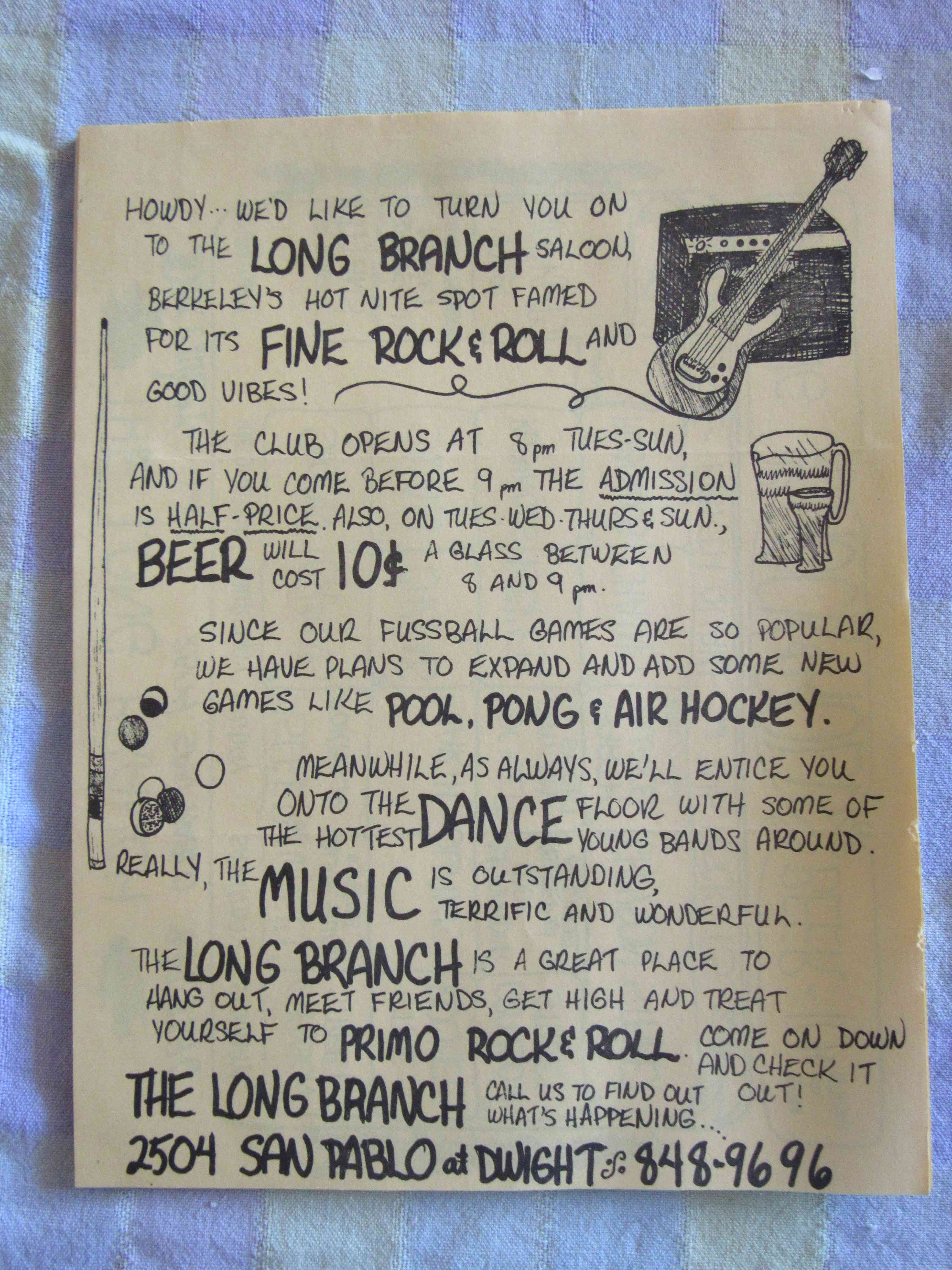
The back of a Long Branch flyer, October '73 (thanks to Lydia Frazier Bosley), encouraging patrons to hang out at the club

Bands would build a following at the Long Branch, and the bands that headlined weekends at the Branch would play weeknights at the Keystone Berkeley, with a built-in audience. Although it's hard to be sure, I think the Long Branch crowd lived relatively near the club, and was in the just-over-21 bracket. The Long Branch was definitely a hard-rocking club, with loud bands and patrons who liked to dance, with less of the University overlay that was included in the Keystone Berkeley audience. The Keystone was right near campus, so it's audience was broader but to some extent more snobby. The Long Branch was in West Berkeley, and less pretentious.

As a result, the Long Branch ended up being a sort of farm team for the Keystone Berkeley. That wasn't a bad thing, necessarily, for the bands themselves. Keystone Berkeley and Long Branch didn't have identical crowds. The Keystone was nearer to campus, and at least on weekends drew people from Alameda, Contra Costa and Marin counties. The Long Branch had a little bit younger crowd who just liked to go out, and probably mostly lived around Berkeley. 

At the Long Branch, mostly the same bands played the club over and over. If a band could build an audience at Long Branch, the expectation was that their own regulars would see the band over and over. Earth Quake, for example, the archetype for a Long Branch band, could play a wide variety of exotic British Invasion cover songs, so that their regular fans didn't hear the exact same set every time.

In a previous post, I looked at all the known bookings for the Long Branch in it's opening year of 1971. This post will look at bookings at the Long Branch for the first half of 1972. If anyone has any updates, corrections, insights or interesting speculation, please included them in the Comments.

The Scenedrome listing in each week's Berkeley Barb was my main source for Long Branch bookings

January 1, 1972 Long Branch, Berkeley, CA: Linx/Frank Biner Band
(Saturday)
The Long Branch was generally open from Wednesday through Sunday, with bands every night. Wednesday was usually "audition night," with local bands that were hoping to build a following. The Long Branch did not advertise in the local papers. There may have been some flyers around town (common in Berkeley at the time), but none from this period have surfaced. The entertainment listings for the Berkeley Barb or the San Francisco papers would usually include the weekend bookings for the Long  Branch.

I have only noted dates where I could find a listing. Bands played the Long Branch over and over, so while some dates are missing, I have likely captured the weekend bands. The weeknights would have just featured local bands, for the most part, although a few of them would go on to success.

Linx played the Long Branch regularly, as well as other Berkeley clubs. They featured the teenage saxophonist Lenny Pickett, later to become well-known in Tower Of Power and then leading the Saturday Night Live band. Also in the group was Jonathan Waxman, who became a well-known chef in Manhattan.

Frank Biner was a popular local soul singer. Over the course of the 70s, Tower Of Power recorded a few of his songs, and he put out a few albums as a bandleader, but back in '71 Biner was just another guy working the clubs. Biner was originally from Chicago, where he had recorded a few singles, but he had moved to the East Bay in the late 60s.

January 7-8, 1972 Long Branch, Berkeley, CA: Yogi Phlegm/Frank Biner (Friday-Saturday)
Yogi Phlegm was the new name for the Sons Of Champlin. At the time, the Sons were not sure they had the rights to their name, and they also wanted to distinguish their newer music from their past sounds. Yogi Phlegm emphasized jamming, sometimes in pretty far-out formulations. Now, they were still funky, and you could still dance to them, but there was more jazz and less R&B than the 60s lineup of the Sons.

The name "Yogi Phlegm" was a joke about Indian gurus. No one got it. Everyone hated it, particularly Bill Graham. Most club owners would advertise "Yogi Phlegm--formerly The Sons" anyway. The band reverted to being the Sons Of Champlin by the next year. 

The Yogi Phlegm lineup had the old front line of Bill Champlin on vocals, organ and guitar, Geoff Palmer on keyboards and vibes and Terry Haggerty on lead guitar. The bassist was old Marin pal Dave Schallock, and the drummer was Bill Vitt. The band had dispensed with any horn players, leaving them more freedom to jam.

January 9, 1972 Long Branch, Berkeley, CA: Dennis Geyer Band/Hunun Dean (Sunday)
Dennis Geyer had been the guitarist and singer in a Wisconsin band called The New Blues. In 1968, they had relocated to San Francisco and added organ player Howard Wales. They changed their name to AB Skhy Blues Band, and had released an album on MGM. Wales and then Geyer had left AB Skhy, to be replaced by other players. Geyer continued to play around the Bay Area. 

Hunun Dean is unknown to me.

January 13-14, 1972 Long Branch, Berkeley, CA: Wayne The Harp (Thursday-Friday)
Wayne The Harp was guitarist Wayne Ceballos. Ceballos had led the Bay Area trio AUM (pronounced "Ohm") in the sixties. AUM had released two albums, and opened at both Fillmores as well. Ceballos still played the same kind of hard-driving blues guitar in his new group. 


January 15, 1972 Long Branch, Berkeley, CA: Stoneground (Saturday)

Stoneground had been put together by KSAN impresario Tom Donahue in 1970 for an intended movie about a "traveling Woodstock" called Medicine Ball Caravan. The Grateful Dead were booked for the  movie, but backed out at the last minute. Stoneground had released their self-titled debut album on Warner Brothers in 1971, and then its followup, Family Album, later in that year.  Among the key members of Stoneground were singers Sal Valentino, Lynne Hughes, Annie Sampson and Deirdre LaPorte. Guitarist Tim Barnes also sang. Pete Sears had been the pianist for the album, although he had  been replaced by Cory Lerios by this time.

January 21-22, 1972 Long Branch, Berkeley, CA: Grootna/Knee Deep (Friday-Saturday)
Grootna was a Berkeley band that had arisen out of a 60s Berkeley band called Sky Blue. Guitarist Vic Smith and singer (and sometime drummer) Anna Rizzo had teamed up with guitarist/writer Allan "Slim Chance" Silverman. Drummer Greg Dewey (from Mad River) was also in the band, along with a few others. The band played a batch of songs written by Silverman and his songwriting partner Austin DeLone. DeLone, however, was playing pubs in London with the band Eggs Over Easy. Everybody in Grootna had many links to numerous Berkeley ensembles.

Grootna's album had been released by Columbia in December 1971. Now, it's probably true that not that many people had heard it, but in those days that had an album was a "real" band, implicitly above other groups playing the clubs. Many of the songs on the album were written by the team of Alan Silverman (Slim Chance) and Audie DeLong (Austin DeLone). However, since Silverman was only listed as "Slim Chance" with no reference to his real name, and DeLong wasn't in the band, the "Siverman/DeLone" credits were confusing at the time.

Knee Deep is largely unknown to me. In 1973, they would change their name to The Titans.

Eddie Money, former lead singer of The Rockets, released his debut solo album on Columbia in 1977

January 23, 1972 Long Branch, Berkeley, CA: Asleep At The Wheel/Rockets
(Sunday)
Asleep At The Wheel were from Paw-Paw, WV, and played Western Swing music with a rock beat. They generally gigged around the greater Washington, DC area. In 1971, they had opened for Commander Cody and His Lost Planet Airmen, and the Cody crew encouraged them to move to the East Bay. Asleep At The Wheel relocated to Oakland, and started playing regularly at local nightclubs. In October of 1971, Asleep At The Wheel had opened a weekend at the Long Branch for the Airmen. Within six weeks, The Wheel were headlining the Long Branch themselves. 

This booking appears to be the first time The Rockets were booked on a weekend at the Long Branch, although that implicitly suggests they had played a weeknight earlier. Probably the Rockets had played a Wednesday audition, had sounded good, and had played some other weeknights, and done well enough to be second-billed on a Sunday night. That was the usual pattern for local bands playing the Long Branch, without a record company or agency support. With respect to the history of the Long Branch, however, the Rockets weren't just another band.

The lead singer of the Rockets was a transplanted New Yorker, a former NYPD trainee cop named Eddie Mahoney. Also in the band was guitarist Dan Alexander, bassist Chris Sohlberg and drummer John Cuniberti. The Rockets would rise to be regular weekend headliners at the Long Branch, along with Grayson Street, Earth Quake and others. In mid-1974, Mahoney would change his stage name to Eddie Money, and the band evolved into Eddie Money and The Rockets, and later just the Eddie Money Band. In 1975, the Bill Graham organization started managing Money, and by 1977 he had released his debut album on Columbia. "Two Tickets To Paradise" and "Baby Hold On To Me" were huge hits. Mahoney (1949-2019) suffered a variety of health issues and has passed on, but thanks to television commercials and oldies, Eddie Money is far and away the biggest act ever to come out of the Long Branch.

January 25, 1972 Long Branch, Berkeley, CA: Hades (Tuesday)
Hades, sometimes billed as the Hades Blues Band, or Hades Blues Works, was a local band. They had played the club back when it was called Babylon.

In the late 60s, guitarist Jimmy Thorsen, bassist Steve Wright and drummer John Cuniberti had been in a band called Traumatic Experience. With the addition of guitarist Craig Ferreira, they became Hades. Steve Wright would go on to play in the Greg Kihn Band, and John Cuniberti became an important engineer and producer, particularly for Bay Area punk rock acts. At some point, Cuniberti joined The Rockets (see above), so I think Hades was near the end of the line here.

 I think the Long Branch wasn't regularly open on Tuesdays, but without listings it's hard to be sure.

January 27, 1972 Long Branch, Berkeley, CA: Copperhead/Jesse, Wolff and Whings (Thursday)
Copperhead was the relatively new band formed by former Quicksilver Messenger Service lead guitarist John Cippolina. Membership was always somewhat fluid. At this time, the band probably had Cippolina and Jimmy Murray (himself ex-QMS ca. 1967) on guitars, Jim McPherson on bass, Pete Sears on keyboards and probably David Weber on drums. Copperhead would go on to release a 1973 album on Columbia. They were promising, but never seemed organized.

Jesse, Wolff and Whings released one album on Leon Russell's Shelter label, distributed by Capitol. The group featured lead singer Jesse Barish, lead guitarist Bill Wolff, bassist Kevin Kaufmann and drummer Kevin Kelley, among other members. The group was supposed to be called Wings, but Capitol had Paul McCartney's Wings, so they had to change the spelling.

Jesse Barish, per his bio, apparently played a little bit with the all-instrumental Orkustra (I think he played flute), back in the 60s. Bill Wolff was in a later version of the Peanut Butter Conspiracy. Kevin Kelly had been in The Rising Sons and The Byrds, among other bands, and both Kelly and Kevin Kaufmann had backed Phil Ochs.

When Jesse, Wolff and Whings fell apart, Jesse Barish went on to work with Marty Balin and Grunt Records. Barish ended up co-writing many songs with Balin, and as a result he has many songwriting credits on Jefferson Starship albums, such as "Count On Me."

As a point of comparison, Copperhead had headlined the Keystone Berkeley on Friday, January 7, and  Whings had opened the following weekend (January 14-15, for the HooDoo Rhythm Devils).

(note: I am missing any listings for the weekend of January 28-29)

February 1-2, 1972 Long Branch, Berkeley, CA: Joe Crane and The HooDoo Rhythm Devils (Tuesday-Wednesday)
The HooDoo Rhythm Devils, led by singer Joe Crane, had arisen out of a local blues-rock band called P, G &E. The HooDoos had released an album on Capitol in 1971, Rack Jobbers Rule. By 1972, they would switch to Blue Thumb, where their next album Barbeque of Deville, came out later in the year.

February 3-4, 1972 Long Branch, Berkeley, CA: Flamin Groovies/Hades (Thursday-Friday)
The Flamin' Groovies were an original San Francisco band, having formed as The Chosen Few in 1965. The Groovies, however, stuck to the Rolling Stones' sound when the rest of the city's bands went psychedelic, and they did not particularly thrive during the Fillmore era. Along with their manager, the Flamin' Groovies had rented the old Fillmore and put on shows with various bands in 1969 and '70. Thus they stayed in the public eye, even if not many fans had heard them yet.

Still, by 1969 the Flamin Groovies had released their debut album on Epic, Supersnazz. Subsequently they released Flamingo (1970) and Teenage Head (1971) on Kama Sutra. Neither record sold well, and the band had were dropped by Kama Sutra. Lead singer Roy Loney left the band, leaving singer/guitarist Cyril Jordan as the principal driving force. Later in 1972, the Groovies would move to England, where their "Power Pop" sound would be less of an anomaly. At this time, however, the Groovies were without a label, and without much of a following in their home territory.

Earth Quake's 1971 debut album on A&M Records

February 5, 1972 Long Branch, Berkeley, CA:  Earth Quake/Fluid Drive
(Saturday)
Earth Quake, from Berkeley, were the ultimate Long Branch band, and it's fitting that they played opening night. Originally, they had been a Berkeley High band called Purple Earthquake. By early 1972, they were a quintet, with Robbie Dunbar on lead guitar, Gary Phillips on rhythm guitar, lead vocalist John Doukas, bassist Stan Miller and drummer Steve Nelson. Earth Quake had released their debut album on A&M Records sometime in 1971

Earth Quake would play the Long Branch at least every month for five years, and in many months every Friday night. Earth Quake, with their vast trove of cover versions, always had a loyal audience at the club

Fluid Drive is unknown to me. 


February 6, 1972 Long Branch, Berkeley, CA:  Jabo Stokes (Sunday)
Jabo Stokes is unknown to me.

February 9, 1972 Long Branch, Berkeley, CA: Bittersweet (Wednesday)
Bittersweet was a rock band from Chico, CA, who moved to the East Bay. Rock historian Bruno Cerriotti has a detailed history of their adventures.  

February 10, 1972 Long Branch, Berkeley, CA: Bittersweet/Full Moon (Thursday)
Full Moon is unknown to me, although it's possible they were formerly known as Womb.

February 11 1972 Long Branch, Berkeley, CA:  Stoneground/Country Weather (Friday)
Country Weather were a Walnut Creek (Contra Costa County) group, from just over the Berkeley Hills. They had originally been called The Virtues, but soon after lead guitarist Greg Douglass joined, they changed their name to Country Weather. Country Weather never released a record when they were together from 1967-73.  Since the group was familiar from many posters from 1968 onward, Country Weather became one of the great lost San Francisco groups of the 1960s.  Ultimately, the group reformed in the 21st century and still performs occasionally. RD Records released some of their 60s demos and live performances, alonmg with some 21st century recordings.

Greg Douglass became a successful guitarist in the Bay Area, best known for co-writing “Jungle Love” for Steve Miller, with whom he played for many years. Douglass was also a member of Hot Tuna for one brief, sensational tour in Spring 1975.

The Doobie Brothers, ca 1971

February 12, 1972 Long Branch, Berkeley, CA: Doobie Brothers/Nipple
(Saturday)
In early 1972, the Doobie Brothers were another unknown band climbing the ladder. The Doobies were from the San Jose area, and they had built a following in the South Bay. They were largely unknown in the East Bay, however. Throughout January, they had played every Thursday night at The New Monk, just 2 miles up the road at University and Shattuck (and later the Keystone Berkeley).

The Doobie Brothers had released their first, self-titled album on Warner Brothers, back in April, 1971. It hadn't done well. Although the Doobies had gone on a National tour (with Mother Earth), they were mostly just slugging it out in the local clubs. Still, Warner Brothers was behind them. In January, the Doobie Brothers had played live on KSAN-fm (at Pacific High Recorders on January 16), which meant that Warners had coughed up the ad dollars to subsidize the broadcast. At this time, the Doobies had just replaced original bassist Dave Shogren with Tiran Porter, and they had added Michael Hossack as a second drummer (along with John Hartmann). Guitarists Tom Johnston and Pat Simmons were the lead singers. 

Nipple is unknown to me.

February 13, 1972 Long Branch, Berkeley, CA: Country Weather (Sunday)

February 16-17, 1972 Long Branch, Berkeley, CA: Dr Hook And The Medicine Show (Wednesday-Thursday)
Dr Hook and The Medicine Show were a somewhat comic country-rock act, produced by Shel Silverstein. Their debut album would have just been released on Columbia. They would soon hit it big with "Silvia's Mother" and "Cover Of The Rolling Stone."

February 18, 1972 Long Branch, Berkeley, CA: Linx/Frank Biner Band (Friday)

February 19, 1972 Long Branch, Berkeley, CA: Linx/Runnin Easy (Saturday)
Runnin' Easy is unknown to me, although I recognize their name from various bookings.

February 20, 1972 Long Branch, Berkeley, CA: Dennis Geyer Band (Sunday)

I am missing any listings for the weekend of February 25-28. 

February 29, 1972 Long Branch, Berkeley, CA: Asleep At The Wheel (Tuesday)

March 1, 1972 Long Branch, Berkeley, CA: Orisha/Free And Easy (Tuesday)
Both Orisha and Free And Easy are unknown to me. The New Monk opened as the Keystone Berkeley this night.

March 3-4, 1972 Long Branch, Berkeley, CA: Wayne The Harp (Friday-Saturday)

March 5, 1972 Long Branch, Berkeley, CA:  Loading Zone/Dennis Geyer Band (Sunday)
The Loading Zone, from Oakland, had played the original Trips Festival back in 1966. By 1972, they had been through many different iterations. By this time, although they still broadly featured the mix of rock and soul as when they had started, they had no original members. They were good, though: Linda Tillery and Wendy Haas on vocals, Tom Coster on organ, Doug Rauch on bass, Tony Smith on drums and Bruce Conte on guitar. 


March 10, 1972 Long Branch, Berkeley, CA: Cold Blood/Linx
(Friday)
Cold Blood are generally associated with the East Bay funk sound of bands like Tower Of Power. The East Bay association was appropriate musically, but in fact Cold Blood had its roots in the South Bay. Lead singer Lydia Pense, from San Mateo, and bassist Rod Ellicott had been in a Peninsula Band in 1966 called the New Invaders, who had evolved into The Generation. The Generation were known as the first Bay Area band to merge a horn section with a rock band. The Generation evolved into Cold Blood, and they were signed  to Bill Graham's San Francisco label (distributed by Atlantic).  

Cold Blood  released two albums on San Francisco, their self-titled debut (1969) and Sisyphus (1970), which spawned a modest local hit with a remake of "You Got Me Hummin'."After Graham's labels folded, Cold Blood ended up on Reprise. In 1972, they would release First Taste Of Sin. Lydia Pense was a powerful singer, and Cold Blood was a tight band, so the group was very popular in night clubs and at local dances. In retrospect, however, they sound as if they were trying a bit too hard, instead of just playing the music they liked. 

March 11, 1972 Long Branch, Berkeley, CA:  Stoneground/Linx (Saturday)

March 15, 1972 Long Branch, Berkeley, CA: Cesar's Combo (Wednesday)
The Examiner lists this as "Latin Jazz." I assume Cesar's Combo was a version of the house band at Cesar Ascarrunuz's 830 Club, led by Luis Gasca. To my knowledge, they played in a Latin jazz-rock vein, sort of like Malo.

March 18, 1972 Long Branch, Berkeley, CA:  Copperhead/The Ducks (Saturday)
I believe The Ducks were a Marin band featuring guitarist and songwriter Kent Housman.

March 19, 1972 Long Branch, Berkeley, CA:  Grootna/Jabo Stokes
(Sunday) 


March 24, 1972 Long Branch, Berkeley, CA:  Commander Cody and His Lost Planet Airmen/Asleep At The Wheel
(Friday)
The headliners were Berkeley's very own Commander Cody and His Lost Planet Airmen. Cody and the Airmen had moved out to California in Summer '69, setting up shop in a rambling house in nearby Emeryville. The band played "hippie honky-tonk," a strange brew of Western Swing, traditional country, old-time rock and roll and Berkeley sensibilities. Their November 1971 debut album, Lost In The Ozone, had spawned the local hit single "Hot Rod Lincoln."

The Airmen had been regular headliners at the Long Branch since it had opened in May, 1971. One or two tracks on the debut album had even been recorded live at the Long Branch back in July. The Airmen were regionally popular now, thanks to "Hot Rod Lincoln," and touring around. But I'm sure they could still pack a Friday night house on San Pablo Avenue.

March 25-26, 1972 Long Branch, Berkeley, CA:  Earth Quake/The Rockets (Saturday-Sunday)

April 4, 1972 Long Branch, Berkeley, CA: Asleep At The Wheel/Alice Stuart (Tuesday)
Alice Stuart was a fine blues guitarist and singer. Although she was from Seattle, she had been playing in the Bay Area since about 1964. Stuart had performed and recorded in a variety of settings. At one point in late 1969, she had even been the temporary bass player for the Lost Planet Airmen. In 1972 she led a trio named Snake, and they recorded for Fantasy Records.

April 5, 1972 Long Branch, Berkeley, CA: Cesar's Combo (Wednesday)


April 7, 1972 Long Branch, Berkeley, CA: Copperhead/Big Brother and The Holding Company
(Friday)
Big Brother and The Holding Company had reformed in late 1969, although of course without Janis Joplin. They had put out two fairly good but poorly-received albums on Columbia (1970's Be A Brother and '71's How Hard It Is). Initially, all the original members had been part of the reformation, but by 1972 the band was being held together by guitarist Sam Andrews. Kathi McDonald, a veteran singer from Seattle (and a former Ikette, despite being blonde), had the somewhat thankless task of being the lead singer. McDonald was an excellent singer, in fact, but Janis was an icon, not just a singer.

Five years earlier, Quicksilver Messenger Service and Big Brother had been in two of the Fillmore's biggest, most exciting bands. Now Cippolina and Andrews were sharing a bill at a 350-capacity club on San Pablo Avenue. Phil Elwood reviewed the show and had high praise for Copperhead. He identified Gary Phillipet (guitar) and Jim McPherson (bass) as the singers, and mentioned Pete Sears' fine piano, along with Cippolina. Elwood also said that Big Brother sounded good, but he added no details.

April 8, 1972 Long Branch, Berkeley, CA:  Linx/Little John (Saturday)
Little John was a local blues band, but I don't know anything else about them.

April 9, 1972 Long Branch, Berkeley, CA: Rockets/Jack Frost (Sunday)
Jack Frost is unknown to me. 

April 12, 1972 Long Branch, Berkeley, CA: Clover (Wednesday) 

April 13, 1972 Long Branch, Berkeley, CA: Saving Grace/Ducks (Thursday)
Saving Grace and Ducks are unknown to me.

April 15, 1972 Long Branch, Berkeley, CA: Mike Finnegan and Jerry Wood/Clover (Friday)
Organist and singer Mike Finnegan was from Wichita, KS. Unlike typical musicians, the 6'6" Finnegan had gotten a basketball scholarship to the University of Kansas. He had moved to the Bay Area around 1969, and he had been a member of The Jerry Hahn Brotherhood, who had put out a highly regarded 1970 album on Columbia. Unfortunately, the album went nowhere, and Finnegan had left the band. At this time, Finnegan had another band with guitarist Jerry Wood, and he worked with the re-activated Big Brother and The Holding Company as well. Finnegan and Wood released the album Crazed Hipsters on Blue Thumb in 1972.

April 21, 1972 Long Branch, Berkeley, CA:  Earth Quake/Modern Lovers (Friday)
It's easy to make fun of Berkeley--I for one never tire of it--but you have to give the town its due. Yes, Berkeley is pretentious and sniffs at the provinciality of every other town, ever. But it also means that Berkeley is often ahead of other places, often way ahead. Johnathan Richman and the Modern Lovers were an underground cult sensation in Berkeley around 1975, long before anywhere else had heard of him. And yet, three years earlier--three years!--The Modern Lovers had played at the Long Branch. At the time, the Modern Lovers were fairly self-consciously modeled on the Velvet Underground. At the time, the VU were all but forgotten, and frontman Lou Reed was just an obscure solo artist in New York. Nobody cared about Reed or the Velvets, much less an unrecorded Boston band carrying on their obscure tradition. Warner Brothers had signed the Modern Lovers, and flown them out to Los Angeles to record demos with John Cale. The band also played a few live gigs, including this booking at the Long Branch.

When Beserkeley Records released Richman's sunny takes in 1975, "Road Runner" and "New Teller" were a ray of sunshine on FM radio, when they got played. Yet shortly after, the earlier, darker demos recorded back in '72 with John Cale behind the board revealed a much grimmer version of the Modern Lovers. In 1976, Beserkeley released the demos (the release was known as "The Black Album"). It featured a darker, organ-driven version of "Roadrunner," and the bleak, hilarious "Pablo Picasso" ("Some people walk down the street/Get called an asshole/That never happened to/Pablo Picasso"). The dark, '72 Modern Lovers had opened at the Long Branch for their future label-mates Earth Quake, and someone had the foresight to record it. You have to love Berkeley for that.

The Modern Lovers probably did not go over that well. Besides Richman on electric guitar and vocals, the band had future Talking Head Jerry Harrison on organ and future Car drummer David Robinson, plus bassist Ernie Brooks. In 1998, the Long Branch show was released as part of a vinyl double-LP, Modern Lovers Live At The Longbranch And More.


April 22, 1972 Long Branch, Berkeley, CA:  Grootna/Fletcher Brothers
(Saturday)
Note that bands like Grootna or Copperhead, with recordings to their name (in Copperhead's case, via Cippolina) were playing the Long Branch about once a month.

The Fletcher Brothers played local Bay Area clubs during this period, but I don't know anything else about them.

April 23, 1972 Long Branch, Berkeley, CA:  Bobby Hutcherson (Sunday)
Bobby Hutcherson was an exceptional vibes player from Los Angeles. He had moved to New York, and had recorded for Blue Note as early as 1963. Hutcherson returned to California in 1967, and mostly played on the West Coast thereafter. While Hutcherson was a forward-thinking music, his music was quieter and more acoustic than some of his peers at the time. Since there were no jazz clubs in the East Bay, Hutcherson often played rock clubs on weeknights. Although jazz was a rarity at the Long Branch, Berkeley has always been amenable to eclectic bookings. 

April 25, 1972 Long Branch, Berkeley, CA:  Boogie Brothers/Sober and Sorry (Tuesday)
Boogie Brothers and Sober and Sorry are both unknown to me.

April 27, 1972 Long Branch, Berkeley, CA:  Linx/The Rockets (Thursday)

April 28, 1972 Long Branch, Berkeley, CA:  Linx/Bitterweet (Friday)

April 29, 1972 Long Branch, Berkeley, CA: Earth Quake/Knee Deep (Saturday)

April 30, 1972 Long Branch, Berkeley, CA:  Osceola (Sunday)
Osceola was a band from Florida that had relocated to San Francisco around 1969, and played around the Bay Area for a few years.

May 5, 1972 Long Branch, Berkeley, CA: Linx/Knee Deep (Friday)

May 6, 1972 Long Branch, Berkeley, CA: Dennis Geyer Band/Bittersweet (Saturday)

May 10, 1972 Long Branch, Berkeley, CA: Street Band (Tuesday)
The Street Band is unknown to me.

I am missing listings for the weekend of May 12-14.

May 16, 1972 Long Branch, Berkeley, CA: Mike Finnegan and Jerry Wood (Tuesday)

May 19, 1972 Long Branch, Berkeley, CA:  Grootna/Rockets (Friday)

May 20, 1972 Long Branch, Berkeley, CA:  Linx/Frank Biner (Saturday)

May 21, 1972 Long Branch, Berkeley, CA: Fluid Drive/Jango (Sunday)
Jango is unknown to me.

May 23, 1972 Long Branch, Berkeley, CA: Asleep At The Wheel/High Country (Tuesday)
Asleep At The Wheel tried to work as many nights as possible. From this point on, it appears they played most Tuesday nights at the Long Branch. 

High Country were a Berkeley bluegrass band led by mandolinist Butch Waller. High Country were regulars at Berkeley's already-legendary folk club, the Freight And Salvage (a half-mile North, at 1827 San Pablo). Waller had been pals with Garcia and David Nelson, both former bluegrassers, since 1963. Waller and David Nelson had been in a bluegrass band together in 1964 (the Pine Valley Boys), and in '69, Nelson had even played a little with High Country. One time, High Country's banjo player wasn't available, and Jerry Garcia filled in (June 19, 1969--of course, there's a tape). High Country had released an album on Raccoon, the Youngbloods' label.

May 24, 1972 Long Branch, Berkeley, CA: Is/The Street Band (Wednesday)
Is is unknown to me. 

 May 25, 1972 Long Branch, Berkeley, CA:  Loading Zone/Linx (Thursday)
The Loading Zone were still grinding it out. One of their vocalists, Wendy Haas, had left to join Azteca, but they still had Linda Tillery. 

May 26 1972 Long Branch, Berkeley, CA:  Earth Quake (Friday)

May 27, 1972 Long Branch, Berkeley, CA:  Loading Zone/Linx (Saturday)

Sophomoric, the second album by the Congress Of Wonders comedy duo, was released on Fantasy Records in 1972

May 28, 1972 Long Branch, Berkeley, CA: Congress Of Wonders/Blue Mountain/Fluid Drive
Benefit for George McGovern (Sunday)
George McGovern was the Anti-War candidate for the Democratic Party Presidential nomination, so there were many benefits for him in college towns like Berkeley.

Congress Of Wonders was a hip comedy duo. Congress of Wonders were a comedy duo from Berkeley, initially from the UC Berkeley drama department and later part of Berkeley’s Open Theater on College Avenue, a prime spot for what were called “Happenings” (now ‘Performance Art’).  The group performed at the Avalon and other rock venues.

Karl Truckload (Howard Kerr) and Winslow Thrill (Richard Rollins) created two Congress of Wonders albums on Fantasy Records (Revolting and Sophomoric). Their pieces “Pigeon Park” and “Star Trip”, although charmingly dated now, were staples of San Francisco underground radio at the time. 


Blue Mountain was a band from Palo Alto.

May 30, 1972 Long Branch, Berkeley, CA:  Asleep At The Wheel/Knee Deep (Tuesday)

May 31, 1972 Long Branch, Berkeley, CA: The Street Band (Wednesday)


June 2, 1972 Long Branch, Berkeley, CA:  Tower Of Power
(Friday)
Tower Of Power, though originally from Fremont, were the pride of Oakland. They had been discovered by Bill Graham at the Tuesday night Fillmore West auditions, and their first album East Bay Grease had been released on Graham's San Francisco label (distributed by Atlantic). By 1972, the label was gone, but Atlantic's sister label Warner Brothers had picked up Tower. Tower's immortal second album, Bump City, had been released in the Spring, just as the Oakland A's, Raiders and Golden State Warriors were making all things Oakland ascendant.

Tower Of Power had graduated beyond the Long Branch by this time, but they were the sort of band who preferred to fill up the gig sheet on any empty night.

June 3, 1972 Long Branch, Berkeley, CA:  Frank Biner/Full Moon (Saturday)

June 4, 1972 Long Branch, Berkeley, CA:  Fluid Drive/The Tubes (Sunday) McGovern Benefit
The Tubes had only formed around March, 1972. Most of the band members were from Phoenix, AZ. Initially, guitarist Bill Spooner, keyboard player Vince Welnick and bassist Rick Andersen had been in a popular Phoenix band called The Beans. The Beans had moved to San Francisco in Fall 1970. They had played numerous local gigs, but hadn't really made much headway. After some band members left the Beans, it had turned out that another popular Phoenix band had lost some members, so guitarist Roger Steen and drummer Prairie Prince had relocated to San Francisco to join The Beans. Their roadie John "Fiji" Waldo was added as lead singer, and The Tubes were born.

The Tubes played a sort of progressive rock rather than modified blues. They also had a fairly elaborate stage show, which was pretty much unheard of at the time. Initially, of course, their props were just cardboard and confetti, but they were a performing band from the beginning.

June 6, 1972 Long Branch, Berkeley, CA: Asleep At The Wheel/Boogie Brothers (Tuesday)

Juice Newton's 1981 debut lp, several years after she was in the folk-rock band Dixie Peach

June 7, 1972 Long Branch, Berkeley, CA:  Linx/Dixie Peach
(Wednesday)
Dixie Peach was a folk rock band that featured singer Judy Newton and guitarist and songwriter Robert Otha Young. The two had started performing together when Newton was a student at Foothill College in Los Altos. Bassist Cecil Bollinger, formerly of the great South Bay group Weird Herald, was also a member.

Although Dixie Peach was just another local band on the Bay Area scene, Judy Newton would go on to become far better known in the 80s as country singer Juice Newton. Otha Young (1943- 2009) was her principal songwriter as well, so the two had a fruitful musical partnership well into the 21st century. 

June 8, 1972 Long Branch, Berkeley, CA:  Linx/Loading Zone (Thursday)

June 9, 1972 Long Branch, Berkeley, CA:  Elvin Bishop Group/Django (Friday)
June 10, 1972 Long Branch, Berkeley, CA: Elvin Bishop Group/Fluid Drive (Saturday)
Elvin Bishop had been a regular performer in Bay Area rock nightclubs since he had arrived in San Francisco in 1968, having just left the Paul Butterfield Blues Band. From 1969 onwards, his main gig had been at Freddie Herrera's Keystone Korner in San Francisco, but he played all over. The Elvin Bishop Group had been signed to Bill Graham's Fillmore Records (distributed by Columbia), and had released two albums (the 1969 debut and 1970's Feel It!). By 1972, Fillmore Records had folded, but Bishop had been picked up by Epic, a Columbia subsidiary (he would release Rock My Soul later in '72).

The Elvin Bishop Group had played regularly at the Long Branch in 1971.  In March of '72, however, Freddie Herrera had taken over the New Monk and changed it to the Keystone Berkeley, so Bishop's principal allegiance was just up the road. Still, while Keystone Berkeley and Long Branch were competitors, they weren't enemies, so here was the Elvin Bishop headlining a weekend. At this time, the Elvin Bishop Group featured Stephen Miller on organ (ex-Linn County), and vocals by Miller, Bishop and singer Jo Baker.

June 14, 1972 Long Branch, Berkeley, CA: Tower Of Power (Wednesday)

June 16, 1972 Long Branch, Berkeley, CA: Fluid Drive/Osceola (Friday)

June 17, 1972 Long Branch, Berkeley, CA:  Blue Mountain/Linx (Saturday)

June 20, 1972 Long Branch, Berkeley, CA:  Asleep At The Wheel/Clover (Tuesday)

June 21, 1972 Long Branch, Berkeley, CA:  The Street Band/Blue Moon (Wednesday)

June 24, 1972 Long Branch, Berkeley, CA:  Earth Quake/Grayson Street (Saturday)

June 27, 1972 Long Branch, Berkeley, CA: Asleep At The Wheel/El Rancho Cowboys (Tuesday)
The El Rancho Cowboys were a country band from the San Jose suburb of Cupertino, CA. Guitarist Cornell Hurd would end up leading the Texas "Dance Hall" band--albeit from Cupertino--known as Cornell Hurd and His Mondo Hot Pants Orchestra. Hurd had met Asleep At The Wheel (whether at this show or before isn't clear) and they were hugely influential in his future musical career.

June 28, 1972 Long Branch, Berkeley, CA: Street Band (Wednesday)

June 29, 1972 Long Branch, Berkeley, CA:  Loading Zone/Frank Biner (Thursday)
By this time, Loading Zone organist Tom Coster and bassist Doug Rauch had been recording with Santana, for the album that would become Caravanserai. By September, Coster and Rauch would go out on tour with Santana, and Loading Zone finally broke up. Drummer Tony Smith had gone on to play for Malo, and guitarist Bruce Conte would join Tower Of Power (Tower and the Zone shared a manager and a rehearsal space). Linda Tillery would go on to a substantial career as a solo artist.  This booking likely featured the final lineup of Loading Zone, with Tillery (vocals) and Conte (guitar) supported by Steve Funk (keyboards), Paul Jackson (bass), Mike Clark (drums) and Pat O'Hara (trombone).

June 30-July 1, 1972 Long Branch, Berkeley, CA:  Blue Mountain/Rockets (Friday-Saturday)
The Rockets, slowly climbing the ladder, were now co-headlining on the weekend.

The Long Branch, 2504 San Pablo, Berkeley, some time in the 1970s

The Long Branch Saloon: May 1971-November 1976

The Long Branch lasted a little over five years, and closed around November 1976. It was mostly a thriving club during that period. Berkeley's population grew enormously, and the students lived farther and farther from campus, driving up rents all over Berkeley, Albany and North Oakland. The Keystone Berkeley opened in March, 1972, and the much larger club got the premier bookings. In particular, acts like Jerry Garcia, Elvin Bishop, Tower Of Power and Commander Cody found time to regularly play the Keystone, and rarely if ever played the Long Branch. So Keystone periodically got big draws, even on weeknights, while Long Branch had to depend on its regulars. Earth Quake and Grayson Street were regular performers at the Long Branch throughout most of the 5-year period it was open. Earth Quake in particular held down almost every Friday night for long periods.

The Long Branch didn't look like this in 1971.

Afterwards
The Long Branch briefly re-opened as a music venue around November 1978. The club was run by the former proprietor of the Berkeley club Jerry's Stop Sign (yet another story) and used the name The Branch. It wasn't open for long.

For many years, 2504 San Pablo Avenue was a store called Good Vibrations. It wasn't a music store, but it was scandalous enough to live up to the Cabale history (don't google it at work). Eventually, as Berkeley got more and more wealthy, gentrification finally got all the way down to Dwight Way and San Pablo Avenue. The building was completely remodeled, and re-opened as a restaurant. The new address is 2512 San Pablo Avenue, but it's the same location. The first restaurant I am aware of was called Sea Salt, which opened about 2009 or so. Sea Salt closed, though, and a new restaurant opened on November 11, 2014.

The Long Branch Saloon, at 2512 San Pablo Avenue, Berkeley, ca. 2019

The name of the new restaurant? The Long Branch Saloon. It says "Upscale comfort food is served in a stylish setting with open rafters & butcher-block tables." Given the turnover in Berkeley's population, it's likely that the locals think the Long Branch is just a reference to Dodge City--which it is--and don't see the nod to a hard-rockin' past.

For the previous post in the Long Branch series (May-December 1971), see here 

For the next post in the Long Branch series (October-December 1973), see here


Thursday, March 11, 2021

2504 San Pablo Avenue, Berkeley, CA: The Long Branch Saloon 1971 Performance List (and Building History--Long Branch I)


2504 San Pablo Avenue, Berkeley, as it appeared in August 2011. The building was the former site of the Cabale Creamery, The Good Buddy, Caverns West, the Questing Beast, Tito's, Babylon and The Long Branch Saloon. All were music venues in the 1960s or 70s.

2504 San Pablo Avenue, Berkeley, CA: Building History
2504 San Pablo Avenue (at Dwight Way) is almost two miles West and South of the UC Berkley campus. Back during World War 2, with the Oakland and Richmond shipyards full of workers on three shifts, San Pablo Avenue had been called "Music Row." There had been nightclubs and saloons all along the East Bay, as tired workers with their pockets full relaxed with some live music. Many musicians had relocated from the South or Southwest to the West Coast, since that was where all the work was. Many other musicians had migrated for factory work, only to find playing music more lucrative (and probably more fun). Even into the 1970s, there were still several nightclubs along the San Pablo Avenue corridor, a final hint of the booming war years.

2504 San Pablo Avenue itself was a seminal address in Berkeley '60s music history. It is a fact of zoning that use permits tend to persist, so a venue with a license to allow music will generally continue to offer music. It is far easier for a new proprietor to lease a building with an existing permit than lobby for a new one, so clubs often change names, owners and musical styles, but not addresses. In the early 1960s, 2504 San Pablo had been the site of The Cabale, later The Cabale Creamery, an essential stop on the early 60s folk circuit. In 1965 it briefly became The Good Buddy and then Caverns West, and in November of that year it became the pre-psychedelic Questing Beast. It was at the Questing Beast where local folksingers Joe McDonald and Barry Melton got some friends and "plugged in" to become Country Joe And The Fish.

The Questing Beast had closed in May 1966, and 2504 became Tito's, which featured live music but was mostly a dance club. In late 1969, the club was re-named Babylon, and featured local bands playing original music. In 1971, new owner Malcolm Williams doubled the capacity of the room from about 175 to around 350, and renamed the club The Long Branch Saloon. The Long Branch featured original music, too, but it paid a little better, with a correspondingly higher quality of performers.

Location and Memory
Sometime in the late 1980s or early 90s, Jerry Garcia was asked about his opinions of different venues around the country. By that time, the Grateful Dead had played every venue, some of them many times. Garcia admitted, however, that when he didn't remember names of venues--for one thing, they often changed--and in any case he was just driven there in a van. When he got on stage at the soundcheck, though, he admitted he would look around, and often recognize that he had played there before, thinking "oh yeah, this place, I've been here!"

Although few musicians have had the vast experience of Garcia, any rock fans who have lived in an area for a long time can recall that happening on occasion. You get tickets for a new club, and you get there, and park, and get inside, and look at the stage, and think--"hey wait a minute, this is where I saw the So-And-Sos." Musicians must play a lot of live shows must have this experience regularly, getting on stage and recognizing the view, realizing they had played the club with a different band when it had another name, or had seen their friends play there.

For musicians who played around the East Bay in the 60s and 70s one of those addresses would have been 2504 San Pablo Avenue. To illustrate this, I am going to point out the experiences of Jerry Garcia and Barry Melton, whose notoriety extends far enough that we know their history. The important point here, however, is that numerous patrons and musicians would have had multiple experiences at 2504 San Pablo, recognizing it every time, even if belatedly.

A calendar for Berkeley's Cabale, for December, 1963.

Cabale (Creamery) January 1963-April 1965
Sandy Rothman, a Berkeley bluegrass musician from way back, recalled Berkeley's Cabale (in a reflection no longer accessible on the internet)

It was on San Pablo Avenue, a main north-south thoroughfare parallel to Telegraph on the opposite (west) side of town, at the southwest corner of Dwight Way and San Pablo. I don't recall how "Creamery" got attached to it -- maybe from the steamed milk that was in the cappuccinos and lattes? The name "Cabale" was taken from "Cabala," a medieval system of Jewish mysticism. (Other dictionary definitions are: "a traditional, esoteric, occult, or secret matter" and "an esoteric doctrine or mysterious art." Do any of those terms resonate with bluegrass, nearly a cult in itself?! Hahaha.)

In the early 1960s, there was a ‘folk circuit’ that emphasized serious folk music like Doc Watson and Mississippi John Hurt (as opposed to the more popular Kingston Trio-style of folk music).  The Cabale was one of the anchors of the circuit, along with Club 47 in Cambridge, many clubs in Greenwich Village (such as the Gaslight and Folk City), the Ark in Ann Arbor and the Ash Grove in Los Angeles.  The story of this circuit is well told in Jim Rooney and Eric Von Schmidt’s fine book Baby Let Me Follow You Down (U-Mass Press, 1979).

The Cabale, at 2504 San Pablo Avenue (at Dwight), was a folk club founded in late 1962 by Rolf Cahn and Debbie Green (two Cambridge, MA folkies), along with Howard Ziehm and Red Dog alum Chandler A. Laughlin III (later known as Travus T. Hipp).  Cahn, a Jewish refugee from Nazi Germany, had served in the US Army during the war and also played and taught classical, flamenco, and folk guitar. Cahn had also founded the Blind Lemon in 1958 (at 2362 San Pablo), the first Berkeley coffee house to feature folk music. 

The Cabale had opened on January 4, 1963 and ran until mid-1965, when the folk action moved to the Jabberwock.  Somewhere along the way Carroll Peery, manager of the Chambers Brothers and Big Mama Thornton, happened to acquire a majority interest in the Cabale.  The name of the venue was changed to the Cabale Creamery in August of 1964. (As a side issue, the one-time notoriety of the Cabale/Cabale Creamery coffee house led the local vice squad and FBI to ban the licensing of any business under the name "Cabale" in the future. However, the late Chan Laughlin retained Cabale News Service as his business cover). Physically, per Sandy Rothman and others, the Cabale was a fairly small, long and narrow, dark room with the ambience of a '50s Beat coffeehouse. Coffee drinks were made at the far end of the room. Initially, the stage was against the long wall on the north side of the room (the right side as you walked in); later, it was on the short wall just inside and to the right of the entrance.

The usual entertainment at the Cabale included local musicians and quite a few traveling "folk individuals" from the more developed Cambridge folk scene. Bluegrass was scheduled only occasionally at the Cabale, but on the other hand, it was the only club in Berkeley where it was presented at all during that period (1963-4). Thus, for musicians like Sandy Rothman or Jerry Garcia, the Cabale was a destination when someone like the Kentucky Colonels were playing. 

Jim Kweskin and The Jug Band (Unblushing Brassiness), Vanguard Records, December 1963 (Bruno Wolfe, Bob Siggins, Fritz Richmond, Jim Kweskin, Geoff Muldaur)

On March 11, 1964, the Jim Kweskin Jug Band played the Cabale. Jerry Garcia and his wife, plus some friends, made a pilgrimage to Berkeley to see them. The Kweskin Jug Band were an important band from the Cambridge folk scene, and had released their debut album on Vanguard in December of 1963. For young players like Jerry Garcia (in Palo Alto) or David Grisman (in Hackensack, NJ), it's hard to overstate the importance of this album. For one thing, Jug Band music was unknown prior to this album. Abruptly, every young hipster in America realized that they could form a band with their friends, and use any combination of instruments, whether played well or poorly.

Garcia, then newly married, was teaching music in Palo Alto and trying to start a music career. Famously, the self-absorbed Garcia was practicing banjo in the store on New Year's Eve '63, not reflecting why none of his students had shown up. A teenager heard the music and knocked on the door. When Garcia told the 15-year old from nearby Atherton that he wanted to form a jug band, young Bob Weir said "I'm in." And so it began. When the Kweskin band played a one-nighter, Garcia had to go (Weir was probably in exile at Boarding School). 

For Garcia, the striking thing about the Kweskin Jug Band was not the music, which was great. Unlike literally ever other group at the time, the Kweskin Band were not "entertainers." Even the Beatles, creative as they were, wore matching suits, had a structured show and had bits of showbiz patter between songs. The Kweskin crew wore what they liked, casually bantered with the audience and each other, played requests--if they felt like it--and enjoyed themselves. That was what folk music was like when you played it in your living room. The Kweskin Band was just inviting everybody in to join them. That, right there, was the model for the Grateful Dead: play what you want, enjoy yourself, and invite along anyone who thinks that it would be fun. 

Garcia was also friendly with the Kentucky Colonels and their great guitarist Clarence White. The Colonels played the Cabale a number of times, and Garcia surely went to see them any time he could. The Cabale didn't book bluegrass that often, but no other club booked bluegrass at all. So even though he lived in Palo Alto, Garcia made the trips to Berkeley when it was important. For such a tiny, unassuming place, the Cabale is remembered fondly by many Berkeley musicians.

Just as a sample, in January, 1964, the Cabale booked, among others
Bob Neuwirth-Cambridge folksinger who was famous as Bob Dylan's running mate
Pat Kilroy-Berkeley folk singer who founded the band New Age
Perry Lederman-obscure but influential Berkeley guitarist (later he did something-or-other for some Owsley character)
Danny Kalb-a few years later, lead guitarist for The Blues Project
Reverend Gary Davis-"If I Had My Way," "Death Don't Have No Mercy," and many more
Jesse Fuller-one-man band from Oakland ("San Francisco Bay Blues," "Beat It On Down The Line")

The name was amended from simply "the Cabale" to the Cabale Creamery in August 1964.  The club folded around May, 1965.

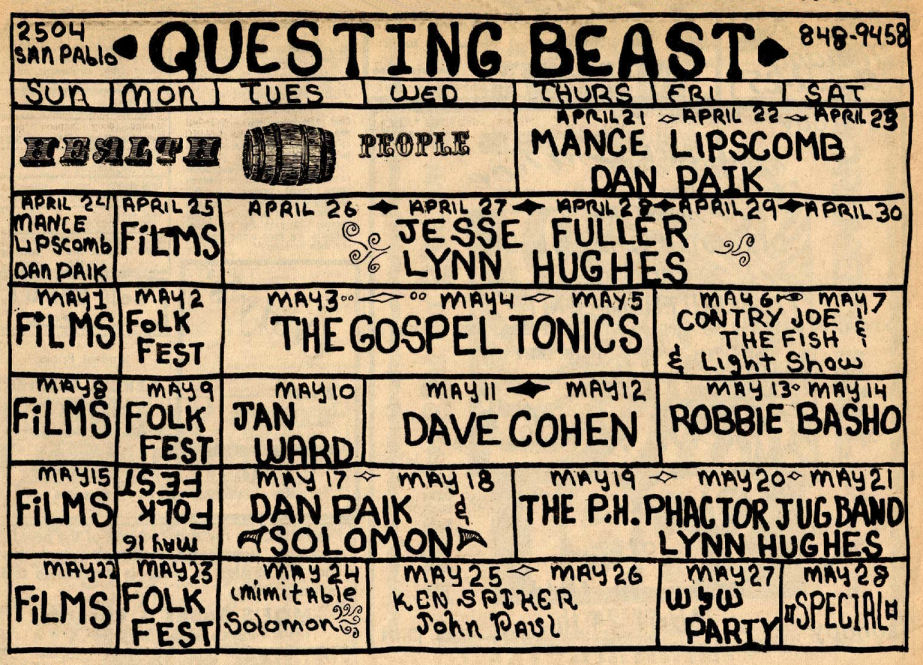
A calendar for the Questing Beast in May, 1966. In fact, most of these gigs were never played, since the City of Berkeley pulled the club's cabaret license. The final musical performers were Country Joe and The Fish on May 7, 1966

The Questing Beast November 19, 1965-May 9, 1966
When the Cabale finally folded, probably sometime in the Spring of 1965, the 2504 San Pablo premises briefly became The Good Buddy (a poster survives from May 1965), and then Caverns West. Ultimately it was taken over by Terry Sullivan and Tony Sage, and re-opened as the Questing Beast on November 19, 1965. For another endeavour, we looked at the history of The Questing Beast in some detail (for a more complete saga, including a list of known performances, see our page on the Questing Beast).

The Questing Beast was primarily a folk coffeehouse and hosted similar acts to the Jabberwock on Telegraph Avenue. It booked mostly Folk, but with a fair amount of flamenco, bluegrass and classical guitar playing thrown in. By all accounts it never managed to turn a profit. Still, there was a hint of electricity in the there, making the Beast a somewhat different animal than prior folk clubs. For one thing, some rock bands were booked. Not from out-of-town, maybe not even good, but they were plugged in. Also, the walls of the club were covered with an elaborate psychedelic mural, although no pictures of it have endured. 

The famous Mr. Owsley lived not far away, on Berkeley Way (roughly near Hearst and McGee, for those who know Berkeley geography), and he was reputed to hang out at the Questing Beast. A long-ago Grateful Dead tape from early 1966 was labeled "rehearsal-Questing Beast Feb 12 '66." The location was spurious, as the Dead never rehearsed there--the tape was probably made at Owsley's house--but there was still a psychedelic association with the Questing Beast, befitting its name.

Among the tiny number of folk musicians in Berkeley at the time were Navy veteran Joe McDonald and Brooklyn transplant Barry Melton. In Fall 1965, The duo had made an anti-war 45 rpm single called "Feel-Like-I'm-Fixin'-To-Die Rag" in a friend's living room, only for sale at one used bookstore near the campus (Moe's Books). For the single, the duo was named Country Joe and The Fish, which reflected jokes about Marxist ideology. Around October 1965, the pair had taken the bus and then hitchhiked around Oregon and Seattle, playing at anti-war gatherings. In February of 1966, however, they saw the Butterfield Blues Band at the Fillmore, and they began to see things differently--although the mysterious Mr. Owsley may have indirectly assisted.

One night around March, Joe and Barry were booked to play folk music at the Questing Beast. This time, however, they brought along a few friends. Barry brought an electric guitar, and some other friends (probably Bruce Barthol and Paul Armstrong) played amplified guitar and bass, and another friend, John Francis Gunning, played some drums, while Joe sang and blew some harmonica. They did some blues, and some instrumentals, and an original song about smoking pot, which would end up being known as "Bass Strings" (with a then-racy introduction where Joe sang "Hey partner/Won't you pass that reefer around"). 

From then on, when Country Joe and The Fish played Questing Beast, they had some friends and some amplifiers. The band--now it was a band--would release their own EP in late 1966, passing that reefer around the world, well beyond the confines of Berkeley. Vanguard Records signed them, but only on the condition that they wouldn't sell their own record any more.

Unfortunately, by May 1966, The Beast had been slain, with its downfall well documented in the May 6 (Vol 2, Number 18) and May 13 (Vol 2, Number 19) issues of the Barb. A hastily arranged three day benefit was arranged with Solomon (Feldthouse – later of eclectic LA band Kaleidoscope) with the Holiday Dancers, Country Joe and The Fish, John Paul, Dave Cohen, Dan Paik and The Gospel Tonics (who had originally been scheduled) appearing.

The very last musical performances at the Questing Beast were Country Joe and The Fish on May 6 and 7 (see the calendar above), getting ready to spread Berkeley to the outside world. Sunday and Monday (May 8 and 9) saw The Questing Beast host Jerry Abrams’ Berkeley Cinematheque (something they had done each Sunday since March 20) and the doors closed for the final time on May 9, 1966. The city of Berkeley had grounds (albeit thin ones) to deny the Beast its Cabaret license, and so they wouldn't have been able to pay performers.


Tito's 1967-June 1969
Somewhere around early 1967, 2504 San Pablo Avenue re-opened as a place called Tito's. It sold beer and pizza, and it had music for dancing on weekends. Tito's didn't buy ads, nor list their bands in the local papers, so it seems to have just had bands playing dance music. Still, once in a while, a local band would print up their own flyer, so we have some traces of the club's existence (The Drongos, above, were a local Berkeley band). 


A flyer for Babylon, from March 13, 1970

Babylon July 1969-April 1971
In the Summer of 1969, Tito's became Babylon. Babylon featured original electric rock bands. A colleague looked into the bookings from July 1969 through November 1970, and they were all local Berkeley bands. The only name that stands out today is Purple Earthquake, a band of former Berkeley High students who would evolve into the band Earth Quake. Earth Quake released several albums in the 1970s, and they would also rule the Long Branch for five years.

A few flyers and artefacts from Babylon survive. The flyer above was from March 13, 1970. The notations "18 and Over Welcome" and "Food" meant that it was a restaurant, technically, with a cabaret license. Minors were allowed in if they were over 18, but they couldn't buy beer (although I bet they drank some). I think the nightly audiences for the Babylon weren't much older than 21, and probably lived relatively near to San Pablo Avenue.

By the Spring of 1971, the Babylon was owned by one Malcolm Williams. I don't know how long Williams had run or owned Babylon, but he decided to expand the club and rename it.

A flyer for Sopwith Camel at Berkeley's Long Branch, playing July 29, 1971

The Long Branch May 28, 1971-November 1976
By 1971, the live rock music market was evolving, and lots of entrepreneurs were noticing. Rock music had always been the province of teenagers, of course. But 60s rock music, with the likes of the Beatles, Bob Dylan and Cream, had raised the ante. Rock music fans didn't just "move on" when they turned 18. Those kids who were 15 when the Beatles had played Ed Sullivan in 1964 were past drinking age. They were still listening to rock music, and they took it seriously. And while every rock fan wanted to see the most popular bands when they came to town, their options were expanding.

A rock fan in his 20s probably had a job, and a few more dollars than when they were teenagers. They also didn't have parents constraining them, and they could drink. They weren't going to go to the Fairmont in San Francisco, but taking a date to a club where you could drink beer and dance was starting to seem like a viable idea.

At the same time, UC Berkeley was expanding. It had never been a small school, but in the early 70s they added more and more students. California parents realized their kids could get a prestigious Ivy League-quality degree for the bargain price of around $212.50 a quarter. When those students graduated, many of them stuck around Berkeley. Rock music had been oriented towards the Fillmore West and other big dance halls, but now nightclubs were starting to book original bands, too. Berkeley had lots of young people, a town that didn't object to long-haired hippies, and a generally central location. 

There had been music clubs in Berkeley since World War 2, of course. But as the 70s dawned, the various music clubs in Berkeley started to evolve. The New Monk, near campus at University and Shattuck, shifted from being a fraternity hangout to a rock nightclub, and by the next year it would become the Keystone Berkeley. Malcolm Williams ran Babylon, but he had big plans, too.

A May 23, 1971 article in the San Francisco Chronicle about Bay Area rock nightclubs had an interview with Malcolm Williams. Williams had hired some of the staff from the old Avalon Ballroom, and he was planning to upgrade Babylon by doubling its capacity, from about 175 to around 350. A bigger club meant better acts, not just local bands who probably lived nearby. Certainly, the Bay Area did not want for good local bands, but they were all trying to make a living. 

As for the name change, at the time it was a fairly obvious choice. The Long Branch Saloon was the name of a famous watering hole in the Wild West town of Dodge City, KS, back in the 1870s. More importantly, Gunsmoke had been a top-rated TV show since 1955, with James Arness as Marshall Matt Dillon. Bars all over the country were named "The Long Branch." Everyone immediately recognized the symbolism, the joint where everyone went, where everything exciting happened.


Ad in the October 1, 1971 Berkeley Barb promotes the New Riders of the ole' Purple Sage and High Country at Long Branch Saloon (2500 [sic] San Pablo) $2.00

Long Branch, Berkeley, CA Performance List May -December 1971

The May 23, 1971 San Francisco Examiner/Chronicle (Sunday edition) interviews Malcolm Williams, who says that the Long Branch is "in the process of expanding." At the time, most Bay Area rock clubs were smallish--The Keystone Korner in the City held 250-300, The Lion's Share in San Anselmo was 250-300, the New Orleans House in Berkeley held about 250. Nearby Mandrake's, at 10th and University, probably only held 200. When the Long Branch completed its expansion to around 350, it would be one of the bigger rock clubs in the Bay Area.

Ironically, the biggest club in the Bay Area would be the Keystone Berkeley, just 2 miles from the Long Branch. The New Monk, at 2119 University, mainly a frat beer joint, would be taken over in 1972 by Freddie Herrera and become the Keystone Berkeley. The Keystone Berkeley officially held 476, but it was widely felt that more people were regularly crammed in. Thanks to regular performances throughout the 70s by Jerry Garcia, Tower Of Power, Elvin Bishop and others, the Keystone Berkeley became the premier nightclub gig in the Bay Area until about 1977. 

The Long Branch, at 2504 San Pablo Avenue in Berkeley, sometime in the 1970s

Bands would build a following at the Long Branch, and the bands that headlined weekends at the Branch would play weeknights at the Keystone Berkeley, with a built-in audience. Although it's hard to be sure, I think the Long Branch crowd lived relatively near the club, and was in the just-over-21 bracket. The Long Branch was definitely a hard-rocking club, with loud bands and patrons who liked to dance, with less of the University overlay that was included in the Keystone Berkeley audience. The Keystone was right near campus, so it's audience was broader but to some extent more snobby. The Long Branch was in West Berkeley, and less pretentious.

As a result, the Long Branch ended up being a sort of farm team for the Keystone Berkeley. That wasn't a bad thing, necessarily, for the bands themselves. Keystone Berkeley and Long Branch didn't have identical crowds. The Keystone was nearer to campus, and at least on weekends drew people from Alameda, Contra Costa and Marin counties. The Long Branch had a little bit younger crowd who just liked to go out, and probably mostly lived around Berkeley. 

At the Long Branch, mostly the same bands played the club over and over. If a band could build an audience at Long Branch, the expectation was that their own regulars would see the band over and over. Earth Quake, for example, the archetype for a Long Branch band, could play a wide variety of exotic British Invasion cover songs, so that their regular fans didn't hear the exact same set every time.

The May 28, 1971 Berkeley Barb lists the Grand Opening of the Longbranch [sic], formerly the Babylon with Country Weather, Wayne The Harp, the Earthquake [sic]. 8pm-2am, $2, refund at door for bridge receipts

May 28, 1971 The Long Branch, Berkeley Country Weather/Wayne The Harp/Earth Quake Grand Opening
(Friday)
The Long Branch promoted its "Grand Opening" on Friday, May 28, 1971. There had been no bookings listed at Babylon for over a month, so I think the Long Branch was closed for renovations. The Chronicle article had said that the Long Branch was "in the process" of doubling its capacity. Based on peripheral evidence, I think those renovations took place over two periods. 2504 San Pablo was closed for about a month before it opened, and then apparently closed again for the month of November. I don't know if the club had fully expanded its capacity by May, or did the expansion in pieces. In any case, based on the quality of bookings, the Long Branch was already a bigger club than Babylon when it opened in May.

The Long Branch didn't really advertise. The club seemed to have made sure that their best weekend bookings were listed in the Berkeley Barb and the San Francisco papers, but there were rarely listings for the weekdays. There were probably flyers around town (common in Berkeley), but none have survived from 1971. Also, FM rock radio stations usually announced an "entertainment calendar" in the afternoons and evenings, where they would run down all the club bookings ("tonight, at the Lion's Share, The Sons, and at Keytstone Korner, Elvin Bishop Group," and so on). No doubt the Long Branch made sure that KSAN and the other stations had their weekend bookings, at least.

The Long Branch had three bands on their opening night, all three of which could have been the headliner on their own. The listings in the Barb and Examiner also said "$2 refund if Bridge receipt." This was to encourage fans from San Francisco (using the Bay Bridge) or Marin (using the Richmond Bridge) or even the Peninsula (using the San Mateo or Dumbarton Bridges). I don't know how many patrons actually took them up, but it was a marker of a club trying to expand its weekend audience beyond its own neighborhood.

Country Weather were a Walnut Creek (Contra Costa County) group, from just over the Berkeley Hills. They had originally been called The Virtues, but soon after lead guitarist Greg Douglass joined, they changed their name to Country Weather. Country Weather never released a record when they were together from 1967-73.  Since the group was familiar from many posters from 1968 onward, Country Weather became one of the great lost San Francisco groups of the 1960s.  Ultimately, the group reformed in the 21st century and still performs occasionally. RD Records released some of their 60s demos and live performances, along with some 21st century recordings.

Greg Douglass became a successful guitarist in the Bay Area, best known for co-writing “Jungle Love” for Steve Miller, with whom he played for many years. Douglass was also a member of Hot Tuna for one brief, sensational tour in Spring 1975. 

Wayne The Harp was guitarist Wayne Ceballos. Ceballos had led the Bay Area trio AUM (pronounced "Ohm") in the sixties. AUM had released two albums, and opened at both Fillmores as well. Ceballos still played the same kind of hard-driving blues guitar in his new group.

Earth Quake's debut album was released on A&M Records in 1971

Earth Quake
, from Berkeley, were the ultimate Long Branch band, and it's fitting that they played opening night. Originally, they had been a Berkeley High power trio called Purple Earthquake. By 1971, they were a quartet, with Robbie Dunbar on lead guitar, lead vocalist John Doukas, bassist Stan Miller and drummer Steve Nelson. Earth Quake would release their debut album on A&M Records sometime this year. 

Earth Quake would play the Long Branch at least every month for five years, and in many cases every Friday night. Earth Quake, with their vast trove of cover versions, always had a loyal audience at the club.

I can't find any reference about who played Saturday night, although I suspect it was one of these three bands. For the balance of this post, I am only noting bands where I have been able to find a listing. In general, the same bands played the Long Branch over and over, so missing nights might not likely reveal other bands.  The Long Branch was generally open from Tuesday through Sunday. Wednesday was "audition" nights, with unknown bands. Most other clubs had "audition night" on Monday, so the Long Branch was smart to choose another night.

June 4, 1971 Long Branch, Berkeley, CA: Grootna (Friday)
Grootna was a Berkeley band that had arisen out of a 60s Berkeley band called Sky Blue. Guitarist Vic Smith and singer (and sometime drummer) Anna Rizzo had teamed up with guitarist/writer Allan "Slim Chance" Silverman. Drummer Greg Dewey (from Mad River) was also in the band, along with a few others. The band played a batch of songs written by Silverman and his songwriting partner Austin DeLone. DeLone, however, was playing pubs in London with the band Eggs Over Easy. Everybody in Grootna had many links to numerous Berkeley ensembles.

June 18-19, 1971 Long Branch, Berkeley, CA: Wayne The Harp/Flying Circus (Friday-Saturday)
Flying Circus were a Marin band. Some form of the band had existed since about 1966. Flying Circus shared equipment and a rehearsal space with the band Clover. Flying Circus lead guitarist Bob McFee was the brother of Clover lead guitarist John McFee. Bassist John Hapaala was the only member who was in both the 60s and 70s versions of Flying Circus. The band had self-released a single in 1970, as a promotional tool, but I have never heard it. To my knowledge, Flying Circus fell broadly into the Marin country-rock category, something like Clover. 

June 20, 1971 Long Branch, Berkeley, CA: Charlie Musselwhite/Cookin' Mama (Sunday)
Charlie Musselwhite had been born in Mississippi and moved to Memphis, and then ultimately to Chicago.  He was one of a small number of white musicians in Chicago (including Nick Gravenites, Paul Butterfield, Mike Bloomfield, Elvin Bishop and a few others) who had stumbled onto the blues scene by themselves.

A Chicago club regular, Musselwhite eventually recorded an album for Vanguard in 1967 called Stand Back, which had started to receive airplay on San Francisco’s new underground FM station, KMPX-fm. Friendly with the Chicago crowd who had moved to San Francisco, his band was offered a month of work in San Francisco in mid-1967, so Musselwhite took a month’s leave from his day job and stayed for a couple of decades.

By 1971, blues weren't as interesting to major labels. Musselwhite's 1971 album was Takin' My Time, on Arhoolie Records. Musselwhite's backing group on the album included Robben Ford, a great young guitarist from Ukiah. By mid-71, I think Ford (and his brother, drummer Patrick Ford) had left Musselwhite to form their own band, but it's not impossible that Robben played the Long Branch with him.

Cookin' Mama was a local band fronted by Sherry Fox, who had been in RJ Fox. They were a big, eight-piece band with horns. Pat Thrall was the lead guitarist. Cookin' Mama would release a 1972 album called New Day.

July 2-3, 1971 Long Branch, Berkeley, CA: Elvin Bishop Group/Linx (Friday-Saturday)
Elvin Bishop had moved to the Bay Area from Chicago in Spring 1968. By 1969 he had a band and was regularly playing The Keystone Korner. Bishop was signed to Bill Graham's San Francisco label, distributed by Columbia, and he had released two albums. After a 1969 debut, the Elvin Bishop Group had released Feel It! in mid-1970. Elvin's band featured Stephen Miller on organ (from the band Linn County) and singer Jo Baker. Baker, Bishop and Miller all shared vocals.  

Linx played the Long Branch regularly, as well as other Berkeley clubs, but I don't know anything else about them [update 20230528: thanks to a Commenter, I know that Linx (sometimes spelled Lynx) featured young Berkeley saxophonist Lenny Pickett, later in Tower Of Power and long-time leader of the Saturday Night Live Band. Also in the group was (future) renowned Manhattan chef Jonathan Waxman]

Alice Stuart's 1970 album Full Time Woman, on Berkeley's Arhoolie Records

July 4, 1971 Long Branch, Berkeley, CA: Alice Stuart/Clover
(Sunday)
On July 4, Bill Graham closed the Fillmore West. The concert industry was getting too large for the 2500-capacity ballroom. Graham moved the action to the much larger Winterland (5400) or Berkeley Community Theater (3500). Fillmore West wasn't a club, but it was a place that many local rock fans went to on a Friday or Saturday night just because it was "the Fillmore." It's closing left room on weekend nights for rock nightclubs all around the Bay Area. 

Alice Stuart was a fine blues guitarist and singer. Although she was from Seattle, she had been playing in the Bay Area since about 1964. Stuart had performed and recorded in a variety of settings. At one point in late 1969, she had even been the temporary bass player for the Lost Planet Airmen. Stuart had released the album Full Time Woman in 1970, on the small label American Records. It was a fairly introspective album. By 1971, Stuart was leading an electric trio called Snake, with Karl Sevareid on bass Bob Jones on drums (and vocals), and they would record for Fantasy in 1972.

Clover's members were also Marin County natives. Clover had formed in late 1967, out of a band called The Tiny Hearing Aid Company. Fantasy Records, flush with Creedence money, had signed Clover. The band released two poorly-produced but pretty good albums, their self-titled debut in 1970, followed by Fourty-Niner in 1971. Clover was a four-piece band, with lead and pedal steel guitarist John McFee, lead singer and guitarist Alex Call, bassist John Ciambotti and drummer Mitch Howie (McFee, Call and Howie had been in Tiny Hearing Aid). Clover worked out of Mill Valley.

By the end of '71, Fantasy seemed to have dropped Clover. Clover kept plugging along, playing Monday nights in Berkeley, even after two albums. The proximity of Mill Valley to downtown Berkeley made this a sensible gig for Clover.

July ?, 1971 Long Branch, Berkeley, CA: Commander Cody and His Lost Planet Airmen
I could find almost no listings for July, but I don't read much into that. Newspapers published listings on a space-available basis, and sometimes lesser clubs like the Long Branch weren't mentioned in the paper due to lack of space. In other cases, no one from the club may have remembered to call the paper with the week's bookings.

Berkeley's very own Commander Cody and His Lost Planet Airmen had moved out to California from Ann Arbor, MI in the Summer of '69. They had set up shop in a rambling house in nearby Emeryville. The band played "hippie honky-tonk," a strange brew of Western Swing, traditional country, old-time rock and roll and Berkeley sensibilities. The band had been signed to Paramount Records, and at this time they were recording their debut (Lost In The Ozone would come out in November). We can infer this Commander Cody date, however, since we know that the band was recording live at the Long Branch and the New Monk in July (as it says so on the back of the album).  On the album, the songs "What's The Matter, Now" and "20 Flight Rock" were recorded live, but whether either (or both) were recorded at the Long Branch isn't clear.

July 29, 1971 Long Branch, Berkeley, CA: Sopwith Camel/Jabo Stokes (Thursday)
The Sopwith Camel was an original San Francisco psychedelic band, with roots going back to the Red Dog Saloon in Virginia City, NV and 1090 Page Street. The Sopwith Camel had been one of the first Fillmore bands to sign a recording contract, and they had one of the first hit singles of the scene, as well, with "Hello Hello" in February 1967. That record was in the Lovin' Spoonful jugband style, which has hot at the time (and the Camel were produced by Spoonful producer Erik Jacobsen). The Camel had to face the grumblings of locals who felt that they had "sold out." The band had ground to a halt in late 1967.

However, Sopwith Camel had reformed in 1971. Their first gig seems to have been at the Matrix on March 5. The re-formed group had 4 of the 5 original members. The original songwriting partnership of guitarists Peter Kraemer and Terry MacNeil was intact, along with bassist Martin Beard and drummer Norman Mayell. In the meantime, Beard and Mayell had played on the hit single "Spirit In The Sky" with Petaluma's Norman Greenbaum.  

Jabo Stokes is unknown to me.

August 6-7, 1971 Long Branch, Berkeley, CA: Commander Cody and His Lost Planet Airmen/The Crabs (Friday-Saturday)
The Crabs were a popular Berkeley club band, although they didn't ever break out of the club circuit. They played in a style that would now be called "Roots-Rock" or "Americana" today, but those terms didn't yet exist. The author Charles Reich, who published a huge bestseller in 1970 called The Greening Of America, was a huge fan of The Crabs, and mentioned them a number of times in his book (Reich also interviewed Jerry Garcia for Rolling Stone, and it was published as a book called A Signpost To New Space). 

August 17, 1971 Long Branch, Berkeley, CA: Driver (Tuesday)
Driver are unknown to me. If a Bay Area band from this period is unknown to me, they are officially obscure. Driver very well may have been a fine band, in fact, but bands booked at the Long Branch on a Tuesday night didn't have any local following.

The August 27, 1971 Berkeley Barb lists Rew Riders [sic]/High Country, Long Branch Saloon (2505 [sic] San Pablo, Brk) $2.50

August 27-28, 1971 Long Branch, Berkeley, CA: New Riders of The Purple Sage/High Country
(Friday-Saturday)
The New Riders Of The Purple Sage headlined the weekend at the Long Branch, so Jerry Garcia returned to where he had been originally inspired by the Jim Kweskin Jug Band. While of course Garcia was quite famous, as I have said I think his experience was quite common for musicians on this list. 2504 San Pablo Avenue had been a venue for several years, and by it's nature, Berkeley is a place where interesting things happen, for good or ill. Many musicians must have had a burst of recognition when they drove up to their gig at the Long Branch for the first time.

The New Riders Of The Purple Sage were Jerry Garcia's vehicle for letting him play pedal steel guitar in a live band. Since John Dawson wrote and sang the songs, and Garcia's old pal David Nelson played guitar, Garcia could just concentrate on the steep learning curve of the pedal steel, with no vocal or front-man duties. By this time, the Riders had completed the recording of their debut album NRPS, which would come out in September. Garcia himself had found the pedal steel too daunting, and had already made plans to cede the chair to the great Canadian steel guitarist Buddy Cage (who had been playing with Ian and Sylvia Tyson's Great Speckled Bird).

Not only was Cage a far better steel player than Garcia, if the band did not have a full-time player in the steel slot, the band could never play enough to make a living. The Grateful Dead had managed to climb out of some severe debt incurred in 1970 (their manager had absconded with $150K), but the Riders were still just trying to break even. A good paying gig on the weekend would help the band cover its expenses until the album made them nationally popular.

High Country were a Berkeley bluegrass band led by mandolinist Butch Waller. High Country were regulars at Berkeley's already-legendary folk club, the Freight And Salvage (a half-mile North, at 1827 San Pablo). Waller had been pals with Garcia and David Nelson, both former bluegrassers, since 1963. Waller and David Nelson had been in a bluegrass band together in 1964 (the Pine Valley Boys), and in '69, Nelson had even played a little with High Country. One time, High Country's banjo player wasn't available, and Jerry Garcia filled in (June 19, 1969--of course, there's a tape)

Butch Waller had surely been to the Cabale many times, as had Nelson, so they too probably had that burst of recognition when they got there.

August 29, 1971 Long Branch, Berkeley, CA: Charles Ford Blues Band (Sunday)
The Charles Ford Blues Band was a fine blues band that featured three brothers from Ukiah, CA up in Mendocino County. Guitarist Robben Ford, drummer Pat Ford and harmonica man Mark Ford played modern, uptempo blues. It was rooted in tradition, but jazzy and flowing as well. Namesake Charles Ford was their father. They would release a fine album on Arhoolie in 1972 (Charles Ford Band). Robben Ford would go on to well-deserved fame, playing with the LA Express, George Harrison, Joni Mitchell, Miles Davis and many others.

August 30-31, 1971 Long Branch, Berkeley, CA: Tower Of Power (Monday-Tuesday)
Tower Of Power, though originally from Fremont, were the pride of Oakland. They had been discovered by Bill Graham at the Tuesday night Fillmore West auditions, and their first album East Bay Grease had been released on Graham's San Francisco label (distributed by Atlantic). Ultimately, Atlantic's sister label Warner Brothers would pick up Tower. Tower's immortal second album, Bump City, would be released in early 1972, presaging an era where the A's, Raiders and Golden State Warriors were making all things Oakland ascendant.

The core of Tower Of Power had been together since 1968. Their unique horn section sound had been honed in Oakland clubs since 1969. Tower Of Power played both rock clubs and R&B dance clubs, dominating both of them with aplomb. At this time, they were just a hard working band, filling in empty nights on their calendar. I think the Long Branch was open on a Monday (and publicizing the booking) just because Tower was available.   

September 1, 1971 Long Branch, Berkeley, CA: Ongood/Wormwood Star (Wednesday)
Ongood and Wormwood Star are both unknown to me. Wednesday was audition night.

September 2, 1971 Long Branch, Berkeley, CA: Pendergrass (Thursday)
Pendergrass is unknown to me. 

September 3-4, 1971 Long Branch, Berkeley, CA: Loading Zone/Staton Brothers (Friday-Saturday)
The Loading Zone, from Oakland, had played the original Trips Festival back in 1966. By 1971, they had been through many different iterations. By this time, although they still broadly featured the mix of rock and soul as when they had started, they had no original members. They were good, though: Linda Tillery and Wendy Hass on vocals Tom Coster on organ, Doug Rauch on bass, Tony Smith on drums and Bruce Conte on guitar. The Zone shared management and a rehearsal space with Tower Of Power, and they, too, played both R&B and rock clubs.

The Staton Brothers were an East Bay band from Hayward who had been signed by the Monkees' management around 1967. Jeff and Mike Staton were both singing guitarists, broadly in the style of Buffalo Springfield. The band had toured with the Springfield and others in the 1960s. In late 1972, the Staton Brothers would release an album on Epic, but there was a problem with distributors, so the album did not sell. Ultimately both Staton brothers worked with Stephen Bishop and many others as guitarists and songwriters, mostly based in Nashville. Since "Staton" was often misunderstood, and just an adopted name anyway, they used different names.

September 8, 1971 Long Branch, Berkeley, CA: Loading Zone/Mike Finnegan (Wednesday)
Organist and singer Mike Finnegan was from Wichita, KS. Unlike most musicians, the 6'6" Finnegan had gotten a basketball scholarship to the University of Kansas. He had moved to the Bay Area around 1969, and he had been a member of The Jerry Hahn Brotherhood, who had put out a highly regarded 1970 album on Columbia. Unfortunately, the album went nowhere, and Finnegan had left the band. At this time, Finnegan had another band with singer Jerry Wood, and he worked with the re-activated Big Brother and The Holding Company as well.

For club gigs, Finnegan pretty much played blues. He was a powerful vocalist as well as a great organ player, so he could play with any combination of musicians. Some of his "friends" might have been had notable musical pedigrees and would definitely have been good players.

Cold Blood's second album, Sisyphus, released on Bill Graham's San Francisco record label (distributed by Atlantic), released in 1970

September 10, 1971 Long Branch, Berkeley, CA: Cold Blood
(Friday)
Cold Blood are generally associated with the East Bay funk sound of bands like Tower Of Power. The East Bay association was appropriate musically, but in fact Cold Blood had its roots in the South Bay. Lead singer Lydia Pense, from San Mateo, and bassist Rod Ellicott had been in a Peninsula Band in 1966 called The Generation. The Generation were known as the first Bay Area band to merge a horn section with a rock band. The Generation had evolved into Cold Blood, and they were signed  to Bill Graham's San Francisco label (distributed by Atlantic).  Cold Blood  released two albums on San Francisco, their self-titled debut (1969) and Sisyphus (1970), which spawned a modest local hit with a remake of "You Got Me Hummin'." [note: a Commenter suggests Stoneground did not play, and was replaced by Bittersweet]

September 11, 1971 Long Branch, Berkeley, CA: Stoneground (Saturday)
Stoneground had been put together by KSAN impresario Tom Donahue in 1970 for an intended movie about a "traveling Woodstock" called Medicine Ball Caravan. The Grateful Dead were booked for the movie, but backed out at the last minute. However, Alembic sound had to honor their part of the contract, so the Dead had stayed home and recorded American Beauty with Stephen Barncard, because Bob Matthews and Betty Cantor had gone on the road with Stoneground.

Stoneground had just released their self-titled debut album on Warner Brothers.  Among the key members of Stoneground were singers Sal Valentino, Lynne Hughes, Annie Sampson and Deirdre LaPorte. Guitarist Tim Barnes also sang. Pete Sears had been the pianist for the album, although he had probably been replaced by Cory Lerios by September.

September 13-14 , 1971 Long Branch, Berkeley, CA: Tower Of Power (Monday-Tuesday)
Clearly the two night booking for Tower Of Power on a Monday and Tuesday was a success, since they returned a few weeks later. 

September 15, 1971 Long Branch, Berkeley, CA: Entity/Driver (Wednesday)
Entity is unknown to me.

September 16, 1971 Long Branch, Berkeley, CA: Bittersweet (Thursday)
Bittersweet was a rock band from Chico, CA, who moved to the East Bay. Rock historian Bruno Cerriotti has a detailed history of their adventures. 

Barry Melton's 1970 album on Vanguard, Bright Sun Is Shining

September 17, 1971 Long Branch, Berkeley, CA: Barry Melton and Fish (Friday)

According to Joe McDonald and Barry Melton, "Country Joe and The Fish" was a duo featuring the two of them, with or without additional band members. That's not how the music world saw it, however. Country Joe and The Fish had called it a day in early Summer 1970, and both leaders had gone solo. Still, when Barry Melton played live with a band, it was usually called Barry Melton and The Fish, to give listeners a hint that it was electric Melton backed by a group.

I don't know how reflective Barry Melton might have been about his own history. But the entire Country Joe and The Fish saga, including playing Anti-War protests, hit albums, Woodstock, European tours and all the rest had pretty much got its start when Joe and Barry had plugged in at the Questing Beast in March, 1966. Now, here was Barry Melton, back at 2504 San Pablo Avenue.

Melton, who had moved from Berkeley to Marin by this time, had released a solo album on Vanguard in 1970 called Bright Sun Is Shining. It had been recorded in Chicago and New York with veteran session pros like Phil Upchurch, rather than with Fillmore West guys. The album had mostly been covers of blues and old R&B songs. This was actually quite consistent with Melton's musical history, but it may not have been entirely expected by 60s fans who were used to songs about politics and drugs. I don't know who was in Melton's live band at this time.

September 19, 1971 Long Branch, Berkeley, CA: Crabs (Sunday)

September 20-21, 1971 Long Branch, Berkeley, CA: Tower Of Power (Monday-Tuesday)

September 23-25, 1971 Long Branch, Berkeley, CA: Grootna/Mike Finnegan (Wednesday-Friday)

September 26, 1971 Long Branch, Berkeley, CA: Bittersweet (Sunday)

September 29, 1971 Long Branch, Berkeley, CA: Road House/Wormwood Star (Wednesday)
Road House is unknown to me. 

NRPS, the debut album of the New Riders Of The Purple Sage, was released by Columbia in September, 1971. Jerry Garcia played pedal steel guitar on the album, and toured with the New Riders through October, in order to promote the band.

October 1-3, 1971 Long Branch, Berkeley, CA: New Riders of The Purple Sage/High Country
(Friday-Sunday)
The New Riders' August weekend must have been a good payday, since they returned for a three-night stand in October. The NRPS album had been released by Columbia in mid-September. Although it was already agreed that Buddy Cage would permanently replace Jerry Garcia, Garcia was going to play on the first leg of the Grateful Dead/NRPS tour in order to promote the band. A number of the shows were broadcast on FM radio, so entire Metro areas would get to hear Garcia play with the Riders. The Fall tour would commence on October 19, 1971, in Minneapolis. Garcia's last show with the Riders as their steel guitarist was October 31 in Cincinnati (Cage took over in Atlanta on November 11).

By this time, High Country had probably released their self-titled album on Raccoon Records.  The Youngbloods had become so successful behind "Get Together" that Warners had given them their own label. Banana (Lowell Levenger) was a bluegrass banjo player from way back, so he recorded High Country at his home studio, and got the album released on the Youngbloods' imprint.

October 5, 1971 Long Branch, Berkeley, CA: Charlie Musselwhite/Charles Ford Blues Band (Tuesday)
Charlie Musselwhite was billed with the band featuring Robben and Pat Ford, two former band members. It's not impossible that Musselwhite just sat in with the Charles Ford Band, instead of bringing his own group. 

October 7, 1971 Long Branch, Berkeley, CA: Charlie Musselwhite/Frank Biner Band (Thursday)
Frank Biner was a popular local soul singer. Over the course of the 70s, Tower Of Power recorded a few of his songs, and he put out a few albums as a bandleader, but back in '71 Biner was just another guy working the clubs. Biner was originally from Chicago, where he had recorded a few singles, but he had moved to the East Bay in the late 60s.

October 8-9, 1971 Long Branch, Berkeley, CA: Commander Cody and His Lost Planet Airmen/Asleep At The Wheel (Friday-Saturday)
Asleep At The Wheel were based in Paw-Paw, WV, and played Western Swing music with a rock beat. They generally gigged around the greater Washington, DC area. In 1971, they had opened for Commander Cody and His Lost Planet Airmen, and the Cody crew encouraged them to move to the East Bay. Asleep At The Wheel relocated to Oakland, and started playing regularly at local nightclubs. This booking was probably one of the first (if not the first) performances by the Wheel in the Bay Area. The Airmen were on the verge of releasing their debut album, and they could pack the Long Branch, so plenty of fans were going to hear Asleep At The Wheel.

October 10, 1971 Long Branch, Berkeley, CA: Earth Quake/Bittersweet (Sunday)

October 12, 1971 Long Branch, Berkeley, CA: Hades (Tuesday)
Hades, sometimes billed as the Hades Blues Band, or Hades Blues Works, was a local band. They had played the club back when it was called Babylon. 

In the late 60s, guitarist Jimmy Thorsen, bassist Steve Wright and drummer John Cuniberti had been in a band called Traumatic Experience. With the addition of guitarist Craig Ferreira, they became Hades. Steve Wright would go on to play in the Greg Kihn Band, and John Cuniberti became an important engineer and producer, particularly for Bay Area punk rock acts.

October 14, 1971 Long Branch, Berkeley, CA: Vertek (Thursday)
Vertek was probably a power trio from Red Bluff, CA, called Vertrek. They had played the Fillmore West audition night in May of 1969.

October 22-23, 1971 Long Branch, Berkeley, CA: Frank Biner/Clover (Friday-Saturday)
Although Clover had been dropped by Fantasy Records, they had soldiered on. The quartet had added two new members, keyboard player Sean Hopper and singer/harmonica player Hugh Cregg. The new six-piece band leaned a little more toward funk than country, in a Marin County kind of way. Cregg's band nickname was "Huey Louie," generally spelled "Huey Louis." About 8 years later, Cregg and Hopper would form a new band, Huey Lewis and The News.

October 24, 1971 Long Branch, Berkeley, CA: Frank Biner/Bittersweet (Sunday)

The lone album by Shanti, released by Atlantic Records in 1971

November 6, 1971 Long Branch, Berkeley, CA: Shanti/Osceola
(Saturday)
Shanti was a conscious attempt to fuse rock music with Indian music. Zakir Hussain, the son of tabla master Ustad Allah Rakha, and himself a brilliant tabla player, was a Marin resident. Along with Sarod player Aashish Khan  and tabla player Pranesh Khan, they combined with some conventional rock musicians to form an "electric" Indian/Rock fusion ensemble. Guitarist Neal Seidel was joined by singer/guitarist Steve Haehl, bassist Steve Leach and drummer Francisco Lupica. In the 60s, Lupica had played with Lee Michaels and had been in bands like The Travel Agency and the Loading Zone (where he used the name Frank Davis).

Shanti put out an album on Atlantic in 1971, recorded at Pacific High Recorders in San Francisco (PHR was probably actually Alembic Studios by this time, but they seemed to prefer to use the outdated name in some instances).  I don't know when the Shanti album was released, but I believe it was actually in the Summer of 1971 (there was an event that seemed to be related to the album release at Mickey Hart's ranch in August). I have not heard the album, but descriptions of it suggest an intriguing experiment that didn't entirely succeed, a mixture of psychedelic rock songs with Indian embellishment, along with genuine efforts to merge electric rock and Indian music in an amplified setting.

Shanti played around the Bay Area until they broke up some time in 1972. Some of the Shanti members went on to have interesting careers, and many of them were Grateful Dead-adjacent. Zakir Hussain was a key figure in the Ali Akbar Khan School Of Music, which had moved to Marin in 1971. An offshoot of the school was the Diga Rhythm Band, a percussion group that included Mickey Hart, who produced their album for Round Records in 1975. Diga Rhythm Band played a few public shows, and Jerry Garcia came and played at one in Golden Gate Park (on May 30, 1975). Francisco Lupica was the inventor of The Beam, and Mickey Hart and Dan Healy adopted the concept as part of the Grateful Dead's concert setup. Guitarist Neil Seidel seems to have had a substantial music career, although I think it was mostly in soundtrack work. Bassist Steve Leach became somewhat known as a producer, as Steven Wold, and in the 21st century, as a performer, as Seasick Steve. 

Osceola was a band from Florida, who had moved to San Francisco around 1969. They had played around at places like The Family Dog on the Great Highway, and other clubs, but they never got to a higher tier.

November 7, 1971 Long Branch, Berkeley, CA: Osceola/Bittersweet (Sunday)
Osceola returned to headline Sunday night. This appears to be the last show at the Long Branch until the first weekend in December. By triangulation, I am assuming that the full expansion to 350 patron capacity was completed in November.

December 3-4, 1971 Long Branch, Berkeley, CA: Country Weather/The Dogs (Friday-Saturday)
The Long Branch returned to business on the first weekend of December. Country Weather were the headliners, as they had been in May. The Dogs are unknown to me.

December 5, 1971 Long Branch, Berkeley, CA: Hades/Grayson Street (Sunday)
The actual Grayson Street was a short street a few blocks from the Long Branch. The band Grayson Street were a sort of roots-rock band from the East Bay. This gig was probably one of their first shows.The band was co-led by harmonica player Rick Kellogg and tenor saxophonist Terry Hanck, both of whom sang. Grayson Street never recorded, but many of its members ended up working with Elvin Bishop, Coke Escovedo, Tower Of Power and others. Grayson Street played the Long Branch as much or more than any band, including Earth Quake. 

December 6, 1971 Long Branch, Berkeley, CA: Hades/Fluid Drive (Monday)
Fluid Drive are unknown to me.

December 8, 1971 Long Branch, Berkeley, CA: Knee Deep/Grayson Street (Wednesday)
Knee Deep are unknown to me.

December 9, 1971 Long Branch, Berkeley, CA: Beefy Red/Linx (Thursday)
Beefy Red was a Marin band, a 10-piece ensemble somewhat in the mold of the Sons Of Champlin, with a horn section and jazzy solos. Band members included trumpeter Mark Isham, guitarist Barry Finnerty and drummer Jim Preston.

December 10, 1971 Long Branch, Berkeley, CA: Asleep At The Wheel/Linx (Friday)
We don't need a review of Asleep At The Wheel's appearances with Commander Cody in October to know how they went down. Here they were two months later, headlining Friday night. The Wheel surely had the whole club up and dancing, and a lot of beer got sold. 

Grootna's album was released by Columbia in December, 1971

December 11, 1971 Long Branch, Berkeley, CA: Grootna/Sopwith Camel
(Saturday)
By the time of this show, Grootna's album had been released by Columbia. Now, it's probably true that not that many people had heard it, but in those days that had an album was a "real" band, implicitly above other groups playing the clubs. Many of the songs on the album were written by the team of Alan Silverman (Slim Chance) and Audie DeLong (Austin DeLone). However, since Silverman was only listed as "Slim Chance" with no reference to his real name, and DeLong wasn't in the band, the "Siverman/DeLone" credits were confusing at the time.

Lost In The Ozone, the epic debut album by Commander Cody and His Lost Planet Airmen, released on Paramount Records in November 1971

December 17, 1971 Long Branch, Berkeley, CA: Commander Cody and His Lost Planet Airmen/Clover
(Friday)
December 18, 1971 Long Branch, Berkeley, CA: Commander Cody and His Lost Planet Airmen/Around and Around
(Saturday)
Commander Cody and His Lost Planet Airmen returned to headline a weekend at the newly-expanded Long Branch Saloon. In November, Paramount Records had released the Airmen's epic debut album, Lost In The Ozone. The album was instantly popular in the Bay Area. Even more remarkably, the song "Hot Rod Lincoln" got airplay not only on FM radio, but Top 40 AM radio as well. Thanks to that Hot Rod Lincoln, the Airmen went from being just a popular Berkeley band to a draw all over the Bay Area.

Around and Around are unknown to me.

December 25 , 1971 Long Branch, Berkeley, CA: Linx/Frank Biner (Saturday)
It's surprising that the Long Branch had a Christmas night show booked, but the Long Branch was a neighborhood joint. A lot of people in Berkeley were from somewhere else, and it's not like they could all FaceTime with their family.

December 29 , 1971 Long Branch, Berkeley, CA: Hades/Mojo Hand (Wednesday)

December 30, 1971 Long Branch Around and Around/Mojo Hand (Thursday)
I'm sure that the Long Branch had a Friday night New Year's Eve show, but I don't know who was booked. I assume it was some of the many bands that played the club regularly.

If anyone has additional information, corrections or insights about bands that played the Long Branch during this period, please put them in the Comments.

The Long Branch Saloon: May 1971-November 1976
The Long Branch lasted a little over five years, and closed around November 1976. It was mostly a thriving club during that period. Berkeley's population grew enormously, and the students lived farther and farther from campus, driving up rents all over Berkeley, Albany and North Oakland. The Keystone Berkeley opened in March, 1972, and the much larger club got the premier bookings. In particular, acts like Jerry Garcia, Elvin Bishop, Tower Of Power and Commander Cody found time to regularly play the Keystone, and rarely if ever played the Long Branch. So Keystone periodically got big draws, even on weeknights, while Long Branch had to depend on its regulars. Earth Quake and Grayson Street were regular performers at the Long Branch throughout most of the 5-year period it was open. Earth Quake in particular held down almost every Friday night for long periods.

Another regular band, The Rockets, started playing the Long Branch in 1972. Lead singer Eddie Mahoney (1949-2019), a former New York City police trainee, started calling himself "Eddie Money" in 1974. By July, 1974, they were Eddie Money and The Rockets, and then just Eddie Money. Eddie Money was picked up by the Bill Graham organization, and he went on huge success as a singer, selling millions of records. Songs like "Two Tickets To Paradise" and "Baby Hold On To Me" are very familiar to listeners of a certain age.

The Long Branch didn't look like this in 1971.

Afterwards
The Long Branch briefly re-opened as a music venue around November 1978. The club was run by the former proprietor of the Berkeley club Jerry's Stop Sign (yet another story) and used the name The Branch. It wasn't open for long.

For many years, 2504 San Pablo Avenue was a store called Good Vibrations. It wasn't a music store, but it was scandalous enough to live up to the Cabale history (don't google it at work). Eventually, as Berkeley got more and more wealthy, gentrification finally got all the way down to Dwight Way and San Pablo Avenue. The building was completely remodeled, and re-opened as a restaurant. The new address is 2512 San Pablo Avenue, but it's the same location. The first restaurant I am aware of was called Sea Salt, which opened about 2009 or so. Sea Salt closed, though, and a new restaurant opened on November 11, 2014.

The Long Branch Saloon, at 2512 San Pablo Avenue, Berkeley, ca. 2019


The name of the new restaurant? The Long Branch Saloon. It says "Upscale comfort food is served in a stylish setting with open rafters & butcher-block tables." Given the turnover in Berkeley's population, it's likely that the locals think the Long Branch is just a reference to Dodge City--which it is--and don't see the nod to a hard-rockin' past. But maybe when a Barry Melton or a Huey Lewis drops by for some upscale comfort food, they pull up and think, "hey I know this joint..."

update 20230604: Historic Flyer

Reader Lydia B sent some historic flyers. Here's a sample from November 1973, front and back

Long Branch November 1973 flyer, front (thanks Lydia B)


Long Branch November 1973 flyer, back (Beer 10 cents until 9 pm!)

For the next post in the Long Branch series (January-June 1972), see here

For the following post in the Long Branch series (October-December 1973), see here

 
For subsequent posts in the 70s Rock Nightclubs series, see here.