Showing posts with label Big Brother. Show all posts

Monday, January 9, 2023

November 12, 1966 Campus Hall, UC Irvine, Irvine, CA: Oxford Circle/Magnficent VII (Lost Family Dog)


An ad from the UC Irvine Anthill newspaper (Nov 11 '67) for the Family Dog presentation of the Oxford Circle in Campus Hall at UC Irvine on Friday, November 12, 1966

Chet Helms and The Family Dog are cornerstones of San Francisco rock history, and thus the history of live rock concerts throughout the world. In late 1965, some proto-hippies who lived in an old house on Pine Street in San Francisco known as "The Dog House" put on some rock concerts. They used the name Family Dog, after one of the adopted strays at home. At the same time, in a rooming house at 1090 Page Street, Chet Helms was organizing jam sessions in the basement, featuring some residents playing weird, loud music. Chet helped them pick the name Big Brother and The Holding Company. By early 1966, Chet Helms had taken over the Family Dog, and Big Brother was playing around town. 

Some local characters called The Merry Pranksters found a way to commercialize their "Acid Tests," billing it as The Trips Festival. The Trips Festival immersed the crowd in loud music and a light show, and everyone was free to dance. Trips Festival stage manager Bill Graham teamed up with Chet Helms to start producing concerts at the nearby Fillmore Auditorium. They were hugely successful, but Bill and Chet had different visions. Graham stayed at the Fillmore, and Helms moved over to the Avalon Ballroom. The Fillmore became the beacon that lit the way for the modern rock concert, while the Avalon was always more underground. Over the decades, rock historians have labored to uncover the intricate history of the Fillmore and the Family Dog, so much so that even the posters for the shows have legendary status on their own terms. 

Chet Helms' Family Dog was a San Francisco phenomenon. After a few shows in '65 and '66, the Dog set up shop at the Avalon from April 1966 through November 1968. In late '67, there were abortive efforts to set up Family Dog affiliates in Denver, London and Portland, but they never took root. When the Avalon closed, Helms had a difficult stretch, but he reopened at the Family Dog on The Great Highway. The beautiful, cleverly conceived operation was either too late or too soon, and undercapitalized, and it was only open from June 1969 through August 1970. Afterwards, the Family Dog receded into memory, the famous logo only brought out on occasion for nostalgia.

Yet one thread of the Family Dog story turns out not to be unraveled. Way back in 1966, before Denver, before the record companies got involved, Chet Helms and the Family Dog put on a show in Southern California. It seems to have been at least a modest success. Yet it has dropped from the sight of any Family Dog scholars. This post will rectify that oversight, and review what is known about the Family Dog presenting the Oxford Circle and The Magnificent VII at Campus Hall in UC Irvine on Saturday, November 12, 1966.

This display ad appeared in the UC Irvine Anthill student newspaper on November 11, 1966. It appears to be a best-efforts attempt at an Avalon-style poster

University of California at Irvine
In the 1950s, the University of California system correctly anticipated an explosion in college enrollment stemming from the "Baby Boom" and the GI Bill. The system expanded their existing campuses, and planned three new campuses in San Diego, Santa Cruz and Orange County. The site of the Orange County campus was the former Irvine Ranch. UC Irvine's first classes began in October, 1965. In that first semester, there were just 1,589 students enrolled (there are currently around 35,000). Campus Hall, the multi-purpose auditorium and gym, was one of the nine original buildings present when the campus was opened. Campus Hall included a 1400 seat arena, used for sports, concerts and student assemblies.

Strange as it may seem today, colleges and universities all had budgets in those days for arts and entertainment. The school was meant to enrich the local culture as well as provide some fun. Intercollegiate athletics, for example, had originally been encouraged as local entertainment, although it had strayed far from that goal after World War 2. Nonetheless, in its initial years, with only a few thousand students, UC Irvine had substantial performers every month. Clearly the fees were subsidized, since the arts were considered a public good. A review of the student paper for the 1966-67 year (The Anthill) reveals performances by Duke Ellington, the Martha Graham Dance company, symphony orchestras and rock bands with hit records.


Preview
The Family Dog show was previewed in the weekly student paper, The Anthill, the day before the show.

SF Family Dog To Present "Freak Out"
"The Family Dog," a professional company from San Francisco, is presenting what is commonly known as a "Happening," an "Op-Dance," or a "Freak-Out" this coming Saturday night, November 12, in UCI's Campus Hall. The show and dance, which begins at 8:30 p.m. and lasts five hours, features two bands, a fantastic array of colored projections, cartoons and abstract images on the wall, and flashing "strobe" lights which make the dancers appear to be moving in fast or slow motion.
According to the Family Dog, because of the rising popularity, hardly a dance is produced in the San Francisco area without this type of show. 
The prices of admission range in San Francisco from $2.50 to $3.50, but because the event is being sponsored by the ASUCI, the price to UCI students and their guests is only $1.00.
The Oxford Circle, a band from the San Francisco area with specializes in Family-Dog type music will be featured in the show. Their performance will be supplemented by a local band, the Magnificent VII. 
The Family Dog has been putting on shows in the Avalon Ballroom and other auditoriums in San Francisco for the past year. Their UCI appearance is the first of what they hope to be a series of performances on college campuses.

A picture in the UC Irvine Anthill promoted the Campus Hall concert by The Association on October 28, 1966. At the time, the band had a hit with "Along Comes Mary."

Universities typically had a student group, usually called the "Entertainment Committee" or something, that made suggestions and recommendations, while a professional booking agency handled the actual arrangement. There must have been some real hipsters on this Committee, however. Just two weeks earlier The Association had appeared at Campus Hall. Now, the Association had a hit single with "Along Comes Mary, " but they weren't really hip. Someone knew something, however, about what was going on San Francisco. At this exact time in Los Angeles, Fillmore/Avalon type events were being held at the Shrine Auditorium in Los Angeles, billed as a "Freak-Out," which the Anthill article references. The eagerness with which the preview article assures the students that it's really cool in San Francisco was probably to make up for the fact that the Oxford Circle had no album, just a single on an obscure label ("Foolish Woman"/"Mind Destruction" on World United, released back in January 1966).


The Oxford Circle
The Oxford Circle were from Davis, CA, near Sacramento. UC Davis had become another branch of the University of California in 1959, so the market for Davis rock bands boomed throughout the 1960s. They were originally a surf band called The Hideaways, but changed their name to the Oxford Circle when the British Invasion became popular. They were influenced by the louder groups like the Yardbirds and Them. When Oxford Circle started getting booked at the Avalon, the band got louder and the guitar solos got longer. By the end of 1966, Oxford Circle's lineup was:

Dehner Patten-lead guitar
Gary Yoder-guitar, vocals
Jim Keylor-bass
Paul Whaley-drums

Paul Whaley would go on to become a founding member of Blue Cheer in 1967, and Gary Yoder would join Blue Cheer in 1969. For a great snapshot of the Oxford Circle live, find the 1997 Big Beat cd Oxford Circle Live At The Avalon 1966, recorded some time that year (likely June 17-18, opening for Captain Beefheart).

The Magnificent VII
The Magnificent VII were an Orange County band with an arc similar to that of Oxford Circle. Per their website, the band had formed in Anaheim as the Vi Counts in 1961, and changed their name to the Nocturnes in 1963. They had a fair amount of regional success, playing places like the Rendezvous Ballroom in Balboa and the Revalaire Club in Redondo Beach (where they beat the Crossfires--later The Turtles--in a Battle Of The Bands). In 1965, in the face of the British Invasion, the Nocturnes changed their name to the Magnificent VII. They were regular performers at Disneyland during this period, one of the premier paying gigs in Orange County at this time. The Magnificent VII had released a few singles on independent labels. 

The Light Show
For a light show, Chet Helms hired The Outfit, the light show associated with the New Delhi River Band. The New Delhi River Band was Palo Alto's second psychedelic blues band, and included future New Riders David Nelson and Dave Torbert (I have written up their entire history elsewhere). The New Delhi River Band and The Outfit were regular performers at a psychedelic outpost called The Barn, in Scotts Valley. The tiny venue was in a rural part of Santa Cruz County, just over Highway 17 from San Jose (I have written up the history of The Barn as well). 

The initial idea had been that some Palo Alto bohemians, organized (sort of) by a guy named Carl Moore, would open up a club called The Outfit, but the strange little venture folded after one night. The projected "house band" of The Outfit became The New Delhi River Band, while the light show became The Outfit. Over time, the light show evolved into using the name Magic Theater, and they would sometimes appear separately from the New Delhi River Band. 

I first heard about the Family Dog's Irvine adventure over a decade ago from one of the old Palo Alto crew (hi Chris), a teenager who had often assisted The Outfit's light show at The Barn or elsewhere. He was invited to go down to Southern California but passed on the episode. In this case, the "traveling" light show seems to have been the remnants of The Outfit, rather than the Magic Theater, although that is just a derived assumption. Until recently, while I had a grainy copy of the ad, I did not know whether the event had actually taken place. The other person I knew who probably went had passed on (the late Rusty Towle), so I had no way to confirm what happened. As more and more universities digitize their archives however, various lost events have surfaced, and I can finally confirm that the Family Dog did put on a full psychedelic dance concert with the Oxford Circle at UC Irvine.

November 12, 1966
The Anthill was only a weekly paper, and only previewed campus events, rather than reviewing them. So the Anthill had no immediate description of the Family Dog event. In January, 1967 however, Big Brother and The Holding Company were booked at Campus Hall (see below), and the preview describes that forthcoming event as "similar to the one presented by the San Francisco Family Dog last November." So it happened, and it must have gone well enough. 

Chet Helms himself almost certainly wasn't at UC Irvine. The 13th Floor Elevators and Moby Grape were tearing it up at the Avalon, so he probably sent one of his lieutenants to manage the Irvine show. The Oxford Circle had a gig the night before at Freeborn Hall in UC Davis. The band probably drove from Davis to Irvine (remember, they would have to take CA-99 through Fresno and Bakersfield, as I-5 was not complete). Over at The Barn, Ken Kesey and his Pranksters were having their own event, so the Outfit (nor the Magic Theater) wouldn't have been booked either, thus freeing them for Irvine duty.

It was a big weekend in Southern California, too. The Sunset Strip Riots, as they were known, peaked on the weekend of November 12, as teenagers with protest signs objected to the crackdown by the Los Angeles Sheriff's Department. As Stephen Stills put it in his famous hit song "For What It's Worth": "What a field day for The Heat/There must have been a thousand people in the street/Singing songs and carrying signs/Mostly saying hooray for our side." Of course, Stills was at the Fillmore that weekend with the Buffalo Springfield, but he surely saw it on TV. 

Although the UC Irvine event was the only Southern California foray by the Family Dog, it hinted at another path for Chet Helms. Since Helms is always compared with Bill Graham, he often seemed like a weak businessman, which was only true when he was compared to Bill--a comparison most people would fall short of anyway. The last line of the Anthill preview says that the "UCI appearance is the first of what [the Family Dog] hope to be a series of performances on college campuses." Honestly, Chet could have had all the Avalon bands playing every college on the West Coast, for good, reliable money, but it wasn't the path he chose to take. Sic transit Gloria Psychedelia.


January 14, 1967 Campus Hall, UC Irvine, Irvine, CA: Big Brother and The Holding Company/Magnificent VII (Saturday)
The Anthill was only published on Thursdays, and did not generally include reviews of past events. In the January 13, 1967 edition, however, I found confirmation that the Family Dog show in November took place. Remarkably, this comment came as part of a description of a Saturday night (January 14) show by no less than Big Brother and The Holding Company. Big Brother had initially been managed by Chet Helms, but they had since split off. Amicably, of course--it was San Francisco--and Big Brother regularly played at the Avalon. There was some underground buzz about Big Brother even though at this time they had no records. 

GRAPE JELLY PLOTS DANCE & LIGHT SHOW [Anthill, UC Irvine, January 12, 1967]
The Grape Jelly Plot, a newly-formed student organization, is presenting a dance concert and light show this Saturday night, January 14, at 8:30 p.m., in UCI's Campus Hall.
The show will be similar to the one presented by the San Francisco Family Dog last November.
The program features two bands, colored lights, movies, slides and cartoons projected on the walls, along with flashing strobe lights which make dancers appear to moving in fast or slow motion.
Supplying music this time will be one of the most popular bands in the San Francisco area, Big Brother and The Holding Company. Completing the show will be a local band, the Magnificent VII.  
Although the price of admission to the show is $2.50, UCI students have the opportunity to buy tickets in advance at $1.50. Advance tickets are on sale at the Activities Office.
I assume that Big Brother played the Irvine show, since there was no news in the next few editions of the Anthill that the show was canceled. For those who are archeologically focused, the Big Brother show at UC Irvine has never appeared on a Big Brother concert list.

It is true that Big Brother and The Holding Company were at San Francisco's Human Be-In on the morning of Sunday, January 15. It is crucial to remember, however, that intra-state air travel in California was both jet-powered and unregulated. Big Brother could have flown from SFO to LAX on Pacific Southwest Airlines for no more than $20 per ticket. Their guitars would have been carry-on luggage and drums and amps would have been checked baggage. If students picked them up at the airport, they could have flown back to SFO on a 6am flight and gone straight to Golden Gate Park. So the economics of an SF band playing a one-nighter in Los Angeles were very plausible (as a regional footnote, Air California would be based at Orange County Airport, and had $10 flights to Northern California, but they did not start until January 16 '67).


The Anthill, UC Irvine, Thursday March 30, 1967
Aftermath
Orange County would become an important place in Southern California rock concert history, but that turned out to surround larger venues like the Anaheim Convention Center. UC Irvine was an attractive booking for an off-night, but the 1400-seat Campus Hall rapidly became awfully small even by college gym standards.  There were still a few random 60s events, however, probably booked when touring bands needed to fill an off night. The most prominent I could find were:

March 31, 1967 Campus Hall, UC Irvine, Irvine, CA: Buffalo Springfield/Cobblestone Garden (Friday)

September 27, 1968 Campus Hall, UC Irvine, Irvine, CA: Big Brother and The Holding Company (Friday)


May 1, 1969 Crawford Hall, UC Irvine, Irvine, CA: Led Zeppelin/Lee Michaels/Hard Luck Boy
(Thursday)
Campus Hall had changed names by this time. The Zeppelin show seems to have been one for the ages, exactly the kind of event that ensures rock concerts aren't held in a venue for decades. Zep manager Peter Grant recalled (on the Led Zeppelin site)
"It was a great night when they appeared at the University of California. They did five encores that night and although the hall was filled to capacity with over 3,000 people in the audience, there were over 700 people outside who couldn’t get in. Fights broke out outside because people couldn’t get tickets and when Jimmy heard about it he asked everyone to squeeze up, had the side doors opened and managed to squeeze the waiting people in the hall.”  (May 1969)

There were occasional concerts at Crawford Hall after this, but not many.  There could hardly have been more memorable ones.

Sunday, September 25, 2022

March 20-22, 1970 Family Dog on The Great Highway, 660 Great Highway, San Francisco, CA: Big Brother and The Holding Company/Kaleidoscope/Devil's Kitchen [FDGH '70 XI]


The Family Dog on The Great Highway, at 660 Great Highway, ca. 1969

The Family Dog on The Great Highway, 660 Great Highway, San Francisco, CA
The Family Dog was a foundation stone in the rise of San Francisco rock, and it was in operation in various forms from Fall 1965 through the Summer of 1970. For sound historical reasons, most of the focus on the Family Dog has been on the original 4-person collective who organized the first San Francisco Dance Concerts in late 1965, and on their successor Chet Helms. Helms took over the Family Dog in early 1966, and after a brief partnership with Bill Graham at the Fillmore, promoted memorable concerts at the Avalon Ballroom from Spring 1966 through December 1968. The posters, music and foggy memories of the Avalon are what made the Family Dog a legendary 60s rock icon.

In the Summer of 1969, however, with San Francisco as one of the fulcrums of the rock music explosion, Chet Helms opened another venue. The Family Dog on The Great Highway, at 660 Great Highway, on the Western edge of San Francisco, was only open for 14 months and was not a success. Yet numerous interesting bands played there, and remarkable events took place, and they are only documented in a scattered form. This series of posts will undertake a systematic review of every musical event at the Family Dog on The Great Highway. In general, each post will represent a week of musical events at the venue, although that may vary slightly depending on the bookings.

If anyone has memories, reflections, insights, corrections or flashbacks about shows at the Family Dog on the Great Highway, please post them in the Comments.

660 Great Highway in San Francisco in 1967, when it was the ModelCar Raceway, a slot car track

The Edgewater Ballroom, 660 Great Highway, San Francisco, CA

As early as 1913, there were rides and concessions at Ocean Beach in San Francisco, near the Richmond District. By 1926, they had been consolidated as Playland-At-The-Beach. The Ocean Beach area included attractions such as the Sutro Baths and the Cliff House. The San Francisco Zoo was just south of Playland, having opened in the 1930s. One of the attractions at Playland was a restaurant called Topsy's Roost. The restaurant had closed in 1930, and the room became the Edgewater Ballroom. The Ballroom eventually closed, and Playland went into decline when its owner died in 1958. By the 1960s, the former Edgewater was a slot car raceway. In early 1969, Chet Helms took over the lease of the old Edgewater.
One of the only photos of the interior of the Family Dog on The Great Highway (from a Stephen Gaskin "Monday Night Class" ca. October 1969)


The Family Dog On The Great Highway

The Great Highway was a four-lane road that ran along the Western edge of San Francisco, right next to Ocean Beach. Downtown San Francisco faced the Bay, but beyond Golden Gate Park was the Pacific Ocean. The aptly named Ocean Beach is dramatic and beautiful, but it is mostly windy and foggy. Much of the West Coast of San Francisco is not even a beach, but rocky cliffs. There are no roads in San Francisco West of the Great Highway, so "660 Great Highway" was ample for directions (for reference, it is near the intersection of Balboa Street and 48th Avenue). The tag-line "Edge Of The Western World" was not an exaggeration, at least in American terms.

The Family Dog on The Great Highway was smaller than the Bill Graham's old Fillmore Auditorium. It could hold up to 1500, but the official capacity was probably closer to 1000. Unlike the comparatively centrally located Fillmore West, the FDGH was far from downtown, far from the Peninsula suburbs, and not particularly easy to get to from the freeway. For East Bay or Marin residents, the Great Highway was a formidable trip. The little ballroom was very appealing, but if you didn't live way out in the Avenues, you had to drive. As a result, FDGH didn't get a huge number of casual drop-ins, and that didn't help its fortunes. Most of the locals referred to the venue as "Playland."

The Family Dog In 1969
Chet Helms had opened the Family Dog at 660 Great Highway to much fanfare on June 13, 1969, with a packed house seeing the Jefferson Airplane and The Charlatans. One of the goals was that the Dog would feature mostly San Francisco bands and a variety of smaller community events and groups. Since so many San Francisco bands were successful, and had record contracts, this didn't confine the venue to obscurity. A lot of great bands played the Family Dog in 1969, but the distant location and the gravitational pull of major rock events hosted elsewhere in the Bay Area kept the Family Dog isolated. We know only the most fragmentary bits about music played, events and audiences throughout the year.  Despite the half-year of struggle, Helms had kept the Family Dog on The Great Highway afloat. He had entered the new year of 1970 with a new plan.


The San Francisco Good Times ad (March 19) for the March 20-22 weekend at the Family Dog is somewhat cryptical, a sign that they were appealing to a narrow audience

March 20-22, 1970 Family Dog on The Great Highway, 660 Great Highway, San Francisco, CA: Big Brother and The Holding Company/Kaleidoscope/Devil's Kitchen (Friday-Sunday)
No band was more synonymous with Chet Helms and the Family Dog than Big Brother and The Holding Company. Back in the Fall of '65, Helms would host jam sessions in the basement of a big boarding house at 1090 Page Street. Some bands formed out of the jams, and a list of potential names was made up. Chet took two of the most promising--"Big Brother" and "The Holding Company"--and combined them for the group he would manage. A few months later, Helms would recruit fellow Texan Janis Joplin to be the lead singer, and the band rocketed to stardom.

Helms and Big Brother had parted ways--amicably--in the Fall of 1966, but Big Brother had continued to play the Avalon Ballroom right up until the end. Indeed, Big Brother had played the last Family Dog show at the Avalon on December 1, 1968. After that, Janis had left the group, bound for stardom, and Big Brother disintegrated. Guitarist Sam Andrew had gone on tour with Janis, fellow guitarist James Gurley had gone to the desert, and Peter Albin (bass) and Dave Getz (drums) had gone on a Spring tour with Country Joe and The Fish.

By Fall 1969, however, Big Brother's members were ready to reconstruct the band. The original quartet played the Family Dog benefit at the Fillmore West on November 19, 1969, and then a few more low-key gigs. In February of 1970, they had headlined a weekend at the Family Dog on The Great Highway. By this time, guitarist David Schallock had been added to the group. The band had three guitarists, and--rather confusingly--Gurley had temporarily switched to bass, with Peter Albin moving to guitar. Producer Nick Gravenites sometimes sang with the band, too.


We have no information about either the February or March Big Brother shows. Were they well attended? What songs did they play? Big Brother and The Holding Company had started recording in Hollywood and San Francisco with Nick Gravenites, and Columbia would release the underrated Be A Brother around July of 1970. It's reasonable to assume that they may have done some of that material, but all that is just a guess.


Kaleidoscope were from Los Angeles, and they were decades ahead of their time. They pretty much invented World Music, and pretty much no one was ready for it. In February, 1970 the band had released their fourth album on Epic, Bernice. On the album, the band's front line was guitarist/multi-instrumentalist David Lindley, multi-instrumentalist Solomon Feldthouse and organist/multi-instrumentalist Chester Crill, with too much instrument-switching to describe here. Paul Lagos was the drummer and Stuart Brotman played bass. Anyone who ever got to see the band live was lucky.

Kaleidoscope had been regulars at the Avalon, but were largely only popular with musicians (most famously Jimmy Page). Rock music fans were simply not yet ready for what Kaleidoscope could do. In 1969, Kaleidoscope had already played the Family Dog on two separate weekends (June 27-29 and October 3-5), and they returned for a final go-round. By the time of these shows, Kaleidoscope was falling apart and there had been several personnel changes. 

Solomon Feldthouse had left during the recording of Bernice, replaced by singer Jeff Kaplan (it's not clear how much Kaplan actually sang on the album). Right before the Family Dog shows, Chester Crill left the band, too (according to Crill, both were fired by David Lindley). Shortly afterwards, David Lindley left as well. It's not even certain if Lindley played the Family Dog shows. Lindley (the de facto leader by this time) told the remaining members that they were free to use the name, so there were a few Kaleidoscope dates after this, but they too had ground to a halt by April. The lineup for the Family Dog shows was probably

David Lindley-guitar, various instruments
Paul Lagos-drums
Ron Johnson-bass
Jeff Kaplan-vocals, piano
Richard Aplan -reeds, flute

As the decades have passed, the music world has caught up with Kaleidoscope, and save for the primitive recording techniques, their music sounds contemporary now. The band has had a few casual reunions over the years. 

Devil's Kitchen was a bluesy four-piece band from Carbondale, IL, that had relocated to San Francisco in late Summer 1969. For much of the Fall of 69, they had been kind of a "house band" at the Family Dog on The Great Highway. The group ultimately had little to show for it, however, and three of the four members returned to Illinois. Guitarist Robbie Stokes did stick around and remained part of the Bay Area music scene for the next dozen years.

Wolfgang's Vault has a tape of Devil's Kitchen from Saturday night (March 21, 1970) as well as Sunday night (March 22), and they were an enjoyable band. This seems to have been one of their last shows in the Bay Area, as far as I can tell. It is a peculiar curiosity that two tapes of the opening act have survived, in Bill Graham's archive of all places, with no trace of the headliner's tapes from those nights. Now, it's possible that some tapes were lost in the 1985 BGP fire, but it's strange that the Devil's Kitchen tapes even ended up in Wolfgang's Vault at all. Still, it's a minor but typical tale of the Family Dog on The Great Highway, as the oddest fragments of history survive, and we are left to try and piece together the whole from the potsherds.

For a link to the next post in the series (March 27-29, 1970-Youngbloods) see here

Thursday, August 18, 2022

February 20-21, 1970 Family Dog on The Great Highway, 660 Great Highway, San Francisco, CA: Big Brother and The Holding Company with Nick Gravenites/Cat Mother and The All-Night Newsboys [FDGH '70 VI]


The Family Dog on The Great Highway, at 660 Great Highway, ca. 1969

The Family Dog on The Great Highway, 660 Great Highway, San Francisco, CA
The Family Dog was a foundation stone in the rise of San Francisco rock, and it was in operation in various forms from Fall 1965 through the Summer of 1970. For sound historical reasons, most of the focus on the Family Dog has been on the original 4-person collective who organized the first San Francisco Dance Concerts in late 1965, and on their successor Chet Helms. Helms took over the Family Dog in early 1966, and after a brief partnership with Bill Graham at the Fillmore, promoted memorable concerts at the Avalon Ballroom from Spring 1966 through December 1968. The posters, music and foggy memories of the Avalon are what made the Family Dog a legendary 60s rock icon.

In the Summer of 1969, however, with San Francisco as one of the fulcrums of the rock music explosion, Chet Helms opened another venue. The Family Dog on The Great Highway, at 660 Great Highway, on the Western edge of San Francisco, was only open for 14 months and was not a success. Yet numerous interesting bands played there, and remarkable events took place, and they are only documented in a scattered form. This series of posts will undertake a systematic review of every musical event at the Family Dog on The Great Highway. In general, each post will represent a week of musical events at the venue, although that may vary slightly depending on the bookings.

If anyone has memories, reflections, insights, corrections or flashbacks about shows at the Family Dog on the Great Highway, please post them in the Comments.

660 Great Highway in San Francisco in 1967, when it was the ModelCar Raceway, a slot car track

The Edgewater Ballroom, 660 Great Highway, San Francisco, CA

As early as 1913, there were rides and concessions at Ocean Beach in San Francisco, near the Richmond District. By 1926, they had been consolidated as Playland-At-The-Beach. The Ocean Beach area included attractions such as the Sutro Baths and the Cliff House. The San Francisco Zoo was just south of Playland, having opened in the 1930s. One of the attractions at Playland was a restaurant called Topsy's Roost. The restaurant had closed in 1930, and the room became the Edgewater Ballroom. The Ballroom eventually closed, and Playland went into decline when its owner died in 1958. By the 1960s, the former Edgewater was a slot car raceway. In early 1969, Chet Helms took over the lease of the old Edgewater.
One of the only photos of the interior of the Family Dog on The Great Highway (from a Stephen Gaskin "Monday Night Class" ca. October 1969)


The Family Dog On The Great Highway

The Great Highway was a four-lane road that ran along the Western edge of San Francisco, right next to Ocean Beach. Downtown San Francisco faced the Bay, but beyond Golden Gate Park was the Pacific Ocean. The aptly named Ocean Beach is dramatic and beautiful, but it is mostly windy and foggy. Much of the West Coast of San Francisco is not even a beach, but rocky cliffs. There are no roads in San Francisco West of the Great Highway, so "660 Great Highway" was ample for directions (for reference, it is near the intersection of Balboa Street and 48th Avenue). The tag-line "Edge Of The Western World" was not an exaggeration, at least in American terms.

The Family Dog on The Great Highway was smaller than the Bill Graham's old Fillmore Auditorium. It could hold up to 1500, but the official capacity was probably closer to 1000. Unlike the comparatively centrally located Fillmore West, the FDGH was far from downtown, far from the Peninsula suburbs, and not particularly easy to get to from the freeway. For East Bay or Marin residents, the Great Highway was a formidable trip. The little ballroom was very appealing, but if you didn't live way out in the Avenues, you had to drive. As a result, FDGH didn't get a huge number of casual drop-ins, and that didn't help its fortunes. Most of the locals referred to the venue as "Playland."

The Family Dog In 1969
Chet Helms had opened the Family Dog at 660 Great Highway to much fanfare on June 13, 1969, with a packed house seeing the Jefferson Airplane and The Charlatans. One of the goals was that the Dog would feature mostly San Francisco bands and a variety of smaller community events and groups. Since so many San Francisco bands were successful, and had record contracts, this didn't confine the venue to obscurity. A lot of great bands played the Family Dog in 1969, but the distant location and the gravitational pull of major rock events hosted elsewhere in the Bay Area kept the Family Dog isolated. We know only the most fragmentary bits about music played, events and audiences throughout the year.  Despite the half-year of struggle, Helms had kept the Family Dog on The Great Highway afloat. He had entered the new year of 1970 with a new plan.


The Rhythm Dukes (with Jerry Miller and Bill Champlin) were originally booked to open for Big Brother on February 20-21, 1970, but they were replaced by Cat Mother

February 20-21, 1970 Family Dog on The Great Highway, San Francisco, CA: Big Brother and The Holding Company with Nick Gravenites/Cat Mother and The All-Night Newsboys (Friday-Saturday)
No band was more synonymous with Chet Helms and the Family Dog than Big Brother and The Holding Company. Back in the Fall of '65, Helms would host jam sessions in the basement of a big boarding house at 1090 Page Street. Some bands formed out of the jams, and a list of potential names was made up. Chet took two of the most promising--"Big Brother" and "The Holding Company"--and combined them for the group he would manage. The band's first gig under their new name was at Berkeley's Open Theater (at 2976 College Avenue, near Ashby).

Big Brother and The Holding Company would go on to play all the hippest, most underground shows in the thriving but still somewhat invisible underground rock scene. The band was a quartet with two guitarists (Sam Andrews and James Gurley), a converted folkie on bass (Peter Albin) and a former jazz drummer (Dave Getz). Big Brother was still figuring things out, but they weren't a cliche nor a copy of any other band. Their weakness was their vocals, compounded by the fact that they didn't really have a compelling figure to be the center of attention on-stage.

Manager Chet Helms had a solution. Back in 1963-64, Helms had become friendly with another expatriate Texan, a folk singer from Austin by way of Port Arthur with a big voice. She had returned to Austin by 1965, as some of her excesses were getting the better of her. So Helms commissioned his friend Travis Rivers to fetch Janis Joplin, and she joined Big Brother and The Holding Company. She made her debut with the band at June 24, 1966 at the Avalon. An eyewitness described her singing as "like tape being rewound," but Janis was compelling. Big Brother and The Holding Company were breakout stars from San Francisco, and Joplin became a one-name celebrity: even today, when we just say "Janis" we know it's her.

Helms was the manager of Big Brother and The Holding Company until late 1966. He had opened the Avalon Ballroom in April 1966, and Big Brother would be regular attractions. Even when Big Brother split with Helms--somewhat amicably--they were still booked at the Avalon. When the Avalon finally folded, Big Brother and The Holding Company had played the final show there on December 1, 1968. It was also Janis Joplin's final show as a member of the band, as she had left for stardom on her own. Big Brother disintegrated after her departure. 

Big Brother Members-1969
Big Brother still had a warehouse for their equipment, and thus a place to rehearse, but they didn't have a band. Guitarist Sam Andrew had joined Janis' Kozmic Blues Band, and James Gurley had retreated to the desert. Peter Albin and Dave Getz were jamming in the warehouse with Albin's old friend David Nelson and others. They even played a one-off gig at the Matrix in January of 1969. In late February, however, Albin and Getz joined up as new members of Country Joe and The Fish, for a National tour that went through May.

By the Fall of '69, the original members of Big Brother were ready to reconstruct themselves. They had been a band prior to Janis, and they would be one afterwards, even if the expectations were now forever changed. Janis Joplin had changed her band, so Sam Andrews was available. David Nelson could have thrown in with Big Brother, but chose a different option: starting the New Riders Of The Purple Sage with another old folkie friend, Jerry Garcia. James Gurley had returned, too, but only wanted to play bass, rather than lead guitar. The versatile Peter Albin could switch to guitar, so that was no problem. They re-debuted, if you will, at the Family Dog benefit at Fillmore West on November 19, 1969. Big Brother and The Holding Company were back.


Big Brother and The Holding Company, 1970

Big Brother and The Holding Company was still a famous name in rock and roll, even without Janis Joplin, so there was plenty of interest. The band was still signed to Columbia Records, too. Sam Andrews had started recording a solo album in Los Angeles, sometime in 1969. This project evolved into the reunion album for Big Brother. Nick Gravenites was signed up as producer. Gravenites had been the producer for Quicskilver Messenger Service's debut album, and he and Mike Bloomfield had helped Janis get her Kozmic Blues Band together, so he was intimately connected with the band. 

Gravenites was a good singer and writer, too, so he was booked to perform with Big Brother at the Family Dog. My general understanding is that Gravenites would come out and sing some numbers with the band, but did not perform the whole show. By this time, Big Brother had added a fifth member, David Schallock. Schallock had been in various Marin bands such as Freedom Highway. Schallock also played guitar (and bass), so Big Brother had a comparatively unique lineup with three lead guitarists. 

The headline weekend at the Family Dog marked the formal return of Big Brother. Since their November date at Fillmore West, they had played a few gigs, but their presence had been low-key. Returning to Chet Helms' venue had a symbolic importance that most fans recognized, even then. Like most Family Dog events of the time, however, we know nothing about the actual shows. Were they well attended? What did the band play? What songs did Gravenites sing? We really have no idea.

Big Brother and The Holding Company would release the underrated Be A Brother album on Columbia in mid-1970, produced by Gravenites. Gravenites sang two of his own songs on the record ("Heartache People" and "I'll Fix Your Flat Tire, Merle").

The Street Giveth and The Street Taketh Away, the debut album of Cat Mother and The All Night Newsboys. Jimi Hendrix produced the album for Polydor, released in 1969.

Cat Mother And The All-Night Newsboys

The Rhythm Dukes had originally been booked at the Family Dog as the opener, and were advertised on the flyer (above). The Rhythm Dukes were led by Jerry Miller of Moby Grape, and had originally included another ex-Grape, Don Stevenson (on guitar rather than drums). Stevenson had left, reducing the band to a trio. Briefly the Rhythm Dukes were a quintet, with which they had played the Family Dog in December, where they had opened for Canned Heat. After yet another gyration, their new lineup would feature no less than Bill Champlin on organ and vocals, as The Sons were sort of breaking up. It turned out, however, that the Sons had what was announced as their final gigs (in Berkeley and Antioch, respectively). As it actually happened, it wasn't the Sons final gigs--not even close--, but Champlin would join the Rhythm Dukes for a few months. Champlin would play with the Dukes at the Family Dog a few weeks later (March 6-8, opening for Lee Michaels). 

Instead of the Rhythm Dukes, the opening act for Big Brother was a Greenwich Village band called Cat Mother and The All Night Newsboys. Cat Mother and The All-Night Newsboys had formed in 1967. By 1969, they had been signed by Michael Jeffery, the manager of Jimi Hendrix. Hendrix had even produced the band's debut album on Polydor, The Street Giveth and The Street Taketh Away. Thanks to the Jeffery connection, Cat Mother got to open for Hendrix and a number of other high profile events. Cat Mother even had a minor hit in late '69, with medley of oldies called "Old Time Rock And Roll." In fact, the band's sound was more country-folk oriented, but they were versatile musicians.

By 1970, however, Cat Mother was anxious to separate themselves from Jeffery's questionable management practices. Their second album, Albion Doo-Wah, would be recorded at Pacific High Recorders in San Francisco. In February, the band had probably just arrived in the City for recording, and were likely to have been added to the Family Dog bill just because they were available.

After they finished their second album, Cat Mother relocated to San Francisco. San Francisco had a unique status for rock bands in the late 1960s and '70s. While the record industry was centered, as it always had been, in Manhattan and Hollywood, San Francisco was an enticing opportunity for rock groups. For one thing, the concert industry was thriving, so a good band could make a living whether they had an album or not. Plus, there were studios and plenty of A&R guys, so SF wasn't the wildnerness. And, it was California--no snow, pretty girls, open minds--so it wasn't hard to persuade fellow band members to make the move. A large number of bands from elsewhere moved to San Francisco.
 
The three founding members of the band, Roy Michaels (bass, vocals), Bob Smith (keyboards, vocals) and Michael Equine (drums), would all relocate permanently to California. At the time of this show, the band still had lead guitarist Paul Johnson and probably violinist Larry Packer. Both of them would ultimately return to New York. Michaels, Smith and Equine would move to Mendocino County and continue on as Cat Mother until 1977.


Tuesday, January 18, 2011

3138 Fillmore Steet, San Francisco, CA, January 6, 1969: Open Jam with Peter Albin and Dave Getz

(San Francisco Chronicle Datebook listings from Monday, January 6, 1969)

The San Francisco Chronicle Datebook section was full of interesting listings in the 1960s, even if they often only provide tantalizing clues to events that would otherwise have disappeared. San Francisco's Matrix club was one of the few hippie hangouts, and all sorts of surprising events took place there. Ironically, as a hangout rather than a major venue--The Matrix was too small to be "major"--many of the most interesting events seems to have taken place on weeknights. On January 6, 1969, the first Monday of the year, the listings of openings (above) are topped by this one:

ROCK CLUB--Peter Albin and David Getz in an open jam session at The Matrix, 3138 Fillmore.

Peter Albin and Dave Getz were the bassist and drummer, respectively, of Big Brother and The Holding Company. Big Brother had just broken up in late 1968, when Janis Joplin had left the group. Janis had not been an original member, but she rapidly eclipsed the group itself, and when their 1968 album Cheap Thrills became a mega-hit, Janis ended up leaving the band behind. The rocket ride from underground hipsters to National rock stars had been very hard on some of the band members, and Big Brother did not survive her departure. Janis Joplin and Big Brother played their last show at the Avalon Ballroom on December 1, 1968. Afterward, guitarist Sam Andrew continued on with Janis's new band, while fellow guitarist James Gurley took some time out from making music. Albin and Getz were left adrift.

I had known from various Family Trees and the like that Albin and Getz started jamming together in early 1969. David Nelson, an old South Bay friend of Albin, was known to be one of the participants. Nelson's group The New Delhi River Band had ground to a halt in early 1968, so he too was at loose ends. A few other musicians are vaguely alleged to have jammed with Albin and Getz, but it was difficult to ascertain. However, until I found this listing, I had no idea that Albin and Getz had led any kind of public performance. Who played with them? What did they play?

From 1968 onwards, at least, Monday night was usually "jam night" at the Matrix. A local band or musician would host a jam session. Usually someone was the host for many Monday nights in a row, but sometimes individual musicians or bands would host a single Monday night session. Monday night was a very thin night for performances, so in many ways it was like "musicians night out." When you read about various rumors about famous San Francisco players sitting in at the Matrix, often as not it turns out to have been on a Monday night. Also, to some extent the term "jam" implied as much that the show wouldn't be "regular" rather than specifically that there was a jam. Thus if a group of players wanted to work on something different in public, billing it as a "jam" implied that you wouldn't be seeing a regular set.

In any case, you know what I know. Albin and Getz, who had probably been jamming with their friends somewhere, led a jam session at The Matrix. I would suspect David Nelson was there, since he has acknowledged hanging out with them at the time, but even that is just a guess. Albin and Getz knew everybody and were well liked, and on a Monday night in January almost no musican in San Francisco was working, so absolutely anyone could have played with them.

Tantalizing as this event was, it doesn't seem to have been repeated. The next weekend, January 13, the bill wasn't Albin and Getz--it was "Carlos Santana And Friends," if anything even more fascinating. The next two Mondays (Jan 20 and Jan 27) were not listed in the Chronicle, so while there may have been even better shows, we don't know anything about them. Needless to say, anyone with insights, recovered memories (real or imagined) or amusing speculation is encouraged to chime in.

Postscript: I am no expert on this, but it is plausible that "The Commodores" who are playing at Nero's Nook in Palo Alto, were in fact the Lionel Richie-led band from Tuskegee, AL, who hit it very big in the 1970s. They did sign to Atlantic in 1968, and Nero's Nook, at the swanky Cabana Hyatt House, would be the sort of supper club engagement Atlantic might have tried to find for them.

Wednesday, December 22, 2010

December 3, 1966: 658 Escondido Drive, Stanford, CA: "A Happening In The Wilburness" with Big Brother and The Holding Company

( a clipping from the entertainment listings of the Berkeley Barb on December 2, 1966)

Stanford University, founded in 1891 by railroad magnate Leland Stanford, was always a unique institution. However, its current status as a sort of West Coast Ivy, where the children of (smart) Presidents attend alongside other future world leaders, even as new industries are invented in dorm rooms, is a rather more recent development. When founder Leland Stanford died in 1893, the University remained on somewhat shaky financial ground until the mid-1950s. The University was always land rich and cash poor, and as a result a more interesting place than it probably is these days. The finances of Stanford changed dramatically in the 1950s, but the University still remained interesting enough in the 1960s. It was not a coincidence that Ken Kesey started the LSD revolution near Stanford, at Perry Lane in Menlo Park,  in the early '60s.

I have reason to believe that the "Happening" listed above in the Berkeley Barb was the last gasp of an older, looser Stanford, mixed in with some 1960s troublemaking, but I am unable to find a reliable eyewitness. Thus, I am using this post to marshal what little evidence I can uncover in the hopes that some reader will Flash Back and find this post and give us clues to what really happened. I can say, however, that there were quite a few interesting rock events in Stanford in the Fall of 1966, yet after this event, Stanford all but eliminated rock music shows. There was one outdoor rock concert in 1967, and one other very interesting event, and two more in 1968, but Stanford seems to have been resolutely against rock music events on campus after Fall 1966.

Did something happen that unsettled the Administration? Could it have been an all-day, acid fueled, multi-building party culminating with Janis Joplin and Big Brother and The Holding Company playing the Wilbur Hall Dormitory Dining Commons? God, I hope so.

"Happening In The Wilburness"
An old Big Brother list mentions a December, 1966 event under the heading "A Happening In The Wilburness." Ross discovered the Barb listing (above, from December 2, 1966) and I am confident this was the same event. Rather than listing the event as a concert, the Barb calls it a "Happening:"
HAPPENING: Big Brother & the Holding Company, lights, film, poetry, jazz, sculpting, experiments; Wilbur Hall, Stanford U.. all day? $1.50
Some reasonable speculation suggests the outline of this event. Wilbur Hall was built after World War 2 to handle the incoming volume of students. The "Hall" was actually a complex of 8 residential houses and a central dining commons. It currently houses 707 students, and the grounds cover a substantial area. The Stanford campus has always been sprawling, since its inception, but in the mid-60s the location of Wilbur Hall would have been less developed, as there were considerably fewer labs, classrooms and other buildings on campus (the mailing address is 658 Escondido, but the actual location of the Dining Commons is on Bowdoin Lane, off Campus Drive).

Since there were no less than nine available buildings, plus some open space, the implication seems to be that different activities took place in different parts of the grounds, presumably culminating with a Big Brother concert in the Dining Commons. I have to assume "The Wilburness" was a student nickname for the grounds as a whole. Crowded as the Stanford campus is today, Wilbur Hall would have been more isolated at the time and the name may have been fairly appropriate.

A "Happening" was a 60s term for what would loosely be termed either "Performance Art" or a "Festival" today. I have to assume that the event was at the end of the Fall Quarter, and some insurrectionist students had gotten permission to hold a "Fall Dance" or something, and turned it into a full-on sixties event. I believe the key word here is "experiments," which I think is code for an Acid Test, but I will explain my reasoning subsequently.

Although Stanford was not nearly as urban as Berkeley, the campus had its share of interesting rock events in the Fall of 1966. The Cryptical Development blog has an excellent post on some 1966 and '67 ads for events in the Stanford Daily, including performances by the Grateful Dead, Butterfield Blues Band and Jefferson Airplane. After that Fall, however, as the post shows, Stanford rock events abruptly ceased. There was an outdoor rock concert in May 1967 at the Frost Amphitheater, and a Summer rock concert at Frost in July 1968, but Stanford seems to have simply declared a moratorium on such events. Why? Surely many of the Stanford students wanted to see all the Fillmore bands, who would have been happy to play there on an available Friday night.

Here's what I think happened, although I cannot find proof. Some students got access to some sort of funds for a "Fall Dance" and asked to have a sort of "Festival" at the Wilbur Hall grounds. They probably emphasized art, poetry and jazz to the Administration, who blithely said yes. LSD was legal up until October 6, 1966, and the Kesey crowd was well connected to the Stanford campus. I think the "Experiments" alluded to was a code for an Acid Test--what else would they be experimenting on?--and madness reigned all day and all night on the Wilbur Hall grounds. Why else would the students be very vague to the Barb about the length of the event?

The campus cops probably wondered why no one smelled like whisky, but they must have figured something was up. A full volume concert by Big Brother and The Holding Company must have finished off the evening and the University's patience, because rock music would not be performed at night on the Stanford campus for a very long time.

I can't prove any of this. If any old Stanford students are having odd flashbacks right now, please Comment.

"The Experimental Group"
Palo Alto and Stanford had an interesting bohemian runup to 1966. Ken Kesey had come to Stanford on a writing fellowship in the early 1960s, and his merry bunch got their start just off campus on Perry Lane. Jerry Garcia and other bohemian folkies lived near downtown, as tolerant Palo Alto was unbothered by bearded, draft-dodging ne'er-do-wells. Palo Alto even had it's own Acid Test on December 18, 1965 (and the building is still there). While Kesey went on the lam, and the Dead moved to San Francisco, there was still a modest core of like minded lunatics in Palo Alto and the Santa Cruz Mountains.

The principal core of hip late 60s Palo Alto was the Mid Peninsula Free University (MFU), who began in 1967 in an attempt to provide an educational alternative to Stanford. The MFU story is too long to tell here, but MFU was instrumental in making sure there were free concerts in Palo Alto throughout 1967 and '68, in contravention to less liberal towns. On their now inaccessible website, the MFU founders were associated with some mysterious entity called "The Experimental Group," seemingly an ad-hoc Stanford organization. Who were they?

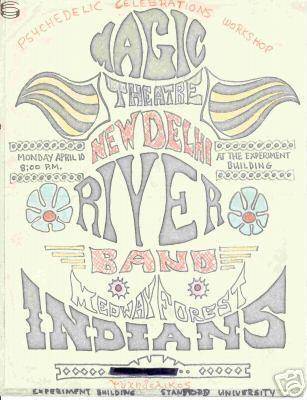
My one whiff of information about "The Experimental Group" is this mysterious poster (h/t Ross)


The poster advertised a "Psychedelic Celebrations Workshop" on Monday, April 10, 1967 at 8:00 pm. The event featured The Magic Theatre, The New Delhi River Band and the Medway Forest Indians. The event seems to have been at 'Experiment Building--Stanford University."  Let's parse what we can about this flyer.

The New Delhi River Band and The Magic Theatre were the "house band" and light show at The Barn, in Scotts Valley. At this time, The Barn had just been closed by the Santa Cruz County Sheriff's department. Both NDRB and Magic Theatre lived in Palo Alto, and two of the principals of The Magic Theatre were both former Stanford art students (they were different than the later Berkeley theater troupe of the same name, however). Since the Barn was closed and the band and light show were in town, this has the look of an ad-hoc student event using some local talent.

Where was the Experiment Building? To my knowledge, there was no such building at Stanford. Although I grew up in Palo Alto, I recognize that there may have been something called that, so here are my speculations:

  • There was a lot of new building on campus at the time, and this may have been a temporary name for a building
  • This may have been a student nickname for a building that really went by another name

Either or both of these speculations seem reasonable. However, if the building named Experiment (why a noun not an adjective, by the way?) was new or colloquial, why are there no directions? It doesn't say "Experiment Building, on Pampas off Serra St." Wherever the "Experiment Building" was, anyone seeing the poster was supposed to know where it was. Anyone who couldn't figure it out--like Campus Administration--wasn't supposed to know. I have a feeling there was a newly constructed or underused new building that was used temporarily as a playhouse by some enterprising students, and this flyer gave just enough information for those who needed to know it.

The Medway Forest Indians are even more mysterious, and likely another code. The Medway Forest seems to be in London, Ontario, Canada, and I'm hard pressed to say whether there was actually any Tribe associated with the Forest. It seems more probable that this was some bogus student group that sounded plausible, like UC Berkeley's "Pretentious Folk Front."

I believe there is a different, more crudely drawn flyer for a similar event, possibly for sometime in November, 1966, but I can't find the flyer right now. I think the April 10, 1967 event with NDRB was an Acid Test disguised as a 'Psychedelic Celebration,' and on the Stanford Campus at least the code word was "Experiment," since I presume even square administrators had learned about "Acid Tests." This leads me back to thinking that the Wilbur Hall listing that promised "Experiments" was a clear shout out those in the know to leave all of Saturday afternoon and evening free for "A Day In The Wilburness."

Friday, June 18, 2010

415 Geary Blvd, San Francisco, CA December 29, 1969: Big Brother and The Holding Company/Youngbloods/Ramblin Jack Elliott/Penny Nichols

The underground rock explosion in San Francisco in the mid-1960s was critical in turning rock into big business, for good or for ill. With a city full of bands, all sorts of efforts were made to create successful rock promotions. Many of them remain largely mysteries. The above clipping from the Datebook section of the San Francisco Chronicle of Monday, December 29, 1969 is one such mystery. The Geary Theater was and is San Francisco's premiere "legitimate" theater, but in 1969, even the Geary attempted to put on some sort of Holiday Rock Extravaganza. Lacking any other information, I will use the post to speculate on what might have been intended. Anyone with even the most fragmentary memories or information is encouraged to Comment or email me.

The Geary Theater
The Geary Theater, located at 415 Geary Boulevard near Mason Street (just East of Union Square), was completed in 1910, and has a capacity of 1,667 patrons. The great 1906 earthquake had destroyed all of San Francisco's theaters, but they were soon replaced. Although the elegant Geary has a complex and interesting history, in 1967 it became the home of the American Conservatory Theater. I am no historian of American theater, but even I know that ACT is a leading Western Theater company. It seems to have been no accident that a vibrant Theater company was established in the cultural ferment of San Francisco in the 1960s.

I can attest that by the 1970s, at any rate, when I saw their productions, while ACT put on many fine productions of 'classics' (George Bernard Shaw, etc), it also produced more cutting edge playwrights like Tom Stoppard. Today, ACT is still widely regarded, although I suspect it depends a little more heavily on more classic playwrights, like Tom Stoppard.

In any case, ACT took up residence in San Francisco in 1967, presenting year-round theater at the Geary as well as elsewhere. By 1974, ACT's reputation was so sterling that an extraordinary donation from the Ford Foundation allowed them to buy the Geary, which has remained their home ever since. I do not know the exact circumstances of the Geary Theater lease in 1969, but I have to assume that American Conservatory Theater at least generally controlled the facility, and if a rock show was put on there it was with ACT's approval if not outright cooperation. To my knowledge, this show has been the only rock show in the history of the Geary Theater.

The Concerts
The Datebook listing advertises 2 shows, at 2pm and 7pm. Although December 29 is a Monday, it is between Christmas and New Years, so there is a reasonable assumption that people will be free to attend the show. Monday night is also most likely to be the night that the regular ACT productions would be dark, so the theater would be available for a rock show. I can't help but think that the ACT business managers were looking for a chance to make a little extra money by booking a rock show on a Holiday Week Monday.

Although ACT is a well-established program today, in the 1960s all the major players at the Company were probably well shy of 40. Also, part of ACT's strength has always been that besides presenting excellent shows, they always had training programs and workshops for younger actors, so many of the participants at ACT would have been the same age as all the Fillmore rock bands. Actors and musicians always keep the same hours and are naturally inclined to each other, so I don't doubt there were many social connections between the younger theater community and the rock bands.

The Geary was presenting two shows, at 2pm and 7pm, with two different headliners and the same opening acts. The headliners were Big Brother and The Holding Company in the afternoon, and The Youngbloods in the evening. The opening acts were Ramblin Jack Elliott, Penny Nichols and The Zig Zag Follies. The choice of acts suggest a conscious effort to create a kind of "revue," which bespeaks a more theatrical approach to the show than the typical aggregation of rock bands. A look at the listing shows that it just says "Geary Theater" without an address, since the Chronicle assumes that everyone should know where the Geary was located. San Francisco exceptionalism aside, this suggests that this show was intended with more of the trappings an 'event' than a typical rock concert.

While the other performers at these concerts are known--if you're me--the Zig Zag Follies are entirely a mystery. It is self-evident today that 'Zig Zag' refers to a brand of rolling papers popular with pot smokers, but that was hardly self-evident in 1969 to people who weren't hippies. I can't help but think that the Zig Zag Follies were some of the younger members of the ACT Company, who prepared some sort of theatrical entertainment to go along with the rock bands. Even by 1971, "Zig Zag" would have been such an obvious doper reference that ACT may have frowned on (at least publicly), but at the time it was like saying "4:20"--in order to know, you had to know.

To my knowledge, this event was not repeated. I do not know whether this was due to a lack of financial success, or because of some constraint of the facility involving theatrical requirements (ACT may have been between productions, for example). Unlike many 60s stories, however, I doubt that there was any conflict between ACT, their staff and the rock bands, as they were all young, alive and living in San Francisco. Maybe this show was just another gig, but I suspec the Zig Zag Follies were more interesting than they might initially seem. Many famous actors got their start as junior members of ACT, so perhaps there are some celebrities involved in this story as well, but unless someone involved recalls it we may never know.

Notes On The Performers
Big Brother and The Holding Company with Nick Gravenites
Janis Joplin had left Big Brother in December of 1968, and the group had scattered somewhat. In Summer of 1969, the original four members of the band (Sam Andrews, James Gurley, Peter Albin and David Getz) got together again. They were a "name" band in San Francisco, but without their star attraction.

Nick Gravenites had been the leader of the Electric Flag, but his largest contribution to San Francisco rock was as a producer. He produced Quicksilver Messenger Service, and, ironically enough, Janis Joplin among many others. He actually recorded with Big Brother (on their 1970 and 71 albums), and performed with them periodically, but this is one of the few shows I know of where he was actually billed with them. He sounded very good with Big Brother, but the peculiar onus of "replacing" Janis made it difficult for the band to use different lead singers.

The Youngbloods
The Youngbloods had moved to San Francisco in September, 1967, and had established themselves as a San Francisco band. By late 1969, they were at their peak, as the re-release of their 1967 song "Get Together" had become a huge radio hit.

Ramblin Jack Elliott
Legendary folk singer Ramblin' Jack Elliott was actually a doctor's son from Brooklyn, but nonetheless he re-invented himself as a troubadour of the American West. Friend to Woody Guthrie and a huge influence on Bob Dylan and many others, by now he sounds familiar even if you've never heard him. In the 1960s, he was not widely known outside of Folk circles. He is a remarkably engaging, hypnotic performer in a way that does not translate well to recordings and is very difficult to explain to those who haven't seen him.

Penny Nichols
Penny Nichols had been an Orange County folksinger in 1965, who ended up touring Vietnam in 1966 as part of a folk duo. By 1967 she had moved to San Francisco, where she was a regular performer at the Fillmore and elsewhere (she opened for Traffic at Winterland in March, 1968, for example). She recorded a 1968 album for Buddah, and then went to England. By late 1969, she had returned, but for the next few decades she mostly wrote and recorded as a studio player (for more see here). This 1969 performance is the only one I can think of for this period, and leads me to suspect that there may have been some personal connection, as she was not a regular performer around the Bay Area at this time.

Friday, February 12, 2010

505 Parnassus Avenue, Steiniger Auditorium, UC Medical Center Auditorium, San Francisco, CA March 4, 1967: Big Brother and The Holding Company/Steve Miller Blues Band/Robert Baker

March 4, 1967 Steiniger Auditorium, University of California Medical Center, San Francisco, CA 
Big Brother and The Holding Company/Steve Miller Blues Band/Robert Baker

This relatively obscure Spring 1967 event is interesting mainly for its venue. One recurring theme of San Francisco underground rock was how sympathetic fans of bands found gigs for them in unlikely places, which could not be repeated once the long-haired bands were revealed in the flesh. In particular, many educational institutions had an "entertainment budget" that allowed students (usually on some school appointed committee) to hire acts that were popular with the student body. In 1960s California, this generally meant folk or jazz music, and perhaps some Beatles-style rock bands for a dance. It did not usually include psychedelic weirdness.

This specific instance is interesting because the University of California at San Francisco was and is strictly a medical and professional school. While part of the University of California system (then including Berkeley, UCLA, Davis, Santa Cruz, Santa Barbara, San Diego, Riverside and Irvine), UCSF had no undergraduate component. All the students were studying for advanced degrees in medicine, to become doctors or other professionals. It was still the 1960s, however, and somehow some aspiring doctors managed to get the Med school's auditorium for a Benefit concert. Big Brother and The Holding Company were rising stars, and had been Fillmore and Avalon headliners for some time. The Steve Miller Blues Band, while based in Berkeley, were also up and coming (Robert Baker was a hip comedian).

UC Medical Center was within walking distance of the Haight Ashbury. While I am unable to determine the current name of Steiniger Auditorium (which may in fact have been remodeled or replaced), I am fairly certain that it was at what is currently known as "The Parnussus Campus" at 505 Parnassus (at 2nd Avenue). This is just up the hill from The Panhandle and The Haight. As a result of some peculiar features of Haight Ashbury geography, if Janis Joplin was coming from the apartment she shared at the time with Joe McDonald on Lyon Street, it would have been quicker for her to walk rather than drive.

I do know of one other rock show at UC Medical Center, at the Student Union on Arguello and Parnassus (which don't precisely intersect, but close enough). Sopwith Camel and The SF Mime Troupe played a show there on May 27, 1967, but even then that was a smaller deal than Big Brother. Still, the Med School seems to have caught on, and after 1967 aspiring doctors seemed to have had to go the Fillmore and Avalon like everyone else.

Tuesday, September 22, 2009

700 M Street, Fresno, CA: Selland Arena, Big Brother And The Holding Company/Mint Tattoo April 19, 1968


This article in the April 14, 1968, edition of The Fresno Bee, promoting the forthcoming Friday night rock show, advises that anyone "Over 35" (with proper ID, of course) will receive free admission to the show. Promoter Stuart Golway admits its a gimmick--and one that worked, since they got in the paper--but says "we also want people to have a chance to see a really [great] rock group, and we think they'll really dig this one."

The student promoters of this concert at Fresno's main Civic Arena (built in 1966), Baba Love, had also promoted a Grateful Dead show on February 17 (with Country Joe and The Fish). According to the Fresno Bee articles, the stated purpose of both the Grateful Dead concert and the Big Brother concert were to raise funds to finance publication of Meher Baba's writings. Make of this what you will.

At the time, Big Brother and The Holding Company were underground legends, but their only release was the first album on Mainstream. They had played Fresno before, but the promoters would have had to depend on word-of-mouth for their to be a good show. Their probably wasn't a significant FM rock radio station in Fresno at this time. Thus an absurd gimmick like allowing 35-year olds in for free got the concert free press, and probably served its purpose.  I have no information on whether anyone took them up on the offer.

The group Mint Tattoo featured Sacramento guitarist Bruce Stephens and organist/bassist Burns Kellogg. They had been in the Berkeley group Melvyn Q Watchpocket, and after Mint Tattoo's sole album release in 1968, both members would join Blue Cheer for their third album (1969's New! Improved!), although Bruce Stephens only played on half of it. Burns Kellogg (1946-2003) remained in Blue Cheer for three more albums, and eventually became well known both as an engineer and producer at his own Radio Tokyo Studios and also as a Hurdy Gurdy player. I saw him open for David Lindley once, playing the Hurdy Gurdy.

I'd love to know the identity of the "Fresno Group [promoter] Golway says "is so new they don't even have a name yet."