(a clipping from the January 17, 1969 San Francisco Chronicle Datebook, announcing shows that would be opening that night)
San Francisco's Straight Theater, located at 1702 Haight Street (at Cole), was seen as the linchpin of a successful Haight Ashbury. The hippies who lived in the neighborhood, bands included, had to go downtown to the Fillmore and the Avalon to make or listen to music. The Straight Theater was an old movie theater that was ripe for conversion to a psychedelic concert hall, but it was blocked by the city of San Francisco in a political struggle over dance permits. By the time the Straight started putting on shows in Summer 1967, the wave had crested somewhat, and the Straight never caught up to its competitors. Although the venue was a crucial part of the Haight community, the Straight never had the cachet of either the Fillmore or the Avalon, but it is remembered fondly. We have attempted to construct the history of musical performances during the Straight Theater's existence as a rock venue, but some gaps persist. Some peculiar listings in the early 1969 San Francisco Chronicle shed some light on an obscure window of the Straight's final months.
January 17, 1969: Straight Theater, San Francisco, CA: Indian Puddin' and Pipe/Tripsichord Music Box
The Straight was managed in a collective, hippie style, but it was not prepared for the explosion of the rock music in the late 60s. Just as rock music became profitable, the absence of working capital insured that the venue was unable to compete. Up until now, we had thought that the venue was dark from New Year's 1968/69 through March 1969. That appears to not quite be the case. In early January, Chronicle columnist Ralph J Gleason wrote "the Straight Theater is now running weekends again with local bands." Although I am not aware of any ads, there were a few listings in the Chronicle's Datebook section. The first one, visible up top, featured two groups, Indian Puddin' and Pipe and the Tripsichord Music Box. Both of these groups were also promoted on the weekend of January 31-February 1.
January 31, 1969: Straight Theater, San Francisco, CA: Indian Puddin' and Pipe/Tripsichord Music Box
What is the significance of these two groups playing some underpublicized shows at the Straight Theater in early 1969? They indicate the unmistakable presence of the infamous promoter Mathew Katz. The rarely photographed Katz had been the manager of Jefferson Airplane and Moby Grape when they had first started. Katz was in litigation with the Airplane for over 20 years; the Grape's lawsuit against him was only settled (in their favor) last year, after over 40 years. Few of the musicians who worked with Katz have fond memories of him.
By 1969, Katz was more focused on owning the names of groups, rather than the groups themselves. Both Indian Puddin' and Pipe and Tripsichord Music Box have complex personnel histories that are hard to follow. Katz seemed to believe that a popular group name had more value than the band members who made up the group, and he would pick out the group names himself. From 1967 onwards, Katz also seemed to have an interest in controlling certain venues, at least temporarily, in order to provide an opportunity for his bands to play. How thinly attended concerts at underpublicized venues helped Katz's promotional plans remains impossible to discern.
The whiff of these two listings suggests that Katz took over the booking of the Straight Theater for a month or two in 1969. The lack of other listings is more likely a sign of Katz's unwillingness to actually purchase advertising or pay for posters, just one of his many inexplicable practices. By March of 1969, circulating posters suggest that other entities were attempting to use the Straight for rock shows, even though they weren't successful. However, if Katz was the de facto promoter of the Straight for a month or two in early 1969, it's not surprising that few people recall it and even fewer mention it. Katz has had a lot of bad ju-ju assigned to him over the decades, apparently with some justification, and no one seems to have good memories they want to recall. It's no wonder that this chapter of Straight Theater history has remained unknown.
As near as I can tell, Katz continued to book his bands in distinctly different venues, apart from the regular rock nightlife in the Bay Area. By the mid-summer of 1969, Katz's bands mostly played at a place on 345 Broadway in San Francisco called Headhunters Amusement Park (it was the former site of a club called Goman's Gay 60s). Later in 1969, his bands were regularly listed at the even more mysterious Aheppa Center, at 7400 MacArthur Blvd in Oakland (near the Eastmont Mall). The radio silence that accompanies most of Katz's activities has left these venues complete ciphers that await excavation.
Saturday, January 8, 2011
Wednesday, December 22, 2010
December 3, 1966: 658 Escondido Drive, Stanford, CA: "A Happening In The Wilburness" with Big Brother and The Holding Company
( a clipping from the entertainment listings of the Berkeley Barb on December 2, 1966)
Stanford University, founded in 1891 by railroad magnate Leland Stanford, was always a unique institution. However, its current status as a sort of West Coast Ivy, where the children of (smart) Presidents attend alongside other future world leaders, even as new industries are invented in dorm rooms, is a rather more recent development. When founder Leland Stanford died in 1893, the University remained on somewhat shaky financial ground until the mid-1950s. The University was always land rich and cash poor, and as a result a more interesting place than it probably is these days. The finances of Stanford changed dramatically in the 1950s, but the University still remained interesting enough in the 1960s. It was not a coincidence that Ken Kesey started the LSD revolution near Stanford, at Perry Lane in Menlo Park, in the early '60s.
I have reason to believe that the "Happening" listed above in the Berkeley Barb was the last gasp of an older, looser Stanford, mixed in with some 1960s troublemaking, but I am unable to find a reliable eyewitness. Thus, I am using this post to marshal what little evidence I can uncover in the hopes that some reader will Flash Back and find this post and give us clues to what really happened. I can say, however, that there were quite a few interesting rock events in Stanford in the Fall of 1966, yet after this event, Stanford all but eliminated rock music shows. There was one outdoor rock concert in 1967, and one other very interesting event, and two more in 1968, but Stanford seems to have been resolutely against rock music events on campus after Fall 1966.
Did something happen that unsettled the Administration? Could it have been an all-day, acid fueled, multi-building party culminating with Janis Joplin and Big Brother and The Holding Company playing the Wilbur Hall Dormitory Dining Commons? God, I hope so.
"Happening In The Wilburness"
An old Big Brother list mentions a December, 1966 event under the heading "A Happening In The Wilburness." Ross discovered the Barb listing (above, from December 2, 1966) and I am confident this was the same event. Rather than listing the event as a concert, the Barb calls it a "Happening:"
Since there were no less than nine available buildings, plus some open space, the implication seems to be that different activities took place in different parts of the grounds, presumably culminating with a Big Brother concert in the Dining Commons. I have to assume "The Wilburness" was a student nickname for the grounds as a whole. Crowded as the Stanford campus is today, Wilbur Hall would have been more isolated at the time and the name may have been fairly appropriate.
A "Happening" was a 60s term for what would loosely be termed either "Performance Art" or a "Festival" today. I have to assume that the event was at the end of the Fall Quarter, and some insurrectionist students had gotten permission to hold a "Fall Dance" or something, and turned it into a full-on sixties event. I believe the key word here is "experiments," which I think is code for an Acid Test, but I will explain my reasoning subsequently.
Although Stanford was not nearly as urban as Berkeley, the campus had its share of interesting rock events in the Fall of 1966. The Cryptical Development blog has an excellent post on some 1966 and '67 ads for events in the Stanford Daily, including performances by the Grateful Dead, Butterfield Blues Band and Jefferson Airplane. After that Fall, however, as the post shows, Stanford rock events abruptly ceased. There was an outdoor rock concert in May 1967 at the Frost Amphitheater, and a Summer rock concert at Frost in July 1968, but Stanford seems to have simply declared a moratorium on such events. Why? Surely many of the Stanford students wanted to see all the Fillmore bands, who would have been happy to play there on an available Friday night.
Here's what I think happened, although I cannot find proof. Some students got access to some sort of funds for a "Fall Dance" and asked to have a sort of "Festival" at the Wilbur Hall grounds. They probably emphasized art, poetry and jazz to the Administration, who blithely said yes. LSD was legal up until October 6, 1966, and the Kesey crowd was well connected to the Stanford campus. I think the "Experiments" alluded to was a code for an Acid Test--what else would they be experimenting on?--and madness reigned all day and all night on the Wilbur Hall grounds. Why else would the students be very vague to the Barb about the length of the event?
The campus cops probably wondered why no one smelled like whisky, but they must have figured something was up. A full volume concert by Big Brother and The Holding Company must have finished off the evening and the University's patience, because rock music would not be performed at night on the Stanford campus for a very long time.
I can't prove any of this. If any old Stanford students are having odd flashbacks right now, please Comment.
"The Experimental Group"
Palo Alto and Stanford had an interesting bohemian runup to 1966. Ken Kesey had come to Stanford on a writing fellowship in the early 1960s, and his merry bunch got their start just off campus on Perry Lane. Jerry Garcia and other bohemian folkies lived near downtown, as tolerant Palo Alto was unbothered by bearded, draft-dodging ne'er-do-wells. Palo Alto even had it's own Acid Test on December 18, 1965 (and the building is still there). While Kesey went on the lam, and the Dead moved to San Francisco, there was still a modest core of like minded lunatics in Palo Alto and the Santa Cruz Mountains.
The principal core of hip late 60s Palo Alto was the Mid Peninsula Free University (MFU), who began in 1967 in an attempt to provide an educational alternative to Stanford. The MFU story is too long to tell here, but MFU was instrumental in making sure there were free concerts in Palo Alto throughout 1967 and '68, in contravention to less liberal towns. On their now inaccessible website, the MFU founders were associated with some mysterious entity called "The Experimental Group," seemingly an ad-hoc Stanford organization. Who were they?
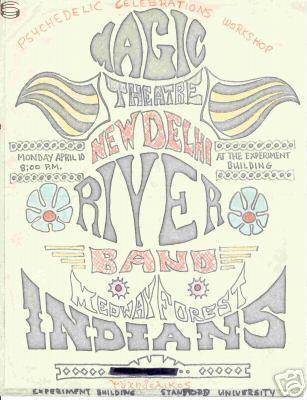
My one whiff of information about "The Experimental Group" is this mysterious poster (h/t Ross)
The poster advertised a "Psychedelic Celebrations Workshop" on Monday, April 10, 1967 at 8:00 pm. The event featured The Magic Theatre, The New Delhi River Band and the Medway Forest Indians. The event seems to have been at 'Experiment Building--Stanford University." Let's parse what we can about this flyer.
The New Delhi River Band and The Magic Theatre were the "house band" and light show at The Barn, in Scotts Valley. At this time, The Barn had just been closed by the Santa Cruz County Sheriff's department. Both NDRB and Magic Theatre lived in Palo Alto, and two of the principals of The Magic Theatre were both former Stanford art students (they were different than the later Berkeley theater troupe of the same name, however). Since the Barn was closed and the band and light show were in town, this has the look of an ad-hoc student event using some local talent.
Where was the Experiment Building? To my knowledge, there was no such building at Stanford. Although I grew up in Palo Alto, I recognize that there may have been something called that, so here are my speculations:
Either or both of these speculations seem reasonable. However, if the building named Experiment (why a noun not an adjective, by the way?) was new or colloquial, why are there no directions? It doesn't say "Experiment Building, on Pampas off Serra St." Wherever the "Experiment Building" was, anyone seeing the poster was supposed to know where it was. Anyone who couldn't figure it out--like Campus Administration--wasn't supposed to know. I have a feeling there was a newly constructed or underused new building that was used temporarily as a playhouse by some enterprising students, and this flyer gave just enough information for those who needed to know it.
The Medway Forest Indians are even more mysterious, and likely another code. The Medway Forest seems to be in London, Ontario, Canada, and I'm hard pressed to say whether there was actually any Tribe associated with the Forest. It seems more probable that this was some bogus student group that sounded plausible, like UC Berkeley's "Pretentious Folk Front."
I believe there is a different, more crudely drawn flyer for a similar event, possibly for sometime in November, 1966, but I can't find the flyer right now. I think the April 10, 1967 event with NDRB was an Acid Test disguised as a 'Psychedelic Celebration,' and on the Stanford Campus at least the code word was "Experiment," since I presume even square administrators had learned about "Acid Tests." This leads me back to thinking that the Wilbur Hall listing that promised "Experiments" was a clear shout out those in the know to leave all of Saturday afternoon and evening free for "A Day In The Wilburness."
Stanford University, founded in 1891 by railroad magnate Leland Stanford, was always a unique institution. However, its current status as a sort of West Coast Ivy, where the children of (smart) Presidents attend alongside other future world leaders, even as new industries are invented in dorm rooms, is a rather more recent development. When founder Leland Stanford died in 1893, the University remained on somewhat shaky financial ground until the mid-1950s. The University was always land rich and cash poor, and as a result a more interesting place than it probably is these days. The finances of Stanford changed dramatically in the 1950s, but the University still remained interesting enough in the 1960s. It was not a coincidence that Ken Kesey started the LSD revolution near Stanford, at Perry Lane in Menlo Park, in the early '60s.
I have reason to believe that the "Happening" listed above in the Berkeley Barb was the last gasp of an older, looser Stanford, mixed in with some 1960s troublemaking, but I am unable to find a reliable eyewitness. Thus, I am using this post to marshal what little evidence I can uncover in the hopes that some reader will Flash Back and find this post and give us clues to what really happened. I can say, however, that there were quite a few interesting rock events in Stanford in the Fall of 1966, yet after this event, Stanford all but eliminated rock music shows. There was one outdoor rock concert in 1967, and one other very interesting event, and two more in 1968, but Stanford seems to have been resolutely against rock music events on campus after Fall 1966.
Did something happen that unsettled the Administration? Could it have been an all-day, acid fueled, multi-building party culminating with Janis Joplin and Big Brother and The Holding Company playing the Wilbur Hall Dormitory Dining Commons? God, I hope so.
"Happening In The Wilburness"
An old Big Brother list mentions a December, 1966 event under the heading "A Happening In The Wilburness." Ross discovered the Barb listing (above, from December 2, 1966) and I am confident this was the same event. Rather than listing the event as a concert, the Barb calls it a "Happening:"
HAPPENING: Big Brother & the Holding Company, lights, film, poetry, jazz, sculpting, experiments; Wilbur Hall, Stanford U.. all day? $1.50Some reasonable speculation suggests the outline of this event. Wilbur Hall was built after World War 2 to handle the incoming volume of students. The "Hall" was actually a complex of 8 residential houses and a central dining commons. It currently houses 707 students, and the grounds cover a substantial area. The Stanford campus has always been sprawling, since its inception, but in the mid-60s the location of Wilbur Hall would have been less developed, as there were considerably fewer labs, classrooms and other buildings on campus (the mailing address is 658 Escondido, but the actual location of the Dining Commons is on Bowdoin Lane, off Campus Drive).
Since there were no less than nine available buildings, plus some open space, the implication seems to be that different activities took place in different parts of the grounds, presumably culminating with a Big Brother concert in the Dining Commons. I have to assume "The Wilburness" was a student nickname for the grounds as a whole. Crowded as the Stanford campus is today, Wilbur Hall would have been more isolated at the time and the name may have been fairly appropriate.
A "Happening" was a 60s term for what would loosely be termed either "Performance Art" or a "Festival" today. I have to assume that the event was at the end of the Fall Quarter, and some insurrectionist students had gotten permission to hold a "Fall Dance" or something, and turned it into a full-on sixties event. I believe the key word here is "experiments," which I think is code for an Acid Test, but I will explain my reasoning subsequently.
Although Stanford was not nearly as urban as Berkeley, the campus had its share of interesting rock events in the Fall of 1966. The Cryptical Development blog has an excellent post on some 1966 and '67 ads for events in the Stanford Daily, including performances by the Grateful Dead, Butterfield Blues Band and Jefferson Airplane. After that Fall, however, as the post shows, Stanford rock events abruptly ceased. There was an outdoor rock concert in May 1967 at the Frost Amphitheater, and a Summer rock concert at Frost in July 1968, but Stanford seems to have simply declared a moratorium on such events. Why? Surely many of the Stanford students wanted to see all the Fillmore bands, who would have been happy to play there on an available Friday night.
Here's what I think happened, although I cannot find proof. Some students got access to some sort of funds for a "Fall Dance" and asked to have a sort of "Festival" at the Wilbur Hall grounds. They probably emphasized art, poetry and jazz to the Administration, who blithely said yes. LSD was legal up until October 6, 1966, and the Kesey crowd was well connected to the Stanford campus. I think the "Experiments" alluded to was a code for an Acid Test--what else would they be experimenting on?--and madness reigned all day and all night on the Wilbur Hall grounds. Why else would the students be very vague to the Barb about the length of the event?
The campus cops probably wondered why no one smelled like whisky, but they must have figured something was up. A full volume concert by Big Brother and The Holding Company must have finished off the evening and the University's patience, because rock music would not be performed at night on the Stanford campus for a very long time.
I can't prove any of this. If any old Stanford students are having odd flashbacks right now, please Comment.
"The Experimental Group"
Palo Alto and Stanford had an interesting bohemian runup to 1966. Ken Kesey had come to Stanford on a writing fellowship in the early 1960s, and his merry bunch got their start just off campus on Perry Lane. Jerry Garcia and other bohemian folkies lived near downtown, as tolerant Palo Alto was unbothered by bearded, draft-dodging ne'er-do-wells. Palo Alto even had it's own Acid Test on December 18, 1965 (and the building is still there). While Kesey went on the lam, and the Dead moved to San Francisco, there was still a modest core of like minded lunatics in Palo Alto and the Santa Cruz Mountains.
The principal core of hip late 60s Palo Alto was the Mid Peninsula Free University (MFU), who began in 1967 in an attempt to provide an educational alternative to Stanford. The MFU story is too long to tell here, but MFU was instrumental in making sure there were free concerts in Palo Alto throughout 1967 and '68, in contravention to less liberal towns. On their now inaccessible website, the MFU founders were associated with some mysterious entity called "The Experimental Group," seemingly an ad-hoc Stanford organization. Who were they?
My one whiff of information about "The Experimental Group" is this mysterious poster (h/t Ross)
The poster advertised a "Psychedelic Celebrations Workshop" on Monday, April 10, 1967 at 8:00 pm. The event featured The Magic Theatre, The New Delhi River Band and the Medway Forest Indians. The event seems to have been at 'Experiment Building--Stanford University." Let's parse what we can about this flyer.
The New Delhi River Band and The Magic Theatre were the "house band" and light show at The Barn, in Scotts Valley. At this time, The Barn had just been closed by the Santa Cruz County Sheriff's department. Both NDRB and Magic Theatre lived in Palo Alto, and two of the principals of The Magic Theatre were both former Stanford art students (they were different than the later Berkeley theater troupe of the same name, however). Since the Barn was closed and the band and light show were in town, this has the look of an ad-hoc student event using some local talent.
Where was the Experiment Building? To my knowledge, there was no such building at Stanford. Although I grew up in Palo Alto, I recognize that there may have been something called that, so here are my speculations:
- There was a lot of new building on campus at the time, and this may have been a temporary name for a building
- This may have been a student nickname for a building that really went by another name
Either or both of these speculations seem reasonable. However, if the building named Experiment (why a noun not an adjective, by the way?) was new or colloquial, why are there no directions? It doesn't say "Experiment Building, on Pampas off Serra St." Wherever the "Experiment Building" was, anyone seeing the poster was supposed to know where it was. Anyone who couldn't figure it out--like Campus Administration--wasn't supposed to know. I have a feeling there was a newly constructed or underused new building that was used temporarily as a playhouse by some enterprising students, and this flyer gave just enough information for those who needed to know it.
The Medway Forest Indians are even more mysterious, and likely another code. The Medway Forest seems to be in London, Ontario, Canada, and I'm hard pressed to say whether there was actually any Tribe associated with the Forest. It seems more probable that this was some bogus student group that sounded plausible, like UC Berkeley's "Pretentious Folk Front."
I believe there is a different, more crudely drawn flyer for a similar event, possibly for sometime in November, 1966, but I can't find the flyer right now. I think the April 10, 1967 event with NDRB was an Acid Test disguised as a 'Psychedelic Celebration,' and on the Stanford Campus at least the code word was "Experiment," since I presume even square administrators had learned about "Acid Tests." This leads me back to thinking that the Wilbur Hall listing that promised "Experiments" was a clear shout out those in the know to leave all of Saturday afternoon and evening free for "A Day In The Wilburness."
Friday, December 3, 2010
March 5, 1970: Freight and Salvage, Berkeley, CA: Peter Rowan and Richard Greene
(the panel from Thursday, March 5, 1970, for the Freight and Salvage calendar from March 1970)
Time, as Steve Miller informs us, keeps on slipping, slipping, slipping into the future. It is thus easy to look back and lose sight of the context of historical artifacts. The specific panel above is from the March 1970 performance calendar for Berkeley's Freight and Salvage club. The Freight opened in July 1968, and despite (or because of) being run by long-haired hippies, it was thoroughly committed to traditional forms of music in all its diversity. Each calendar featured a few dozen miniature panels for each performance (the March 1970 Freight calendar can be seen in its entirety here), and they serve as journals for the psychedelic artwork current at the time, yet they are overlooked because of their tiny size and because "folk" music is not as officially "psychedelic" as rock music from the same period.
Nonetheless, our detailed analysis of the founding of the Freight and Salvage reveals a number of surprising details about rock history. As we have detailed at length in our early history of the Freight and Salvage, the club served a variety of social and musical functions in late '60s Berkeley. One of those functions was to provide an outlet for musicians in rock bands to play the traditional music that had initially inspired them. Many of the rock musicians of the late 60s and early 70s had gotten started in music by playing bluegrass, blues or folk music in folk clubs; Jerry Garcia, Janis Joplin and Jorma Kaukonen were among the most prominent of those in the Bay Area. Yet many other band members around the Bay Area had similar stories.
The group Seatrain was based in Marin County, but its roots were on the East Coast. A few members of the Blues Project (bassist Andy Kulberg and drummer Roy Blumenfield) had moved from East to West, and after completing some contractual obligations (the Blues Project album Planned Obsolescence) formed the group Sea Train. After an initial album, they elided their name to Seatrain, and added East Coast pal Peter Rowan on guitar and vocals, along with the Californian Richard Greene on violin. Greene and Rowan had played together in Bill Monroe's Bluegrass Boys, and Greene had wide experience in various ensembles, including recording with the Gary Burton Quartet (on the 1969 lp Throb). Rowan had been in Earth Opera with David Grisman, who recorded two albums for Elektra, but the band had exploded mid-tour in California in 1969.
By late 1969, Peter Rowan was working with Seatrain in Marin. Rowan, Richard Greene and various other members of Seatrain regularly played acoustic shows at the Freight and Salvage in late 1969 and early 1970 (we have extensively documented the the 1968-69 Freight here). Whether they played "acoustic Seatrain," bluegrass or other original material isn't entirely clear, but the little panel on the March 1970 calendar gives an intriguing clue. The March 5 listing says "Peter Rowan--alias Panama Red." Other listings at the Freight from around that time advertise "Panama Red and Richard Greene," and yet others list Rowan, Greene and other members of Seatrain by name.
Peter Rowan first bubbled out into rock consciousness as the writer of "Panama Red," the title track of the October 1973 New Riders of The Purple Sage album of the same name. Lucky Deadheads in the Bay Area who had seen Rowan play with Jerry Garcia and David Grisman in their bluegrass band Old And In The Way, or heard various local FM broadcasts, knew that Old And In The Way had been doing their version of "Panama Red" as well (both OAITW and the Riders also did Rowan's "Lonesome LA Cowboy"). I have discussed the early, misty origins of Old And In The Way elsewhere, but suffice to say it isn't hard to guess where the New Riders heard the song. The Riders catchy country rock version of the song received regular airplay both on rock stations like KSAN and soon afterwards on the groundbreaking "psychedelic country" station KFAT, out of Gilroy, CA.
"Panama Red" was a perfect mid-70s rock song, catchy and hummable, naughty enough to guarantee no AM airplay, but coded enough to escape the notice of imaginary authority figures (as if High School principals were analyzing rock lyrics). Indeed, as Panama Red itself was replaced by more potent forms of THC, the song itself became a paean to a more carefree era. When the Old And In The Way version was finally released on their 1975 album, the imprimatur of Jerry Garcia assured the song's immortality. Rowan became a popular alternative country rock figure, and new songs like "Free Mexican Airforce" became staples on KFAT. Rowan has had a diverse and successful career ever since, and he continues to tour and record.
It's easy to be nostalgic about Peter Rowan, "Panama Red" and days gone by--I certainly am--but a closer look at the evidence introduces a slightly different twist to the narrative. The Freight and Salvage poster frame celebrating Peter Rowan as Panama Red excerpted above is from March, 1970--a full three years before Old And In The Way and the New Riders started performing the song. Not only had Rowan probably already written the song by 1970, but apparently "Panama Red" was already some sort of performing alter ego for him. "Panama Red" seemed racy and coded enough for 1973, but the song may have been written as early as 1969, when it would have been downright subversive.
Seatrain recorded a number of albums for Capitol, but Peter Rowan had left the group by 1972. I have to assume that Capitol had rejected "Panama Red," or that the band refused to even consider showing it to them. By 1973, Rowan didn't even have a band, so letting the New Riders sing his catchiest song must have been a relief to Rowan, even if he may have been professionally frustrated. Yet it's intriguing to think that the catchiest weed song of 1973, a sort of early Anglo narcocorrido, had been too hot to handle for some years. It's also funny to think that the Freight and Salvage, often chastised back in the day for being too quiet and too serious (people couldn't even smoke!), was the only venue where Rowan's songwriting gems may have revealed themselves, as a true folk tradition in the making.
Although many fine folk artists have played the Freight every month since it's inception (see for yourself), a closer look shows the implicit rock links to the Berkeley folk scene. A few groups who would become Fillmore West and Winterland regulars are already playing there, such as Commander Cody and Joy Of Cooking, and more serious scholars may recognize some connections to the likes of the Diggers and Owsley Stanley. Rowan was a former member of Bill Monroe's Bluegrass Boys, and certainly earned his credentials as a folk musician many years before, but he too was another Freight musician who would make "folk" a part of rock music yet to come.
Time, as Steve Miller informs us, keeps on slipping, slipping, slipping into the future. It is thus easy to look back and lose sight of the context of historical artifacts. The specific panel above is from the March 1970 performance calendar for Berkeley's Freight and Salvage club. The Freight opened in July 1968, and despite (or because of) being run by long-haired hippies, it was thoroughly committed to traditional forms of music in all its diversity. Each calendar featured a few dozen miniature panels for each performance (the March 1970 Freight calendar can be seen in its entirety here), and they serve as journals for the psychedelic artwork current at the time, yet they are overlooked because of their tiny size and because "folk" music is not as officially "psychedelic" as rock music from the same period.
Nonetheless, our detailed analysis of the founding of the Freight and Salvage reveals a number of surprising details about rock history. As we have detailed at length in our early history of the Freight and Salvage, the club served a variety of social and musical functions in late '60s Berkeley. One of those functions was to provide an outlet for musicians in rock bands to play the traditional music that had initially inspired them. Many of the rock musicians of the late 60s and early 70s had gotten started in music by playing bluegrass, blues or folk music in folk clubs; Jerry Garcia, Janis Joplin and Jorma Kaukonen were among the most prominent of those in the Bay Area. Yet many other band members around the Bay Area had similar stories.
The group Seatrain was based in Marin County, but its roots were on the East Coast. A few members of the Blues Project (bassist Andy Kulberg and drummer Roy Blumenfield) had moved from East to West, and after completing some contractual obligations (the Blues Project album Planned Obsolescence) formed the group Sea Train. After an initial album, they elided their name to Seatrain, and added East Coast pal Peter Rowan on guitar and vocals, along with the Californian Richard Greene on violin. Greene and Rowan had played together in Bill Monroe's Bluegrass Boys, and Greene had wide experience in various ensembles, including recording with the Gary Burton Quartet (on the 1969 lp Throb). Rowan had been in Earth Opera with David Grisman, who recorded two albums for Elektra, but the band had exploded mid-tour in California in 1969.
By late 1969, Peter Rowan was working with Seatrain in Marin. Rowan, Richard Greene and various other members of Seatrain regularly played acoustic shows at the Freight and Salvage in late 1969 and early 1970 (we have extensively documented the the 1968-69 Freight here). Whether they played "acoustic Seatrain," bluegrass or other original material isn't entirely clear, but the little panel on the March 1970 calendar gives an intriguing clue. The March 5 listing says "Peter Rowan--alias Panama Red." Other listings at the Freight from around that time advertise "Panama Red and Richard Greene," and yet others list Rowan, Greene and other members of Seatrain by name.
Peter Rowan first bubbled out into rock consciousness as the writer of "Panama Red," the title track of the October 1973 New Riders of The Purple Sage album of the same name. Lucky Deadheads in the Bay Area who had seen Rowan play with Jerry Garcia and David Grisman in their bluegrass band Old And In The Way, or heard various local FM broadcasts, knew that Old And In The Way had been doing their version of "Panama Red" as well (both OAITW and the Riders also did Rowan's "Lonesome LA Cowboy"). I have discussed the early, misty origins of Old And In The Way elsewhere, but suffice to say it isn't hard to guess where the New Riders heard the song. The Riders catchy country rock version of the song received regular airplay both on rock stations like KSAN and soon afterwards on the groundbreaking "psychedelic country" station KFAT, out of Gilroy, CA.
"Panama Red" was a perfect mid-70s rock song, catchy and hummable, naughty enough to guarantee no AM airplay, but coded enough to escape the notice of imaginary authority figures (as if High School principals were analyzing rock lyrics). Indeed, as Panama Red itself was replaced by more potent forms of THC, the song itself became a paean to a more carefree era. When the Old And In The Way version was finally released on their 1975 album, the imprimatur of Jerry Garcia assured the song's immortality. Rowan became a popular alternative country rock figure, and new songs like "Free Mexican Airforce" became staples on KFAT. Rowan has had a diverse and successful career ever since, and he continues to tour and record.
It's easy to be nostalgic about Peter Rowan, "Panama Red" and days gone by--I certainly am--but a closer look at the evidence introduces a slightly different twist to the narrative. The Freight and Salvage poster frame celebrating Peter Rowan as Panama Red excerpted above is from March, 1970--a full three years before Old And In The Way and the New Riders started performing the song. Not only had Rowan probably already written the song by 1970, but apparently "Panama Red" was already some sort of performing alter ego for him. "Panama Red" seemed racy and coded enough for 1973, but the song may have been written as early as 1969, when it would have been downright subversive.
Seatrain recorded a number of albums for Capitol, but Peter Rowan had left the group by 1972. I have to assume that Capitol had rejected "Panama Red," or that the band refused to even consider showing it to them. By 1973, Rowan didn't even have a band, so letting the New Riders sing his catchiest song must have been a relief to Rowan, even if he may have been professionally frustrated. Yet it's intriguing to think that the catchiest weed song of 1973, a sort of early Anglo narcocorrido, had been too hot to handle for some years. It's also funny to think that the Freight and Salvage, often chastised back in the day for being too quiet and too serious (people couldn't even smoke!), was the only venue where Rowan's songwriting gems may have revealed themselves, as a true folk tradition in the making.
Although many fine folk artists have played the Freight every month since it's inception (see for yourself), a closer look shows the implicit rock links to the Berkeley folk scene. A few groups who would become Fillmore West and Winterland regulars are already playing there, such as Commander Cody and Joy Of Cooking, and more serious scholars may recognize some connections to the likes of the Diggers and Owsley Stanley. Rowan was a former member of Bill Monroe's Bluegrass Boys, and certainly earned his credentials as a folk musician many years before, but he too was another Freight musician who would make "folk" a part of rock music yet to come.
Thursday, November 11, 2010
Rhythm Dukes Performance List: January-July 1970 (with Jerry Miller and Bill Champlin)
(a scan of a poster for Lee Michaels, The Rhythm Dukes and Robert M. Savage at The Family Dog On The Great Highway, March 6-8, 1970)
I did extensive research into the performance history of The Sons Of Champlin from 1966 through mid-1970, and as a result I became familiar with the history of The Rhythm Dukes. The Rhythm Dukes were a Santa Cruz Mountains band from 1969 to about 1972, with various members, but they were founded by Jerry Miller and Don Stevenson of Moby Grape, so the Dukes have always been historically associated with The Grape. However, after a variety of somewhat mysterious personnel changes in late 1969, The Rhythm Dukes were revitalized in 1970 when Bill Champlin joined Miller and the rhythm section to make a somewhat serious attempt at success. Some recorded evidence suggests that this configuration was a terrific band, if short-lived, and I felt I should document what I have been able to find out about their performing history.
The Rhythm Dukes
I wrote about a 1969 version of The Rhythm Dukes elsewhere, specifically about a surviving tape from December 1969 at The Family Dog, so I will not repeat all of it here. Suffice to say, the original formulation of The Rhythm Dukes featured both Miller and fellow Graper Don Stevenson, along with bassist John Barrett and drummer Fuzzy Oxendine, all of whom shared a house in the Santa Cruz Mountains. Although Stevenson had been the drummer in Moby Grape, he played guitar and shared vocals in the Dukes. The original Rhythm Dukes did one tour in the Summer of 1969, but they were often billed as Moby Grape, much to their dismay. Sometime in the Fall, Stevenson left the group.
The Rhythm Dukes played a number of Bay Area shows in Fall 1969, but the exact lineup or lineups remains a mystery. The surviving tape features a five piece band, with Jerry Miller as the sole lead vocalist, and a saxophonist as well as a pianist/rhythm guitarist joining Oxendine and Barrett. The material is also obscure, although they sound pretty good for an opening act at The Family Dog.
The Sons Of Champlin
I have written an extensive performance history of The Sons, so I needn't recap it. However, by early 1970, despite a loyal Bay Area following and two excellent Capitol albums, the Sons were frustrated and broke and they decided to go "on hiatus." Effectively that meant they were breaking up, although they continued to finish an album they owed Capitol (released in 1971 as Follow Your Heart). How the plan for Champlin to join The Rhythm Dukes came about remains unknown, and since band members are usually cagey about their future plans (so as not to offend their current bandmates), I'm not aware of how long the idea was afoot. Nonetheless, Moby Grape and The Sons Of Champlin went way back together, and I suspect that Miller and Champlin knew each other from their predecessor bands as well (The Frantics and Opposite Six, respectively). More importantly, bassist Barrett and drummer Oxendine had been in a band called Boogie that rehearsed at the Sausalito Heliport along with The Sons. Oxendine had even been in The Sons briefly in mid-69, when the band experimented with having two drummers. So there were plenty of connections between Bill Champlin and the other members of the Rhythm Dukes.
Bill Champlin played his first show with The Rhythm Dukes in January, 1970. After The Sons gave their "Farewell" performance on February 21, 1970, Champlin moved to the Santa Cruz Mountains and made The Rhythm Dukes his primary musical endeavor. What follows is my chronicle of the known performances of The Rhythm Dukes with Bill Champlin. Anyone with additional information, updates, insights or corrections is encouraged to email me or put them in the Comments.
Rhythm Dukes Performance History January-June 1970
January 7, 1970: The Matrix, San Francisco, CA: Rhythm Dukes w/Jerry Miller and Bill Champlin
The Sons were still actively touring at this juncture, but Bill Champlin joined the Rhythm Dukes for this Wednesday night show at The Matrix. The show was mentioned in Ralph J. Gleason's SF Chronicle column that day (above).
>February 20-21, 1970: Family Dog At the Great Highway, San Francisco, CA: Big Brother and The Holding Company with Nick Gravenites/Rhythm Dukes with Jerry Miller and Bill Champlin
Because the poster for this shows circulates comparatively widely (for a Family Dog On The Great Highway event), it often represents one of the few ways in which the Miller/Champlin collaboration was known. However, the dates on this poster conflicts with the heavily publicized shows the Sons played as their "farewell" shows (Berkeley on Friday February 20, and Contra Costa Fairgrounds on February 21). However, a close look at the SF Chronicle listings for the weekend show that Cat Mother and The All Night Newsboys had replaced The Rhythm Dukes at The Family Dog.
March 4, 1970: High Street Local, (Santa Cruz), CA: Rhythm Dukes
This show is known from a J.Freiermuth poster on the Rhythm Dukes website, although I don't know the exact address of the venue. There's every reason to assume that the Rhythm Dukes played a fair number of shows in the Santa Cruz/Monterey area, particularly on weeknights. However, the Santa Cruz area was much less populated than it is now, and while the shows were probably very fun, the club scene would not have been that lucrative.
March 6-8, 1970: Family Dog at The Great Highway, San Francisco, CA: Lee Michaels/Rhythm Dukes/Robert M Savage
An eyewitness reported that Lee Michaels was “impossibly loud.” This would probably have been the effective debut of the Champlin/Miller version of The Rhythm Dukes in the Bay Area (poster up top).
March 11, 1970: High Street Local, (Santa Cruz), CA: Rhythm Dukes
March 20-21, 1970: New Orleans House, Berkeley, CA: Rhythm Dukes
The New Orleans House was Berkeley's home for original rock music, giving groups that were lower on the bill at the Fillmore West or Family Dog a chance to headline.
April 3, 1970: Civic Auditorium, Santa Cruz, CA: Rhythm Dukes/Snail/Joint Possession
This show is known from a Richard Moore poster on the Rhythm Dukes site. It is interesting for a number of reasons. Opening act Snail had evolved out of two local bands, Talon Wedge and The Bubble, and they would go on to be local heroes for the next several years, even putting out two albums. Snail never made much headway outside of Santa Cruz County, but they remain a headline act in Santa Cruz clubs even today (they have a reunion every decade or so).
Equally interesting is the use of Santa Cruz Civic Auditorium. The Civic, at 307 Church, would have been the perfect 60s rock venue, in a hip college town not far from San Francisco, but for a variety of reasons the City of Santa Cruz refused to sanction that. Their refusal opened the door for the temporary success of The Barn, a much wilder venue a few miles Northeast, in Scotts Valley, and I have discussed the history of The Barn elsewhere. This show headlined by The Rhythm Dukes seems to be the first to use the Civic for a rock show since 1967, and that is an interesting piece of Santa Cruz rock history in its own right.
April 10-12, 1970: Family Dog at The Great Highway, San Francisco, CA: Albert Collins/Rhythm Dukes/A.B. Skhy
On April 16, 1970, old friend Bruce Walford recorded a demo tape of The Rhythm Dukes at The Sons’ rehearsal facility (The Church in San Anselmo). The 10 tracks appear to be recorded live in the studio, with some modest piano and harmony vocal overdubs from Bill Champlin. Bill sings lead on 8 of the 10 tracks, all but one of which turned up in some form in the Sons repertoire in the next few years (the exception was a cover of “Kansas City”). The Rhythm Dukes, however, had a more laid-back bluesy feel than the Sons uptempo, swinging sound. The material was officially but privately released (a mere 34 years later) on a cd entitled Flash Back. The accompanying Rhythm Dukes website has some nice photos of the band and posters.
April 23-25, 1970: The Matrix, San Francisco, CA: The Rhythm Dukes w/Jerry Miller and Bill Champlin
May 1, 1970: Gym, Monterey Peninsula College, Monterey, CA: Rhythm Dukes/Potter’s Wheel
For about a year, thanks to the Millard Agency (Bill Graham's booking agents) and some local promoters, there were regular rock shows in the Monterey area, mostly at the gym at the local Junior College. This little scene did not quite have the momentum to sustain itself, but many San Francisco-area bands played there for that year.
This show is known from the Richard Moore poster on the Dukes website. Potter's Wheel was the Santa Cruz incarnation of a Bay Area band called Phoenix.
May 22-23, 1970: New Orleans House, Berkeley, CA: Rhythm Dukes w/Bill Champlin/Nargul
June ?, 1970: The Matrix Rhythm, San Francisco, CA: Dukes w/Jerry Miller and Bill Champlin
A poorly reproduced May/June 1970 Matrix calendar makes the exact date difficult to read.
June 19-21, 1970: Family Dog at The Great Highway, San Francisco, CA: Flying Burrito Brothers/Cat Mother and The All Night Newsboys/Rhythm Dukes with Bill Champlin, Jerry Miller
June 27, 1970: Gym, Cabrillo College, Aptos, CA: Elvin Bishop/Rhythm Dukes/Snail
Cabrillo College was a Junior College in Aptos, not far from the UC Santa Cruz campus. It's not clear when Bill Champlin left the Rhythm Dukes, but since he was booked at the Family Dog the week before, I have to think that he played this show as well.
July 3, 1970: The Matrix, San Francisco, CA: Bill Champlin and Friends
It's not at all clear if this was a Rhythm Dukes show or Bill playing with other musicians. I am more likely that to believe the latter. The exact date of Champlin’s departure from the Rhythm Dukes is unknown.
At some point in the Summer, Bill Champlin moved back to Marin County. He may have finished a few shows with the Rhythm Dukes, but he left the band and they continued on without him. Champlin started to hang out at The Lion's Share in San Anselmo, playing impromptu gigs with various musicians, including former members of The Sons. One thing led to another, and by September, 1970 The Sons Of Champlin were back in business under the improbable name of Yogi Phlegm. They rapidly returned to their original name, however, and went on to long career--with some significant interruptions--that is still lively today.
The Rhythm Dukes continued on until about 1972, weathering not only Bill Champlin's departure in 1970 but Jerry Miller's departure in 1971, when Moby Grape reformed once again. What little recorded evidence remains of The Rhythm Dukes suggested they were an excellent live band, although an actual live tape of the Dukes with Champlin remains elusive. The Rhythm Dukes have even been known to reform on occasion, including once in 1992 at the Crow's Nest in Santa Cruz, when Bill Champlin joined in once again.
I did extensive research into the performance history of The Sons Of Champlin from 1966 through mid-1970, and as a result I became familiar with the history of The Rhythm Dukes. The Rhythm Dukes were a Santa Cruz Mountains band from 1969 to about 1972, with various members, but they were founded by Jerry Miller and Don Stevenson of Moby Grape, so the Dukes have always been historically associated with The Grape. However, after a variety of somewhat mysterious personnel changes in late 1969, The Rhythm Dukes were revitalized in 1970 when Bill Champlin joined Miller and the rhythm section to make a somewhat serious attempt at success. Some recorded evidence suggests that this configuration was a terrific band, if short-lived, and I felt I should document what I have been able to find out about their performing history.
The Rhythm Dukes
I wrote about a 1969 version of The Rhythm Dukes elsewhere, specifically about a surviving tape from December 1969 at The Family Dog, so I will not repeat all of it here. Suffice to say, the original formulation of The Rhythm Dukes featured both Miller and fellow Graper Don Stevenson, along with bassist John Barrett and drummer Fuzzy Oxendine, all of whom shared a house in the Santa Cruz Mountains. Although Stevenson had been the drummer in Moby Grape, he played guitar and shared vocals in the Dukes. The original Rhythm Dukes did one tour in the Summer of 1969, but they were often billed as Moby Grape, much to their dismay. Sometime in the Fall, Stevenson left the group.
The Rhythm Dukes played a number of Bay Area shows in Fall 1969, but the exact lineup or lineups remains a mystery. The surviving tape features a five piece band, with Jerry Miller as the sole lead vocalist, and a saxophonist as well as a pianist/rhythm guitarist joining Oxendine and Barrett. The material is also obscure, although they sound pretty good for an opening act at The Family Dog.
The Sons Of Champlin
I have written an extensive performance history of The Sons, so I needn't recap it. However, by early 1970, despite a loyal Bay Area following and two excellent Capitol albums, the Sons were frustrated and broke and they decided to go "on hiatus." Effectively that meant they were breaking up, although they continued to finish an album they owed Capitol (released in 1971 as Follow Your Heart). How the plan for Champlin to join The Rhythm Dukes came about remains unknown, and since band members are usually cagey about their future plans (so as not to offend their current bandmates), I'm not aware of how long the idea was afoot. Nonetheless, Moby Grape and The Sons Of Champlin went way back together, and I suspect that Miller and Champlin knew each other from their predecessor bands as well (The Frantics and Opposite Six, respectively). More importantly, bassist Barrett and drummer Oxendine had been in a band called Boogie that rehearsed at the Sausalito Heliport along with The Sons. Oxendine had even been in The Sons briefly in mid-69, when the band experimented with having two drummers. So there were plenty of connections between Bill Champlin and the other members of the Rhythm Dukes.
Bill Champlin played his first show with The Rhythm Dukes in January, 1970. After The Sons gave their "Farewell" performance on February 21, 1970, Champlin moved to the Santa Cruz Mountains and made The Rhythm Dukes his primary musical endeavor. What follows is my chronicle of the known performances of The Rhythm Dukes with Bill Champlin. Anyone with additional information, updates, insights or corrections is encouraged to email me or put them in the Comments.
Rhythm Dukes Performance History January-June 1970
January 7, 1970: The Matrix, San Francisco, CA: Rhythm Dukes w/Jerry Miller and Bill Champlin
The Sons were still actively touring at this juncture, but Bill Champlin joined the Rhythm Dukes for this Wednesday night show at The Matrix. The show was mentioned in Ralph J. Gleason's SF Chronicle column that day (above).
>February 20-21, 1970: Family Dog At the Great Highway, San Francisco, CA: Big Brother and The Holding Company with Nick Gravenites/Rhythm Dukes with Jerry Miller and Bill Champlin
Because the poster for this shows circulates comparatively widely (for a Family Dog On The Great Highway event), it often represents one of the few ways in which the Miller/Champlin collaboration was known. However, the dates on this poster conflicts with the heavily publicized shows the Sons played as their "farewell" shows (Berkeley on Friday February 20, and Contra Costa Fairgrounds on February 21). However, a close look at the SF Chronicle listings for the weekend show that Cat Mother and The All Night Newsboys had replaced The Rhythm Dukes at The Family Dog.
March 4, 1970: High Street Local, (Santa Cruz), CA: Rhythm Dukes
This show is known from a J.Freiermuth poster on the Rhythm Dukes website, although I don't know the exact address of the venue. There's every reason to assume that the Rhythm Dukes played a fair number of shows in the Santa Cruz/Monterey area, particularly on weeknights. However, the Santa Cruz area was much less populated than it is now, and while the shows were probably very fun, the club scene would not have been that lucrative.
March 6-8, 1970: Family Dog at The Great Highway, San Francisco, CA: Lee Michaels/Rhythm Dukes/Robert M Savage
An eyewitness reported that Lee Michaels was “impossibly loud.” This would probably have been the effective debut of the Champlin/Miller version of The Rhythm Dukes in the Bay Area (poster up top).
March 11, 1970: High Street Local, (Santa Cruz), CA: Rhythm Dukes
March 20-21, 1970: New Orleans House, Berkeley, CA: Rhythm Dukes
The New Orleans House was Berkeley's home for original rock music, giving groups that were lower on the bill at the Fillmore West or Family Dog a chance to headline.
April 3, 1970: Civic Auditorium, Santa Cruz, CA: Rhythm Dukes/Snail/Joint Possession
This show is known from a Richard Moore poster on the Rhythm Dukes site. It is interesting for a number of reasons. Opening act Snail had evolved out of two local bands, Talon Wedge and The Bubble, and they would go on to be local heroes for the next several years, even putting out two albums. Snail never made much headway outside of Santa Cruz County, but they remain a headline act in Santa Cruz clubs even today (they have a reunion every decade or so).
Equally interesting is the use of Santa Cruz Civic Auditorium. The Civic, at 307 Church, would have been the perfect 60s rock venue, in a hip college town not far from San Francisco, but for a variety of reasons the City of Santa Cruz refused to sanction that. Their refusal opened the door for the temporary success of The Barn, a much wilder venue a few miles Northeast, in Scotts Valley, and I have discussed the history of The Barn elsewhere. This show headlined by The Rhythm Dukes seems to be the first to use the Civic for a rock show since 1967, and that is an interesting piece of Santa Cruz rock history in its own right.
April 10-12, 1970: Family Dog at The Great Highway, San Francisco, CA: Albert Collins/Rhythm Dukes/A.B. Skhy
On April 16, 1970, old friend Bruce Walford recorded a demo tape of The Rhythm Dukes at The Sons’ rehearsal facility (The Church in San Anselmo). The 10 tracks appear to be recorded live in the studio, with some modest piano and harmony vocal overdubs from Bill Champlin. Bill sings lead on 8 of the 10 tracks, all but one of which turned up in some form in the Sons repertoire in the next few years (the exception was a cover of “Kansas City”). The Rhythm Dukes, however, had a more laid-back bluesy feel than the Sons uptempo, swinging sound. The material was officially but privately released (a mere 34 years later) on a cd entitled Flash Back. The accompanying Rhythm Dukes website has some nice photos of the band and posters.
April 23-25, 1970: The Matrix, San Francisco, CA: The Rhythm Dukes w/Jerry Miller and Bill Champlin
May 1, 1970: Gym, Monterey Peninsula College, Monterey, CA: Rhythm Dukes/Potter’s Wheel
For about a year, thanks to the Millard Agency (Bill Graham's booking agents) and some local promoters, there were regular rock shows in the Monterey area, mostly at the gym at the local Junior College. This little scene did not quite have the momentum to sustain itself, but many San Francisco-area bands played there for that year.
This show is known from the Richard Moore poster on the Dukes website. Potter's Wheel was the Santa Cruz incarnation of a Bay Area band called Phoenix.
May 22-23, 1970: New Orleans House, Berkeley, CA: Rhythm Dukes w/Bill Champlin/Nargul
June ?, 1970: The Matrix Rhythm, San Francisco, CA: Dukes w/Jerry Miller and Bill Champlin
A poorly reproduced May/June 1970 Matrix calendar makes the exact date difficult to read.
June 19-21, 1970: Family Dog at The Great Highway, San Francisco, CA: Flying Burrito Brothers/Cat Mother and The All Night Newsboys/Rhythm Dukes with Bill Champlin, Jerry Miller
June 27, 1970: Gym, Cabrillo College, Aptos, CA: Elvin Bishop/Rhythm Dukes/Snail
Cabrillo College was a Junior College in Aptos, not far from the UC Santa Cruz campus. It's not clear when Bill Champlin left the Rhythm Dukes, but since he was booked at the Family Dog the week before, I have to think that he played this show as well.
July 3, 1970: The Matrix, San Francisco, CA: Bill Champlin and Friends
It's not at all clear if this was a Rhythm Dukes show or Bill playing with other musicians. I am more likely that to believe the latter. The exact date of Champlin’s departure from the Rhythm Dukes is unknown.
At some point in the Summer, Bill Champlin moved back to Marin County. He may have finished a few shows with the Rhythm Dukes, but he left the band and they continued on without him. Champlin started to hang out at The Lion's Share in San Anselmo, playing impromptu gigs with various musicians, including former members of The Sons. One thing led to another, and by September, 1970 The Sons Of Champlin were back in business under the improbable name of Yogi Phlegm. They rapidly returned to their original name, however, and went on to long career--with some significant interruptions--that is still lively today.
The Rhythm Dukes continued on until about 1972, weathering not only Bill Champlin's departure in 1970 but Jerry Miller's departure in 1971, when Moby Grape reformed once again. What little recorded evidence remains of The Rhythm Dukes suggested they were an excellent live band, although an actual live tape of the Dukes with Champlin remains elusive. The Rhythm Dukes have even been known to reform on occasion, including once in 1992 at the Crow's Nest in Santa Cruz, when Bill Champlin joined in once again.
Monday, November 1, 2010
7551 Sunset Blvd, Los Angeles, CA: Thee Experience: Performance List March-December 1969
(a scan of an ad for the opening of Thee Experience, at 7551 Sunset Blvd in Los Angeles, for March 14, 1969)
Thee Experience was a rock club in Hollywood at 7551 Sunset Boulevard (at N. Genesee). While only open for about 9 months in 1969, it often gets mentioned in memoirs of the 60s Hollywood rock club. Despite the constant references, there is very little coherent information about the club. Mark and I have been researching performance dates at the club from a variety of sources, and although the resulting list is incomplete, it still provides a useful snapshot. I am posting my information as it currently stands, in the hope that readers can add information about performers or the circumstances around the club. I'm particularly interested in hearing from people who went to the club, even if they don't recall who they saw. It appears from published ads that the club was open 7 nights a week, but I do not know if there were live bands every night. I also gather that Thee Image was consciously attempting to be a cool hangout for musicians and industry folks, but I do not know if it was cleaner, louder or had better food, or just depended on a sort of vibe.
Background
Thee Experience operator Marshall Brevetz had been been an important player in the Miami rock scene. He had a Miami club in late 1967 called Thee Experience, but by early 1968 he needed a bigger place. He found a disused bowling alley and converted it to a psychedelic ballroom called Thee Image. A Tampa, FL group called The Motions moved to Miami and became the house band, changing their name to Blues Image. Thee Image became a major stop on the fledgling underground rock circuit, and most of the top bands played there in 1968 and early 1969. Brevetz also played a key role in the December 1968 Hollywood Pop Festival in Florida, along with future Woodstock promoter Michael Lang. By the end of 1968, however, the Blues Image had been encouraged by the likes of Frank Zappa and Eric Burdon to relocate to Los Angeles, and they did so. Brevetz followed Blues Image to Southern California.
The middle 60s had been the high water mark of live rock on the Sunset Strip in West Hollywood, with the legendary Whisky Au Go Go as the most famous location. By 1969, the Whisky was still thriving, and the record companies were clustered around Hollywood, but as the rock market had become much bigger, the best live bands often bypassed the Sunset Strip as the venues were simply too small. It appears that Hollywood had become more of a hangout and less of a place for touring bands, and smaller clubs that had really been conceived as dance clubs weren't as conducive for the kind of business being conducted in Hollywood.
From what I can tell, Thee Experience was planned as a place where industry people could hang out, and record companies could book their newest bands, giving industry people and local tastemakers a chance to hear them and spread the word. Casual jamming seems to have been encouraged, and there are numerous (if rather vague) tales of numerous players sitting in whenever they were in town. With studios and record companies in Los Angeles and many musicians making their home in Southern California, the idea that a civilian could go to see a hip new band and potentially rub shoulders with the industry and see a late night jam with some heavy players seems very enticing.
The only feature I know for sure about the decor of Thee Experience was that its front had a giant mural of Jimi Hendrix, and the front door was his mouth. Although this seems quite weird, Marshall Brevetz was apparently friendly with Hendrix (and many other stars) so while he may not have had formal permission, Hendrix must have at least been somewhat OK with it (in any case, he seems to have shown up to jam one night in June). Apparently there was a light show, which may have been a little outdated for style conscious LA, but I can't say that for sure. In various references to Thee Image, there are general references to the fact that the club had extremely pretty waitresses, but that may have been a Hollywood thing (and may still be) rather than specifically associated with Thee Image.
The list of performers that we have uncovered generally features bands that were newly signed to labels, or had just released an album, or were on their first National tour. As a result, a number of interesting bands played there, although not big stars. There appears to have been a number of interesting guest appearances, but they are much harder to pin down, and I have only referred to them here when I can identify a date. Anyone with additional information, corrections, insights or recovered memories (real or imagined) is encouraged to Comment or email me.
THEE EXPERIENCE PERFORMANCE LIST March-December 1969
March 14, 1969: T.I.M.E/Blues Image/Steve Young/Magical Berri Lee
No group was listed in the ad for the grand opening on March 14 (above), but Marc managed to figure out who played. Friends and namesake Blues Image had been signed by Atco and had released their debut album in February 1969, so in that respect they fit the Thee Experience mold: hip, connected and with a debut album on a major label.
T.I.M.E was a new band socially connected to Steppenwolf. Steve Young was a singer/songwriter. I have no idea about Berri Lee and his or her magic.
Marc discovered that Thee Experience was apparently open every night of the week. We assume that groups like Rockin Foo played on the weeknights, and the relatively bigger names played the weekends.
March 27-29, 1969: Alice Cooper/Slim Harpo/Rockin Foo
Alice Cooper (a band at the time, rather than just lead singer Vincent Furnier) had been signed to Frank Zappa's Bizarre label (a Warners subsidiary), but they would not release their debut album until August.
April 3, 1969: Albert Collins/Linn County
April 4-5, 1969: T.I.M.E./Albert Collins/Linn County
Linn County was a Cedar Rapids, IA band that had relocated to San Francisco. They had already released their first album on Mercury.
April 10-12, 1969: AB Skhy/Fair Befall/Rockin Foo
AB Skhy were a progressive blues band from Milwuakee, WI, who had recently relocated to San Francisco. They featured organist Howard Wales.
April 17, 1969: Blues Image/Blues Magoos/Rockin Foo
This seems like a fairly late performance for The Blues Magoos.
April 18, 1969: Blues Image/Southwind/Rockin Foo/Black Pearl
Southwind were from Oklahoma, but they had relocated to Los Angeles. They had an obscure debut album, and then released a 1970 album on Blue Thumb, Ready To Ride. Singer/guitarist John "Moon" Martin had success later as a songwriter, including "Cadillac Walk" (Mink DeVille) and "Bad Case Of Loving You" (Robert Palmer).
April 19, 1969: Pogo/Blues Image/Rockin Foo
Pogo was still a fairly new group at this time. Their first album would not be released until May, by which time there name had been changed to Poco. The group was probably a quartet at this time, as bassist Randy Meisner had left during the recording of their debut. Guitarist Jim Messina took over the bass chores during this period.
April 24-25, 1969: Flying Burrito Brothers/Junior Markham and The Tulsa Rhythm Review/Bobby Doyle
Although the Flying Burrito Brothers had been together for some time, they had played very few live shows. Despite their immense talent and wonderful songwriting, they were a very erratic live band.
I'm fairly certain that Junior Markham and the Tulsa Rhythm Review were a loose aggregation of Oklahoma area players like Don Nix, Jessie Ed Davis and Jimmy Karstein. These guys were studio regulars and toured with different acts, but they liked to have some fun on their own. Delaney and Bonnie and Friends were a similar organization, and they may have shared some members.
May 1-3, 1969: Colwell-Winfield Blues Band/T.I.M.E/Blues Magoos
May 8-10, 1969: Screaming Lord Sutch/Mighty Fat/Fields
Lord Sutch, an English rock and roller known as Screaming Lord Sutch, was a legendary English figure, sort of a pre-Beatles Alice Cooper. Despite Sutch's lack of vocal talent, he was a charismatic and entertaining character.
May 15, 1969: Illinois Speed Press/Linn County/C.K. Strong
May 16, 1969: Linn County/C.K. Strong
May 17, 1969: Blues Image/Linn County/C.K. Strong
Illinois Speed Press had been signed by Columbia and relocated to Los Angeles. They had just released their first album. CK Strong featured singer Lynn Carey, later to become a sort of legend due to the album cover of her of next band, Mama Lion (google it yourself, but not at work).
May 22-24: Joanne Vent/Congress Of Wonders/Rockin Foo
May 27-28, 1969: John Lee Hooker/Earl Hooker/Blues Image
May 29-31, 1969: John Lee Hooker/Earl Hooker/Golden Earring
May 29-31, 1969: John Lee Hooker/Golden Earring/Earl Hooker
Golden Earring were already a popular group in Holland, but not known in the States. Some years later they would have a big Top 40 hit with "Radar Love." I think they still perform.
June 5, 1969: Sons of Champlin/Tsong
The Sons Of Champlin were a funky, sophisticated band from San Francisco who had just released their first album on Capitol, Loosen Up Naturally.
June 6-7, 1969: Blues Image/Tsong
June 8, 1969: Tsong
June 9-11, 1969: Joe Cocker and The Grease Band/Bluesberry Jam
Joe Cocker and The Grease Band were on tbeir first American tour, and this would probably have been one of their first Stateside shows. Bluesberry Jam was a local blues group. They would later evolve into the group P, G and E.
June 12, 1969: Southwind/Bangor Flying Circus
June 13-14, 1969: Blues Image/Southwind/Bangor Flying Circus
June 16-17, 1969: Lord Sutch
Apparently Jimi Hendrix showed up to jam one night.
June 19, 1969: Larry Coryell/Bonzo Dog Band
June 20-21, 1969: Larry Coryell/Bluesberry Jam
The story of the Bonzos is too long (and too unbelievable) to tell here, but they were an influential, one-of-a-kind band whose impact far outweighed their modest record sales. Anyone lucky enough to have seen the show would have, among other things, found out the musical answer to the age-old question "Can Blue Men Sing The Whites?"
June 26, 1969: Roxy/Rockin Foo
June 27-28, 1969: Blues Magoos/Roxy/Rockin Foo
July 3, 1969: Eric Burdon/C.K. Strong
Eric Burdon's activities during this period were somewhat mysterious. He wasn't playing with War yet, but he was supporting a Best Of album by playing a few shows. Its not clear who he played with, but he did at least some shows with Blues Image, so perhaps he played with them here. Possibly he just sat in with someone who was booked at the club. However, since Burdon was billed for three nights at Fillmore West on the weekend (July 4-6), this show may have been a warmup gig to get the music together.
July 4-5, 1969: Lonnie Mack/Southwind
July 6, 1969: Lonnie Mack/C.K. Strong
July 10-12, 1969: Illinois Speed Press/Charity
July 13, 1969: Fields/Jerome
July 18-19, 1969: Poco/The Baby/C.K. Strong
July 20, 1969: Jerome/Armageddon/Fat Legs
July 21-23, 1969: Charlie Musslewhite/Roxy/Fat Legs
August 7-10, 1969: Grand Funk Railroad,/The Baby/Stoneface
Grand Funk Railroad had just released their Capitol debut On Time. Its clear that Thee Experience was positioning itself to be the Hollywood debut for bands that had just released their debut albums. Such bookings probably guaranteed that the record companies bought a lot of tickets and paid for a lot of drinks.
August 11-13, 1969: Tyrannosaurus Rex
Tyrannosaurus Rex were a hippie folk duo at this time, featuring guitarist Marc Bolan and conga player Steve Took. They had a sort of spacey, Tolkienesque vibe, quite a long way from the hard rocking glam music that would make Bolan famous in T-Rex.
August 14-17, 1969: Spencer Davis Group/SRC
The Spencer Davis group had reconstituted itself after Steve Winwood had departed. SRC was a well regarded power trio from Detroit.
August 18-20, 1969: Buddy Miles Express/Thumper
August ?, 1969: Bonzo Dog Band
September 4, 1969: Elvin Bishop/The Crow/Sun Country
Elvin Bishop was signed to Bill Graham's label, a Columbia subsidiary. I'm not sure of the exact timing of his debut album, which was released sometime in 1969, but although Bishop was an established club and concert attraction in San Francisco, this would have been an opportunity to introduce him to the Los Angeles based music industry.
September 5-7, 1969: Delaney and Bonnie and Friends/Sun Country
In 1968, Delaney and Bonnie had mainly been playing in the Topanga Corral in Topanga Canyon. They had a number of fine transplants from Oklahoma and thereabouts playing in their group, many of them also working days in the studio, such as Carl radle and Leon Russell. Delaney and Bonnie had released a little noticed album on Stax in early 1969, but in mid-1969 they had released their album Accept No Substitute on Elektra. The album came to the attention of Eric Clapton (via George Harrison, apparently) and Delaney & Bonnie had opened for Blind Faith for their mammoth Summer '69 American tour.
September 8-11, 1969: Blues Image
September 18-20, 1969: PG&E/The Litter/South
PG& E had evolved from the Bluesberries.
September 21-23, 1969: Merryweather/Jerome
Neil Merryweather was a Canadian musician who had come to California via Chicago.
September 24, 1969: Jean Luc Ponty Experience with the George Duke Trio
This show was recorded for a live album with George Duke on Fender piano, John Heard on bass and Dick Bock on drums. There were probably several more shows. These were Jean Luc Ponty's American debut, and it seems that these shows were how Frank Zapppa discovered both Ponty and George Duke.
September ?, 1969: James Cotton
October 2-5, 1969: Flying Burrito Brothers/Lighthouse/Rockin Foo
Lighthouse was a Canadian group led by drummer Skip Propop.
October 10-11, 1969: Poco/Stonehenge/Smoke
TIm Schmidt had joined Poco as bassist by this time, returning them to a quintet.
October 16-18, 1969: Big Mama Thornton/Bluesberry
Since PG& E had evolved out of the Bluesberries, I'm not sure who "Bluesberry" might have been. Perhaps part of the band kept going under the old name.
October 19-22, 1969: Southwind/Linn County
October 23-26, 1969: Charles Lloyd/Baby Tsong/Bonzo Dog Band
Tenor saxophonist/flautist Charles Lloyd did not tour that much during this period, as he was mostly studying Transcendental Meditation in Los Angeles, but he was still an exceptional player.
October 29-November 1, 1969: Albert Collins
November 20-23, 1969: Red Hot And Low Down with Barry Goldberg
November 28-29, 1969: Frank Zappa/Captain Beefheart
Zappa had broken up the Mothers in August. His lineup was either FZ, Artie Tripp, Jeff Simmons and Ian Underwood, or FZ, Underwood, Captain Beefheart, Sugarcane Harris, Max Bennett and a drummer, possibly Ralph Humphrey. Zappa played gigs with various one-off lineups during this period.
[update] Bruno and leading FZ scholar Charles Ulrich confirm that Zappa's lineup was FZ/Tripp/Simmons/Underwood. Captain Beefheart and His Magic Band were also on the bill.
December 1, 1969: Richard Groove Holmes
December 4-6, 1969: Captain Beefheart/TIME
I do not know who was in Captain Beefheart's band at this time. TIME was a group of mostly Toronto transplants, socially and musically connected to Steppenwolf.
After December, the trail of Thee Experience grows cold. I think the club closed around this time, but closures are never advertised like openings. The idea of a destination club for up and coming bands was an idea somewhat ahead of its time, although it would be successfully executed a few later when The Roxy opened. Marshall Brevetz would go on to open Thee Club in 1970, a sort of rock and roll supper club. This too was ahead of its time, but in 1970 rock fans did not have the money or inclination to pay for a fine meal as part of their rock and roll menu. As fans got older, ate better and had more stable incomes, the idea began to make more sense. To some extent this concept was copied by the Rainbow Bar and Grill, upstairs from The Roxy, although the Rainbow did not have performers.
Marshall Brevetz was an interesting character, and friends with many of the bands he booked. He seems to have a great feel for seeing trends before they happened, whether outdoor rock festivals or happening nightclubs, but he never managed to put all the pieces together. He went on to produce films and manage Bobby Womack, among other things, and he would probably have quite an interesting story to tell, but he passed away in 1986.
Update: Tales From The Kitchen Of Thee Experience
Although you'll have to embiggen this to read it, it's worth it. Roger Martin of Lawrence, KS was a dishwasher at Thee Experience in 1969. When he returned to Kansas, he wrote about it in the local underground paper, Public Notice. If you've read this far, check it out.
Thee Experience was a rock club in Hollywood at 7551 Sunset Boulevard (at N. Genesee). While only open for about 9 months in 1969, it often gets mentioned in memoirs of the 60s Hollywood rock club. Despite the constant references, there is very little coherent information about the club. Mark and I have been researching performance dates at the club from a variety of sources, and although the resulting list is incomplete, it still provides a useful snapshot. I am posting my information as it currently stands, in the hope that readers can add information about performers or the circumstances around the club. I'm particularly interested in hearing from people who went to the club, even if they don't recall who they saw. It appears from published ads that the club was open 7 nights a week, but I do not know if there were live bands every night. I also gather that Thee Image was consciously attempting to be a cool hangout for musicians and industry folks, but I do not know if it was cleaner, louder or had better food, or just depended on a sort of vibe.
![]() |
| The notice of ownership of Thee Experience by Marshall Brevetz, from the March 13, 1969 Hollywood Citizen-News (thanks mhfoto) |
Background
Thee Experience operator Marshall Brevetz had been been an important player in the Miami rock scene. He had a Miami club in late 1967 called Thee Experience, but by early 1968 he needed a bigger place. He found a disused bowling alley and converted it to a psychedelic ballroom called Thee Image. A Tampa, FL group called The Motions moved to Miami and became the house band, changing their name to Blues Image. Thee Image became a major stop on the fledgling underground rock circuit, and most of the top bands played there in 1968 and early 1969. Brevetz also played a key role in the December 1968 Hollywood Pop Festival in Florida, along with future Woodstock promoter Michael Lang. By the end of 1968, however, the Blues Image had been encouraged by the likes of Frank Zappa and Eric Burdon to relocate to Los Angeles, and they did so. Brevetz followed Blues Image to Southern California.
The middle 60s had been the high water mark of live rock on the Sunset Strip in West Hollywood, with the legendary Whisky Au Go Go as the most famous location. By 1969, the Whisky was still thriving, and the record companies were clustered around Hollywood, but as the rock market had become much bigger, the best live bands often bypassed the Sunset Strip as the venues were simply too small. It appears that Hollywood had become more of a hangout and less of a place for touring bands, and smaller clubs that had really been conceived as dance clubs weren't as conducive for the kind of business being conducted in Hollywood.
The only feature I know for sure about the decor of Thee Experience was that its front had a giant mural of Jimi Hendrix, and the front door was his mouth. Although this seems quite weird, Marshall Brevetz was apparently friendly with Hendrix (and many other stars) so while he may not have had formal permission, Hendrix must have at least been somewhat OK with it (in any case, he seems to have shown up to jam one night in June). Apparently there was a light show, which may have been a little outdated for style conscious LA, but I can't say that for sure. In various references to Thee Image, there are general references to the fact that the club had extremely pretty waitresses, but that may have been a Hollywood thing (and may still be) rather than specifically associated with Thee Image.
The list of performers that we have uncovered generally features bands that were newly signed to labels, or had just released an album, or were on their first National tour. As a result, a number of interesting bands played there, although not big stars. There appears to have been a number of interesting guest appearances, but they are much harder to pin down, and I have only referred to them here when I can identify a date. Anyone with additional information, corrections, insights or recovered memories (real or imagined) is encouraged to Comment or email me.
![]() |
| Thee Experience, The Whisky and other Sunset Boulevard clubs at night. From the Hollywood Citizen-News December 10, 1969 (thanks mhfoto and QueenCityJamz) |
THEE EXPERIENCE PERFORMANCE LIST March-December 1969
March 14, 1969: T.I.M.E/Blues Image/Steve Young/Magical Berri Lee
No group was listed in the ad for the grand opening on March 14 (above), but Marc managed to figure out who played. Friends and namesake Blues Image had been signed by Atco and had released their debut album in February 1969, so in that respect they fit the Thee Experience mold: hip, connected and with a debut album on a major label.
T.I.M.E was a new band socially connected to Steppenwolf. Steve Young was a singer/songwriter. I have no idea about Berri Lee and his or her magic.
Marc discovered that Thee Experience was apparently open every night of the week. We assume that groups like Rockin Foo played on the weeknights, and the relatively bigger names played the weekends.
March 27-29, 1969: Alice Cooper/Slim Harpo/Rockin Foo
Alice Cooper (a band at the time, rather than just lead singer Vincent Furnier) had been signed to Frank Zappa's Bizarre label (a Warners subsidiary), but they would not release their debut album until August.
April 3, 1969: Albert Collins/Linn County
April 4-5, 1969: T.I.M.E./Albert Collins/Linn County
Linn County was a Cedar Rapids, IA band that had relocated to San Francisco. They had already released their first album on Mercury.
April 10-12, 1969: AB Skhy/Fair Befall/Rockin Foo
AB Skhy were a progressive blues band from Milwuakee, WI, who had recently relocated to San Francisco. They featured organist Howard Wales.
April 17, 1969: Blues Image/Blues Magoos/Rockin Foo
This seems like a fairly late performance for The Blues Magoos.
April 18, 1969: Blues Image/Southwind/Rockin Foo/Black Pearl
Southwind were from Oklahoma, but they had relocated to Los Angeles. They had an obscure debut album, and then released a 1970 album on Blue Thumb, Ready To Ride. Singer/guitarist John "Moon" Martin had success later as a songwriter, including "Cadillac Walk" (Mink DeVille) and "Bad Case Of Loving You" (Robert Palmer).
April 19, 1969: Pogo/Blues Image/Rockin Foo
Pogo was still a fairly new group at this time. Their first album would not be released until May, by which time there name had been changed to Poco. The group was probably a quartet at this time, as bassist Randy Meisner had left during the recording of their debut. Guitarist Jim Messina took over the bass chores during this period.
April 24-25, 1969: Flying Burrito Brothers/Junior Markham and The Tulsa Rhythm Review/Bobby Doyle
Although the Flying Burrito Brothers had been together for some time, they had played very few live shows. Despite their immense talent and wonderful songwriting, they were a very erratic live band.
I'm fairly certain that Junior Markham and the Tulsa Rhythm Review were a loose aggregation of Oklahoma area players like Don Nix, Jessie Ed Davis and Jimmy Karstein. These guys were studio regulars and toured with different acts, but they liked to have some fun on their own. Delaney and Bonnie and Friends were a similar organization, and they may have shared some members.
May 1-3, 1969: Colwell-Winfield Blues Band/T.I.M.E/Blues Magoos
May 8-10, 1969: Screaming Lord Sutch/Mighty Fat/Fields
Lord Sutch, an English rock and roller known as Screaming Lord Sutch, was a legendary English figure, sort of a pre-Beatles Alice Cooper. Despite Sutch's lack of vocal talent, he was a charismatic and entertaining character.
May 15, 1969: Illinois Speed Press/Linn County/C.K. Strong
May 16, 1969: Linn County/C.K. Strong
May 17, 1969: Blues Image/Linn County/C.K. Strong
Illinois Speed Press had been signed by Columbia and relocated to Los Angeles. They had just released their first album. CK Strong featured singer Lynn Carey, later to become a sort of legend due to the album cover of her of next band, Mama Lion (google it yourself, but not at work).
May 22-24: Joanne Vent/Congress Of Wonders/Rockin Foo
May 27-28, 1969: John Lee Hooker/Earl Hooker/Blues Image
May 29-31, 1969: John Lee Hooker/Earl Hooker/Golden Earring
May 29-31, 1969: John Lee Hooker/Golden Earring/Earl Hooker
Golden Earring were already a popular group in Holland, but not known in the States. Some years later they would have a big Top 40 hit with "Radar Love." I think they still perform.
June 5, 1969: Sons of Champlin/Tsong
The Sons Of Champlin were a funky, sophisticated band from San Francisco who had just released their first album on Capitol, Loosen Up Naturally.
June 6-7, 1969: Blues Image/Tsong
June 8, 1969: Tsong
June 9-11, 1969: Joe Cocker and The Grease Band/Bluesberry Jam
Joe Cocker and The Grease Band were on tbeir first American tour, and this would probably have been one of their first Stateside shows. Bluesberry Jam was a local blues group. They would later evolve into the group P, G and E.
June 12, 1969: Southwind/Bangor Flying Circus
June 13-14, 1969: Blues Image/Southwind/Bangor Flying Circus
June 16-17, 1969: Lord Sutch
Apparently Jimi Hendrix showed up to jam one night.
June 19, 1969: Larry Coryell/Bonzo Dog Band
June 20-21, 1969: Larry Coryell/Bluesberry Jam
The story of the Bonzos is too long (and too unbelievable) to tell here, but they were an influential, one-of-a-kind band whose impact far outweighed their modest record sales. Anyone lucky enough to have seen the show would have, among other things, found out the musical answer to the age-old question "Can Blue Men Sing The Whites?"
June 26, 1969: Roxy/Rockin Foo
June 27-28, 1969: Blues Magoos/Roxy/Rockin Foo
July 3, 1969: Eric Burdon/C.K. Strong
Eric Burdon's activities during this period were somewhat mysterious. He wasn't playing with War yet, but he was supporting a Best Of album by playing a few shows. Its not clear who he played with, but he did at least some shows with Blues Image, so perhaps he played with them here. Possibly he just sat in with someone who was booked at the club. However, since Burdon was billed for three nights at Fillmore West on the weekend (July 4-6), this show may have been a warmup gig to get the music together.
July 4-5, 1969: Lonnie Mack/Southwind
July 6, 1969: Lonnie Mack/C.K. Strong
July 10-12, 1969: Illinois Speed Press/Charity
July 13, 1969: Fields/Jerome
July 18-19, 1969: Poco/The Baby/C.K. Strong
July 20, 1969: Jerome/Armageddon/Fat Legs
July 21-23, 1969: Charlie Musslewhite/Roxy/Fat Legs
August 7-10, 1969: Grand Funk Railroad,/The Baby/Stoneface
Grand Funk Railroad had just released their Capitol debut On Time. Its clear that Thee Experience was positioning itself to be the Hollywood debut for bands that had just released their debut albums. Such bookings probably guaranteed that the record companies bought a lot of tickets and paid for a lot of drinks.
August 11-13, 1969: Tyrannosaurus Rex
Tyrannosaurus Rex were a hippie folk duo at this time, featuring guitarist Marc Bolan and conga player Steve Took. They had a sort of spacey, Tolkienesque vibe, quite a long way from the hard rocking glam music that would make Bolan famous in T-Rex.
August 14-17, 1969: Spencer Davis Group/SRC
The Spencer Davis group had reconstituted itself after Steve Winwood had departed. SRC was a well regarded power trio from Detroit.
August 18-20, 1969: Buddy Miles Express/Thumper
August ?, 1969: Bonzo Dog Band
September 4, 1969: Elvin Bishop/The Crow/Sun Country
Elvin Bishop was signed to Bill Graham's label, a Columbia subsidiary. I'm not sure of the exact timing of his debut album, which was released sometime in 1969, but although Bishop was an established club and concert attraction in San Francisco, this would have been an opportunity to introduce him to the Los Angeles based music industry.
September 5-7, 1969: Delaney and Bonnie and Friends/Sun Country
In 1968, Delaney and Bonnie had mainly been playing in the Topanga Corral in Topanga Canyon. They had a number of fine transplants from Oklahoma and thereabouts playing in their group, many of them also working days in the studio, such as Carl radle and Leon Russell. Delaney and Bonnie had released a little noticed album on Stax in early 1969, but in mid-1969 they had released their album Accept No Substitute on Elektra. The album came to the attention of Eric Clapton (via George Harrison, apparently) and Delaney & Bonnie had opened for Blind Faith for their mammoth Summer '69 American tour.
September 8-11, 1969: Blues Image
September 18-20, 1969: PG&E/The Litter/South
PG& E had evolved from the Bluesberries.
September 21-23, 1969: Merryweather/Jerome
Neil Merryweather was a Canadian musician who had come to California via Chicago.
September 24, 1969: Jean Luc Ponty Experience with the George Duke Trio
This show was recorded for a live album with George Duke on Fender piano, John Heard on bass and Dick Bock on drums. There were probably several more shows. These were Jean Luc Ponty's American debut, and it seems that these shows were how Frank Zapppa discovered both Ponty and George Duke.
September ?, 1969: James Cotton
October 2-5, 1969: Flying Burrito Brothers/Lighthouse/Rockin Foo
Lighthouse was a Canadian group led by drummer Skip Propop.
October 10-11, 1969: Poco/Stonehenge/Smoke
TIm Schmidt had joined Poco as bassist by this time, returning them to a quintet.
October 16-18, 1969: Big Mama Thornton/Bluesberry
Since PG& E had evolved out of the Bluesberries, I'm not sure who "Bluesberry" might have been. Perhaps part of the band kept going under the old name.
October 19-22, 1969: Southwind/Linn County
October 23-26, 1969: Charles Lloyd/Baby Tsong/Bonzo Dog Band
Tenor saxophonist/flautist Charles Lloyd did not tour that much during this period, as he was mostly studying Transcendental Meditation in Los Angeles, but he was still an exceptional player.
October 29-November 1, 1969: Albert Collins
November 20-23, 1969: Red Hot And Low Down with Barry Goldberg
November 28-29, 1969: Frank Zappa/Captain Beefheart
Zappa had broken up the Mothers in August. His lineup was either FZ, Artie Tripp, Jeff Simmons and Ian Underwood, or FZ, Underwood, Captain Beefheart, Sugarcane Harris, Max Bennett and a drummer, possibly Ralph Humphrey. Zappa played gigs with various one-off lineups during this period.
[update] Bruno and leading FZ scholar Charles Ulrich confirm that Zappa's lineup was FZ/Tripp/Simmons/Underwood. Captain Beefheart and His Magic Band were also on the bill.
December 1, 1969: Richard Groove Holmes
December 4-6, 1969: Captain Beefheart/TIME
I do not know who was in Captain Beefheart's band at this time. TIME was a group of mostly Toronto transplants, socially and musically connected to Steppenwolf.
After December, the trail of Thee Experience grows cold. I think the club closed around this time, but closures are never advertised like openings. The idea of a destination club for up and coming bands was an idea somewhat ahead of its time, although it would be successfully executed a few later when The Roxy opened. Marshall Brevetz would go on to open Thee Club in 1970, a sort of rock and roll supper club. This too was ahead of its time, but in 1970 rock fans did not have the money or inclination to pay for a fine meal as part of their rock and roll menu. As fans got older, ate better and had more stable incomes, the idea began to make more sense. To some extent this concept was copied by the Rainbow Bar and Grill, upstairs from The Roxy, although the Rainbow did not have performers.
Marshall Brevetz was an interesting character, and friends with many of the bands he booked. He seems to have a great feel for seeing trends before they happened, whether outdoor rock festivals or happening nightclubs, but he never managed to put all the pieces together. He went on to produce films and manage Bobby Womack, among other things, and he would probably have quite an interesting story to tell, but he passed away in 1986.
Update: Tales From The Kitchen Of Thee Experience
Although you'll have to embiggen this to read it, it's worth it. Roger Martin of Lawrence, KS was a dishwasher at Thee Experience in 1969. When he returned to Kansas, he wrote about it in the local underground paper, Public Notice. If you've read this far, check it out.
Subscribe to:
Posts (Atom)