 |
| The Elvin Bishop Group, 1970: L-R: Elvin Bishop, Jo Baker, Applejack, John Chambers, Stephen Miller, Kip Maeckerlin |
Guitarist and singer Elvin Bishop is well-known to most American 20th century rock fans. He isn't a major figure, but he's not a footnote, either. He's in the Rock And Roll Hall Of Fame, for what that's worth, as a founding member of The Paul Butterfield Blues Band. As a member of that group, he backed Bob Dylan when he "went electric" at the Newport Folk Festival in July 1965. Bishop later went solo and led his own group, toured successfully throughout the 1970s, and scored a major National hit in 1976 with his song "Fooled Around And Fell in Love." Since that time, Bishop has continued to record and perform, mostly focusing on the blues, and now stands as one of the revered elder statesmen of the blues that he once merely aspired to.
In the middle of 1968, Bishop left the Butterfield Blues Band and moved to San Francisco. After spinning his wheels a bit, in 1969 Bishop formed his own band and signed with Columbia Records. Initially, while Bishop had an established pedigree, his music was hardly known outside of San Francisco. In 1970, with his debut album released on Bill Graham's Columbia Imprint, Fillmore Records, the Elvin Bishop Group set out to make Bishop's musical career. It took a few years, but by and large Bishop has had a successful career that almost all popular musicians would envy.
The always engaging Bishop has been interviewed many times, but he's so entertaining that an overview of the roots of his success has remained unexamined. In the early 1970s, while records were the ultimate source of success for any musician, it was live performances that paid the daily bills and built to path to substantial record sales. In this post, I will look at all the known live performances of Elvin Bishop and the Elvin Bishop Group in 1970. From that we can discern the contours of Bishop's steady climb up the rock and roll ladder. Along the way, we will look at the different venues he played and the various industry factors that contributed to his success.
The live history of the Elvin Bishop Group in 1970 will tell us a lot about the music industry in the United States in that year. If anyone has insights, corrections, reflections, speculation or memories about live Elvin Bishop performances during this time, please put them in the Comments. Flashbacks encouraged.

Elvin Bishop Roots and Branches
On stage and during interviews, Bishop has regularly reminded listeners that he grew up on a chicken farm in Tulsa. This is true. Bishop's family was from Iowa, and his family had moved to Tulsa when he was 10. Living out in the country, Bishop discovered the blues on the radio, and hung around juke joints on the wrong side of Tulsa, too. Bishop earned entry into the University of Chicago in 1960 as a National Merit Scholar.
As soon as he arrived in Chicago, young Elvin sought out the blues. In Jud Cost's excellent liner notes for the Sundazed Records cd re-release of his debut album, Bishop explained that he enquired of the largely African-American food service staff at the University where the best blues music could be found, and they steered him right to it. He also met Paul Butterfield his first week in Chicago. Butterfield showed Elvin how to properly play the guitar, as Bishop had only learned by ear. Butterfield was the son of a painter from Hyde Park. By 1963, after playing in various blues and soul bands in Chicago, and dropping out of University, Bishop had joined Butterfield in an amplified blues quartet.
Bishop got his degree in the Chicago blues, but not from the University. The Butterfield band had a white front line (Bishop and Butterfield) and an experienced black rhythm section (bassist Jerome Arnold and drummer Sam Lay), groundbreaking for the time. They had a regular booking at an Old Town folk club called Big John's. There was one other white blues band working in Chicago, featuring guitarist Mike Bloomfield, and the groups would jam occasionally.
Elektra Records producer Paul Rothchild looked to sign the Butterfield Blues Band in late 1964. Having witnessed a jam session, Rothchild persuaded Butterfield to bring Bloomfield into the band as well, and signed them to Elektra Records. After some unsatisfying attempts to record the band in 1964 and 1965, Rothchild finally succeeded in Fall '65, and the debut Butterfield Blues Band album was released in October of 1965. By this time, the band had added Mark Naftalin on organ. The Butterfield Blues Band was now a sextet, with an African-American rhythm section.
 |
| The Paul Butterfield Blues Band at the Unicorn Coffee House, Boston, 1966 |
Besides being hip and handsome, the Butterfield Blues Band was light years ahead of any other electric bands in early 1966. All over the country, folk musicians were smoking funny cigarettes, growing their hair and plugging in their guitars, but most of them hadn't figured out electric instruments or playing with a drummer in the band. The experienced Butterfield Blues Band, meanwhile, had not one but two sizzling guitarists and an exceptional harmonica player. Everywhere they played, the Butterfield Blues Band knocked out all the local musicians.
The Butterfield Blues Band were managed by no less than Albert Grossman, Bob Dylan's manager. Grossman already managed Dylan and Peter, Paul & Mary, so he dominated the folk circuit. He certainly saw rock music's coming popularity, and he would also sign Big Brother and The Holding Company and The Band, among many other rock acts. The Butterfield Blues Band were thus not only talented and ahead of their curve, they were aligned with the most powerful manager in American popular music.
Bill Graham booked the Butterfield Blues Band at the Fillmore in February 1966. Bands like the Grateful Dead, Jefferson Airplane and Quicksilver Messenger Service saw the future right there in front of them. A folk ensemble in Berkeley called Country Joe & The Fish, for example, decided to "go electric" the night after seeing them. The Butterfield Blues Band would cap off their shows with a 12-minutes-and-counting instrumental they called "Raga," later called "East-West" and showed every band how John Coltrane could be merged with the blues. Mike Bloomfield was rightly and widely hailed as America's first guitar hero, and the Butterfield Blues Band appeared to be America's Rolling Stones.
 |
| The Resurrection Of Pigboy Crabshaw, the third Elektra Records album by the Butterfield Blues Band, released in December 1967. Elvin Bishop played lead guitar. |
In 1966, the Butterfield Blues Band had toured heavily and were an underground sensation, demolishing everything in their path. "East-West" evolved every night, getting as long as 27 minutes. Every musician in every town went to see them when they played, and their influence was enormous. Still, there was no FM radio yet, and there was no hit single, so the band never really sold that many records. Also, management kept the band working non-stop, and the always-mercurial guitarist Mike Bloomfield finally decided he had had enough. After having been booked for three gigs in the same day (probably in Boston in February 1967), Bloomfield finished out a tour, but then left the group. He moved to San Francisco to start a new band. Grossman got Columbia Records, which was Dylan's label, to sign Bloomfield's new All-Star band, which was called the Electric Flag.
 |
| The Paul Butterfield Blues Band at the Monterey Pop Festival, June 16, 1967 (L-R: Mark Naftalin, Gene Dinwiddie, Elvin Bishop, Keith Johnson, Paul Butterfield) |
With their star gone, some might have thought that the Butterfield Blues Band would be has-beens. But the live rock market was booming, and FM radio was coming. Elvin Bishop took over the sole lead guitar duties for Butterfield, which had originally been his anyway, and the band added a horn section, breaking new ground again. With a crack horn section, featuring a young David Sanborn on alto sax, the Butterfield Blues Band had evolved from just a blues band to a blues-plus-soul ensemble. The Butter band continued to tour around the new concert circuit of psychedelic ballrooms and college campuses, and they played at the Monterey Pop Festival in June 1967. The band's third album, The Resurrection Of Pigboy Crabshaw, released in December 1967, had put Bishop front and center and showed that both Elvin and the band were a vibrant and viable group.
Unexpectedly, Elvin Bishop also quit the Butterfield Blues Band around May, 1968. Bishop had already recorded the lead guitar on their next album, In My Own Time, released in July '68, but on tour he had been replaced by guitarist Buzzy Feiten. Bishop, too, moved to San Francisco, which was the vortex of the rock music universe at the time. Many Chicago musicians were moving to the Bay Area. Mike Bloomfield had already moved to Marin County in Spring 1967 to start the Electric Flag. Organist Mark Naftalin had also moved to the Bay Area in 1968, so it may have seemed unsurprising when Bishop moved there, too. Oddly enough, however, Bishop almost never played with either musician again, save for a few brief, high-profile reunions.
 |
| Poster for the Jam at the Carousel Ballroom, May 21, 1968 |
Elvin Bishop In San Francisco, 1968
Elvin Bishop was first sighted in San Francisco in May 1968, initially at a Steve Miller Band show (at the Carousel Ballroom on May 11) and at a Grateful Dead sponsored Tuesday night jam session (at the Carousel on May 21). He shared a stage with Jerry Garcia, Jorma Kaukonen, Jack Casady, Steve Miller and others. In September and October, Bishop made a few guest appearances, sitting in with Al Kooper at the Fillmore West (September 28) and appearing with Jerry Garcia and Phil Lesh at least twice at the Matrix (October 8 and 30). Whatever the Dead may say about it now, Garcia and Lesh were at least flirting with the idea of replacing Bob Weir, and jamming with different guitarists.
In 1968, Bishop only booked one known date under his own name, playing the Matrix on October 12-13. We have a tape of October 13, and it's Elvin leading a blues quartet with no vocals. There's no telling who else is on the gig, although there is reason to assume that Stephen Miller, of the band Linn County (from Cedar Rapids, IA via Chicago), is holding down the organ chair. On one of the Dead's "Mickey And The Hartbeats" tapes (October 30), Bishop tells the audience that he's forming a new band, and he has some girls who "sing like angels." Almost certainly these angels were Oakland's Pointer Sisters.
For the last seven months of 1968, and also in early '69, Bishop was in San Francisco. He didn't record, he played one gig where he probably made $20, and jammed with a few friends. What was he doing? And how was he making a living? He had probably done OK financially in the Butterfield Blues Band, but it's highly unlikely that he made the kind of money that could sustain him for nearly a year. No one has ever asked Bishop about this, to my knowledge. Talkative Elvin always gives great interviews, so journalists never had to query him with tough questions.
Recall that The Butterfield Blues Band were managed by Albert Grossman, perhaps the most powerful manager in American rock music at the time. Bishop's one recording credit during this period was guest appearance with Al Kooper at Fillmore West, on a night when Mike Bloomfield did not show up for "Super Session" jam. On the double-album released in early 1969 (The Live Adventures of Mike Bloomfield and Al Kooper), Bishop's guest appearance is "courtesy of Elektra Records." This suggests that Bishop was still under contract to Elektra. I have to assume that Grossman was subsidizing Elvin Bishop in some way, whether by making sure he got royalties or some other stipend, at least enough for him to afford an apartment in San Francisco (apparently on Sacramento or California Street) and to be able to rehearse a band. I have to assume that Bishop's contractual status meant that it didn't make good sense for him to actively gig or record. At the same time, Grossman was never going to let a promising artist like Bishop just walk away from his empire.
 |
| Albert Grossman with a client, 1965 |
Elvin Bishop, Bill Graham and Albert Grossman, Spring 1969
The biggest player in the San Francisco music scene was Bill Graham. In July 1968, Graham had moved the Fillmore a mile away to the larger Fillmore West. He had also opened the Fillmore East in Manhattan's East Village in March 1968. Graham's partner at Fillmore East? No less than Albert Grossman, who underwrote the risk. So Graham and Grossman were partners and allies. The opening night of Fillmore East (March 8 '68) was headlined by Big Brother, one of Grossman's clients. At the opening of Fillmore West, the first three weekends were headlined by Grossman acts (Butterfield Blues Band July 5-7, Electric Flag July 9-11 and Big Brother July 16-18).
In March 1969, the new Elvin Bishop Group debuted at a Tuesday night Jam at the Fillmore West (likely March 12 or 19). At that point, they started to play around at the few Bay Area rock clubs that booked original rock music, such as the Matrix, The Poppycock in Palo Alto, and the New Orleans House in Berkeley, as well as the Fillmore West and The Family Dog on The Great Highway. Mid-year, he signed with one of Bill Graham's new labels, Fillmore Records, distributed by Columbia.
It's not hard to guess what was going on here, even if there are no quoted sources. Grossman made sure that his soon-to-be-former client Elvin Bishop went to his ally Bill Graham, and that Graham assigned Elvin to Columbia, who produced Grossman's biggest acts (Dylan, Janis and Bloomfield). This can't have been a coincidence. Transactions of this sort were hardly unknown. Famously, in order to get permission for Stephen Stills to appear on Al Kooper's Super Session album, Columbia "traded" David Crosby to Atlantic so that he could record with Stills and Graham Nash.
In any case, after March 1969, the Elvin Bishop Group was billed regularly around the Bay Area. They were booked by The Millard Agency, another Graham-controlled entity. Bishop was part of Bill Graham's crew now. In the Summer of '69, the Elvin Bishop Group recorded their debut album, released by Fillmore Records around October 1969. Graham, of course, made sure that the Elvin Bishop Group played the Fillmore East (on October 3 and 4) when the album was released, introducing his band to the East Coast.
 |
| The Elvin Bishop Group's debut album, Fillmore Records (distributed by Columbia) October '69 |
The Elvin Bishop Group, 1970
Elvin Bishop followed the lead of many other Chicago musicians, who named their ensembles after themselves. The Steve Miller Band was so-named because, apparently, Buddy Guy had explained to Miller that it ensured the bandleader could not be replaced. The Miller Band, the Paul Butterfield Blues Band, the Barry Goldberg Reunion and the Siegal-Schwall Band were characteristic names of Chicago bands, in contrast to say, the Lovin' Spoonful or Buffalo Springfield. Nonetheless, by calling themselves the Elvin Bishop Group, it emphasized that they were a band, and not just hired guns playing some leader's charts. By the end of 1969, the Elvin Bishop Group was:
Elvin Bishop-lead guitar, vocals
Jack "Applejack" Walrath-harmonica, vocals
Stephen Miller-organ, vocals
Art Stavro-bass
John Chambers-drums
 |
| Proud Flesh Soothseer, the debut album by Linn County (from Cedar Rapids, IA), released by Mercury Records in 1968. Stephen Miller played keyboards and sang lead vocals. |
Stephen Miller, from Cedar Rapids, IA, was the keyboard player, lead singer and main songwriter for the band Linn County (Cedar Rapids is in Linn County). Linn County, formerly called The Prophets, had moved from the Chicago and Midwest circuit to San Francisco back in early 1968. By early 1970 , the quintet had already released three albums. Two were on Mercury (Proud Flesh Soothseer in '68, and Fever Shot in '69), and one on Phillips (late '69's Till The Break Of Dawn). From '68 onwards, Miller also regularly led blues ensembles at Bay Area clubs on weeknights. With the shared duties, Miller was not always on stage with the Elvin Bishop Group--for example he had not gone to New York for the Fillmore East shows--and was initially listed as a guest on the debut album. Linn County fell apart by the end of '69, and Miller joined the Elvin Bishop Group as a permanent member.
Applejack (Jack Walrath) was a singer and harmonica player from Chicago who had also moved to San Francisco in the late 60s (record nerd note: there was a jazz and soul trumpet player named Jack Walroth who often gets entwined with Applejack on google searches. It's a different guy).
John Chambers had been the leading student of San Francisco's top jazz drummer, Jerry Granelli. Granelli was Vince Guaraldi's regular drummer for much of the 60s, which was the top jazz gig in the Bay Area. As a result, Granelli had played drums on sessions for a group called The We Five, who had scored a giant hit with "You Were On My Mind," and Granelli recommended Chambers when the band toured. When the We Five fell apart, Chambers had played with various jazz and rock ensembles, mostly playing with roommate John Kahn in various groups.
Art Stavro had just gotten out of the Navy in 1968, and had played in San Francisco with Harvey Mandel, another transplanted Chicago blues guitarist. Stavro was friends with Chambers, so he joined the Elvin Bishop Group too.
 |
| Bill Graham presents New Year's Eve in San Francisco, 1969, with Santana at Fillmore West and Jefferson Airplane at Winterland (the Grateful Dead were in Boston that year) |
Elvin Bishop Performance Log: 1970
December 31, 1969 Fillmore West, San Francisco, CA: Santana/It's A Beautiful Day/Elvin Bishop Group/Joy Of Cooking (Wednesday)
Bill Graham was the most important figure in live San Francisco rock, and also in the greater National rock market. As part of his empire, he not only promoted concerts at the Fillmores and elsewhere but he had a management company, two record companies and a booking agency. Legally, these were all separate entities. So Graham managed the Elvin Bishop Group, recorded them on his Fillmore Records label and booked them through his Millard Booking Agency.
New Year's Eve at Fillmore West featured bands booked by the Millard Agency: Santana, It's A Beautiful Day and the Bishop Group. Joy Of Cooking regularly shared bills with Millard groups, but I don't know if they were actual clients. It's worth noting that Booking Agents, like Real Estate agents, often worked together and shared fees, so Joy Of Cooking may have had a different agency but clearly worked with Millard.
 |
| Santana's debut album, released in August 1969 by Columbia Records |
At this time, Santana's debut album was riding high on the charts. Columbia had been released in August, and it would ultimately reach #4 on Billboard (and sell double Platinum) behind the single "Evil Ways,” which would be released in January. Very soon, Winterland would be too small for Santana. It's A Beautiful Day, also on Columbia, had a big hit with their debut album and the single "White Bird." In contrast to Santana, who only went on to greater success, management problems would cripple IABD's career, and this was their high water mark. Note also that all three headline bands were on Columbia labels, as well as booked by the Millard agency. Joy Of Cooking was a Berkeley band, but they were already a big draw in that town. Their unique twist was that while they played typical jamming blues music that you could dance to, they were fronted by two women, guitarist Terry Garthwaite and pianist Tony Brown.
The logic at the time was that rock fans, then relatively young, liked to spend the whole evening out at a concert. Even though the opening acts might not play to a full house, it was still more people than would hear a group at a nightclub. New Year's Eve was a high profile concert, and Santana was a rising band, so booking Elvin Bishop Group offered them a lot of exposure.
January 5, 1970 The Matrix, San Francisco, CA: Elvin Bishop Jam (Monday)
The Matrix, at 3138 Fillmore Street in the Marina, had been founded by Marty Balin in 1965 and was the cornerstone of San Francisco rock. The tiny pizza joint had preceded even Bill Graham's Fillmore. The Jefferson Airplane had been the main attraction back in August '65, and every San Francisco band, and plenty of other ones, had played the Matrix on the way up. The club, however, held 150 at most, only sold beer and didn't allow dancing. It was also in a neighborhood that was difficult to park. By 1969, the Matrix wasn't an attractive gig for bands that had risen high in the Fillmore West food chain.
Paradoxically, by 1970, although a weak gig, the Matrix was a primo musician's hangout. Local musicians played there on weeknights, sometimes outside of their regular bands, and it was a safe place to try out new material or a new drummer. I wrote some lengthy posts about the musicians who played ther Matrix in 1970. One of the standing traditions of The Matrix was that Monday was "jam night," borrowed from jazz clubs. Musicians mostly didn't have paying jobs on Monday night, so an open jam session was held where they could jam with their pals. The Matrix version had a "host" who played, and his friends would drop by and jam, too. If fans were lucky, the likes of Jerry Garcia or Carlos Santana might indeed drop by.
Elvin Bishop hosted the Monday night jam at the Matrix for much of January. The assumption was that Elvin's band played a set, and then presumably his friends came by to jam some blues. One of the other assumptions of "Jam Night" was that the host band didn't always have its regular lineup, or play a regular set. Since Bishop's band was going through some changes (more about this below) it's likely the Matrix gig helped him break in some newcomers.
When the regular Fillmore West season began, Elvin Bishop Group was up second to Chicago, and on top of a brand new duo called Seals and Crofts. Chicago had released their debut album Chicago Transit Authority in April 1969, and it had spawned two giant hits ("Does Anyone Really Know What Time It Is" and "Questions 67 and 68"). Although the group had been founded in Chicago, they had moved to Los Angeles in mid-1968. Chicago second album (Chicago II) would be released later in January, and it too would be huge. Chicago, like Santana, was on Columbia, and booking another Columbia act like Bishop in support made excellent promotional sense.
January 12, 1970 The Matrix, San Francisco, CA: Elvin Bishop Jam (Monday)
 |
| Club owner Freddie Herrera took this photo of the original Keystone Korner stage back in 1970. The first notable act to play Keystone Korner was Mike Bloomfield, shown here. L-R, Mark Naftalin, John Kahn, Jeff Carp, Nick Gravenites, Mike Blomfield (drummer obscured, likely Bob Jones) |
January 16-18, 1970 Keystone Korner, San Francisco, CA: Elvin Bishop Group (Friday-Sunday)
The Keystone Korner was at 750 Vallejo Street (at Powell). Owner Freddie Herrera had made some money in the construction business, and ended up owning a bar formerly known as DinoCarlo's, after its two owners. DinoCarlo's, open from 1965 to '68, had been the lowest rung on the San Francisco rock ladder, but remains fondly remembered by bands and patrons alike. Bands like Santana and Creedence Clearwater had gotten their starts there, passing a beer pitcher around to the crowd to get paid.
Herrera had tried to run Keystone Korner as a topless bar, but he was too far from Broadway. Chicago blues legend Nick Gravenites had wandered in, and persuaded Herrera to book music there. Gravenites and Mike Bloomfield played many weekends at the Keystone Korner, starting in September 1969, and continuing the San Francisco tradition begun at the Matrix where local legends could be found in clubs. Slowly Herrera turned Keystone Korner into a rock club with a heavy helping of blues, so the weekend booking of Elvin Bishop Group made sense. The club held 250 or 300 people at most.
January 19, 1970 The Matrix , San Francisco, CA: Elvin Bishop Jam (Monday)
There's reason to assume that Elvin Bishop hosted the January 26 Matrix jam as well.
 |
| A 1950s postcard for Litchfield's, at 737 Francisco Boulevard in San Rafael |
January 23-24, 1970 Litchfield's Citadel, San Rafael, CA: Albert Collins/Elvin Bishop Group/Linn County (Friday-Saturday)
Litchfield's was part of a hotel and entertainment complex at 737 Francisco Boulevard in San Rafael, built in the late 1940s. At various times, rock venues such as The Euphoria, Pepperland and the Bermuda Palms were there in various ballroom. I don't know exactly which building the Citadel would have been.
Albert "The Iceman" Collins had been a well-known Texas blues guitarist since 1964. In 1968 members of Canned Heat got him signed to Imperial Records, and helped him get gigs when he moved to California. He regularly played around the rock circuit.
 |
| Till The Break Of Dawn, by Linn County, released by Phillips (a Mercury subsidiary) in 1970 |
Linn County had pretty much folded its tent by early 1970, even though Phillips (associated with Mercury) had released a third album, called Till The Break Of Dawn. Drummer Clark Pierson would leave to join Janis Joplin, and Stephen Miller had gone full-time to the Elvin Bishop Group. Guitarist Fred Walk would keep the band going for a while longer. This may have been a sort of last hurrah for the original lineup.
 |
| Ukiah Daily Journal, January 22, 1970 |
Ukiah is the seat of Mendocino County, then a town of about 10,000, two hours North of San Francisco. In the past it had been an agricultural and logging center, and was slowly evolving to more of a tourist destination.
A note in the Ukiah Daily Journal says "Want to hear Fillmore West caliber music without traveling to San Francisco?" The Millard Agency was quick to figure out that the Fillmore West was a magical name on the West Coast, and teenagers wished they could go there. Millard specialized in bringing bands like the Elvin Bishop Group, a genuine Fillmore West group but not a headliner, to places where the kids couldn't easily get to Fillmore West. Hard-working Millard bands like Bishop and Cold Blood built loyal audiences one high school gym at the time.
Among the local students given credit for bringing the group (above) was Robin Ford. Today better known as Robben Ford, he was raised in Ukiah and had gone to San Francisco to play guitar with Charlie Musselwhite in 1969. In subsequent years, Ford has played with the LA Express, Joni Mitchell, George Harrison and Miles Davis, among others.
February 2, 1970 The Matrix, San Francisco, CA: Elvin Bishop Jam (Monday)
February 9, 1970 The Matrix, San Francisco, CA: Elvin Bishop Jam (Monday)
February 11, 1970 Oakland Symphony Auditorium, Oakland, CA: Cold Blood/Elvin Bishop Group (Wednesday) Benefit for St Elizabeth's High School
The Oakland Symphony Auditorium was a small, elegant seated theater in the "back" of the Oakland Auditorium Arena. It seated about 1500, and it was rarely used for rock concerts. It was the home of the Oakland Symphony, and was later re-named the Calvin Simmons Theater.
St. Elizabeth's High School, at 1530 34th Avenue in the Fruitvale District, had been opened in 1921. Like many private schools in the Bay Area, St. Elizabeth's regularly held student dances. In 1968 and '69, however, for reasons that are not clear to me, St. Elizabeth's booked a who's who of the Fillmore West and Avalon. There must have been some deep connection between the school and the bands. Thus it made sense that the benefit for the school featured two regular Millard Agency bands.
Cold Blood were from the Peninsula, and featured singer Lydia Pense. They were more associated with the East Bay soul sound of Tower Of Power. Cold Blood was also managed by Bill Graham, booked by the Millard Agency and signed to a Bill Graham record label. Cold Blood, however, was signed to Graham's San Francisco Records distributed by Atlantic (Bishop was on the Columbia-distributed Fillmore label).
Note that Elvin Bishop was also booked at Fillmore West this night for the Magic Sam benefit (below). The Bishop Group presumably opened in Oakland and then must have zipped across the Bay Bridge.
 |
| Bill Graham Presents a Magic Sam Memorial Concert at Fillmore West, February 11, 1970 |
February 11, 1970 Fillmore West, San Francisco, CA: Mike Bloomfield/Paul Butterfield Blues Band/Elvin Bishop Group (Wednesday) Magic Sam Benefit
Guitarist and singer "Magic Sam" Maghett (1937-Dec 1 '69) had died of an unexpected heart attack at age 32. Magic Sam was best known for his 1968 Delmark Records album West Side Soul. On a Wednesday night, when the Fillmore West was usually closed, a benefit was held for Magic Sam's family, featuring Chicago's leading blues expatriates. All of them would have known Sam. The Paul Butterfield Blues Band anchored the show, along with Mike Bloomfield and the Elvin Bishop Group. Per SF Examiner critic Phil Elwood, Charlie Musselwhite and Nick Gravenites were there too. It's unclear if Bloomfield played with a band, or just sat in with Butterfield. Elwood did not stay late, but implied that a big jam ended the night, presumably featuring an on-stage reunion of the seminal Butterfield Blues Band lineup.
This benefit concert also spotlights a little-discussed perspective on Bishop's post-Butterfield career. Paul Butterfield himself moved to Woodstock, NY in the early 1970s, but the rest of the front line--Mike Bloomfield, Elvin Bishop and Mark Naftalin--all moved to San Francisco in 1967 and '68. Bloomfield, legendary though he was, had an erratic career filled with health issues before his death in 1981, so he rarely toured. As a result, Bloomfield played endlessly around the Bay Area in clubs and smaller concerts. Naftalin played many of those gigs with Bloomfield. Naftalin also played in other groups and numerous studio sessions for a wide variety of bands well into the 21st century.
Bishop, though he toured widely throughout the United States, was omnipresent in Bay Area clubs all through the 1970s, not just as a headliner, but dropping in to jam with his pals, like Van Morrison or John Lee Hooker. Yet Bishop never seems to have shared a stage with Bloomfield or Naftalin, except when Paul Butterfield was present. Bishop and Butter went back to Elvin's first week in Chicago, so it seems that Bishop was always available for him, yet he was never around when Bloomfield or Naftalin was playing some club. Bloomfield and Naftalin had joined the Butterfield Blues Band at the behest of Elektra Records. Their musical contribution was undeniable. But it seems Elvin was not as close to them.
Bishop has never said a bad word about Bloomfield or Naftalin. Indeed, Elvin Bishop appears never to have said a bad word about anyone. Nonetheless it is hard not to notice that Bishop assiduously avoided his fellow bandmates after 1968.
February 12, 1970 New Orleans House, Berkeley, CA: Elvin Bishop Group (Thursday)
The New Orleans House, at 1505 San Pablo Avenue (at Delaware St), was Berkeley’s first club to book original rock almost every night. It had opened as a jazz club in 1966, but by early 1967 it had evolved to a rock club. It held about 250 people at most, with a dance floor and a light show, so it was like a miniature Avalon, except with beer. The New Orleans House was Berkeley’s main rock gig until it got sized out by larger clubs like the Keystone Berkeley in the early 1970s. Bishop had played New Orleans House regularly in 1969, but he was already getting too large for the Berkeley club.

February 13-14, 1970 Family Dog , San Francisco, CA: Steve Miller Band/Elvin Bishop Group (Friday-Saturday)
Chet Helms had effectively been the co-founder of the San Francisco ballroom scene with Bill Graham, and his Avalon Ballroom had been as important as the Fillmore in 1966 and '67. Yet Helms had lacked the cut-throat savvy of Graham, and the Avalon had closed by the end of 1968. Helms then opened a new venture on Ocean Beach, The Family Dog on The Great Highway (I have discussed this at great length). In February of 1970, apparently with new financial backing, Helms was booking high profile shows. The Bishop Group supported fellow expatriate Steve Miller and the Steve Miller Band.
 |
| The Daily Utah Chronicle February 16, 1970 |
The Millard Agency knew that the Fillmore West mojo extended beyond Northern California. Bishop, conveniently, was not just a Fillmore West "name" but had the credibility of having been in the original Butterfield Blues Band as well. Salt Lake City, due to its location, was an attractive weekend gig for San Francisco and Los Angeles. It was a quick flight and just a day's drive for the equipment truck (if you were a roadie, anyway). The ad in the University of Utah paper (above) says "It's A Trip," in an oblique nod to the Fillmore.
Warburton Country and Big Sky Blues Band were local groups.
The Elvin Bishop-hosted Monday night jams at The Matrix were clearly a success, as shown by the fact that he was hosting a jam for Tuesday night at well. Although details are hard to discern from this distance, the Elvin Bishop Group was going through some personnel changes during this time. Most newspaper concert notices around this time simply recited information from the Press Kit, which included descriptions of the band lineup from when the album had been recorded back in the Summer of '69.
The most important change was the addition of lead singer Jo Baker. Baker was from Waltham, MA, where she had sung with a group called Clouds, who had played The Boston Tea Party on occasion. Baker and Bishop had met when the Butterfield Blues Band had played Boston in February 1967. Baker was a powerful vocalist in an Aretha Franklin style, clearly with solid gospel roots. According to legend, in late 1968 Bishop put a personal ad in Rolling Stone that said "Jo Baker--call Elvin Bishop," giving a San Francisco number. Baker ended up in San Francisco in 1969, living with a sister. I'm not certain exactly when she joined the Elvin Bishop Group, but she was established by the time Phil Elwood mentions her in March (below).
Bassist Art Stavro had moved on to the band Southern Comfort, which was signed to Columbia and was producing an album in San Francisco. The bandleader was Bob Jones, formerly of The We Five. The Bishop Group replaced Stavro with Kip Mackerlein. Also, Applejack had essentially retired from the music business. Nonetheless, he probably still sat in on occasion.
Bishop's Monday night Jams at The Matrix were clearly a success, so much so that they moved to the larger Keystone Korner. The Matrix Monday night jam hosting was taken over by drummer Bill Vitt and organist Howard Wales. The duo invited their friend Jerry Garcia to drop by, and Jerry found that it suited him to spend Monday nights playing spaced out music. Out of these Monday night jams came the Garcia/Wales Hooteroll album, the entire history of the Garcia/Saunders ensemble and Garcia's lifelong musical partnership with bassist John Kahn.
 |
| A poster for Santana and Elvin Bishop in Fresno (scan from the indispensable Santanamigos site) |
February 26, 1970 Exhibit Hall, Fresno Convention Center, Fresno, CA: Santana/Elvin Bishop Group/Wolfgang (Thursday)
Santana was bigger than ever, with the single "Evil Ways" boosting their popularity everywhere. In the orthodoxy of the time, a hit band toured with another act who shared a record company or management. In this case, Columbia Records had signed both Santana and the Elvin Bishop Group, and the Millard Agency booked both of them as well. They didn't share management, but two out of three was enough. Elvin Bishop and Santana would tour together for much of 1970. Certainly, many more fans heard the Elvin Bishop Group than would have otherwise, even if album sales didn't immediately follow.
Interestingly, although the Santana band was clearly the main attraction of the pair, Elvin Bishop would have been seen as a guitar-playing peer by Carlos. Carlos was one of many young San Francisco guitarists who were inspired by the Paul Butterfield Blues Band's debut album. Carlos had met Bloomfield and Bishop when the played the Fillmore in early 1967, so Bishop had already achieved what Carlos was trying for. Carlos and Elvin have remained friends to this day, and still jam together when the opportunities arise.
Fresno was an agricultural center in Central Valley, roughly between Los Angeles and San Francisco but inland. It wasn't as big a city as it has become today, but there were still plenty of teenagers there. Graham, through the Millard Agency, helped create a market booking Fillmore West headliners on weeknight. The Exhibit Hall at the Convention Center was at 848 M Street. The nearby Selland Arena (at 700 M Street), was the main sports arena and civic auditorium for the region.
Continuing the thread of associated booking, Wolfgang was a Los Angeles-based band managed by Bill Graham, whose birth name was Wolfgang (albeit "Germanized," since in Hungarian his name was Wolodia). Members of the group included bassist Leland Sklar and singer Rickey Lancelotti.
 |
| By 1970, custom posters were not a worthwhile expense, as advertising was mostly on FM radio. Promoters would get a "blank," in this case based on an older BGP Fillmore West poster (BG 134), and the date and venue could be filled in. These were usually for record stores. |
Ventura is on the Pacific Coast Highway, 68 miles (and an hour and a half) North and West of downtown Los Angeles. At the time, Ventura had a population of about 57,000 (in 2020 it was 120,000). Ventura College was the Community College serving the area.
Under normal circumstances major rock bands did not play Ventura. In this instance, however, Santana and the Bishop Group were between two well-paying gigs (Fresno and Santa Monica), and if they didn't play, they would still have had expenses. Thus a booking of any sort between the two spots made sense. It appears that the bands played the Ventura Athletic Events Center, at 4667 Telegraph Road. I can't figure out the capacity of the building at the time, but if it was a typical Community College gym, it was probably around 2000.
 |
| Los Angeles Times February 15, 1970 |
February 28, 1970 Santa Monica Civic Auditorium, Santa Monica, CA: Santana/Elvin Bishop Group (Saturday)
The Santa Monica Civic Auditorium, at 1855 Main Street, had been built in 1958 and had a capacity of about 3000. Since it was a civic facility, no one promoter had exclusive rights to it, so lots of great bands in the 60s and 70s played there. On the other hand, it was kind of a concrete tomb, and rock shows there were not always the best Los Angeles had to offer.
The show was presented by some legacies of major Southern California promoters. Sight & Sound Productions was linked to what was formerly Pinnacle (and would later evolve into Pacific Presentations), and Concert Associates had been founded by the team of Wolf & Rissmiller.

Elvin Bishop's Monday night jams at the Matrix had been successful enough for the band to get hired away by Keystone Korner. Since Monday was usually a slow night, Keystone Korner's gimmick was that they advertised free fried chicken. Of course, the chicken was salty, and plenty of beer was sold as a result. Bishop would host Monday night jams at Keystone Korner regularly for over a year.
 |
| The back of a poster for a Neil Young concert (March 13 '70) has a pre-GPS map with directions to Contra Costa College in San Pablo from Berkeley and San Francisco |
March 6, 1970 Gym, Contra Costa College, San Pablo, CA: Cold Blood/Elvin Bishop Group/Commander Cody and His Lost Planet Airmen (Friday)
San Pablo (1970 population 21,461) was about 10 miles Northwest of Berkeley on Highway 80, but in a separate county (Berkeley and Oakland are in Alameda, while San Pablo is part of Contra Costa County). San Pablo isn't that far from Berkeley proper, but it's a world away in other senses. Conta Costa College had been founded in 1950. initially located at the shuttered Kaiser Shipyards in nearby Richmond. By 1957, it had moved inland to 26000 Mission Bell Drive in San Pablo. Around 1963-64, El Cerrito's John Fogerty was a student at Contra Costa JC, probably to avoid the draft, but he went on to join the California National Guard instead.
Contra Costa Junior College typically had one big rock show in the gym each semester in 1969-70, and they actually had some interesting bands (most remarkably, Neil Young and Crazy Horse on March 13, 1970). The Millard Agency was alert for opportunities to bring Fillmore West to the suburbs. At this time, Commander Cody and The Lost Planet Airmen were just getting known outside of the Berkeley city limits.
The Santa Clara County Fairgrounds, at 344 Tully Road in San Jose, had been a regular, if intermittent, rock concert venue in the San Jose area. There wasn't really a good concert venue in San Jose or the South Bay at the time, despite the huge number of teenage and college-age rock fans.
Kimberley was associated with Santana's management.
 |
| Phil Elwood's review of the Elvin Bishop hosted jam at Keystone Korner on Monday March 9 (SF Examiner March 11) |
March 9, 1970 Keystone Korner, San Francisco, CA: Elvin Bishop Jam (Monday)
SF Examiner music critic Phil Elwood, the only local music writer who really liked going out to clubs, gave a detailed rave review on March 11 of one of Elvin Bishop's "Jams" at the Keystone Korner. Elwood reported that there were 200 people there, which for a Monday night in a 300-max capacity club was really impressive. His description of the band tells us that Jo Baker had already fully on board as a singer. Elwood also reported that both John Lee Hooker and Charlie Musselwhite stepped up to jam. Both were Bay Area residents by this time.
Cal Expo was part of the California State Fairgrounds complex in Sacramento. Many events were held there, including indoor concerts. Lee Michaels was riding high on some hits like "Heighty Hi," and was famous for his ear-splitting performances with just his Hammond organ and a powerful drummer (San Jose's Bartholomew Smith-Frost, aka "Frosty"). Butterfield Blues Band were still legendary, still good live, but not the must-see band of the Bishop and Bloomfield days. Their most recent album was Keep On Movin', released in October 1969, with Ralph Wash on lead guitar..
Per the Sacramento Bee, the Farewell Cream movie was also shown as part of the event.
March 14, 1970 [gym], Cal State Fullerton, Fullerton, CA: Paul Butterfield Blues Band/Savoy Brown/Elvin Bishop Group/Blue Rose (Saturday) A Celebration of The Spring Equinox Presented by the Students of California State College, Fullerton[update 20240325: ace scholar and friend-of-the-blog David Kramer-Smyth found numerous dates that I missed. Noted as {DKS}]
Cal State Fullerton, founded in 1957 as Orange County State College, had changed its name in 1964. It was inland, about 30 miles Southeast from Los Angeles. It grew rapidly, and today it has 41,000 students. It didn't have that many back in 1970, but it was a center of culture in Orange County. Savoy Brown was an English band, touring hard behind their 4th album, A Step Further. Besides perennial lead guitarist Kim Simmonds, they included singer Chris Youlden and three future members of Foghat (Lonesome Dave Peverett, Tone Stevens and Roger Earl). Blue Rose is unknown to me.
March 16 , 1970 Keystone Korner, San Francisco, CA: Elvin Bishop Jam (Monday)
March 23, 1970 Keystone Korner,San Francisco, CA: Elvin Bishop Jam (Monday)
There's every reason to assume Elvin Bishop hosted a Monday night jam at Keystone Korner almost every week throughout 1970 when he was in town, but for various newspaper reasons they weren't always listed. I have not assumed any listings here (March 30, April 13, April 20, etc).
The Loading Zone had been an original underground band in the early ballroom days, merging soul with psychedelic rock. They had released two albums, but they hadn't crossed over to larger things. The Staton Brothers were from Hayward. {DKS}
April 6, 1970 Keystone Korner, San Francisco, CA: Elvin Bishop Group Jam/Abel (Monday)
A sign of the success of Bishop's residency at Keystone Korner was that sometimes an opening act was listed, pretty rare for a Monday night jam in San Francisco. It meant that fans were coming early and staying late.
Abel was a band featuring guitarist Abel Zarate, formerly of the band Naked Lunch, and who would be among the future co-founders of the Latin rock band Malo (who would become famous for "Suavecito"). Malo, too, would become part of the Santana/Bishop/Bill Graham Presents nexus in the early 1970s.

April 12, 1970 Frost Amphitheatre, Stanford University, Palo Alto, CA: Cold Blood/Elvin Bishop/Aum/Lamb/Dan Hicks and His Hot Licks/Jon Buckley (Sunday)
Stanford was uneasy about using giant Frost Amphitheatre for concerts (capacity around 11,000) but they consented in 1970. All of the groups were locally popular, but not huge, with the idea not to fill the place. Cold Blood, Bishop, Aum and Lamb were all booked by Bill Graham's Millard Agency. Cold Blood played "East Bay soul" even though they were actually from the Peninsula. AUM (pronounced "Ohm") was a heavy power-trio, and Lamb was a songwriting duo featuring pianist Barbara Lamb. Dan Hicks was, well, Dan Hicks. Jon Buckley was a local blues singer. {DKS}
April 27, 1970 Keystone Korner, San Francisco, CA: Elvin Bishop/Abel (Monday)
 | |
| Hanford Sentinel Apr 25 |
Hanford, CA is a railroad town about 28 miles South of Fresno, in the San Joaquin Valley. In 1970, it had a population of about 15,000, and was mainly an agricultural center. Once again, the Millard Agency was bringing the Fillmore to teenagers, since the teens couldn't come to the city. The headline in the Sunday (April 25) Hanford Sentinel said "High School Council Presents 'SF Style Concert' Thursday." The Fillmore pedigree of Elvin Bishop mattered far more outside the Bay Area.
AUM (pronounced "Ohm") was another Bill Graham act booked by the Millard Agency. They were a power trio led by guitarist Wayne Ceballos, along with Kenneth Newell (bass) and Larry Martin (drums). AUM's second album, Resurrection had been released in 1969 on Fillmore Records.
May 3, 1970 Berkeley Community Theater, Berkeley, CA: Ike & Tina Turner Revue/Elvin Bishop Group/Sonny Terry and Brownie McGhee (Sunday)
Ike & Tina Turner need no introduction today, but in 1970 they were just crossing over from black audiences to white ones. "River Deep, Mountain High" had been released in September '69, and their cover of "Come Together" had been released in December, so white rock audiences were just catching on to them. The Elvin Bishop Group was comfortable enough for white rock audiences and soulful enough for the black audiences. The country blues of Sonny Terry and Brownie McGhee were probably out of place here, but then, that's Berkeley.
May 5-10, 1970 Whisky A Go Go, West Hollytwood, CA: Elvin Bishop Group/Taos (Tuesday-Sunday)
The Whisky A-Go-Go, on the Sunset Strip in West Hollywood (8901 Sunset Blvd at Clark), was the place to be heard in Los Angeles. Everyone went--record producers, other bands, scenemakers, kids from the Valley, you name it. Ironically, the Whisky was so influential that bands were hardly paid to play there. Reputedly they just got union scale, often barely enough to cover their bar bill. Still, with the music industry centered in Los Angeles, playing a week at the Whisky was the best way for a band to ensure that booking agents, record company sales reps, influential djs and other characters actually heard their music live. Taos was likely a band that had released an album on Mercury in 1970.
May 11, 1970 Keystone Korner, San Francisco, CA: Elvin Bishop jam (Monday)
 |
| The Monday May 18, 1970 SF Examiner offers a couple of choices to hear music |
May 18, 1970 Keystone Korner, San Francisco, CA: Elvin Bishop jam (Monday)
 |
| Stephen Miller's solo lp on Phillips Records, released around April 1970. It probably fulfilled Linn County's contract. Most of the Elvin Bishop Group played on 4 tracks. |
May 19-20 The Matrix, San Francisco, CA: Linn County (Tuesday-Wednesday)
It appears that when Stephen Miller left his band Linn County at the end of 1969, after three albums, they still owed another one to Mercury Records. Guitarist Fred Walk kept Linn County together and touring around, but it seems that Mercury considered Miller the "key man." It looks like his solo album was recorded to fulfill that obligation. Phillips Records (associated with Mercury) released Stephen Miller in April 1970. Four of the tracks were recorded with the old Linn County band, probably left over from a prior session, and four were recorded with the Elvin Bishop Group.
It is worth remarking upon the releasing albums was lucrative enough that Mercury insisted on a solo album from a member of a band that had broken up. I have never heard this record, nor do I know anyone who has.
I assume that the Matrix weeknight booking was for the remaining version of Linn County. I wonder if Miller showed up to jam anyway?
Santana, bigger than ever, headlined two night at the outdoor "Wakiki Shell," a sort of natural arena in Honolulu. According to the Hawaii reviews, the concerts were huge successes, drawing around 9000 each night, and a generally relaxed but excited crowd. The Elvin Bishop Group went over well, also.
May 25-26, 1970 The Power House, Honolulu, HI: Elvin Bishop Group (Monday-Tuesday)
The May 25 (Monday) Honolulu Advertiser gave a rave review of Santana and Bishop. It also reported that Bishop announced from the stage Saturday night that he was playing a club called The Power House on Waikiki on both Monday and Tuesday (25 & 26). It was common for bands playing Hawaii to spend a whole week there, so all the travel got them some time off. But Bishop seems to have chosen to spend some of those days rocking out in a bar near the beach.
A site memorializing Oahu nightspots of the past recalls:
The Power House – across from the Red Noodle in Waikiki / very rowdy place with lots of action that spilled into the parking lot behind the International Market Place during the late 1960s.
The Red Noodle--Duke’s Lane/Kuhio Ave, behind International Market Place in the old Reef Hotel / Restaurant Corp. of Hawaii (RCOH) ran this nightclub hot spot in the early 70’s; mostly African-American clientele, however some locals would chance ‘um; glad we did because most of the time was pretty much fun; at the grand opening in 1970 Quicksilver Messenger Service played
Those with too many records may recall that Frank Zappa discovered Napoleon Murphy Brock at the Red Noodle. A place like The Power House, in a tourist area, probably sold a lot of drinks, and the Elvin Bishop Group probably made good money these nights.

June 5-6, 1970 Lion's Share, San Anselmo, CA: Elvin Bishop Group/Dry Creek Road (Friday-Saturday)
The Lion's Share was a tiny bar conveniently located 10 miles from downtown San Rafael. Though only having a capacity of about 250, it was still Marin County's biggest--also only--rock nightclub. All of the Marin bands played the Lion's Share, and friends dropping by to jam was a common occurrence.
The Crabs were a Berkeley group who played what would today be called "Roots Rock." {DKS}
 |
| June 18, 1970 Honolulu Star-Bulletin |
June 19-20, 1970 Civic Auditorium, Honolulu, HI: Elvin Bishop Group/Boz Scaggs/John Lee Hooker/Mike Bloomfield (Friday-Saturday) Keystone Family Presents
After the success of the Santana/Elvin Bishop show at Waikiki Shell, and Bishop's booking at the Power House bar, the Elvin Bishop Group was booked to headline two nights at the Honolulu Civic Auditorium. The show was presented by the Keystone Family, which appears to have been affiliated with Freddie Herrera of Keystone Korner. Initially it was advertised as featuring Bishop, Boz Scaggs and John Lee Hooker. All three were Bay Area based, and either band could have backed Hooker (who lived in Redwood City by this time).
A few weeks before showtime, Mike Bloomfield was announced as an additional act, a sign the concert needed some star power to sell more tickets. As noted before, bookings with Bloomfield and Bishop when Paul Butterfield was not present were startlingly rare. This is the only one I know of.
The notoriously mercurial Bloomfield did not like playing outside of the Bay Area at this time, as he did not like going away from his connections. There's no review of this show, so I don't know if Bloomfield actually played the gig. Bloomfield often skipped out on booked shows in 1970 and '71. It's significant here because it's the only time I know of Bloomfield and Bishop booked together without Butterfield. I could not find a review of the show. Since nothing like it was repeated, if it happened I suspect it didn't do that well.
[update 20240322] crack researcher David Kramer-Smyth found a review. Bloomfield indeed showed up and played, but it does not appear that Bishop and Bloomfield played with each other.
The Elvin Bishop Group must have recorded their second album Feel It! sometime in the Summer, but I don't know exactly when. It would be released around October of 1970.
June 29, 1970 Keystone Korner, San Francisco, CA: Elvin Bishop (Monday) {DKS}
July 2, 1970 The Matrix, San Francisco, CA: Elvin Bishop Group (Thursday)
Given that Elvin Bishop probably played every Monday at Keystone Korner, I don't know why he might have needed to play a one-off at the Matrix. It wasn't for money--the Matrix barely paid.
July 7-12, 1970 Golden Bear, Huntington Beach, CA Elvin Bishop Group (Tuesday-Sunday)
The Golden Bear, a restaurant, bar and nightclub on the Pacific Coast Highway, had been open since at least 1929 at the address of 306 Pacific Coast Highway (US-1) in Huntington Beach. Huntington Beach was about an hour South (38 miles) of Downtown Los Angeles. The Golden Bear had gone through various incarnations as a folk and rock club. The Golden Bear had hosted the original Butterfield Blues Band for extended engagements in 1966 and '67, and was essential to establishing the legendary status of the band.
Elvin Bishop had played the Golden Bear numerous times as a member of The Butterfield Blues Band, including a a three week stint from July 1-21, 1967, right after Monterey Pop. The Golden Bear had some parallels to the Whisky, in that it probably wasn't that lucrative a booking, but the kind that attracted a lot of attention in Southern California. The week-long booking was a standard engagement for the club.
July 18, 1970 The Matrix, San Francisco, CA: Elvin Bishop Group (Saturday)
 |
| Berkeley Barb Scenedrome listing, July 24, 1970 |
July 26, 1970 Frost Amphitheatre, Stanford University, Palo Alto, CA: Boz Scaggs/Elvin Bishop Group/Fast Eddie/Mad Dog (Sunday) Benefit for Stanford Children's Community Center and Legal Defense
There weren't really any good rock venues on the SF Peninsula save for at Stanford University, but Stanford wasn't that interested in rock concerts. Still, a series of afternoon shows were booked for the Summer of 1970. Most of them featured higher profile local groups. Fast Eddie and Mad Dog were local Palo Alto-area groups. Although Frost Amphitheater was a grassy bowl that could hold as many as 11,000 fans, shows like these were only expected to draw a few thousand.
July 31-August 2, 1970 Fillmore West, San Francisco, CA: Its A Beautiful Day/Elvin Bishop Group/Boz Scaggs (Friday-Sunday)
While rock fans are rightly nostalgic for the Fillmore West, the fact was that by 1970 Bill Graham had a hard time booking high-profile acts in the 2500-capacity venue. From the point of view of local Bay Area rock fans, It's A Beautiful Day, Elvin Bishop Group and Boz Scaggs were all local bands who played around constantly. Now, It's A Beautiful Day had scored a hit with "White Bird," and had just released their second album Marrying Maiden in June. But Bishop and Scaggs still only had their debut albums. In retrospect, Elvin and Boz went on to huge success, and the music at the show was surely terrific, but it wasn't an event that would have caused local fans to circle their calendars.
The California Ballroom was at 6th and E Street. Jordon and Red Dwarf were local groups. {DKS}

August 14-16, 1970 Family Dog on The Great Highway, San Francisco, CA: It's A Beautiful Day/Elvin Bishop Group/Sawbuck (Friday-Sunday)
Chet Helms had reactivated his Great Highway venue in February, but despite good intentions it had ground to a halt. It was a funny paradox that though Helms was Bill Graham's competitor, the Millard Agency nonetheless booked all their acts into the Family Dog. Note, however, that Fillmore West got first bite of the apple with IABD and Bishop, and the Family Dog got any left over fans a few weeks later.
Sawbuck was another Millard band, featuring guitarist Ronnie Montrose. This was the next to last weekend that the Family Dog on The Great Highway was open.
August 17, 1970 Keystone Korner, San Francisco, CA: Elvin Bishop/Abel (Monday) free food
 |
| Sacramento Bee August 16, 1970 |
August 21-22, 1970 California State Fair, Sacramento, CA: Southwind/Elvin Bishop Group/Joy Of Cooking (22 only) (Friday-Saturday)
Elvin Bishop Group had played Cal Expo in March (see above), but I think this show at the State Fairgrounds was outdoors. Note that the Sacramento Bee lists the bands as playing in the "Age Of Aquarius" area of Cal Expo.
Southwind, originally a University of Oklahoma rockabilly group called The Disciples, had moved to Los Angeles in 1968, recording their debut album for the small Venture label. By 1970 Southwind had moved to Blue Thumb, where their second album (Ready To Ride) was released. Guitarist John ‘Moon’ Martin was the best known member of the band (he wrote the Robert Palmer hit "Bad Case Of Lovin’ You"), although he was not the principal lead vocalist. Other members were bassist Jim Pulte, organist Phil Hope and drummer Erik Dalton.
August 24 , 1970 Keystone Korner, San Francisco, CA: Elvin Bishop (Monday) free food
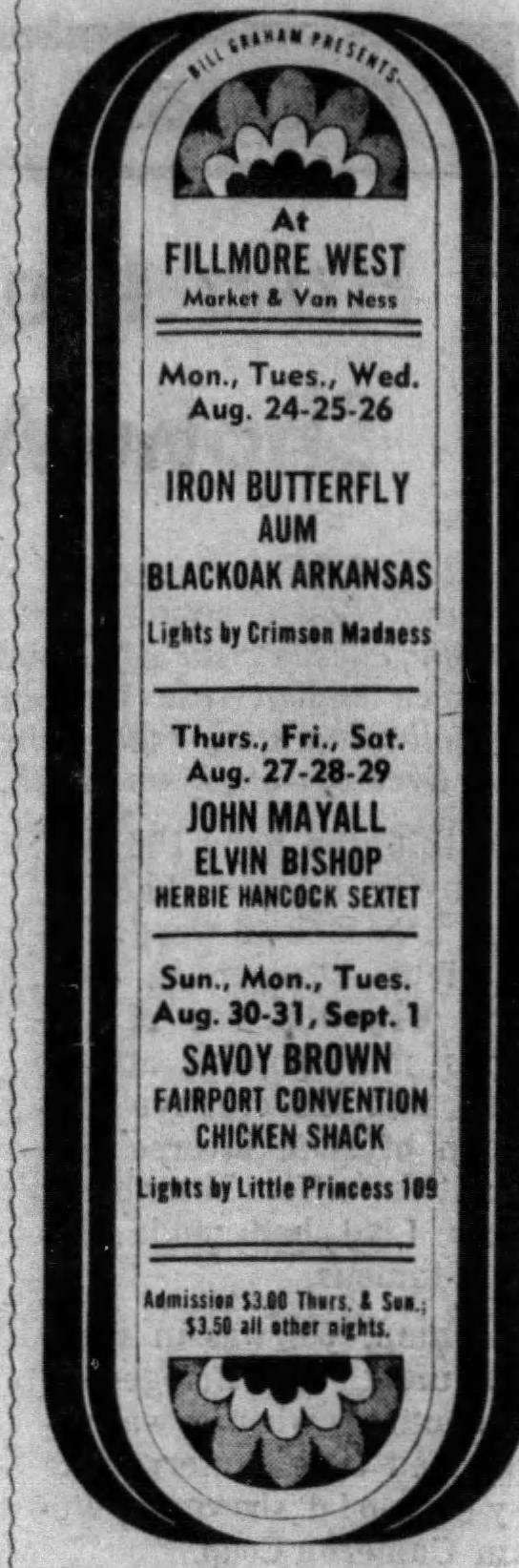
August 27-29, 1970 Fillmore West, San Francisco, CA: John Mayall/Elvin Bishop Group/Herbie Hancock (Thursday-Saturday)
Whatever his problems with booking major touring acts, Bill Graham still had intriguing bills. This weekend's bill was headlined by John Mayall, who had become well-known for hiring Eric Clapton, Peter Green and Mick Taylor, although only the latter had ever toured the States with Mayall. Mayall changed his lineup almost every tour, rarely played old songs and often improvised on stage. At this time, his current album was the almost-acoustic Empty Rooms. Yet Mayall's stage band was a quartet without a drummer: guitarist Harvey Mandel, bassist Larry Taylor (both ex-Canned Heat) and electric violinist Sugarcane Harris.
Don "Sugarcane" Harris was a unique talent, and uniquely difficult. In the 50s and early 60s, as a songwriter with the duo of Don & Dewey, he had written and recorded several songs that had become huge hits when others recorded them ("Farmer John," "Big Boy Pete" and others). In the 60s he had switched over to electric violin, a fairly distinct instrument for the time. When properly used, such as by Frank Zappa on The Mothers Of Invention's "Directly From My Heart To You" or "Peaches En Regalia" Harris was truly special. Sugarcane was also unreliable, liked guns, and was really hard to be in a band with. Nonetheless, Mayall managed a few tours with him, and this lineup would soon record the album USA Union.
Herbie Hancock, meanwhile, had a six-piece band that was among the most forward looking in modern jazz. Phil Elwood of the Examiner reviewed the first night (August 27) and singled out trumpeter Woody Shaw, trombonist Garnett Brown and reedman Bennie Maupin.
The Elvin Bishop Group was a contrast to Mayall and Hancock by playing some danceable, straight ahead rock and roll. Elwood praised them as well, and mentioned the exceptional vocals provided by Jo Baker and three of the Pointer Sisters. The Pointer Sisters definitely played some concert gigs with the Elvin Bishop Group throughout 1970, but it's hard to tell how many. There is a circulating, lo-fi audience tape of the John Mayall performance from Saturday, August 29, and Bishop joins in with the Mayall band for the last few numbers. The same tape also includes the first few numbers of the Elvin Bishop Group's set, with The Pointer Sisters sharing vocals with Jo Baker with some high-energy, gospel-infused soul music.
In early September 1970, various papers mentioned that the Elvin Bishop Group was releasing "Feel It" as a single from their forthcoming album.
August 31, 1970 Keystone Korner, San Francisco, CA: Elvin Bishop and Friends (Monday) {DKS}
September 1-7, 1970 Golden Bear, Huntington Beach, CA: Elvin Bishop Group (Tuesday-Sunday) {DKS}
September 12, 1970 Gunn High School Football Field, Palo Alto, CA: Elvin Bishop Group/Aum/Tower of Power/Fast Eddie/Nevada (Saturday) noon-5pm Autumnal
There were no viable rock venues between San Jose and San Francisco, so the city of Palo Alto concerned itself with finding something to entertain restless teenagers. This is both admirable and very Palo Alto. Keep in mind that it was also an effort to discourage them from taking the family station wagon to San Francisco or Berkeley, which was really what they wanted to do.
Gunn High School, at 780 Arastradero Road in South Palo Alto, was the city's newest, having only opened in 1964. The Youth Advisory Council budgeted for a rock concert on the football field, able to accommodate up to 5000 people. The Millard Agency booked all their acts, plus two local ones (Fast Eddie and Nevada). Although the music was probably good, the concert was apparently a financial debacle. The city held an "Autumnal 2" concert out at the Baylands in November, anticipating Shoreline Amphitheater by fifteen years, but it too failed.
September 16, 1970 Auditorium, Lincoln High School, San Francisco, CA: Boz Scaggs/Elvin Bishop Group/Tower Of Power/Naked Lunch/Victoria (Wednesday)
San Francisco's Lincoln High School, established 1940 in the Sunset District, had some equipment stolen from the High School radio station (KOOL). Local bands held a benefit in the school auditorum at 23rd Avenue and Quintara for new equipment. All of them were Millard bands. Victoria (Domalgaski) was a singer-songwriter signed to Bill Graham's San Francisco Records label (distributed by Atlantic, as opposed to Fillmore, distributed by Columbia). Naked Lunch was some variation on Abel Zarate's band.
Cookin' Mama was fronted by guitarist Pat Thrall and singer Sherry Foxx (of RJ Fox). They would release the album New Day in 1972. {DKS}
September 23, 1970 Fillmore East, New York, NY: Van Morrison/Allman Brothers/Elvin Bishop Group/Albert King/Flock/Sha Na Na (Wednesday)
The Fillmore East usually only booked shows on Friday and Saturday nights. This Wednesday night, however, several bands played for a high profile TV special for public television. At this remove, noting Van Morrison in his prime (between Moondance and Street Choir) and the original Allman Brothers, it seems like a sensational special. At the time, however, all of these bands were basically up and coming, so Bill Graham had the clout to make sure his own group got on the show. Of course, to the other musicians, particularly the Allman Brothers themselves, Bishop's tenure in the Butterfield Blues Band made him an instant peer.
The Flock had been signed to Columbia in 1969, along with other groups like Chicago and Blood, Sweat & Tears, so they had full record company support at this time. Sha Na Na had struck it big at Woodstock, but was still somewhat of a local New York group, having been founded at Columbia University.
Due to some dispute, the PBS special was never aired, although a few video snippets circulated. Bishop remained friends with Van Morrison and the Allmans throughout his career, and indeed his greatest success came when he signed with Capricorn Records, the Allmans' label.

September 24, 1970 Frederickson Fieldhouse, OK City U, Oklahoma City, OK: Santana/Elvin Bishop Group/Cold Blood (Thursday)
The Elvin Bishop Group joined Santana and Cold Blood on a swing through the Southwest. Santana had just released their second album, Abraxas, and it would be even bigger than their debut, peaking at #1 on the Billboard charts. Hit singles included "Black Magic Woman" and "Oye Como Va." Oklahoma City University is a private Methodist University of about 3000 students, founded in 1919. Frederickson Fieldhouse was built in 1959, and held 3400 in basketball configuration. At the time of its construction, it was the largest hyperbolic paraboloid building on Earth.
Although Applejack had quit the music business, Stephen Miller had brought in one of his Iowa friends as part of the road crew. Perry Welsh had moved from Iowa to San Francisco in 1967, and had played harmonica in various clubs. Welsh became part of the Elvin Bishop Group's traveling road crew, and thus was always available to play some harmonica and sing a little. He was sort of an adjunct member of the Elvin Bishop Group, playing and singing on the second and third albums.

September 25 , 1970 Music Hall, Houston, TX: Santana/Cold Blood/Elvin Bishop Group (Friday) 6:00 & 9:30pm
The Houston Music Hall was a 2200-seat auditorium constructed in 1937, as part of the Sam Houston Coliseum.
 |
| San Antonio Express September 26, 1970 |
September 26, 1970 Hemisfair Arena, San Antonio, TX: Santana/Cold Blood/Elvin Bishop Group (Saturday) Jam Productions and Concerts West
The Hemisfair Arena, constructed in 1968 as part of the Hemisfair. It had a capacity of around 10,000. Concerts West was Jerry Weintraub's production company, later famous for promoting Elvis Presley and Led Zeppelin national tours.
 |
| Ft Worth Star-Telegram September 27, 1970. Columbia took out ads promoting both Elvin Bishop and Santana in the Telegram (but not Cold Blood, since they were on another label). |
September 27, 1970 Will Rogers Memorial Coliseum, Ft Worth, TX: Santana/Cold Blood/Elvin Bishop Group (Sunday) 3 pm show Middle Earth Productions
The Will Rogers Coliseum was a 5600-capacity arena built in 1936.
Feel It!,The Elvin Bishop Group's second album on Fillmore Records was probably released on October 1, 1970. It's important to note that release dates in those days were rather flexible. By the end of September, FM radio stations probably already had advance copies of the record. If Columbia's distribution was doing their job, then record stores in Texas and Oklahoma would have already had the album in stores, even if the rest of the county hadn't caught up.

Feel It! featured vocals by Jo Baker and Stephen Miller, supported on a couple of tracks by the Pointer Sisters and Perry Welsh, giving rock fans a much clearer idea of what the Elvin Bishop Group really sounded like in concert. Chepito Areas and Mike Carabello, from Santana's percussion crew, also joined in on a few tracks. Up until this time, anyone who had bought the debut album would have been surprised to find out how different the Bishop Group had become in concert, with the ensemble R&B style vocals. In the Bay Area, at least, the songs "So Fine" and "Party Til The Cows Come Home" got good airplay on FM radio.
September 28, 1970 Keystone Korner, San Francisco, CA: Elvin Bishop Group/Cookin' Mama (Monday) {DKS}
October 5, 1970 Keystone Korner, San Francisco, CA: Elvin Bishop Group/Loose Gravel(Monday)Loose Gravel was led by ex-Charlatans guitarist Mike Wilhelm. {DKS}

The Elvin Bishop Group joined Santana for a swing through the East Coast. The tour had probably been booked before the titanic success of Abraxas. Rensselaer Polytechnic Institute had been founded in 1824 in Troy, NY, where the Hudson River meets the Mohawk. It is near Albany and about 150 miles from Manhattan.
Santana played two shows on Saturday night (October 10) at the Rhode Island Auditorium in Providence, and on Sunday night (October 11) at the Roberts Center in Boston College. James Cotton opened in Boston, and I don't know if there was an opening act in Providence. I can't help but suspect that the Elvin Bishop Group may have had other gigs in New England this weekend. [update: DKS figured it out]
October 10-11, 1970 Ungano's, New York, NY: Elvin Bishop Group (Saturday-Sunday)
Ungano's was a club on West 70th Street. Many bands who opened at the Fillmore East would also play Ungano's around the same time. {DKS}
This show was listed in the Examiner, but the band was in the East Coast. I suspect Elvin didn't fly home just for a Monday night at Keystone, but I guess it's possible. {DKS}

October 14, 1970 Capitol Theater, Port Chester, NY Santana/Elvin Bishop Group (Wednesday) 2 shows
The Capitol Theater was a beautiful old 1800-seat movie theater at the last stop of the commuter train to Manhattan. Howard Stein booked shows there in 1970 and '71, and the venue is fondly remembered by fans and musicians alike. Santana and Elvin Bishop played two shows on a Wednesday night, no doubt booked well before Abraxas. Note all the great bands in the ad who were booked there (Rod Stewart, Zappa, Traffic, the Dead), who would not be playing 1800-seat theaters much longer, even on weeknights.
October 16-17, 1970 Fillmore East, New York, NY: BB King/Butterfield Blues Band/Elvin Bishop Group (Friday-Saturday)
The Elvin Bishop Group finished up their Eastern leg at the Fillmore East. Although not as well known as either BB King or Butterfield, Bishop belonged on the bill. The Butterfield Blues Band had gone out of their way to flag BB King and other giants as their inspirations, making sure that the new white rock audience for the blues knew the sources, and BB knew it. The Butterfield Blues Band was still chugging along, excellent live though not recording anything interesting.
October 30, 1970 Bear's Lair, UC Berkeley, Berkeley, CA: Elvin Bishop Group (Friday) 9:00 and 10:30pm
The Bear's Lair was a tiny student beer joint on campus, in Lower Sproul Plaza.
 |
| Boston Globe Nov 4 1970 |
November 5-7, 1970 Boston Tea Party, Boston, MA: Leon Russell/Elvin Bishop Group/Juicy Lucy (Thursday-Saturday)
The Elvin Bishop Group played at the Boston Tea Party, opening for Leon Russell. The Tea Party was also kind of small, holding perhaps 2000. It was to close soon after this, since it simply could not compete with larger venues. Still, the Boston market was important, and the Tea Party had a lot of cachet. Leon Russell had been a Hollwyood studio guy who had burst out into view on Joe Cocker's Mad Dogs And Englishmen tour in early 1970. His self-titled debut, with it's All-Star guests (Clapton, Winwood, three Stones, two Beatles, etc) and classic songs ("A Song For You," "Delta Lady" and "Roll Away The Stone," among others), was played often on FM radio, so by the end of 1970 Russell was probably already too big for the Tea Party. Juicy Lucy was a British group that featured pedal steel guitar player Glenn Ross Campbell, from Riverside, CA.
Given the timeline, it's clear that it was worth it for the Bishop Group to fly back out from California to play the Boston Tea Party. I looked for other dates on the East Coast around this time, but the band may have simply returned home. The Boston Globe gave a positive review of the Bishop Group (November 9), mentioning that Jo Baker had sang around Boston in Clouds.
 |
| Chicago Tribune, November 13, 1970 |
The Syndrome was the name for the final, rock-and-roll identity of the crumbling Chicago Coliseum at 15th Street and Wabash. It would close in March 1971. Rod Stewart and Faces were just starting to tour America. Haystacks Balboa and Soup were Chicago-area bands. {DKS}

November 14, 1970 Main Pavilion, Santa Rosa Fairgrounds, Santa Rosa, CA: It's A Beautiful Day/Cold Blood/Boz Scggs Elvin Bishop Group (Saturday) Darling Arlyn Presents
All four of the bands were booked by the Millard Agency. {DKS}
November 16, 1970 Keystone Korner, San Francisco, CA: Elvin Bishop and Friends (Monday) {DKS}
Both Elvin Bishop Group and Tower Of Power, though local, were rising in stature in the Bay Area. With a new album, the Bishop Group was getting renewed attention. Tower Of Power was also booked by Millard and had released their debut album East Bay Grease on a Graham label (San Francisco, distributed by Atlantic). Sha Na Na, initially formed as a kind of novelty act at Columbia University, were fairly well-known thanks to their appearance in the Woodstock movie and hit soundtrack album.

November 25, 1970 Selland Arena, Fresno, CA: Elvin Bishop Group/It's A Beautiful Day/Cold Blood/Boz Scaggs (Wednesday) Presented by Don Branker
The Millard Agency strategy of bringing the Fillmore to the hinterlands seemed to be working. According to a November 26 note in the Fresno Bee, the bands played the Selland Arena to a "capacity crowd" on the evening before Thanksgiving. Since Selland held 6000, that was twice the capacity of Fillmore West. All but Boz Scaggs had released their second albums (and Boz's would come in March), and they were starting to get heard on local FM radio everywhere. The review also mentioned that the Pointer Sisters (as a trio) were with Bishop, so it seems their appearances were somewhat regular, too.
December 1, 1970 Jazz Workshop, San Francisco, CA: Albert King (Tuesday)
Russ Wilson of the Oakland Tribune reviewed Albert King's opening night at San Francisco's Jazz Workshop, a club at 473 Broadway (near Kearny Street). Near the end of the Tuesday night show, Albert spotted Elvin Bishop in the crowd and invited him onstage to jam. {DKS}
 |
| The Elvin Bishop Group replaced the English group Trapeze when they opened for The Moody Blues at Stanford's Maples Pavilion on December 3, 1970 |
December 3, 1970 Maples Pavilion, Stanford University, Palo Alto, CA: Moody Blues/Elvin Bishop Group (Thursday)
Stanford University had upgraded Maples Pavilion to make it more amenable to rock concerts, and the first show in the new configuration was The Moody Blues. The English group Trapeze had been booked to open the show, but they canceled their American tour, so the Elvin Bishop Group filled in.
December 4-5, 1970 Keystone Korner, San Francisco, CA: Elvin Bishop Group/Tower of Power (Friday-Saturday) {DKS}
December 6-7, 1970 New Monk, Berkeley, CA: John Lee Hooker/Elvin Bishop Group (Sunday-Monday)
The New Monk, at 2119 University Avenue (at Shattuck) in downtown Berkeley, was the successor to a fraternity beer joint called The Monkey Inn, known by all as "The Monk" (at 3105 Shattuck). The newer, larger club had an official capacity of nearly 500, and booked higher profile rock and blues groups on weekends. The New Monk would never really find its place, however, and by the end of 1971 it would be taken over by Freddie Herrera of the Keystone Korner. Once re-christened as the Keystone Berkeley in March, 1972, it was the anchor of the Herrera Keystone empire, and the Elvin Bishop Group would play the club almost every month until 1977.
 |
| Upland News, December 10 |
December 11, 1970 Gym, Cal State Poly Pomona, Pomona, CA: Paul Butterfield Blues Band/Elvin Bishop Group/Becker (Friday)
College gigs were extremely lucrative for touring bands. Restless undergraduates would see anybody who came to campus, and since colleges never went out of business, bands always got paid. Cal Poly Pomona (formally, the California State Polytechnic University, Pomona) had been a satellite of Cal Poly in San Luis Obispo, but in 1966 it split into a separate institution. Pomona is a small town 30 miles East of Los Angeles.
December 12-13, 1970 Golden Bear, Huntington Beach, CA: Elvin Bishop Group (Saturday-Sunday)
The Bishop Group returned to the Golden Bear to finish out the weekend in Southern California.
I believe that the Elvin Bishop Group was still regularly playing Monday night jams at Keystone Korner, although very likely something like once a month rather than every week. I'm not sure why they needed to play a Saturday night, but the Bishop Group liked to play, and in any case not every fan was free Monday night. Commander Cody and His Lost Planet Airmen had started to develop a name for themselves outside of Berkeley, but they were just a year removed from Ann Arbor, MI, and a year away from releasing their epic debut, Lost In The Ozone.
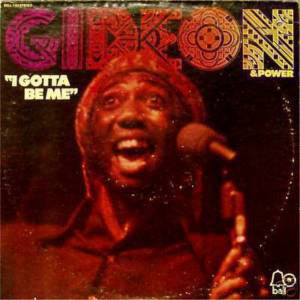 |
| I Gotta Be Me, by Gideon & Power, released by Bell Records in 1972. It featured lead singer Gideon Daniels. Elvin Bishop played on a few tracks. |
Gideon & Power was a sort of "Gospel-Rock" group fronted by singer Gideon Daniels. They were booked with the Elvin Bishop Group many times, and Bishop played on their Bell album in 1972. Although a minor Bay Area group, Gideon & Power turned out to be a sort of feeder for the Elvin Bishop Group. Singer Mickey Thomas, who sang lead on Bishop's giant "Fooled Around And Fell In Love," had been in Gideon & Power before the Elvin Bishop Group. Later, after Thomas had already joined him, Bishop drafted organist Melvin Seals from Gideon & Power. Neither would have been in Gideon & Power in 1970, however.
Danville, at the time, was a fairly distant suburb, even though it is now just a commuter city. American Canyon was a band from Napa (also the name of a town), and I assume Copperhead Creek was local, too. {DKS}

December 31, 1970 Fillmore West, San Francisco, CA: Cold Blood/Elvin Bishop/Boz Scaggs/Voices Of East Harlem (Thursday)
The Elvin Bishop Group closed out 1970 the same place they had closed out 1969, booked at the Fillmore West for Bill Graham. In 1969 Santana had headed the proceedings, with Bishop third on the bill, but for 1970 the Elvin Bishop Group was sharing the front line with Cold Blood and Boz Scaggs.
The seeds of the Elvin Bishop Group's later success had been carved into place throughout 1970. Elvin Bishop had established his aw-shucks country persona, but he had a reputation as a serious blues guitarist as well. Although his band was named after himself, he did not fall into the trap of insisting that his limited lead vocals had to dominate every song. The Bishop Group was not trapped in the guitar-hero blues bag of so many sixties groups, with a healthy dose of soul and a touch of country to broaden his sound. By the end of 1970, Bishop had already met the Allman Brothers, for whose label he would record his biggest hit, and he was working with Bill Graham, the most high profile concert promoter in the business. His associations with Graham and Columbia ensured that Bishop was regularly booked with major acts like Santana and the Allmans, so that Bishop could build an audience one concert at a time. All of Bishop's hard work would pay off a few years later, with "Fooled Around And Fell In Love, " the single released on Capricorn Records in February 1976.
 |
| The back cover of the Elvin Bishop Group's debut album on Fillmore Records, from 1969 |
Appendix: Elvin Bishop and The Elvin Bishop Group 1968-69
In order to construct my 1970 Elvin Bishop Group Performance Log, I had to do the homework for 1968 and ‘69 as well. I am posting the list of known Elvin Bishop gigs for those years below, with minimal comments. Mainly I comment where the Bishop Group played a venue that was not part of the larger 1970 list above.
 |
| The Steve Miller Band headlined at the Carousel Ballroom on the weekend of May 10-12, 1968, supported by Kaleidoscope and the Youngbloods. Elvin Bishop dropped by on Saturday night (May 11) to jam with Miller, an old pal from Chicago. |
May 11, 1968 Carousel Ballrom, San Francisco, CA: Steve Miller Band/Kaleidoscope/Youngbloods (Saturday)
Elvin Bishop’s first known appearance as a San Francisco resident was as a guest of the Steve Miller Band at the Carousel Ballroom. Miller was an old pal from Chicago. The Carousel had been taken over by the Grateful Dead and some of the other bands, and was operating as a direct competitor to the Fillmore West and the Avalon Ballroom.
The Grateful Dead organized a series of Tuesday night Jams at the Carousel. The first was on May 21, and it was put together by Rhoney Stanley, one of Owsley’s girlfriends. Owsley taped much of the proceedings. Other guests at the jam included Steve Miller, Jerry Garcia, Jorma Kaukonen and Jack Casady.
 |
| The Live Adventures of Mike Bloomfield and Al Kooper, released January 1969 by Columbia Records. The double album was recorded the weekend of September 26-28, 1968, and included a cover painting by Norman Rockwell. Elvin Bishop played on one track. |
September 28, 1968 Fillmore West, San Francisco, CA: Mike Bloomfield & Al Kooper/It's A Beautiful Day/Loading Zone (Sunday)
After the unexpected, phenomenal success of the Mike Bloomfield and Al Kooper Super Session album, Graham booked the pair for a weekend at the Fillmore West (formerly the Carousel). Columbia was there to record the proceedings. After fine shows on Friday and Saturday night, Bloomfield reverted to character and checked into the hospital, making him unavailable for the Sunday show. Al Kooper got on the phone and called all his friends, so Bishop, Carlos Santana and Steve Miller all dropped in to jam instead of Bloomfield. One of Bishop’s tracks made it to the album (The Live Adventures of Mike Bloomfield and Al Kooper), and his presence is credited as “courtesy of Elektra Records.”
Note that Bishop only showed up to jam on the night when Bloomfield was not there.
 |
| A hard to read flyer for The Matrix in October 1968 |
October 8, 1968 The Matrix, San Francisco, CA: Jerry Garcia and Friends/Marble Farm (Tuesday)
After some in-house turmoil, some members of the Grateful Dead decided to take up playing without Bob Weir or Pigpen. It is hard not to infer that the Dead were auditioning different guitar players, if somewhat informally. Jerry Garcia, Phil Lesh, Mickey Hart and Bill Kreutzmann played three weeknights at the Matrix on October 8-10, billed as Jerry Garcia and Friends. Amongst Deadheads, this configuration is known as “Mickey and The Hartbeats.” Local band Marble Farm opened the show.
We have tapes of the August 8 (Tuesday) and 10 (Thursday) shows, and Bishop plays on August 8. The configuration this night seems to be Jerry Garcia, Jack Casady (bass) and the drummers. Elvin Bishop joins in for some blues near the end, and also sings “Prisoner Of Love.”
October 11-12, 1968 The Matrix, San Francisco, CA: Elvin Bishop/ Marble Farm (Friday-Saturday)Elvin Bishop’s only booking under his own name in 1968 was two nights at the Matrix on the weekend of October 11-12. We have a tape of one set from the second night, all blues instrumentals. The organ is prominent, and I suspect it’s Linn County’s Stephen Miller. I have no idea who the rhythm section might have been.
October 30, 1968 The Matrix, San Francisco, CA: Jerry Garcia and Friends/Marble Farm (Wednesday)
Mickey and The Hartbeats returned to the Matrix for a four-night stand on October 28-31 (Monday through Thursday). We have a partial tape of October 29, and a likely complete one for October 30. The basic lineup is Garcia, Lesh, Kreutzmann and Hart. Bishop joins in at the end of the October 30 tape for some blues jamming and “Prisoner Of Love.”
Harvey Mandel hosted a jam on Christmas Eve, and a tape has survived. Bishop dropped in, along with Jerry Garcia, Jack Casady and John Chambers on drums.
March 12 or 19, 1969 Fillmore West, San Francisco, CA: Tuesday night Audition and Jam (Tuesday)
Starting in Fall 1968, Bill Graham had shows almost every Tuesday night at Fillmore West, usually featuring three local bands, some just newly arrived in town. There was also a “jam,” which was either a musician’s hangout or a better known band trying something new. There were no posters, and details are scant (I am pretty much the only source). The Elvin Bishop Group made their San Francisco debut at one of the Tuesday night shows, with no advance publicity. Jud Cost’s great liner notes for the Sundazed Records re-release marked the Fillmore West Tuesday show as March, 1969.
March 22-23, 1969 The Matrix, San Francisco, CA: Elvin Bishop Group/Terry Dolan (Friday-Saturday)
April 24-26, 1969 New Orleans House, Berkeley, CA: Elvin Bishop Group/Mother Bear (Friday-Sunday)
May 1 & 4, 1969 Fillmore West, San Francisco, CA: Mongo Santamaria/Cold Blood/Elvin Bishop Group (Thursday & Sunday)
Bill Graham booked Jefferson Airplane and the Grateful Dead together at Winterland on the weekend of May 2 and 3, joined by Mongo Santamaria. To fill out the weekend, Graham booked Mongo with Elvin Bishop and Cold Blood at Fillmore West on Thursday and Sunday.
The 1969 Northern California Rock Festival was a huge, never -to-be-repeated outdoor event, and too complex a story to tell here. Dozens of acts played over the course of three days, including Jimi Hendrix and Led Zeppelin. I’m not sure which day the Elvin Bishop Group played.
The bands got together to provide funds to bail out those arrested at various protests at People's Park in Berkeley.

May 30, 1969 Merced County Fairgrounds, Merced, CA: Santana/Elvin Bishop Group/Sanpaku/Crystal Syphon/Stonehenge/Wildfire/Superchief (Friday)
The 13rd Tribe was a sort of hippie commune, who often put together free concerts and benefits. Crazy Horse was a local band, probably from Merced, not Neil Young's guys from LA.

June 6-7, 1969 The Barn, Rio Nido, CA: Linn County/Elvin Bishop Group/Southwind (Friday-Saturday)
The Barn was a short-lived name for the Rio Nido Dance Hall, a tiny but charming building at the very Northern edge of Sonoma County. Fondly remembered, it was too small to really be viable for a rock venue.
June 8, 1969 Fillmore West, San Francisco, CA: Grateful Dead/Junior Walker and The All-Stars/Glass Family (Sunday)
The Grateful Dead headlined a weekend at the Fillmore West. For the final Sunday night show, Owsley had concocted an “experimental” brew that had unforeseen consequences. For the last set of Sunday night, Jerry Garcia was too high to play—how high did Jerry have to be to be “too high to play”?—and emergency steps were taken. Elvin Bishop and Aum guitarist Wayne Ceballos sat in for the longest “Turn On Your Lovelight” in Grateful Dead history (48 minutes) and two blues numbers (including “Things I Used To Do”), until Jerry was able to return to the stage and close out the show.
The Poppycock in Palo Alto had opened in late 1967, and it too had started booking original rock by the end of the year. The Matrix, the New Orleans House and The Poppycock formed a tiny circuit for bands that played original rock. The little club at the corner of University Avenue and High Street also held only about 250, too small to thrive into the 1970s.

June 20-22, 1969 Family Dog on The Great Highway, San Francisco, CA: Sons Of Champlin/Congress Of Wonders/Elvin Bishop Group (Friday-Sunday)
After a high-flying opening weekend with Jefferson Airplane (June 13 and 14 ‘69), Chet Helms’s Family Dog on The Great Highway’s second seeking featured Sons Of Champlin and Elvin Bishop Group.
We have a tape of some of Bishop's set. If the Matrix followed their usual pattern, the Bishop Group probably played a Tuesday-through-Thursday (June 24-26) booking.

June 28, 1969 Gym, Monterey Peninsula College, Monterey Aum/Elvin Bishop Group/Linn County (Saturday) Pure Filth Presents
With the rock market expanding, some promoters put on some shows at the gym in Monterey Peninsula College, the Junior College for the county. The Millard Agency was happy to supply the groups, including the Grateful Dead (June 14 ‘69) and Santana (July 19 ‘69).
July 11, 1969 The Bear's Lair, UC Berkeley, Berkeley, CA: Elvin Bishop Group/Terry Dolan (Friday)
July 15-17, 1969 Fillmore West, San Francisco, CA: BB King/Elvin Bishop Group/Albert Collins (Tuesday-Thursday)
July 22-24, 1969 New Orleans House, Berkeley, CA: Elvin Bishop Group (Tuesday-Thursday)

July 25, 1969 Cow Palace, Daly City, CA: The Doors/Lonnie Mack/Elvin Bishop Group (Friday)
The Doors were one of the most popular live attractions in rock, touring behind their newly released album Soft Parade. Bill Graham booked the show at the 13,000 seat Cow Palace, rather than at Fillmore West or Winterland. He also made sure that his own act was heard by a huge number of potential fans.
The Elvin Bishop Group recorded their debut album sometime in the Summer of 1969, possibly around August.

August 2, 1969 Convention Center, Fresno, CA: Youngbloods/Elvin Bishop Group/Linn County (Saturday) Avalanche Productions Presents
August 22-23, 1969 New Orleans House, Berkeley, CA: Elvin Bishop Group/Mother Bear (Friday-Saturday)
Opening for the Bishop Group at the Poppycock this weekend was a band from Menlo Park, the next town over from Palo Alto. Opening act Fritz included former Menlo-Atherton High School students Lindsay Buckingham on bass and singer Stephanie “Stevie” Nicks.
September 19, 1969 Terra Nova High School, Pacifica, CA: Elvin Bishop/Country Weather/Feeling (Friday)
Taj Mahal, who had a terrific band featuring guitarist Jesse Ed Davis, was also on Columbia.
Serptember 27, 1969 Sonoma County Fairgrounds, Santa Rosa, CA: Santana/It's A Beautiful Day/Elvin Bishop Group (Saturday)
Bill Graham made sure that the band releasing an album on his new album got to open at the Fillmore East, the highest profile gig in the country.
John Mayall had a unique band with Jon Mark (acoustic guitar), Johnny Almond (tenor sax and flute) and Stephen Thompson (electric bass), yet with no drummer. Mayall had just released his Turning Point album (with the classic “Room To Move”), recorded at Fillmore East by the quartet in July.
October 7-8, 1969 Cafe-Au-Go-Go, New York, NY: Elvin Bishop Quartet (Tuesday-Thursday)Bands that opened at Fillmore East often played a few days at the Cafe At-Go-Go as well. It provided a good opportunity for writers, djs and record company staff to see new bands. The billing of “Elvin Bishop Quartet” tells us Stephen Miller was not on at least some or all of the Eastern tour.
October 9-11, 1969 Boston Tea Party, Boston, MA: Spirit/Elvin Bishop Group/Sha Na Na (Friday-Saturday)
The Boston Globe suggests that this bill played on Thursday October 9, when Bishop was booked at the Au Go Go. Pending new information, I am (somewhat arbitrarily) assuming that Elvin Bishop played Boston on Thursday.
By late '69, there was a sort of "Fillmore Circuit," of which Fillmore East and Boston Tea Party were the most memorable. But the same bands played the Kinetic Playground (Chicago), the Grande Riviera (Detroit), Ludlow's Garage (Cincinnati) and a few other venues. American and English Bands would traverse the country, playing in triple bills at the new psychedelic ballrooms. The Elvin Bishop Group's October '69 tour was typical of these bookings.
There must very likely be a midwestern booking on the weekend of October 17-18.
October 24-25, 1969 Grande Riviera, Detroit, MI: John Mayall/Elvin Bishop Group/Barry Goldberg and The Red Hot Low (Friday-Saturday)

October 31-November 2, 1969 Ludlow’s Garage, Cincinnati, OH: Elvin Bishop Group/Humble Pie/Devil’s Kitchen/Catfish (Friday-Sunday)
Ludlow's Garage, founded in 1969 by promoter Jim Tarbell, was another legendary stop on the Fillmore circuit. Tarbell had brought Vanilla Fudge and then the Grateful Dead to a tiny "Teen Center" in old church in 1968. Ludlow's Garage (a former mechanic's shop) was kind of small, holding only about 1200, but it was between Detroit and Chicago, so lots of bands fit in gigs there.
Humble Pie, with both Steve Marriott and Peter Frampton, was thoroughly unknown at the time, touring behind their first album (As Safe As Yesterday Is) on soon-to-be-bankrupt Immediate Records. Catfish were from Detroit, and featured singer Bob "Catfish" Hodge. Devil's Kitchen were from Carbondale, IL but had moved to San Francisco--they must have been visiting Carbondale and taken a side trip.
Thelma was an attempt to open an "upscale" rock club on the Sunset Strip, about two years too early. It was only open briefly. It was at 8917 Sunset Boulevard, just a few doors from both the Galaxie and the Whisky-A-Go-Go.
Sacramento had a gala Sunday afternoon opening for their new shopping mall. They had various free performances, including rock bands, jazz groups and folk singers.
December 3-4, 1969 New Orleans House, Berkeley, CA: Elvin Bishop Group/Devil’s Kitchen (Wednesday-Thursday)
December 12 & 14, 1969 Keystone Korner, San Francisco, CA: Elvin Bishop Group (Friday & Sunday)
December 20, 1969 The Poppycock, Palo Alto, CA: Elvin Bishop Group (Saturday)
December 22, 1969 The Matrix, San Francisco, CA: Elvin Bishop Jam (Monday)
December 31, 1969 Fillmore West, San Francisco, CA: Santana/It’s A Beautiful Day/Elvin Bishop Group/Joy Of Cooking (Wednesday)


 Posts

