Wednesday, June 2, 2010

Hwy 14, Middleton, WI The Bunny Hop April 25, 1966: The Sir Douglas Quintette

Some intriguing research finds only lead to more intrigue, which may never be resolved. The above ad is from the April 25, 1966 edition of the Capital Times in Wisconsin. On a Monday night, San Antonio's answer to the British Invasion, the Sir Douglas Quintette (sic) are playing a fairly large venue called The Bunny Hop. The ad says there is seating for 599, and the address is "2 Mi. W. of Middleton-Hwy 14" suggesting a rural rocking roadhouse.

The ad also says "Bring Your Wis. ID Card." I am fairly certain that Wisconsin had a drinking age of 18 rather than 21, and Middleton was a suburb of Madison, so many University of Wisconsin students would be expected. I assume the reference to "Wisconsin ID" cards was to discourage out-of-state drinkers from Northern Illinois, but perhaps there was a different reason. In any case, the musicians of the original Sir Douglas Quintet had been schooled in tough rhythm and blues sounds before the British Invasion arrived, so they knew a little bit about keeping a crowd of beered-up kids dancing all night long.

The Sir Douglas Quintet had scored a huge hit with "She's About A Mover" in Spring 1965, and they had a modestly successful early 1966 follow-up, "The Rains Came," and they had appeared on TV shows like Hullabaloo and Where The Action Is, so they were certainly well known enough to play for University of Wisconsin students on a Monday night. On the other hand, Doug Sahm and other members of the group had been busted for marijuana at the Corpus Christi airport in December, 1965, and as a result their movements were restricted by court dates and probation. If the Quintet was restricted by probation, did they actually play Wisconsin that Monday night?

The answer, apparently, is probably not. The Sir Douglas Quintet were a hugely popular American group in the British Invasion era, when beyond a hit single no one really knew what a group was like. Initially, the Quintet was encouraged to let everyone think they were actually English. However, the Quintet's promoter was a shady, fascinating character named Huey Meaux, and his business dealings were always suspect. It appears there was more than one group touring the country under the name Sir Douglas Quintet, possibly even before the bust. Somewhere on the web (I can no longer find it), there is an hilarious memoir by a group called Larry And The Bluenotes, which includes lengthy memories of impersonating the Sir Douglas Quintet out on the road, under the direction of various doubtful operators.

Of course, its possible that the Wisconsin show was played by Doug Sahm and some Texan variation of the Quintet, but its unlikely. When Sahm moved to San Francisco in about May 1966, it was because his court case was settled with 5 years probation. However, organist Augie Meyers was apparently unable to leave the state for his probation. As a result, by mid-66 there were at least two versions of the Sir Douglas Quintet: Doug Sahm led one in San Francisco, (along with drummer Johnny Perez and saxophonist Frank Morin), and Meyers led the Texas version (along with bassist Harvey Kagan). Then add in Larry And The Bluenotes, and who knows who else, and it appears that the Quintet were movers indeed.

Probably the band that played the Wisconsin show doesn't remember it, and probably had a vested interest in forgetting it: they were impersonating a band, or they were breaking probation, or something. Oh well--as long as the band played "She's About A Mover," and all the UW students got their Monday night beer on, it was probably fine.

Sunday, May 30, 2010

Initial Shock Performance List 1967-69 (Work In Progress)

(a poster for the Steppenwolf/Ace Of Cups/Initial Shock concert at the Sound Factory, Sacremento, CA on July 12-13, 1968. h/t Ross for the scan)

The Initial Shock were one of many bands who moved to San Francisco in 1967, but were more or less alone insofar as having been the only band who moved from Montana. Apparently the group was from Missoula, MT and featured members of local groups The Chosen Few and Mojos Mark IV, and at least one member was assigned to an Air Force base in the area. When the Air Force commitment was over, the band decided to move to San Francisco to be where the action was.

The  Initial Shock released two singles, but no albums.  The first, "Mind Disaster"/"Its Not Easy" (BFD 036), was recorded in Montana and released in 1966. The second, rarer single "You Been A Long Time Comin'"/I Once Asked" (BFD 2022) was released in 1967. I know nothing about the record label nor details of the recordings.

The Initial Shock was well regarded by those who were there at the time, although unfortunately the only live recorded evidence that circulates (to my knowledge) is an excellent 4-song piece of an Avalon Ballroom concert from 1968. It reveals a driving, bluesy sound, but its hard to know how representative of their material it might be. Members of the group were

George Wallace-lead guitar
William "Mojo" Collins-guitar, vocals
Steve Garr-bass
Brian Knaff-drums, vocals

While relatively little is known about the Initial Shock, they played a number of interesting shows in the Bay Area from 1967-69. I gather from various signs and portents that a journal of great importance (in my tiny Universe) will be doing an extensive article on the Initial Shock, so it seemed like a good time to begin trying to determine a list of Bay Area performance for The Initial Shock. As with most groups, it is easiest to find the most high profile shows, where posters or other evidence survives, and that may be only a small portion of a band's performances. Nonetheless, here is the information I have so far. Anyone who has additions, corrections, insights or recovered memories (real or imagined) about Initial Shock performances in the Bay Area is encouraged to Comment or email me.

Initial Shock Performance List 1967-69

September 24, 1967 Provo Park, Berkeley: Initial Shock
Free Sunday concerts in Provo Park (on Grove and Allston downtown) were a regular occurrence in Berkeley, and provided a good opportunity for new or newly-arrived bands to get heard.

October 4, 1967 Straight Theater, San Francisco: Mad River/Mount Rushmore/Anonymous Artists of America/Initial Shock
October 5, 1967 Straight Theater, San Francisco: Sopwith Camel/Black Swan/Hair/Frumious Bandersnatch/Don Garrett/Initial Shock
This was a benefit for the Haight Ashbury Medical Center.  Various poets, dancers and other performers were also part of the show.

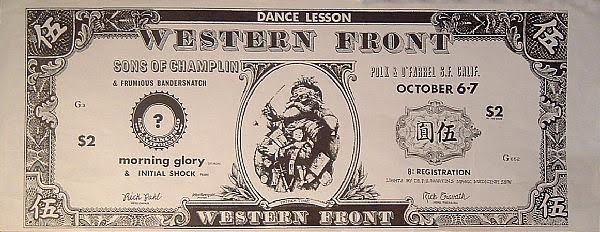
October 7, 1967 Western Front, San Francisco:  Sons of Champlin/Frumious Bandersnatch/Initial Shock
The Western Front was one of many attempts to open a psychedelic ballroom in San Francisco. The venue, at 895 O'Farrell (at Polk), never managed to find its footing.

Although I can find no Initial Shock shows until December, I assume they were playing around various places--I just haven't figured out where.

December 1-3, 1967 Western Front, San Francisco: Youngbloods/Wildflower/Initial Shock
The Initial Shock returned to The Western Front, although its my belief that there were different promoters at this point.

December 19, 1967-January 15, 1968: Northwest Holiday Tour
Ross Hannan found a remarkable ad in the Berkeley Barb of December 22, 1967, announcing that the Initial Shock would be returning to San Francisco on January 16, "After 28 Consecutive One Night Stands."

I don't know where or how the band played 28 straight nights, including Christmas Eve, Christmas Day and New Year's Day. If this is true and not hyperbole, I have to assume they played ski resorts in places like Idaho. Given the band's Montana background, they may have gone as far afield as Montana as well.

I assume that Initial Shock had shows booked when they returned to San Francisco, but we have yet to uncover them.

March 16, 1968  Straight Theater, San Francisco: Flamin Groovies/Initial Shock

May 12, 1968 Civic Center Plaza, San Francisco: Kaleidoscope/Initial Shock/Country Weather/AB Skhy Blues Band
This was a daytime show.  It was a benefit for Haight-Ashbury Free Medical Clinic.

May 28, 1968  Avalon Ballroom, San Francisco: Crystal Syphon/Phoenix/Indian Head Band/Mint Tattoo/Initial Shock/Loading Zone
“Spring Medicine Show” Benefit for The Haight Ashbury Free Medical Clinic

June 28-30, 1968 Carousel Ballroom, San Francisco: Steve Miller Band/Buddy Guy/Initial Shock 
This show was advertised (a poster exists) but did not take place.

July 3, 1968 Straight Theater, San Francisco: Initial Shock/Allmen Joy/Indian Head Band/Phoenix

July 12, 1968 Cow Palace, Daly City: Iron Butterfly/Creedence Clearwater Revival/Vanilla Fudge/Kai Moore/Canned Heat/Sweet Rush/West/Sandy Bull  
Harmony Benefit  
A variant poster has Sandy Bull, Canned Heat, Vanilla Fudge, Iron Butterfly, West, Initial Shock, Wedge and Phoenix. Of course, Initial Shock was booked in Sacramento (below), but given that its less than two hours from San Francisco to Sacramento, they could easily have played both shows. However, since absolutely nothing is known about this Benefit, I have no idea who actually played.

July 12-13, 1968 Sound Factory, Sacramento: Steppenwolf/Ace of Cups/Initial Shock
The Sound Factory, at 1817 Alhambra, was a newly-opened venue run by Whitey Davis, the former proprietor of Portland's Crystal Ballroom as well as a critical figure at the Avalon Ballroom. This was one of the earliest shows at the Sound Factory (it appears to have opened on June 28--the July 12-13 poster is up top).

July 14, 1968 Balconades Ballroom, San Jose: Initial Shock/Womb/Phoenix/Freedom Highway/Rejoice/Day Blindness/Fritz Rabyne/Marble Gardens/Pure Funk/Uncut Balloon
The Balconades was on an upper floor of The Lyndon Building (built 1882), at 181 W. Santa Clara St. After time as a printing press for a newspapers, it had been turned into a ballroom (probably in the 1920s). It had been part of a Country and Western circuit for performers like Hank Williams and Bob Wills, back when San Jose was an agricultural center and the biggest radio station (KEEN 1370 AM) played country music.  There were a few rock shows at Balconades in 1968, although this appears to be one of the last ones.

Most of the groups at this Sunday event were club bands that played around, but weren't yet at the Avalon level. "Fritz Rabyne" was probably the Fritz Rabyne Memorial Band, a Menlo Park band that featured former Menlo-Atherton High School students Lindsay Buckingham and Stephanie (Stevie) Nicks.

July 26-27, 1968 New Orleans House, Berkeley: Initial Shock/Shiva’s Head Band
The New Orleans House, at 1505 San Pablo Avenue, was Berkeley's premier club for rock bands that played original music.

August 16-17, 1968 Sound Factory, Sacramento: Pink Floyd/Initial Shock/AB Skhy Blues Band
Road manager George Crowe (see his Comment) recalls opening for Pink Floyd in Sacramento.

August 2-4, 1968 Fillmore West, San Francisco: Iron Butterfly/Canned Heat/Initial Shock 

 (the Roger Weil poster for FD135, August 29-31 at the Avalon. h/t Ross for the scan)
August 29-31, 1968 Avalon Ballroom, San Francisco: Youngbloods/It’s A Beautiful Day/Initial Shock

October 18-20, 1968 Avalon Ballroom, San Francisco: Velvet Underground/Charley Musselwhite/Initial Shock

October 31-November 2, 1968 The Ark, Sausalito Initial Shock/Devil's Kitchen/White Lightning
A flyer recently turned up on eBay. The flyer says "Boogie--Ball." Perhaps the Marin band Boogie was on the bill, or perhaps it was just an invocation. Devil's Kitchen were recently arrived from Carbondale, IL.

The Ark was a grounded steamer docked on Gate 6 in Sausalito. It was a hippie rock club and hangout, mostly open on weekends (Halloween was a Thursday this year).

November 8-9, 1968 New Orleans House, Berkeley: Initial Shock/Orion

November 28-30, 1968 Avalon Ballroom, San Francisco: Quicksilver Messenger Service/Sons of Champlin/Initial Shock
The Avalon Ballroom had one more show after these that was still under Chet Helm's aegis, when Big Brother headlined (December 1, 1968), but Helms had to give up the lease on the Avalon due to financial difficulties and a struggle to get a Dance Permit.

The Avalon would reopen in March 1969, and members of Initial Shock were apparently part of the Avalon management team. This is just one of many tantalizing bits of history that makes their definitive story so worth looking forward to. 


December 5, 1968 New Committee Theatre, San Francisco: Initial Shock/Aum/Notes From The Underground
December 6, 1968 New Committee Theatre, San Francisco: Initial Shock/Devils Kitchen/Sanpaku
December 7, 1968 New Committee Theatre, San Francisco: Initial Shock/Notes From The Underground/Sanpaku

The New Committee Theatre was at 836 Montgomery. The Committee (an improvisational comedy troupe) was the main performer there, but various rock shows were held as well.

December 20-21, 1968  Sound Factory, Sacramento: Initial Shock/Salloom Sinclair & Mama Bear

Although I recognize that I have only been capturing highlights of the Initial Shock's bookings in 1967 and '68, the trail runs pretty dry in 1969. Given that some members of the group--perhaps all--were involved in the management of the Avalon Ballroom when it re-opened on March 21, 1969, perhaps that had an effect, but the revised Avalon only lasted until April 6, so the final year of the Initial Shock remains vague. I have to assume there were many more shows than are listed here.

January 17-18, 1969 The Matrix, San Francisco: Initial Shock

February 28-March 1, 1969 New Orleans House, Berkeley: Initial Shock/Welliver Fields

March 26-30, 1969 Avalon Ballroom, San Francisco 
Jef Jaisun and the Slow Truck, Santana, AAA, It's A Beautiful Day, All Men Joy, Youngbloods, Country Weather, Welliver Fields, Initial Shock, AB Skhy, Linn County, Conqueroo, Frumious Bandersnatch, Fourth Way, Melting Pot, Cleanliness and Godliness Skiffle Band, Clover, Shades of Joy, Alice Cooper, Pure Funk
The poster lists all the bands who will play over four nights, so I assume Initial Shock played some but not all of the shows, but I do not know for certain.

May 15-17, 1969 New Orleans House, Berkeley: Ace Of Cups/Initial Shock
The trail runs cold after this point, and future published revelations will be welcome.

Lead guitarist George Wallace apparently went on to work with Janis Joplin. Lead singer and guitarist Bill "Mojo" Collins went on to play in the group Sawbuck with Ronnie Montrose (they helped close the Fillmore West on June 29, 1971), but he relocated to Coastal North Carolina in late 1971. He remains an active and successful performer in the greater Wilmington area today.

This is a work in progress. Anyone with additional information about Initial Shock performances is encouraged to Comment or email me.

Saturday, May 15, 2010

660 Great Highway, San Francisco Family Dog On The Great Highway July 25-27, 1969 Zoot Money/Poco/Charley Musselwhite

Chet Helms opened his Family Dog On The Great Highway in June, 1969 as a successor to his legendary operation at the Avalon Ballroom. Helms knew he had lost the battle to be San Francisco's leading rock entrepreneur to Bill Graham, but he also knew that he had a better ear and a different perspective than Graham, so he intended the Great Highway operation to be a sort of cultural center, focusing on rock as a medium for cultural and social development rather than mere entertainment. While the FDGH did not really achieve its goals, it still featured many interesting acts, some of which are worthy considerably more research.

One of the most intriguing bookings for the Family Dog was the July 25-27 weekend show featuring Zoot Money, Poco and Charley Musselwhite. Charley Musselwhite was a fine local blues act, probably featuring Ukiah guitarist Robben Ford by this time, but he was well-known in Bay Area venues. Poco was a new Los Angeles group started by Richie Furay and Jim Messina, formerly of the Buffalo Springfield. Their first album Pickin Up The Pieces (Epic Records) had been released in May 1969. While the album is now seen as a forward looking country rock album, at the time of its release it was not a commercial success. Poco was an excellent live group, although at this time bassist Randy Meisner had left the group, and lead guitarist Jim Messina had temporarily taken over the bass chores (in September, Timothy B Schmidt would take over as bassist, while Meisner would play in Rick Nelson's Stone Canyon Band and then join The Eagles). Poco had played a few dates in the Bay Area by mid-1969, but in general they would have been a new and somewhat unknown quantity to most Northern Californians.

However, the enduring mystery of this weekend's booking at the Family Dog was headliner Zoot Money. Organist George Bruno Money, called 'Zoot' in honor of saxophonist Zoot Sims, had led one of England's leading R&B bands in the mid-60s, Zoot Money's Big Roll Band. When psychedelia hit, Zoot and lead guitarist Andy Somers dropped the horn section and made some amazing psychedelic rock as Dantalian's Chariot. However, the Chariot never found an audience, and by Spring 1968 Money ended up in Los Angeles, joining Eric Burdon and The (New) Animals, effectively taking over as musical director from guitarist Vic Briggs. When Briggs left, Money brought in his pal Somers, and they played in the Animals until that group's demise in late 1968.

The activities of Eric Burdon and his former Animals in the year 1969 are somewhat vague. Eric Burdon brieflyt attended film school (he didn't like doing his assigned work), did a brief tour in support of a Best Of album with an unknown backing group (probably Blues Image) and finally joined the group War by July. Bassist John Weider ended up replacing Rick Grech in the group Family. Somers stayed in Los Angeles, getting a degree at Cal State Northridge and marrying a Californian, but his biography (under his better known name Andy Summers) remains very vague about this year. Zoot Money also remained in Southern California and looked into being an actor, an alternative career that he has continued to this day.

Mysteriously, however, Zoot Money headlined a weekend at the Family Dog. Who was in the group? What kind of music did they play? Was this part of a project that got stalled, or just a creative lark? The newspaper article above, from the San Francisco Chronicle Entertainment section from Saturday, July 26, 1969, offers the only information I have ever found about this venture, and its not much. It says
The Zoot Money Band, a British "classical jazz-rock" group, is making its first appearance this weekend at the Family Dog on the Great Highway
So, from knowing nothing, we now know that they considered themselves a classical jazz-rock group. That's it. At one point, I had considered the idea that the Zoot Money group was some sort of stealth Eric Burdon performance, but the timeline was all wrong, as Burdon was already working with War. I wonder who else was in the group? I have to think Andy Somers was a likely candidate, since he was in Southern California, but it still begs a lot of questions.

I know of one other Zoot Money show in California during this period, at a club called The Comic Strip in Santa Monica (on 120 Ocean Front), from June 6-8. This only adds to the peculiarity--a weekend in a tiny Santa Monica club, then a headlined weekend in San Francisco 5 weeks later, then nothing? Zoot Money did return to England, where he has continued to have a successful career as a musician, bandleader and actor that continues to this day, but his brief sojourn as a Californian band leader remains a cipher. Anyone with helpful information or entertaining speculation is encouraged to Comment or email me.

Monday, April 26, 2010

Winterland, San Francisco "Monster Jam" for Olompali, March 17, 1969

March 17, 1969 Winterland "Monster Jam"

Rancho Olompali was the Marin County retreat for the Grateful Dead in Spring 1966, before they moved to 710 Ashbury (via Western Marin) in September.  It was owned by Don McCoy, who later lived across the street at 715 Ashbury. In 1967, McCoy started a commune called The Chosen Family. A fire caused by faulty wiring burned down the mansion. I assume that this Ralph Gleason column item from the San Francisco Chronicle (from Monday, March 17, 1969), refers to the fire's aftermath. It says "Tonight at Winterland, there's a benefit for Olompali with a monster jam session, light shows by both Jerry Abrams and Glenn McKay and also the Garden of Delights."

I know nothing else about this show except what you are reading here. Nevertheless, a Monday night rock show at the largest rock venue in San Francisco, with three established light shows, suggests that someone interesting was expected to show up at the jam. Given the connections between Don McCoy and the Grateful Dead, it does at least hint that Jerry Garcia and/or members of the Dead might be there. Glenn McKay was the Airplane's light show man, so that hints at some members of the Airplane who might like to jam (as the t-shirt says, if you don't know Jorma, you don't know Jack).

Most San Francisco bands didn't work Monday nights, and both the Dead's and the Airplane's March touring itinerary puts them in town. I don't know how to pursue this any further, but I'd certainly be looking for a Jorma and Jack, Mickey and The Hartbeats kind of thing. [update: As you can see in the Comments, Ross found that my supposition was largely correct].

Rancho Olompali, and the mansion on it, had a long and complicated history dating back to 1843, General Vallejo and Mexican California. The property had ended up in the hands of the University of San Francisco by the 1950s. In the 1960s, they attempted to sell it various times, but when various buyers defaulted, the property kept reverting back to USF. I assume Don McCoy gave up on the property as well. In 1977, the State of California purchased the property from USF, and turned it into Olompali Historic State Park. The address of the park is 8901 Old Redwood Highway, 3.5 miles East of Novato, CA.

Friday, April 23, 2010

Matrix, 3138 Fillmore Street San Francisco, CA Lightnin' Hopkins, JC Burris, Jean Ball: October 1, 1965

I have posted this review from Rag Baby magazine (Vol 1, No. 2 - October 1965) as it provides a good insight in to the structure of the performances at the Matrix shortly after it opened on August 13. The article is uncredited but I am pretty certain that it was written by ED Denson, who would go on to help shape the careers of Country Joe and The Fish. The only changes I have made to the review are a minor edit to the first paragraph, the addition of the graphics and the amendment of Lightning to Lightnin'. Otherwise the review has stood the test of time for nearly 45 years.

Lightnin’ Hopkins opened at the Matrix, a folk club, to a varied audience. The hippies turned out, and were mixed with the collegiate crowd and a few people who looked society. A few blacks were here and there in the audience - almost all in the collegiate or society categories. The emcee asked Lightnin’ how to introduce him: "just say an old blues singer". But when he hit the stage he was king. He slowly and carefully made certain that everything was set as he wanted it, and between numbers for the first half of the set he had his manager or one of the club owners come up and make adjustments on the amplifier, or move things around on the stage.

The set opened with a fast rocker, and then a Chicago sounding modern blues. Slowing down the pace he played a really fine version of "Baby Please Don't Go" - the audience was beginning to yell now when he hit long notes - and then he dropped into a really slow blues. He was playing flashily: hitting slam chords at the ends of measures, picking the bass strings all the way up the neck, moving his hands all over the gui tar, striking long slow "soul" notes, and mak-ing those incredible long runs which are his trademark. The audience was picking up on it. Cries of "play it baby" rang out, and J. C. Burris - a long time friend of Lightnin's - was whooping and yelling from his seat by Lightnin's wife. When the number stopped the requests began to come in, and he played "It’s Mighty Crazy (how they keep on rubbing at the same old thing)" - a bawdy novelty piece. The next request was for "Rocky Mountain", a blues with mediocre lyrics , and then the set was closed with a fast finger-picking piece Lightnin’ calls "The Old Folks Dance". It is a raggy song in the style of John Hurt or Mance Lipscomb, and is a half-joking put-down. Lightnin’ picked so fast that the notes blended in the amplifier and sounded like a horn. The audience was wild.

During the break the house, which had been jammed, cleared somewhat and Lightnin’ sat at his table talking to his wife, cousin, and J.C. Burris, surrounded by an entourage which had swollen to 12, all drinking free as the performer's party. Jean Ball played, and then J.C. Burris, and the audience was warmed up. When Lightnin’ got back on the stage the house was full and excited. This time he gave them a set with messages in it. He started with a genre song:

I don't want your woman, mister,
please don't mess with mine.
She's bowlegged and knock-kneed
and she sticks out behind,
but she's mine.

and the audience really dug it. They laughed so much they could hardly hear the words. He followed it with a song about J.C. Burris. The audience laughed thru the first half of it before they realized that he was serious when he said they should help J.C. out when they could. "You know when a man got to leave all he's got, that's hard". He was talking between the verses, telling about J. C. losing his house in New York, and his family. J.C. would yell "that's right" periodically and nudge the boy at the next table so that he would give him another glass of beer.

The mood lightened with "Mojo Hand" and you could see people in the audience intently following every note, every twist and turn in these Hopkins runs. They were yelling comments now, and after the song requests came in thick, Lightnin’ joked about wigs for a while and then sang "Deep Sea Diver", the party song for the set. Once the listeners realized what it was about they howled, and then Lightnin’ got serious again.

In the afternoon he had told the reporter that he was born in a field, and had spent his youth travelling in wagons, and now he was afraid of airplanes. Whereas the younger generation had it easy - they had been born into a modern world, and their parents had enough money to send them to college. "If I had gone to college ..." he began. But "some people hold guitars in their hands and some people hold pencils". The gulf had been deeper than Lightnin’ had realized, for the reporter had grown up in Chicago and never heard of Howling Wolf, or Little Walter, or Sonny Boy Williamson - his parents wouldn't let him go into the section of town where the blues clubs were. Anyway Lightnin’ was still thinking about his childhood that evening, and he played a piece that never stopped rocking, and yet was one of the most beautiful blues I have heard. He told about being a child and peeping into his girlfriend's house and seeing her asleep in the moonlight. "Mean Old Frisco" followed, and then Lightnin’ sang another song about his childhood. This time it was about picking cotton in the hot sun and watching his mother tally up the day's wages for the family. When he got up to end the set the audience cheered and called for at least a full minute while Lightnin’ hesitated. He sat down again, played a take-off on Ray Charles, and then left the stage.

On the way back to Berkeley he talked about J. C- Burris.