Showing posts with label 1968. Show all posts

Friday, September 25, 2020

700 West 32nd Avenue, Los Angeles, CA Shrine Exposition Hall: Rock Concerts 1966-69 (Vintage LA)


The Shrine Auditorium and Exposition Hall was built in 1925 by the Al Malikah Temple of the Masonic Order.  The building is in a Spanish Colonial Style with a Moorish flair.  The main entrance to the Auditorium was at 665 West Jefferson Street.  The stage is huge (186 by 72 feet) and it is a popular home for the Academy Awards.  The Auditorium has 6,489 seats on three levels.  The Exposition Hall, part of the same complex but around the corner at 700 West 32nd (at Figueroa) is a 56,000 square foot open area that was (and is) used for trade shows and conventions as well as rock concerts.  The Expo Hall had a capacity of about 5,000. In the late 1960s, most rock concert listings that say “Shrine” are typically at the Exposition Hall rather than the Auditorium. From the 1970s onward, however, almost all rock concerts listed as "The Shrine" were at the Auditorium. 

Los Angeles, more than any other American city, traffics in the glorification of its own history, particularly when it comes to entertainment. LA always celebrates old theaters or nightclubs from brighter days, so often historical sites are better known now than they were back in the day. Looking at the best retro-LA sites, like VintageLA, is like reading about American popular culture history from the inside, and 60s rock history has its place in that world. VintageLA, for example--which I can't recommend enough--has features on the Aquarius Theater and The Whisky-A-Go-Go. Yet it has nothing about the Shrine Exposition Hall, which tried to be the Fillmore scene for Los Angeles. 

In another post, I discussed how the rise and decline of the Shrine Expo Hall was linked to the role of the Grateful Dead, as it was in so many cities. In the sixties, at least, Los Angeles didn't really warm up to the Dead, and whether cause or corollary, the Shrine Expo Hall was far less important than comparable venues in other city. 

In writing my post on the Grateful Dead at the Shrine Expo Hall, I discovered that there was no accessible on-line repository of 60s rock shows at Shrine Expo Hall. This post acts as a companion piece to the other post, mainly just listing of Fillmore-type rock concerts at the Shrine Exposition Hall in the late 60s.
 

FREAK OUT Hot Spots! Insert to the first Mothers of Invention album, with a map of underground sites in 1966 Los Angeles (Freak Out album released June 1966) 

August 13, 1966 Shrine Exposition Hall, Los Angeles, CA:  Mothers of Invention/others
Los Angeles is an Entertainment industry town, and proud of it. Thus any cultural progression--new, contrarian, regressive, progressive, even revolutionary--gets assimilated into modern entertainment. Any performer who can be accused of "selling out" is also buying in, because it's the nature of the beast. In the Summer of '66, with the Vietnam War expanding, the Watts Riots still haunting the city and hair getting longer everywhere, Los Angeles had an underground rock scene, just like the Fillmore and Avalon. We like to think of Frank Zappa as an iconcoclast, or should I say, Frank wanted us to think that, but the very first Mothers Of Invention album included a map to LA's nascent 1966 underground.

One of the founding events of the Los Angeles underground was a show at the Shrine Exposition Hall on August 13, 1966, featuring the Mothers of Invention and several other (then unknown) acts. Just like the Family Dog events in San Francisco, Southern California "Freaks" suddenly realized there were a lot more people like them than they realized. The Shrine was apparently simply rented, probably because it was centrally located and available.

September 17, 1966 Shrine Exposition Hall, Los Angeles, CA: Mothers of Invention/Little Gary Ferguson/Factory/Count 5/West Coast Pop Art Experimental Band
October 15, 1966 Shrine Exposition Hall, Los Angeles, CA: Little Gary Ferguson/Davie Allan & The Arrows/Kenny Dino/The Mugwumps/Dolores Johnson/The Way Out/The Fabs/Vito
“Freak-In” Presented By Pat Morgan

In September and October there were sequels at The Shrine Expo Hall. The Mothers headlined in September, with some other undergroundish bands, and there was a light show as well. The October event didn't advertise the Mothers, and there were none after that. I have no idea what happened at the third one--was it a financial debacle, or did the cops hassle everyone? In any case, there were no more Freak Outs, but the Shrine Expo Hall had been proven as a possible venue for Fillmore style "Dance Concerts."

December 18, 1966  Shrine Exposition Hall, Los Angeles, CA: Big Brother and The Holding Company/Quicksilver  Messenger Service/Loving Impulse (possibly canceled)
Big Brother and Quicksilver booked a show at Shrine Expo Hall, and some ads circulate. I'm not convinced the concert actually took place. The importance of the ads, however, was that it meant that word had gotten around that the Shrine Expo Hall might make a Southern California Fillmore stand-in.


November 10-11, 1967 Shrine Exposition Hall, Los Angeles, CA: Buffalo Springfield/Grateful Dead/Blue Cheer Pinnacle Concerts Presents
By the fall of 1967, almost every psychedelic rock band had played Los Angeles, at a wide variety of venues, but there was no venue that played the role of the Fillmore. At the Fillmore, the mere fact of playing there meant you were a hip band, and fans came just to see what was hip. All over the West Coast, there were comparable places--the Crystal Ballroom in Portland, Eagles Auditorium in Seattle and The Retinal Circus in Vancouver, for example--but none in Southern California. The Kaleidoscope had been conceived to fill the void, but the City Council (and perhaps the cops) had throttled it pre-birth. There may have been a few hip little nightclubs, like the Magic Mushroom (at 11345 Ventura Blvd, formerly the Cinnamon Cinder), but no venue where the rising underground bands played profitably on a regular basis.

The first regular promoter of rock shows at the Shrine was Pinnacle Dance Concerts, the partnership of Sepp Donahower, Marc Chase and John Van Hamersveld. Supposedly some of the money was supplied by the heir to a cereal fortune, but that may be apocryphal. Pinnacle promoted concerts at the Shrine, both the Expo Hall and the Auditorium, on many weekends between November 1967 and August 1968. As far as I know, during the week the Shrine presented the usual run of corporate or civic events, but I don't know that for certain.

Van Hamersveld was a poster artist, at the time most famous for the promotional poster for the legendary surf film Endless Summer. By 1967, he was the the head of design for Capitol Records. Over the course of his career, Van Hamersheld did the covers for over 300 albums. Among his many, many classic album covers were the Beatles' Magical Mystery Tour, the Rolling Stones' Exile On Main Street and the Grateful Dead's Skeletons From The Closet. Van Hamesveld did the posters for Pinnacle Productions, and many of the posters were so good that we remain familiar with them today.

After Pinnacle's debut with Buffalo Springfield and The Dead, they put on a series of shows at Shrine Exposition Hall. Pinnacle only used the Shrine on weekends, and not even all of them, and the Exposition Hall seems to have had the usual trade events and the like throughout the whole period. There weren't as many rock concerts at the Shrine as at the Fillmore, but Van Hammersveld's posters are fairly recognizable today. Pinnacle must have made at least some money, since they kept putting on shows.

December 15-16, 1967 Shrine Exposition Hall, Los Angeles, CA: Moby Grape/Country Joe and The Fish/Blue Cheer Pinnacle Concerts Presents
The poster is very obscure

December 22-23, 1967 Shrine Exposition Hall, Los Angeles, CA: The Doors/Tim Buckley/Sweetwater
I am only indicating the Promoter when I can see it on a poster or read about it. The promoter for this weekend very likely was Pinnacle, but I don't know that yet.  Pinnacle seems to be on a plan to present shows two weekends a month at The Shrine Expo Hall, although that doesn't precisely work out on the calendar.

December 31, 1967 Shrine Exposition Hall, Los Angeles, CA: Wolfman Jack's New Year's Eve Party
Wolfman Jack was, of course, the legendary dj who worked out of XERB in Rosarito Beach, Mexico, bringing R&B to teenagers across the West with 50,000 watts of power.. The bands at this event were probably a lot of fun--The Olympics, The Soul Survivors ("Expressway To Your Heart"), Sam & Dave and so on. But it wasn't the Fillmore crowd. I don't really know anything else about this show. Still, it was a sign that Shrine Expo Hall was just for rent, and it wasn't just rented to hippies.

January 12-13, 1968 Shrine Exposition Hall, Los Angeles, CA:  Big Brother & The Holding Company/Blue Cheer/Mint Tattoo Pinnacle Presents

A handbill for the Jimi Hendrix Experience show at the Shrine Auditorium on February 10, 1968

February 10, 1968  Shrine Auditorium, Los Angeles, CA:  Jimi Hendrix Experience/Soft Machine/Electric Flag/Blue Cheer Pinnacle Concerts Presents
The most famous Pinnacle production at the Shrine has, ironically, had the effect of painting a misleading picture of Shrine concerts in the 1960s. Jimi Hendrix was not only huge, but a sensation. So, appropriately, the Jimi Hendrix Experience played the Shrine Auditorium. There were 6000 seats, instead of about 5000 for the Expo Hall, and reserved seats meant not only higher prices, but guaranteed places for important people. 

Since Hendrix was so rightfully famous, the poster and the event have had far more reach than any event at Shrine Expo Hall. So there has been an implicit, somewhat unstated assumption that "Shrine" rock concerts in the 60s were at the Auditorium. I believe there were more Shrine Auditorium concerts in the 1970s, as the rock market got bigger, and that lent weight to the assumption that 60s concerts were in the seated Auditorium.

February 23-24, 1968 Shrine Exposition Hall, Los Angeles, CA: Jefferson Airplane/Charlie Musselwhite/The Ceyleib People/Clear Light

March 15-16, 1968  Shrine Exposition Hall  Los Angeles  Cream/Buffalo Springfield/James Cotton/Mint Tattoo Pinnacle Dance Concert
Buffalo Springfield was unbilled.

March 29-30, 1968 Shrine Exposition Hall, Los Angeles, CA: Traffic/Quicksilver Messenger Service/Crumbs Pinnacle Presents

April 12-13, 1968 Shrine Exposition Hall, Los Angeles, CA: Electric Flag/Quicksilver Messenger Service/Charley Musselwhite  High Torr Dance Concert
I have never understood who High Torr represented, and why they put on shows on a couple of weekends, instead of Pinnacle.

May 2-3-4, 1968 Shrine Exposition Hall, Los Angeles, CA: Big Brother and The Holding Company/Albert King/PG&E  Pinnacle Presents

May 10-11, 1968  Shrine Exposition Hall, Los Angeles, CA: Mothers of Invention/Charley Musselwhite Blues Band/Sweetwater High Torr Presents

May 17, 1968 Shrine Exposition Hall, Los Angeles, CA: Grateful Dead/Steve Miller Band/Taj Mahal
May 18, 1968 Shrine Exposition Hall, Los Angeles, CA: Grateful Dead/Steve Miller Band/Taj Mahal/
[with Jefferson Airplane as unbilled guests] Pinnacle Presents
By May of '68, Pinnacle had put on a steady run of hip shows at the Shrine Expo Hall. For the weekend of May 18-19, the Grateful Dead returned, along with another rising San Francisco group, the Steve Miller Band. The Miller Band had just released their debut album on Capitol, the great Children Of The Future. Taj Mahal was a well-known local act, whose debut album had just been (or was about to be) released on Columbia. 

In line with being cool, the Airplane "showed up" at the Grateful Dead concert on Saturday night. This was probably announced on FM radio. Pinnacle would not have had the Airplane drop in if ticket sales had been more robust. It's worth noting that the Dead, Airplane and Steve Miller were all playing the Northern California Folk-Rock Festival in Santa Clara this weekend. The Dead would have played the Shrine on Friday night, flown up to San Jose, played the Fairgrounds on Saturday afternoon, and then returned to the Shrine for the Saturday night show.

llumaniti Alert: in an interview, poster artist and Pinnacle partner John Van Hammerseld, interviewed in Paul Grushkin's Art Of Rock book (p.255), says that George Lucas was part of the light show crew at some point in 67-68. So for those of you who feel that there was a secret connection between the Grateful Dead and Star Wars...

May 24-25, 1968 Shrine Exposition Hall, Los Angeles, CA: Chambers Brothers/Dr. John The Night Tripper/Velvet Underground/Salvation  Pinnacle Presents
Velvet Underground did not appear, and were replaced by Electric Flag. There is some intimation that Blues Project played, but that group only barely existed at the time and were based in the Bay Area.

May 31-June 1, 1968 Shrine Exposition Hall, Los Angeles, CA:  The Yardbirds/B.B. King/Sons of Champlin  Pinnacle Presents

June 14-15, 1968 Shrine Exposition Hall, Los Angeles, CA: Chambers Brothers/Chuck Berry/Peter Green's Fleetwood Mac Pinnacle Presents
This date is only known from the well-known Who poster for the end of June (below). I do not know if the show actually happened. I do know that Fleetwood Mac did not debut in North America until June 28. The Chambers Brothers had a big hit with "Time Has Come Today," so the show very well may have come off.

June 28-29, 1968 Shrine Exposition Hall, Los Angeles, CA: The Who/Peter Green’s Fleetwood Mac/Crazy World of Arthur Brown Pinnacle Presents
This was Fleetwood Mac’s American live debut. They had been scheduled for a few shows earlier in the month in San Francisco, but the band was delayed by visa problems. The Mac was still the original 4-piece lineup (Peter Green, Jeremy Spencer, John McVie and Mick Fleetwood) as Danny Kirwan would not join until August.

The second night (June 29) Steve Miller Band replaced Crazy World of Arthur Brown, due to an injury in the band.

July 11, 1968 Shrine Exposition Hall, Los Angeles, CA: Grateful Dead/Blue Cheer
July 12-13, 1968 Shrine Exposition Hall, Los Angeles, CA: Butterfield Blues Band/Velvet Underground/Sly and The Family Stone/The Rockets
Pinnacle Presents
The Grateful Dead returned in 1968 to headline a rare Thursday show at Shrine Expo Hall. It's hard to read the poster (done by Neon Park), but I'm not sure if it was a Pinnacle show. Certainly Pinnacle produced the weekend show, with a triple bill of Butterfield Blues Band, Sly and The Family Stone and the Velvet Underground. Presumably, the fact the Dead could play on a Thursday suggested they had an audience, but they weren't a big enough draw for a weekend show. 

The Rockets would go on to become Crazy Horse, and work with Neil Young.

July 19-20, 1968 Shrine Exposition Hall, Los Angeles, CA: Love/Rhinoceros
Another poster has Iron Butterfly/Barry Goldberg Reunion/The Collectors. I don't have any more information.

July 26-27, 1968 Shrine Exposition Hall, Los Angeles, CA: Pink Floyd/Jeff Beck/Blue Cheer Pinnacle Presents

August 2, 1968 Shrine Exposition Hall, Los Angeles, CA: Electric Flag/Ornette Coleman/Jeff Beck Group/Charles Lloyd/Rockets
August 3, 1968 Shrine Exposition Hall, Los Angeles, CA: Jeff Beck Group/Blue Cheer/Steve Miller Band/Big Mama Thornton and the original Hound Dog Band/Charles LloydAugust 4, 1968 Shrine Exposition Hall, Los Angeles, CA:  Butterfield Blues Band/Ike & Tina Turner/Electric Flag/Magic Sam/Steve Miller Band/Kaleidoscope
Pinnacle Presents
A poster shows Pinnacle presenting all this weekend's shows. Mike Bloomfield had left Electric Flag by this time. If the group played on Friday (Aug 2) and Sunday (Aug 4), it would have been among their last gigs.

August 4-5, 1968 Shrine Exposition Hall, Los Angeles, CA: Buddy Miles Express/Taj Mahal And His Great Plains Boogie Band/The Rockets
A newspaper ad says “Lifeline Presents a New Season At The Shrine.” This conflicts with the August 4 date above, but those dates have always been a bit uncertain. As is typical with the Shrine, it's unclear who "Lifeline" was, why they would book shows on a Sunday and Monday night, and why it might conflict with a pre-existing Pinnacle booking.

To add to the confusion, the disintegrating Electric Flag renamed themselves the Buddy Miles Express, since Miles was leading the band anyway. It makes even less sense that a band would play the same venue a few days after re-naming itself. Possibly the "Lifeline" ads are mis-dated, and replaced the Pinnacle weekend bookings.

August 23-24, 1968 Shrine Exposition Hall, Los Angeles, CA: Grateful Dead/Taj Mahal/others Pinnacle Presents
The Grateful Dead released one of their many archival cds (1992's Two From The Vault) from these Shrine shows. While a beautifully restored tape, in the Grateful Dead tradition, the liner notes suggest that the Dead played the Auditorium when they in fact played the Expo Hall. Clearly, everyone seems to have had a memory lapse... 

August 30-31, 1968 Shrine Exposition Hall, Los Angeles, CA: Barry Goldberg Reunion/Charlie Musselwhite/The Rockets 
Known from a newspaper ad. The ad says “Fresh Air: Arbor Day Presents Blues”

September 6-7, 1968 Shrine Exposition Hall, Los Angeles, CA: John Mayall/Junior Wells/Taj Mahal Pinnacle Presents
Pinnacle's last stand.  John Mayall's new Blues From Laurel Canyon quartet (with future Rolling Stones guitarist Mick Taylor leading the way, plus bassist Stephen Thompson and drummer Colin Allen) makes their American debut. According to Mayall (in Chris Hjort's indispensable Strange Brew book), Mayall called it "a big hit." This weekend is the last Pinnacle promotion.

An ad for a canceled concert at the Shrine Expo Hall on September 27-28, 1968, presented by "Zenith Sunrise," and featuring the Grateful Dead and Buddy Miles Express

September 27-28, 1968 Shrine Exposition Hall, Los Angeles, CA: Grateful Dead/Buddy Miles Express/Black Pearl/Little John Farm  [canceled] Zenith Sunrise presents
The Pinnacle company fell apart after August. An intriguing artifact is this poster for scheduled Grateful Dead concerts at Shrine Expo on the weekend of September 27-28. The poster says the shows will be presented by Zenith Sunrise. The concerts never happened. Presumably, Zenith Sunrise was a reformed version of Pinnacle, but it didn't happen. Much of the Pinnacle team reconvened as Scenic Sounds, and started putting on shows around Southern California. The Dead were very loyal to promoters, so I assume that if they took the September booking, it would have been with the same principals as Pinnacle.

November 2, 1968 Shrine Exposition Hall, Los Angeles, CA: Iron Butterfly Scenic Sounds presents
The Pinnacle group reconstituted itself as Scenic Sounds. I know that John Van Hammersveld was the Art Director for Capitol Records by this time, and the cereal heir was gone (if he was ever really there). Scenic Sounds rented Shrine Expo Hall again for a few more shows in the Fall.

November 9, 1968  Shrine Exposition Hall, Los Angeles, CA:   Love

November 29-30, 1968 Shrine Exposition Hall, Los Angeles, CA: Jeff Beck/Moody Blues/Ten Years After/Mint Tattoo Scenic Sounds presents
We know for certain from the poster that Scenic Sounds promoted this show.

December 6-7, 1968  Shrine Exposition Hall, Los Angeles, CA:  Mothers of Invention/Easy Chair/GTO’s/Alice Cooper/Wild Man Fischer
Frank Zappa and his manager (Herb Cohen) had two "imprints" (vanity labels) on Warners, Bizarre Records and Straight Records. This weekend was a celebration of all the acts on the label, probably subsidized by Warners. Presumably, the Scenic Sounds team ran the show. 

Captain Beefheart and His Magic Band may have played, unbilled (per fellow scholar Charles Ulrich) Easy Chair featured Jeff Simmons (was he playing Comedy Music?). All of the acts are now infamous or famous.

December 20-21, 1968 Shrine Exposition Hall, Los Angeles, CA:  Grateful Dead/Country Joe and The Fish/Spirit/Pulse/Sir Douglas Quintet/Mint Tattoo Scenic Sounds presents
It is largely forgotten that outside of San Francisco, Country Joe and The Fish had a higher profile than the Grateful Dead. Since Country Joe and The Fish had no bass player at the time, Mark Andes of Spirit filled the chair for these shows, per eyewitnesses.

There were two stages, apparently, to speed up the set changes. Still, it must have been a long evening.

December 31, 1968 Shrine Exposition Hall, Los Angeles, CA: Canned Heat/Pogo/Lee Micheals/Black Pearl/Love Army/Sweetwater Scenic Sounds presents a New Year’s Eve Extravaganza.
"Pogo" was Poco (Richie Furay, Jim Messina et al) before they changed their name. I know almost nothing else about this show save for the fact that it was advertised.

January 11, 1969 Shrine Exposition Hall, Los Angeles, CA: Vanilla Fudge/Spirit
Vanilla Fudge was the main touring act for Concerts West. In the Pacific Northwest, they had been booked with the newly-arrived Led Zeppelin. By January 11, however, Led Zeppelin was killing it at Fillmore West, and the Fudge were just another band past their prime. Spirit was probably good, though.

January 24-25, 1969 Shrine Exposition Hall, Los Angeles, CA:   Mothers of Invention/Sir Douglas Quintet/Fleetwood Mac/Black Pearl (double shows each night)
Fleetwood Mac released a cd in the 1990s, recorded on January 25. Apparently there were double shows each night, probably an effort to turn over the house and make it more profitable. The fact that this approach was only tried once suggests it wasn't a viable idea (I'm not even certain it happened that way). I can't tell from the poster who might have promoted this show.

January 31-February 1, 1969 Shrine Exposition Hall, Los Angeles, CA:  Pacific Gas & Electric/Charles Lloyd/James Cotton/Things To Come Scenic Sounds presents
The last Scenic Sounds event couldn't have sold a lot of tickets. In fact, the music would have been pretty good: P,G&E were a funky blues band from San Francisco, James Cotton and Charles Lloyd were always great, and Things To Come was a rising band on the LA club circuit. But who was going to buy tickets and drive over to see it? By definition, there are always million things to do in LA, and all teenagers had access to cars--why would they go see some obscure band from SF, even with some quality blues and jazz acts on the bill?

After this, Scenic Sounds moved their operation to The Rose Palace in Pasadena, and they no longer put on concerts at The Shrine. The Expo Hall and Theater were still rented out occasionally to concert promoters, however.

October 31, 1969 Shrine Exposition Hall, Los Angeles, CA: Delaney & Bonnie & Friends/Geronimo Black/Smoke/Eric Burdon/Southwind/C.K. Strong/Gypsy
“LA Rumor Control and Information Center Presents.”
The last gasp of Shrine Expo in the 60s was Halloween '69. I don't know who the promoter really was. The ad just says “The Shrine.”  Eric Burdon would have played with War. Delaney & Bonnie & Friends were mostly playing Topanga Canyon, and would not become well known until Eric Clapton toured with them a few months later. CK Strong featured singer Lynn Carey, who would later be in Mama Lion (the Mama Lion album cover is infamous, but don't google it at work, even though it was a legit album).

Aftermath: Pacific Presentations
The significant impact of Pinnacle concerts at Shrine Expo was the genesis of subsequent concert promotion companies. The Pinnacle team became Scenic Sounds. In early '69, Scenic Sounds started booking regular concerts on weekends at the Rose Palace in Pasadena. Many of the same bands who played The Shrine returned to play The Rose Palace. The ever-loyal Grateful Dead, for example,  played for Scenic twice more at the Rose Palace, on March 21-22, 1969 and then again on May 10.

Scenic Sounds in turn became Pacific Presentations. Pacific put on concerts all over the country, particularly in secondary markets like San Antonio or Rochester, where there weren't major promoters. Band like the Dead and Ten Year After were willing to play the hinterlands, but they wanted to work with promoters they already knew, so Pacific Presentations promoted a lot of shows all over the country.

Pacific grew into one of the largest concert companies in the United States, promoting thousands of concerts all over the US and Canada. The company established and popularized venues such as the Hollywood Palladium, and the Santa Barbara County Bowl. Pacific put together California Jam in 1974, which set the record for paid attendance. The company also promoted entire tours of Rod Stewart & The Faces all through the 1970s, helping make the artist one of the biggest attractions in the world. In the late 1970s, Gary Perkins, Brian Murphy, and Bob Bogdanovich split from Pacific and formed Avalon Attractions. Danny Kresky was also with Pacific. After around four years, Danny left to start his own company, DKE in Pittsburgh. Donahower stayed with Pacific and promoted tours with Bob Marley & The Wailers and other attractions. 
 
Sepp Donahower is currently the sole owner of Pacific Presentations. After Perkins left Avalon a few years later, Irving Azoff and Bob Getties bought into Avalon and it was sold to SFX a few years later. SFX was then sold to Clear Channel, and Clear Channel spun off their concert company into Live Nation, which now has merged with Ticketmaster.


Saturday, July 11, 2020

July 28, 1968 Frost Amphitheatre, Stanford U., Palo Alto, CA: Chambers Brothers/Quicksilver Messenger Service/Sons of Champlin/Creedence Clearwater Revival/Santana Blues Band/Morning Glory (“Stanford Summer Rock”)


Stanford's big 1968 rock event on July 28 was headlined by the Chambers Brothers, on top of a bunch of local bands

In 1966, Stanford University had the concentration of finance and young folks to provide extra booking for the hip Fillmore bands. Even when Stanford got nervous about bands on campus, the Stanford-based MidPeninsula Free University were the ones putting on Be-In in Palo Alto's biggest park. By 1968, loud rock and roll was more mainstream, at least in Northern California. Young people up and down the Peninsula wanted to see bands full of long-haired guitarists playing their own music. Palo Alto's downtown, having been gutted by the Stanford Shopping Center in the 1950s, started to add shops selling lava lamps and posters. There weren't any bars in Palo Alto yet--not until 1981--but The Poppycock sold beer, and that was enough. The locus of rock music in town had moved off the Stanford campus and over to the Poppycock. I have written about Palo Alto rock music in 1968 in great detail.

Still, there was one big event on the Stanford campus in 1968. Frost Amphitheatre, a beautiful outdoor arena built in 1937, was an expansive grass bowl with perfect sight lines. With a capacity of 6,900, however, it was generally far too large for 60s rock events. Stanford, like most colleges, was also generally resistant to rock shows that might interfere with classes. By the Summer of '68, the rock business had gotten big enough that using Frost at least made some financial sense. For whatever unknown reasons, Stanford was amenable to a 7-hour, Sunday afternoon rock "festival." It was the only event of its kind at Frost--to the present day--and it is perpetually recalled, albeit in the foggiest ways, when old Palo Alto rock concerts are resurrected.


July 28, 1968 Frost Amphitheatre, Stanford U., Palo Alto  Chambers Brothers/Quicksilver Messenger Service/Sons of Champlin/Creedence Clearwater Revival/Santana Blues Band/Morning Glory  “Stanford Summer Rock”
The July 19 Stanford Daily had a display ad for "Student Police Needed for Folk-Rock Festival at Frost." $1.50/hr for, apparently seven hours of work, was actual money in 1968.

The cover of the 1969 Chambers Brothers lp Shout! (on Vault), recorded in 1967. The cover photo, however, was taken at Frost Amphitheatre on July 28, 1968. On the side, Carlos Santana, blue shirt, back row, 6-r.
Modern readers may think the order of the billing (from the poster) is inverted. In fact, the Chambers Brothers were Fillmore headliners with a successful hit single “Time” (with the memorable chorus “The time has come today”). The Chambers Brothers were popular enough in 1968 that other record companies released crummy old tapes of theirs in order to cash in. Vault Records released a 1967 live Chambers Brothers tape as Shout!, with front and back covers taken at the Frost concert (above and below). It's an inferior, terrible record, by the way--and I like the Chambers Brothers--but the cover is fun if you're from Palo Alto.

The back cover of the 1969 Chambers Brothers Vault Records album Shout!, recorded in 1967, but with pictures from the July 1968 Frost show. Note the tiny backline.
Quicksilver had always been locally popular, their first album on Capitol had only been out for a few months. The Sons of Champlin did have a local following, but were still several months away from recording their first album (also on Capitol), which would not be released until the Spring of 1969. Morning Glory was a Marin band ((with an album on Fontana), but I have never been able to determine if they played. Gypsum Heats is also unknown to me, nor have I been able to determine if they played [update: I have learned that Gypsum Heats was a rock band with horns, with the guitarist from Kensington Market (Chris Guiver) and the future lead singer of Tower Of Power. They had a single on Onyx)

Creedence Clearwater Revival, while performing together as a unit for several years, mostly as The Golliwogs, had only recently become a full-time group because John Fogerty had completed his duties in the US Army Reserve. Their debut album on Fantasy had probably just been released. Possibly their first single “Suzie Q” was getting play on AM radio at this time, as it did become a local hit. Creedence had played The Poppycock, and they had been broadcast live on Stanford radio station KZSU-fm, but they were still just up-and-coming. As it happened, Quicksilver Messenger Service was late, so they came on last, after the Chambers Brothers.


The July 19, 1968 Stanford Daily reports that the Satan Blues Band will open at Frost
As for Santana, they were still called the Santana Blues Band at this time. Organist and singer Gregg Rolie was from Palo Alto, Cubberely High School class of '65. Rolie had been in a popular South Bay band, William Penn And His Pals, who were a local knock-off of then-popular Paul Revere And The Raiders. Rolie, presciently, had quit the popular band to move to the city and play the blues with a young guitarist from the Mission. The Santana Blues Band had a following around San Francisco, but were unknown in the South Bay. For a Palo Altan like Rolie, it must have been a kick to play Stanford's huge amphitheatre. In the Stanford Daily (July 19, above), the group was called the Satan Blues Band.

On the cover of the Chambers Brothers lp, amongst the crowd watching from stage left, Carlos Santana is clearly visible in a blue shirt (back row, 6th from the right), just another hippie checking out the hit band. Three summers later, when Bill Graham closed the Fillmore West, Santana, Quicksilver and Creedence all headlined, and the Sons played as well, and all were broadcast live on FM radio. No wonder this 1968 Frost show looms so large in Palo Alto memory.

Friday, June 26, 2020

Petrus w/Ruthann Friedman and Peter Kaukonen (Half Moon Bay, CA-1968)


The SF Chronicle Datebook from March 1, 1968 announces what appears to be the debut performance of the band Petrus, at the Straight Theater in the Haight-Ashbury
The San Francisco Bay Area band Petrus, which seems to only have existed in the Spring of 1968, was hardly a major band. They never released an album, and I have only been able to find evidence of a small number of shows. Still, despite their low profile, they are fairly intriguing. In this post, I have attempted to put together what I could find out about the band.

Petrus was based in El Granada, near Half Moon Bay, of all places, on the opposite side of the hill from San Mateo. The lead guitarist was Peter Kaukonen, Jorma's brother. Peter had been Jorma's first choice as electric bassist for the Jefferson Airplane back in October '65, but Peter had had to stay in Stanford to avoid the draft, so the bass chair had gone to Jack Casady instead.

More intriguingly, the lead singer and principal songwriter of Petrus was Ruthann Friedman. Friedman was an interesting Los Angeles songwriter, best known for writing "Windy," which hit #1 for The Association in July 1967 (when you hear it, you'll realize that everyone knows it's "Windy").

Friedman (b.1944), from the Bronx, had moved to Southern California as a young teenager. She had fallen in with the young folk crowd, playing guitar and singing. After 1964, she bounced around a bit, first to Denver and then to San Francisco in 1966.

Around the time that Signe Anderson left Jefferson Airplane (October 1966), Ruthann was living in Haight-Ashbury with members of the band. She was briefly considered to be their new vocalist. “The Jefferson Airplane gave me enough money to buy boots… They didn’t take me, which was smart. I mean, Grace Slick, how can you turn that down? While I was up there, I sang with Country Joe and the Fish at the Avalon Ballroom and learned the pleasures of Southern Comfort from Janis Joplin and purple acid from Owsley.” 

Back in Los Angeles by1967, Friedman began working with various Los Angeles players, including songwriter Tandyn Almer, who had written "Along Comes Mary" for The Association."
“Tandyn asked me if I’d like to come in and sing on a Goodyear tire commercial. It was a parody of Nancy Sinatra’s hit, (sings "These tires are made for walking"). Soon after Tandyn asked Ruthann to sing on a new song he wrote with John Walsh called “Little Girl Lost–and–Found.” “I fell in love with that song. Tom Shipley [of Brewer & Shipley] and I sang the vocal parts. It was Tandyn and Larry Marks’ studio project. Why they didn’t release it under my name I could never understand. That could’ve been my entrée.”

“Little Girl” was issued by A&M in April 1967 under the moniker The Garden Club and the single was a regional success, especially in Los Angeles where it received a significant amount of airplay. As a result, Ruthann was asked to form a live “Garden Club” to help promote the record. Jorma Kaukonen (Jefferson Airplane) suggested his brother Peter for the “Club.” As a result, Ruthann and Peter became fast lovers, traveled up and down the coast, and formed a band called Petrus.

Concurrent to this activity, Ruthann received a call from Association member Jim Yester’s wife, Jo-Ellen, inquiring if she had any songs suitable for them to record. Ruthann suggested a new tune she had written while living in a single underneath David Crosby’s house on Beverly Glen. “It only took me 20 minutes to write, and I wrote it as an escape."

“Windy” went to Number One in July 1967, staying there for four weeks, and reached Number 3 on Billboard’s Top 100 Songs of 1967. “I ended up not getting any of the publishing, and if I had a decent person representing me, I would’ve made out much better.
Ruthann Friedman's 1970 solo album Constant Companion, on A&M Records. Peter Kaukonen played some guitar parts, co-wrote some songs and did the cover art. The album is the only hint of what a Petrus albummight have sounded like

I have only found traces of a few Petrus shows in the Bay Area, and the Carousel one seems to be the most notable. Petrus broke up later in 1968, as did Peter and Ruthann. Friedman went on to release one interesting solo album in 1970, Constant Companion, which included some co-writing credits, guitar parts and cover art from Peter Kaukonen. Friedman only recorded and performed intermittently after that, but she is still around. Peter went on to play with Hot Tuna, Jefferson Starship and even the final version of the Jefferson Airplane, and has continued to have a long and interesting musical career. If there are any lost Carousel tapes in the Owsley Archives, I hope Petrus is one of them. If they had recorded, the combination of a famous songwriter and a talented Kaukonen could have been interesting indeed.

Owsley Stanley notes Marvin Boxley's presence (upper right) on his tape of the Grateful Dead at the Matrix in San Francisco on December 1, 1966

I think Petrus was a conventional rock quartet, with Peter Kaukonen on lead guitar, Ruthann Friedman on gutar, and a bassist and drummer. But I don't even know that for sure.

[update 12 Jan 2023] Petrus was a quintet, and its members were identified in the Palo Alto Times.

Ruthann Friedman-vocals
Peter Kaukonen-lead guitar
Marvin Boxley-guitar, harmonica
Mike Eggleston-bass
David Prentice-drums 

Marvin Boxley (1946-2003) had moved from Texas to San Mateo in 1962, where he had attended the College Of San Mateo. No doubt CSM is where he fell in with the Albin brothers and other folk hipsters, since he sat in with the Grateful Dead once at the Matrix (December 1, 1966) and with Mickey Hart and The Hartbeats (Garcia/Lesh/Hart/Kreutzmann) at the Matrix in October 10, 1968. Since it's the Dead, we have tapes: on the 1966 tape, Owsley has written "Marvin" (upper left). On the 1968 tape, Garcia says "oh, Marvin's here--did you bring your harmonica." He comes out of the crowd to play harp on "Next Time You See Me," "The Rub" and "Look Over Yonder's Wall." Boxley even sings "Yonders Wall."[thanks to The Yellow Shark, RunOnGuinness and Hawk for solving this 40-year old mystery!!]

Bassist Mike Eggleston would end up in the Loading Zone in 1969, and stayed through 1971. David Prentice is otherwise unknown to me.

March 1-2, 1968 Straight Theater, San Francisco, CA: Charlie Musselwhite/Santana Blues Band/Petrus
The Straight Theater was at 1702 Haight Street, in the heart of the Haight-Ashbury. By the time it had opened in late 1967, however, the hippies had moved out of the Haight, and the neighborhood itself had declined. Kids from the suburbs, the real rock audience, weren't going to drive all the way into the neighborhoods. The Straight, though fondly remembered, floundered as a business. A lot of cool San Francisco bands played there, but mostly to tiny crowds.

Charlie Musselwhite may have still had Harvey Mandel on lead guitar. The Santana Blues Band was still 15 months from their debut album and Woodstock tour de force, but they were a good blues band. Carlos and organist Gregg Rolie were the only band members at this time who would appear at Woodstock.


April 16-18, 1968 The Poppycock, Palo Alto, CA: Petrus
Petrus lived on top of a hill in nearby Half Moon Bay, about 22 miles Northwest of Palo Alto, only a mile or so from the beach and not convenient to anywhere. However, the Poppycock, at 135 University Avenue in downtown Palo Alto, would have been the nearest venue to the band’s hilltop home.  The Poppycock was Palo Alto's leading rock club from 1967 through 1970. Although not a major club, lots of original bands played the Bay Area circuit, playing clubs like The Poppycock in the hopes of getting an opening slot at the Fillmore or the Avalon.

The Palo Alto Times reviewed Petrus on April 17, 1968 (reproduced on Ruthann Friedman's now-incactive website). This itself was rare: the conservative Times generally paid no attention to rock music, and certainly not to the Poppycock. For some reason, the Times reveiwed the Thursday night show at the club.
Ralph Gleason's Ad Lib column in the SF Chronicle mentions Petrus at The Poppycock on Friday and Saturday, May 10-11, 1968 (they probably played Thursday May 9 as well)
 
May 10-11, 1968 The Poppycock, Palo Alto, CA: Petrus 
Things must have gone well, as Petrus returned to the Poppycock a few weeks later (they probably played Thursday, May 9, as well).
 
May 18, 1968 Straight Theater, San Francisco, CA: Allmen Joy/Curley Cooke's Hurdy Gurdy Band/Petrus
May 19, 1968 Straight Theater, San Francisco, CA: Flamin' Groovies/Curley Cooke's Hurdy Gurdy Band/Petrus
Petrus returned to the Straight a few months after their debut. The bands playing the Straight were, if anything, more obscure than before. Allmen Joy was not Duane and Gregg Allman's band (their band was called Hour Glass, and based in Los Angeles). James "Curley" Cooke had been in the first Berkeley version of the Steve Miller Band. The Flamin' Groovies were a local band who preferred British Invasion-style music to the typical SF blues-jamming.
May 31, June 1-2, 1968 Carousel Ballroom, San Francisco, CA: Grateful Dead/Charlie Musselwhite/Petrus (Friday-Sunday)
Jun 2, 1968 The Panhandle, San Francisco, CA: Grateful Dead/Charlie Musselwhite/Petrus
(Sunday afternoon free) 
Everything to do with the Grateful Dead takes on a much higher profile historically than they usually did at the time. The Dead were infamous, of course, and genuine rock stars by 1968, but they weren't enormously popular. The Dead, Jefferson Airplane and others were trying to run the Carousel Ballroom as a competitor to Bill Graham and Chet Helms, and it was failing dismally. For this weekend at the Carousel, the Dead headlined over Charlie Musselwhite and Petrus for three days. On the last day, the bands played a free concert in the Panhandle.
 
Among other things, the dates on the poster are wrong, and Petrus' name is mispelled as "Petris."  Like most shows at the Carousel, this was poorly attended, and the venue closed within a few weeks. Bill Graham took it over and renamed it the Fillmore West.
 
Given that Marvin Boxley would sit in with Jerry Garcia at the Matrix in October (see below), it's not unreasonable to think he played a little harmonica on stage with the Dead during this three-night stand.

June 7-8, 1968 The Ark, Sausalito, CA: Petrus/Flamin' Groovies
The Ark was a grounded ferryboat in Sausalito Harbor. The Charles Van Damme had been made into a sort of floating restaurant and hangout. Bands would play on Friday and Saturday night, and another band would play a "Breakfast Show" from 2-6am on Sunday morning (this weekend it was the Marin band Transantlantic Railroad).
 
September 26-27, 1968 The Matrix, San Francisco, CA: Petrus
I can find no trace of Petrus for three months, but then there was a final weekend at the Matrix. 
Petrus drops off the radar after playing the Matrix. They probably broke up shortly after. Ruthann Friedman continued to record, and then abruptly retired from the music industry for family reasons around 1973. In 2006, after getting her degree at UCLA and raising a family, re-releases of Constant Companion led to her return to performance. Peter Kaukonen went on to play in Hot Tuna, Black Kangaroo and various solo projects, in a professional music career extending many decades. He was in the initial touring lineup of Jefferson Starship, and later part of the reunified Jefferson Airplane in 1990. 
 

October 10, 1968 The Matrix, San Francisco, CA: Jerry Garcia and Friends
Colloquially known amongst Deadheads as Mickey Hart and The Hartbeats, Garcia, Phil Lesh and both drummers played the Matrix for three weeknights (Tuesday through Thursday, October 8-10). We have some tapes, and various friends dropped in to jam, including Elvin Bishop and Jack Casady. As mentioned above, Marvin Boxley is invited up on stage by Jerry Garcia on Thursday night (October 10). Garcia asks him if he has his harmonica, and when he does not, one is found for him. There aren't many musicians who can say that Garcia invited them up on stage from the audience, in 1968 or any other year, so Boxley obviously made a mark. Boxley would have been at the Carousel just a few months earlier (May 31-June 2, above). 
 
Based on the chronology of his obituary, it seems that Boxley would have left UC Berkeley around 1967, so it makes sense that he returned to action. He went on to have a notable career as a musician, playing on records by Mike White and Babatunde, and apparently working with many local notables. 
 
Marvin Boxley's obituary in the Marin Independent-Journal, October 2, 2003


Sunday, May 30, 2010

Initial Shock Performance List 1967-69 (Work In Progress)

(a poster for the Steppenwolf/Ace Of Cups/Initial Shock concert at the Sound Factory, Sacremento, CA on July 12-13, 1968. h/t Ross for the scan)

The Initial Shock were one of many bands who moved to San Francisco in 1967, but were more or less alone insofar as having been the only band who moved from Montana. Apparently the group was from Missoula, MT and featured members of local groups The Chosen Few and Mojos Mark IV, and at least one member was assigned to an Air Force base in the area. When the Air Force commitment was over, the band decided to move to San Francisco to be where the action was.

The  Initial Shock released two singles, but no albums.  The first, "Mind Disaster"/"Its Not Easy" (BFD 036), was recorded in Montana and released in 1966. The second, rarer single "You Been A Long Time Comin'"/I Once Asked" (BFD 2022) was released in 1967. I know nothing about the record label nor details of the recordings.

The Initial Shock was well regarded by those who were there at the time, although unfortunately the only live recorded evidence that circulates (to my knowledge) is an excellent 4-song piece of an Avalon Ballroom concert from 1968. It reveals a driving, bluesy sound, but its hard to know how representative of their material it might be. Members of the group were

George Wallace-lead guitar
William "Mojo" Collins-guitar, vocals
Steve Garr-bass
Brian Knaff-drums, vocals

While relatively little is known about the Initial Shock, they played a number of interesting shows in the Bay Area from 1967-69. I gather from various signs and portents that a journal of great importance (in my tiny Universe) will be doing an extensive article on the Initial Shock, so it seemed like a good time to begin trying to determine a list of Bay Area performance for The Initial Shock. As with most groups, it is easiest to find the most high profile shows, where posters or other evidence survives, and that may be only a small portion of a band's performances. Nonetheless, here is the information I have so far. Anyone who has additions, corrections, insights or recovered memories (real or imagined) about Initial Shock performances in the Bay Area is encouraged to Comment or email me.

Initial Shock Performance List 1967-69

September 24, 1967 Provo Park, Berkeley: Initial Shock
Free Sunday concerts in Provo Park (on Grove and Allston downtown) were a regular occurrence in Berkeley, and provided a good opportunity for new or newly-arrived bands to get heard.

October 4, 1967 Straight Theater, San Francisco: Mad River/Mount Rushmore/Anonymous Artists of America/Initial Shock
October 5, 1967 Straight Theater, San Francisco: Sopwith Camel/Black Swan/Hair/Frumious Bandersnatch/Don Garrett/Initial Shock
This was a benefit for the Haight Ashbury Medical Center.  Various poets, dancers and other performers were also part of the show.

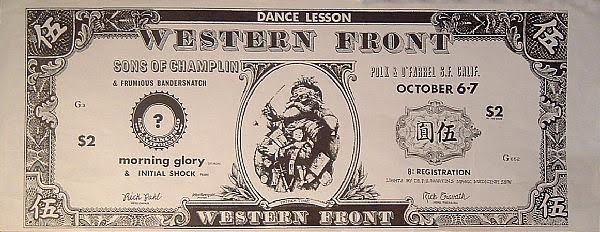
October 7, 1967 Western Front, San Francisco:  Sons of Champlin/Frumious Bandersnatch/Initial Shock
The Western Front was one of many attempts to open a psychedelic ballroom in San Francisco. The venue, at 895 O'Farrell (at Polk), never managed to find its footing.

Although I can find no Initial Shock shows until December, I assume they were playing around various places--I just haven't figured out where.

December 1-3, 1967 Western Front, San Francisco: Youngbloods/Wildflower/Initial Shock
The Initial Shock returned to The Western Front, although its my belief that there were different promoters at this point.

December 19, 1967-January 15, 1968: Northwest Holiday Tour
Ross Hannan found a remarkable ad in the Berkeley Barb of December 22, 1967, announcing that the Initial Shock would be returning to San Francisco on January 16, "After 28 Consecutive One Night Stands."

I don't know where or how the band played 28 straight nights, including Christmas Eve, Christmas Day and New Year's Day. If this is true and not hyperbole, I have to assume they played ski resorts in places like Idaho. Given the band's Montana background, they may have gone as far afield as Montana as well.

I assume that Initial Shock had shows booked when they returned to San Francisco, but we have yet to uncover them.

March 16, 1968  Straight Theater, San Francisco: Flamin Groovies/Initial Shock

May 12, 1968 Civic Center Plaza, San Francisco: Kaleidoscope/Initial Shock/Country Weather/AB Skhy Blues Band
This was a daytime show.  It was a benefit for Haight-Ashbury Free Medical Clinic.

May 28, 1968  Avalon Ballroom, San Francisco: Crystal Syphon/Phoenix/Indian Head Band/Mint Tattoo/Initial Shock/Loading Zone
“Spring Medicine Show” Benefit for The Haight Ashbury Free Medical Clinic

June 28-30, 1968 Carousel Ballroom, San Francisco: Steve Miller Band/Buddy Guy/Initial Shock 
This show was advertised (a poster exists) but did not take place.

July 3, 1968 Straight Theater, San Francisco: Initial Shock/Allmen Joy/Indian Head Band/Phoenix

July 12, 1968 Cow Palace, Daly City: Iron Butterfly/Creedence Clearwater Revival/Vanilla Fudge/Kai Moore/Canned Heat/Sweet Rush/West/Sandy Bull  
Harmony Benefit  
A variant poster has Sandy Bull, Canned Heat, Vanilla Fudge, Iron Butterfly, West, Initial Shock, Wedge and Phoenix. Of course, Initial Shock was booked in Sacramento (below), but given that its less than two hours from San Francisco to Sacramento, they could easily have played both shows. However, since absolutely nothing is known about this Benefit, I have no idea who actually played.

July 12-13, 1968 Sound Factory, Sacramento: Steppenwolf/Ace of Cups/Initial Shock
The Sound Factory, at 1817 Alhambra, was a newly-opened venue run by Whitey Davis, the former proprietor of Portland's Crystal Ballroom as well as a critical figure at the Avalon Ballroom. This was one of the earliest shows at the Sound Factory (it appears to have opened on June 28--the July 12-13 poster is up top).

July 14, 1968 Balconades Ballroom, San Jose: Initial Shock/Womb/Phoenix/Freedom Highway/Rejoice/Day Blindness/Fritz Rabyne/Marble Gardens/Pure Funk/Uncut Balloon
The Balconades was on an upper floor of The Lyndon Building (built 1882), at 181 W. Santa Clara St. After time as a printing press for a newspapers, it had been turned into a ballroom (probably in the 1920s). It had been part of a Country and Western circuit for performers like Hank Williams and Bob Wills, back when San Jose was an agricultural center and the biggest radio station (KEEN 1370 AM) played country music.  There were a few rock shows at Balconades in 1968, although this appears to be one of the last ones.

Most of the groups at this Sunday event were club bands that played around, but weren't yet at the Avalon level. "Fritz Rabyne" was probably the Fritz Rabyne Memorial Band, a Menlo Park band that featured former Menlo-Atherton High School students Lindsay Buckingham and Stephanie (Stevie) Nicks.

July 26-27, 1968 New Orleans House, Berkeley: Initial Shock/Shiva’s Head Band
The New Orleans House, at 1505 San Pablo Avenue, was Berkeley's premier club for rock bands that played original music.

August 16-17, 1968 Sound Factory, Sacramento: Pink Floyd/Initial Shock/AB Skhy Blues Band
Road manager George Crowe (see his Comment) recalls opening for Pink Floyd in Sacramento.

August 2-4, 1968 Fillmore West, San Francisco: Iron Butterfly/Canned Heat/Initial Shock 

 (the Roger Weil poster for FD135, August 29-31 at the Avalon. h/t Ross for the scan)
August 29-31, 1968 Avalon Ballroom, San Francisco: Youngbloods/It’s A Beautiful Day/Initial Shock

October 18-20, 1968 Avalon Ballroom, San Francisco: Velvet Underground/Charley Musselwhite/Initial Shock

October 31-November 2, 1968 The Ark, Sausalito Initial Shock/Devil's Kitchen/White Lightning
A flyer recently turned up on eBay. The flyer says "Boogie--Ball." Perhaps the Marin band Boogie was on the bill, or perhaps it was just an invocation. Devil's Kitchen were recently arrived from Carbondale, IL.

The Ark was a grounded steamer docked on Gate 6 in Sausalito. It was a hippie rock club and hangout, mostly open on weekends (Halloween was a Thursday this year).

November 8-9, 1968 New Orleans House, Berkeley: Initial Shock/Orion

November 28-30, 1968 Avalon Ballroom, San Francisco: Quicksilver Messenger Service/Sons of Champlin/Initial Shock
The Avalon Ballroom had one more show after these that was still under Chet Helm's aegis, when Big Brother headlined (December 1, 1968), but Helms had to give up the lease on the Avalon due to financial difficulties and a struggle to get a Dance Permit.

The Avalon would reopen in March 1969, and members of Initial Shock were apparently part of the Avalon management team. This is just one of many tantalizing bits of history that makes their definitive story so worth looking forward to. 


December 5, 1968 New Committee Theatre, San Francisco: Initial Shock/Aum/Notes From The Underground
December 6, 1968 New Committee Theatre, San Francisco: Initial Shock/Devils Kitchen/Sanpaku
December 7, 1968 New Committee Theatre, San Francisco: Initial Shock/Notes From The Underground/Sanpaku

The New Committee Theatre was at 836 Montgomery. The Committee (an improvisational comedy troupe) was the main performer there, but various rock shows were held as well.

December 20-21, 1968  Sound Factory, Sacramento: Initial Shock/Salloom Sinclair & Mama Bear

Although I recognize that I have only been capturing highlights of the Initial Shock's bookings in 1967 and '68, the trail runs pretty dry in 1969. Given that some members of the group--perhaps all--were involved in the management of the Avalon Ballroom when it re-opened on March 21, 1969, perhaps that had an effect, but the revised Avalon only lasted until April 6, so the final year of the Initial Shock remains vague. I have to assume there were many more shows than are listed here.

January 17-18, 1969 The Matrix, San Francisco: Initial Shock

February 28-March 1, 1969 New Orleans House, Berkeley: Initial Shock/Welliver Fields

March 26-30, 1969 Avalon Ballroom, San Francisco 
Jef Jaisun and the Slow Truck, Santana, AAA, It's A Beautiful Day, All Men Joy, Youngbloods, Country Weather, Welliver Fields, Initial Shock, AB Skhy, Linn County, Conqueroo, Frumious Bandersnatch, Fourth Way, Melting Pot, Cleanliness and Godliness Skiffle Band, Clover, Shades of Joy, Alice Cooper, Pure Funk
The poster lists all the bands who will play over four nights, so I assume Initial Shock played some but not all of the shows, but I do not know for certain.

May 15-17, 1969 New Orleans House, Berkeley: Ace Of Cups/Initial Shock
The trail runs cold after this point, and future published revelations will be welcome.

Lead guitarist George Wallace apparently went on to work with Janis Joplin. Lead singer and guitarist Bill "Mojo" Collins went on to play in the group Sawbuck with Ronnie Montrose (they helped close the Fillmore West on June 29, 1971), but he relocated to Coastal North Carolina in late 1971. He remains an active and successful performer in the greater Wilmington area today.

This is a work in progress. Anyone with additional information about Initial Shock performances is encouraged to Comment or email me.

Tuesday, April 13, 2010

1119 SW Park Avenue, Portland, OR Masonic Temple Rock Performance List 1966-69

(a poster advertising the Grateful Dead and regional bands Poverty's People, US Cadenza and Nigells, from Tuesday, July 18, 1967)

I have been working through the history of psychedelic rock in Portland, Oregon in the late 1960s. Portland makes an interesting study, as it was very much a part of the West Coast scene, but not quite economically robust enough to create lasting traction. I have made a pretty good start at identifying the history of the Crystal Ballroom in Portland, and I am working on other projects as well (see here and here). However, the nature of the Oregon scene at the time meant that there was relatively little contemporary record of concerts and other events at the time. As a result, some intriguing venues remain somewhat mysterious. Perhaps the most fascinating venue, beyond the Crystal, was the Masonic Temple ballroom.

The Masonic Temple was built in 1925, at 1119 SW Park Avenue at SW Jefferson Street. The Masonic Temple building is now part of the Portland Art Museum (the address is 1219 SW Park).  The 4-story building still includes the Grand Ballroom, which is probably a remodeled version of the Ballroom used for rock concerts in the 1960s. The current capacity is about 1000 (per the site), so perhaps up to twice that many could have been squeezed in.The Masonic Temple was a regular, if intermittent venue for Portland rock concerts in the 60s. I do not know if a specific promoter controlled the lease; more likely, the hall was simply for rent. In particular, the Masonic Temple had a number of high profile Fillmore-type bands in the Summer of 1967, exactly when the Crystal Ballroom was at a low ebb since its founding partners (Mike Magaurn and Whitey Davis) were in absentia that Summer. There seems to have been intermittent concerts throughout the end of the 1960s, but our information is spotty.

The definitive work on the Portland music and cultural scene as folk music transformed into electric rock is Valerie Brown's excellent article in the Oregon Historical Quarterly of Summer 2007, Music On The Cusp: Folk To Acid Rock in Portland Coffeehouses 1967-70. However, Brown's superb research is focused more on the musicians themselves rather than the specific concert venues, and while she alludes to the Masonic, that is not the focus of her article. Since there is so little information extant, I am posting what little information is available, along with some informed speculation on my part, in the hopes of finding out more.

The random shreds of information available about rock concerts at the Masonic Temple offer tantalizing hints of out-of-town bands and a thriving local scene. Yet hints can be deceiving--perhaps only the most interesting events are memorialized, and the truth is smaller and duller. I am inclined towards the former possibility, however, and have pursued this on the assumption that Portland's Masonic Temple is an interesting story waiting to be told. Anyone who recalls more about specific shows at Masonic Temple in the 60s, or knows anything about the promoters or economic backdrop, or even just has intriguing speculation, please Comment or email me.

Portland Masonic Temple Performance List: 1966-69

October 29, 1966 PH Phactor Jug Band/US Cadenza/The Weeds/ Inc w/Joe Uris/The Sodgamoli Jug Band/Dave Coffin/Earl Benson
The first rock poster presents a mixture of electric rock bands (The Weeds and US Cadenza) and more folk-oriented acts. The Weeds would have just arrived in Portland at this time, probably the week before, having run out of gas on the way to Vancouver. This show was not the first "ballroom" rock concert in Portland (that is another topic), but it represents a very early event(h/t Ross for the Masonic posters).

July 15, 1967 Battle of The Bands
United Travel Service was one of the bands (which is how we know the date). This suggests that many of the events featured local bands, and were more oriented towards dancing than anything else. I simply have no idea of whether there were many or few concerts at the Masonic Temple between October 1966 and July 1967.

July 18, 1967 Grateful Dead/Poverty’s People/U.S. Cadenza/Nigells
The Grateful Dead had played in Portland before, at the “Portland Acid Test” at Beaver Hall (at 425 NW Glisan) in January 1966 (the exact date has never been satisfactorily confirmed to my knowledge), but this was the first time they played an advertised rock concert. Anticipating future touring, the Dead had played the weekend in Seattle and Vancouver, and played a Tuesday night on their way back to San Francisco.

In the 1960s, while many bands flew from concert to concert, their equipment traveled by truck, and most major engagements were on weekends. Many medium sized cities thus featured mid-week rock concerts on weeknights, as bands migrated from city to city. This touring schedule was particularly prominent for cities on major Interstate Highways. Thus bands playing California and then Chicago might play weeknight shows in Salt Lake City, Omaha or Des Moines, because they were intermediate stops on I-80.

In the case of Portland, even the limited information available to us now suggests that the relatively small Masonic Temple could host weeknight shows by Fillmore headliners who were in between California and Seattle or Vancouver. Portland (particularly in the 1960s) was considerably smaller than any of those cities, but was more or less halfway from San Francisco to Seattle on I-5.

July 26, 1967 The Doors
At this time, although The Doors were extremely popular on the strength of their debut album and the single “Light My Fire,” they were still considered an “underground” band. The Doors would never play an Oregon venue as small as the Masonic Temple again. This was a Wednesday night show, and once again Portland fans benefited from being in the middle of the West Coast (besides the obvious inherent advantages of living in Portland).

August 11, 1967  Moby Grape/Peanut Butter Conspiracy
This date comes from The Peanut Butter Conspiracy list of shows, which refers to a double bill with Moby Grape. The Moby Grape list does not confirm this booking. However, while Moby Grape was billed at The Avalon (August 10 thru 13), on at least one or all of those shows they did not play. Supposedly it was because Skip Spence was unavailable, but perhaps it was because they had a gig in Portland.

In any case, although not widely regarded today, the Conspiracy were a popular band amongst hippies, and whether or not Moby Grape played, the Masonic Temple seems to have had another interesting show by an out-of-town band (or two). There is a chance that the Conspiracy and Moby Grape actually took place at the Crystal Ballroom, but concerts during the Summer of Love in Portland seems to be a murky subject indeed.

December 29, 1967 Family Tree/Gentlemen Wild/Poverty’s People/Sound Vendor/Echoes/Epix  “Grand Opening”
The poster says “Grand Opening”, but its not clear what that means. Presumably new promoters had taken over, but of course its unknown whether there were concerts at the Masonic Temple since the Summer. I will note that while our information about Portland rock concerts stems almost exclusively from surviving posters, it does seem that Masonic posters pop up when there was little or no known activity at the Crystal Ballroom. I know of no Crystal concerts between December 3, 1967 and February 2, 1968, and while I wouldn't read too much into those dates, there may not have been room for two concert halls in Portland. The Crystal was the leading rock venue in Portland until July 1968, when it closed, and no Masonic Temple posters seem to have endured from that specific time period.

The Family Tree was a Northern California band with a great live reputation who were very popular in Oregon. Lead singer Bob Segarini went on to lead both Roxy and The Wackers, among other bands.

June 1, 1968  “Rock Festival”
25 bands including Portland Zoo/The Epix/Stone Garden/Brigade/Soundvendor/Music-Box/The Redcoats/The Echoes/The Mod’s/The Wom-Bats/The Quents/The Phantoms/Fringe Benefit/Peppermint Express/The Le-Sabres/Back Street Electric Band/C.C. Riders/Dark Ages/Peace Corps/The Grail/The Band of Angels/US Cadenza/others
It seems surprising that all the bands played in one day, but then there are multiple floors at the Masonic Temple, so perhaps this took place in multiple rooms. Once again, I have no idea how much or how often there were concerts at the Masonic after the December "Grand Opening."
  
July 10, 1968 Kaleidoscope/Crazy World of Arthur Brown
The Kaleidoscope, who invented "World Music" about 25 years before most of the world (Jimmy Page and a few others excepted) were ready for it, had played some well received shows at the Crystal Ballroom in May. It seems surprising that the Kaleidoscope wouldn't play the Crystal again, but I take it that the Crystal was on very shaky financial footing and may have already closed by this time. The City of Portland officially closed the Crystal on July 12, 1968, but the venue may not have put on shows for some weeks prior to this.

Arthur Brown is best known for his hit single "Fire," and the band was reputed to have a wild stage show in an era when bands usually just stared at their amplifiers while they jammed. Both the Kaleidoscope and Arthur Brown had records and a following, so once again the Masonic seems to be stepping into a breech left by the (imminent) demise of the Crystal Ballroom.

November 8, 1968 Thundering Heard/Muddy Valley/Crawdad Band
This date comes from a poster or flyer or advertised for auction. It suggests that many local bands played regular gigs at Masonic Temple, but of course its hard to say for sure.

March 16, 1969 Paul Butterfield Blues Band/Pulse
The poster says “Temple Dance”, but the venue is not actually the Masonic Temple. The show took place a few blocks away, in one of the ballrooms at the Governor Hotel at 614 SW 11th Street (at Alder). The Governor Hotel was built in 1909 (as The Seward Hotel), and has several ballrooms. The Hotel and the ballrooms are still in use.

The term “Temple Dance” suggests that it is a “Brand Name” (to use a modern term) that would be a self-evident reference, another sign that there were many more Masonic Temple events than we have posters for. The same bill, with Butterfield Blues Band and Pulse, had played Seattle’s Eagles Auditorium the night before (Saturday, March 15 1969). Mike Bloomfield and Elvin Bishop had long since left the Butterfield Blues Band (in 1967 and 68 respectively), but guitarist Buzzy Feiten and a horn section supported Butterfield admirably.

The Light Show was provided by PH Martin's Magic Medicine Show, which presumably was Gary Ewing's popular light show at the Crystal Ballroom. The hip Portland music scene was small, so its reasonable to assume that there were many more connections between the Masonic Temple and the Crystal Ballroom.

April 13, 1969 Deep Purple
This was the original version of  Deep Purple (with Rod Evans on vocals), touring the West Coast behind their hit single “Hush.” It’s possible that Deep Purple was not the headliner. As this is a Sunday night show, one is left to speculate whether this performance was actually at the Masonic Temple or at the Governor Hotel, as for the Butterfield show above.


June 25, 1969 Steve Miller Band/Total Eclipse/United States Cadenza
June 25 was a Wednesday night. The random assortment of dates that we have found for the Masonic Temple makes it hard to guess whether weeknight gigs were typical or rare. However, we know that the Steve Miller Band were on their way to Seattle, where they played the next night (June 26), and probably elsewhere, so once again Portlanders were treated to a weeknight headliner by virtue of their location.

The Steve Miller Band would have just released their excellent third album, Brave New World, in June of 1969. Boz Scaggs and organist Jim Peterman had left the group, and I'm not certain if guitarist Bobby Winkelmann would have joined by this time. The group may have just been a trio with Miller, bassist Lonnie Turner and drummer Tim Davis.

July 29-30, 1969 Steve Miller Band/Alice Cooper/Total Eclipse
These gigs were for a Tuesday and Wednesday night. Alice Cooper had recently signed with Frank Zappa’s Straight Records label, and would have been touring in conjunction with their first album (Pretties For You). There were major events in the Pacific Northwest the previous weekend, including the Seattle Pop Festival in Woodinville, WA (July 25-27) and the one-day Eugene Pop Festival (Saturday July 26). Alice Cooper was playing both events, and I assume that Steve Miller Band played at least one of them, although they weren't billed for either of them.

Aftermath
I have only vague information about rock concerts at the Masonic Temple after 1969. That in itself does not mean anything, given the scattered nature of our sources, but the concert business changed considerably after 1969. I do know of a Sons Of Champlin poster that is probably from the early 1970s (on the PNW Band site). In Portland, in particular, an old rule outlawing music at venues that served alcohol was changed in 1973, allowing bars and taverns to compete in the music business, so its unlikely there was a substantial music history to the Masonic Temple after that. In 1992, the building was purchased by its next door neighbor, the Portland Art Museum, and it was rechristened the Mark Building.


(The former Masonic Temple today, at 1119 SW Park Avenue, now known as the Mark Building at the Portland Art Museum. photo: wikimedia commons)

The scattered evidence of Portland's Masonic Temple in the 1960s suggests a number of very interesting stories, just beyond my current reach. Anyone with information, corrections or interesting speculation is encouraged to Comment or email.